
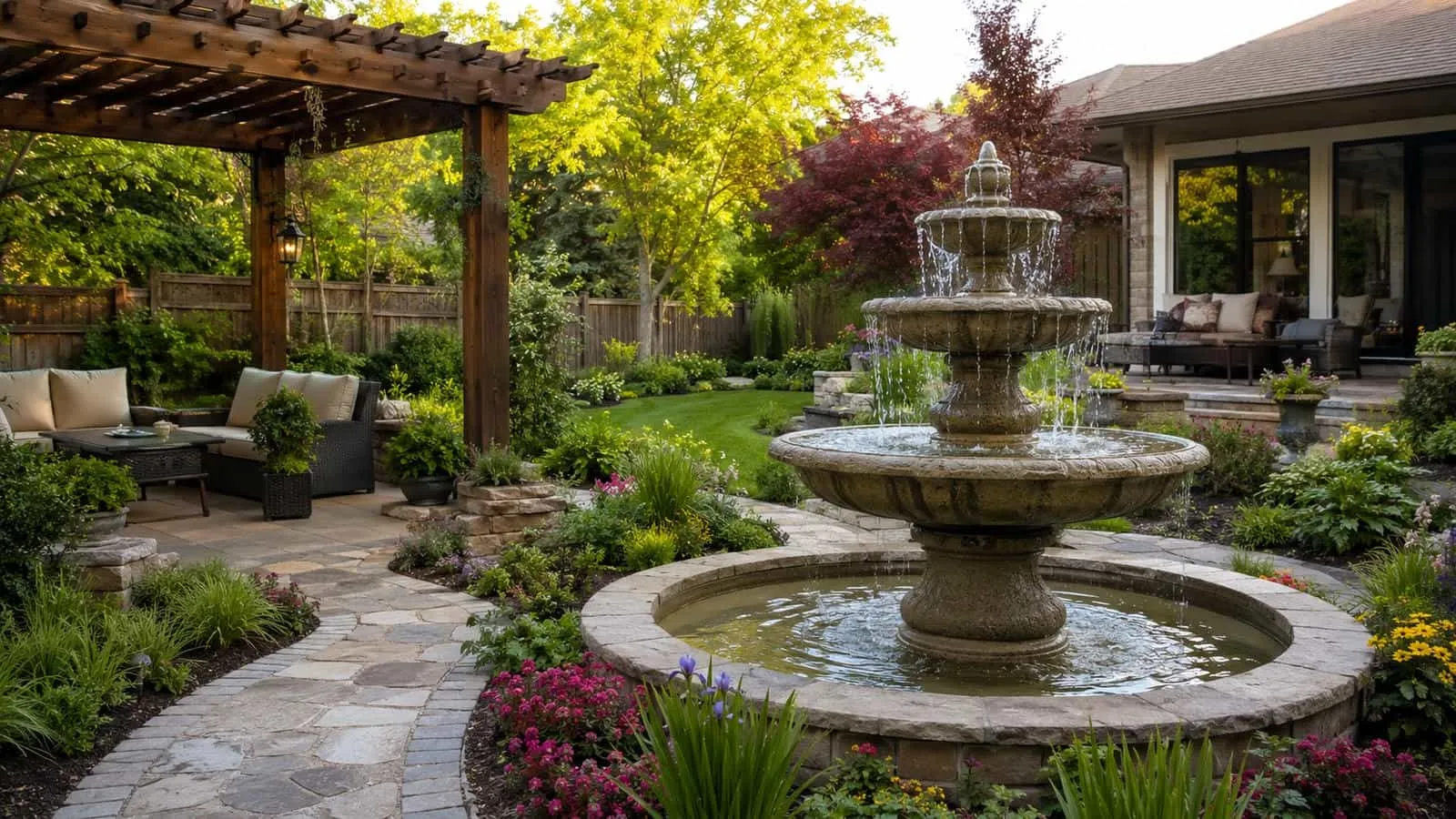
🌊⛲ Choosing an outdoor water fountain starts with the conditions around it. A compact bubbling urn may fit a small patio where seating is close, while a tiered fountain, wall fountain, bubbling rock, birdbath fountain or pondless cascade may make more sense in a larger yard, front entrance, wildlife garden or landscape focal point. Use this guide to compare fountain type, outdoor location, water movement, viewing distance, sound, splash, power, materials, weather exposure, installation difficulty and maintenance commitment before choosing what belongs on your property.
Explore outdoor water fountain ideas for patios, gardens, backyards and outdoor living spaces. Compare fountain types, location, water movement, size, sound, landscaping and relaxing backyard uses before choosing the water feature that best fits your property. Select any image below to explore that section of the guide.


🌿 Outdoor water fountains are easiest to choose when practical conditions come before decorative style. First identify the property zone and usable space, then compare viewing distance, water movement, sound, splash, power access, weather exposure, foundation needs and maintenance expectations. The sections below follow that decision path so a homeowner can move from a broad outdoor fountain idea to the fountain family that genuinely fits the property.
An outdoor water fountain works best when it is selected for the conditions of the property rather than appearance alone. Available space, normal viewing distance, nearby seating, water sound, splash potential, power access, sunlight, wind and seasonal weather all influence how comfortable and practical the fountain will feel after installation. A fountain that looks substantial online can disappear across a broad backyard or overwhelm a compact patio.
Different fountain forms solve different outdoor problems. Tiered fountains provide height and stronger visual presence, wall fountains preserve floor space, bubbling urns and basin fountains suit closer viewing, birdbath fountains support wildlife goals, while bubbling rock and pondless water features blend naturally with landscaping. Solar outdoor fountains can also be useful where a sunny garden or yard lacks convenient electrical access. Compare the broader categories in our complete water fountain types comparison guide.
There is no single best outdoor fountain for every home. A small patio with seating nearby usually benefits from a compact footprint, controlled splash and gentle water movement. A large backyard viewed from the house may need more height, basin width or visual mass. A front entrance places greater emphasis on curb appeal, walkway clearance and the relationship between the fountain and the architecture.
Water movement influences both appearance and sound. Bubbling water creates restrained movement, while cascading bowls, tiered fountains and falling water generally create more visual energy and stronger sound. Viewing distance matters too. Small fountains work best at close range, while larger freestanding or architectural fountains need enough open space to remain visible without crowding the landscape.
Outdoor exposure should narrow the choices before decorative finish becomes the deciding factor. Full sun can increase evaporation, wind can increase splash, overhead trees add leaves and pollen, and freezing weather changes material and seasonal ownership requirements. Pump access, refill convenience and a stable location also affect how easy the fountain is to live with.
A successful outdoor water fountain fits the property before it becomes the focal point. Use these practical checks to narrow the fountain family before comparing individual products, finishes and decorative details.

✅ Best For: Outdoor water fountains work especially well beside patios, pergolas, garden pathways, front entrances, courtyards, landscaped backyards and wildlife gardens where moving water can create a focal point without interfering with circulation or everyday outdoor use.
The best outdoor water fountain is the one that fits the property, viewing distance, desired water movement, sound, power access, weather exposure and maintenance commitment. Start with outdoor conditions and everyday use, then narrow the fountain form, size, material and decorative style that best fits the space.
Every outdoor space creates a different combination of usable area, viewing distance, water sound, splash exposure, electrical access, weather conditions and maintenance needs. Use the ten real world scenarios below to narrow the outdoor fountain family that best fits your patio, garden, backyard, front entrance or outdoor living space before comparing individual fountain styles and products.
Open each scenario to see which outdoor water fountain types best fit common residential conditions. These eight situations focus on property size, viewing distance, water movement, splash, power, weather exposure, wildlife and seasonal ownership so you can narrow the right fountain family before comparing individual designs.
Best choice: Small urn, compact wall fountain, bubbling fountain or small freestanding basin
A small patio needs an outdoor fountain that adds visible water movement without crowding chairs, tables, doors or walking space. Bubbling urns, low basin fountains and compact freestanding designs can create a focal point while keeping the footprint controlled. Wall fountains can be especially useful where floor space is limited.
Because seating is close, sound and splash matter as much as appearance. Gentle bubbling or low trickling water is usually easier to live with than a strong cascade, while a broad enough basin helps keep water away from cushions, dining furniture and nearby doors.
Choose this direction when you want an outdoor fountain near seating but need compact size, controlled splash and conversation friendly water sound.
Micro Recommendations: Measure the usable patio after chairs are pulled out and doors are open. Base fountain size on the remaining clearance rather than the total patio dimensions.
⚠️ Common Mistake: Choosing by product dimensions alone without allowing for splash, furniture movement and maintenance access.
Best choice: Tiered fountain, large freestanding fountain, pondless cascade or architectural fountain
A large backyard often needs more fountain height, basin width or visual mass because the feature may be viewed from windows, decks, pergolas or covered seating many feet away. Tiered fountains provide recognizable vertical structure, while larger freestanding and architectural fountains can anchor broad lawns and landscaped areas. Pondless cascades create a wider natural focal point where rock and planting fit the property.
The main question is whether the fountain remains noticeable from the normal viewing distance. A design that looks substantial up close can disappear against a broad lawn, mature landscaping or a two story house.
Choose this direction when the fountain must remain visually strong from the house, covered patio or another distant viewing area.
Micro Recommendations: View the proposed location from your main windows and seating areas before buying. Compare fountain height and width with nearby architecture rather than judging scale only from close range.
⚠️ Common Mistake: Buying a fountain that looks large online but lacks enough presence for the actual backyard viewing distance.
Best choice: Urn fountain, restrained two tier fountain, wall fountain or bubbling basin
A front entrance fountain should strengthen the relationship between the house, walkway and arrival experience without narrowing the route to the door. Urns provide vertical structure, restrained tiered fountains suit more formal entrances, and wall fountains can preserve ground space where the entry is narrow.
Front yard fountains are often seen from the street, driveway, walkway and front door, so proportion and controlled splash are important. The fountain should support the architecture without sending water onto steps or creating an obstacle near the entrance.
Choose this direction when curb appeal, architectural balance and an inviting entrance matter more than creating a large landscape water feature.
⚠️ Common Mistake: Placing an oversized fountain too close to the front walk, making the entrance feel cramped and increasing splash around visitors.
Best choice: Bubbling rock fountain, pondless water feature, stone basin or Japanese inspired fountain
Natural gardens usually benefit from fountain forms that appear connected to stone, planting and terrain. Bubbling rocks provide controlled movement, pondless cascades create flowing water without a visible pond, while stone basins and Japanese inspired fountains can create quieter focal points beside paths and planting beds.
Allow enough open space for the water feature to remain visible as plants mature. Dense planting can hide water movement, increase falling debris and make pump or reservoir access unnecessarily difficult.
Choose this direction when you want moving water to feel integrated with stone, plants and pathways rather than standing apart as a separate ornament.
⚠️ Common Mistake: Planting so densely around the fountain that the water disappears and routine maintenance becomes difficult.
Best choice: Solar outdoor water fountain with suitable panel exposure
A solar outdoor fountain can be practical when the preferred location is far from an outlet and receives useful sunlight. Small freestanding fountains, birdbath fountains and compact garden fountains are common choices because their pumps can operate from a separate solar panel without permanent electrical service at the fountain.
Solar performance depends on panel exposure and system design. Direct solar fountains may slow or stop when sunlight weakens, while battery equipped models may continue operating after charging. Trees, fences, buildings and seasonal shade should be considered before choosing the final location.
Choose this direction when electrical access is difficult and the property provides useful sunlight for realistic solar operation.
⚠️ Common Mistake: Choosing a direct solar fountain for deep shade and expecting the same steady flow as a plug in pump.
Best choice: Low bubbling fountain, broad basin fountain or protected wall fountain
Wind can push droplets beyond the intended landing area, increasing splash and refill frequency. Low bubbling fountains and broad basins generally keep water closer to the feature than tall jets or fine spray. A protected wall fountain can also work where a fence, wall or building creates a calmer microclimate.
Drop height, flow strength, water width and basin size all influence water loss. Exposed sites benefit from controlled movement and a generous landing area rather than dramatic spray.
Choose this direction when regular wind exposure makes splash control and water retention more important than high jets or dramatic falling water.
Micro Recommendations: Observe the site during typical windy periods before committing to a fountain. Use nearby structures for protection when they do not interfere with maintenance access.
⚠️ Common Mistake: Choosing tall fine jets for an exposed yard and then treating repeated water loss as a fountain problem rather than a site mismatch.
Best choice: Birdbath fountain, shallow basin fountain or gentle bubbler
An outdoor fountain for birds should provide accessible moving water instead of dramatic height or forceful spray. Birdbath fountains, shallow basins and low bubbling fountains can offer visible water movement with stable edges where birds can land.
Nearby vegetation can provide shelter, but the basin should remain visible and easy to clean. Water depth, landing edges, gentle movement and maintenance access are usually more important for wildlife use than decorative complexity.
Choose this direction when attracting birds and adding natural backyard activity are more important than creating a tall decorative focal point.
⚠️ Common Mistake: Choosing deep water or forceful spray because the fountain looks decorative even though those features do not support the wildlife goal.
Best choice: Outdoor fountain selected for material suitability, complete drainage, pump access and realistic winter protection
In a cold climate, the best outdoor fountain must be evaluated for what happens after summer ends. Fountain material, basin construction, trapped water, removable components and pump access can matter as much as appearance because water left in vulnerable bowls, tubing or cavities can freeze and expand.
Lightweight resin or fiberglass fountains may be easier to move when their design allows it. Heavier cast stone, concrete and natural stone fountains may remain in place but need appropriate draining and protection according to manufacturer instructions.
Choose this direction when freezing temperatures and seasonal shutdown are major ownership factors and winter practicality needs to be considered before decorative style.
Micro Recommendations: Before buying, determine how the fountain will be drained, how the pump is accessed and what winter protection the manufacturer requires.
⚠️ Common Mistake: Choosing a fountain only for summer appearance and waiting until freezing weather to consider drainage and pump removal.
These scenarios narrow the fountain family rather than identify one universal best fountain. Compact patios favor controlled low splash designs, long backyard views need stronger scale, natural gardens benefit from landscape integrated forms, outlet free locations may favor solar, windy sites need controlled water movement, wildlife gardens need shallow accessible water and cold climates require realistic winter planning. Once the property scenario is clear, comparing individual outdoor fountain types becomes much easier.
Comparing outdoor water fountain types becomes easier when you focus on what each fountain form does well. Wall fountains save ground space and tiered fountains create height and repeated falling water. Homeowners who want stone, gravel and planting to feel naturally connected with moving water can explore bubbling rock fountains for natural landscapes, while pondless fountains can create streams and cascades with the reservoir hidden below the finished surface.
Space and viewing distance should narrow the choices first. Compact patios generally need controlled footprints and lower splash, while larger backyards can support greater height, wider basins and stronger visual mass. Natural gardens often suit bubbling rock, stone and pondless forms, while entrances and courtyards may benefit from more architectural fountain shapes.
Sound and installation separate the fountain families further. Bubbling fountains usually create softer close range sound, while tiered and cascading fountains produce more noticeable water movement. Freestanding fountains can be relatively simple to install, while wall, bubbling rock and pondless systems may require more structural or hidden reservoir planning.
Use this comparison to narrow the strongest outdoor fountain family for your property before comparing individual sizes, materials, finishes and products.
| ⛲ Fountain Type | 🏡 Best Setting and Space | 🎧 Sound and Visual Presence | 🛠 Installation and Maintenance | 🔎 Best Buyer Fit |
|---|---|---|---|---|
| Tiered Fountain | Medium to large patios, formal gardens, entrances, courtyards and open backyards. | Repeated falling water creates moderate to strong sound and strong vertical presence. | Needs a stable level base, power access and more support as size and weight increase. | Best for homeowners wanting a traditional focal point with noticeable water movement. |
| Wall Fountain | Patios, courtyards, porches and narrow outdoor rooms where floor space is limited. | Can range from gentle trickling to broader sheet flow with strong close range visibility. | May require structural mounting plus access to the basin, pump and tubing. | Best where vertical space is available but patio or courtyard floor area is valuable. |
| Bubbling Rock Fountain | Natural gardens, rock gardens, landscape edges and pathways. | Controlled bubbling creates softer sound and natural visual weight. | Often uses a hidden reservoir below decorative stone and requires accessible pump service. | Best when the fountain should blend into the landscape rather than stand apart from it. |
| Pondless Fountain or Waterfall | Backyards, slopes, garden borders and larger landscaped areas. | Multiple drops can create broad movement and moderate to strong waterfall sound. | Usually requires a hidden reservoir, pump access and more landscape construction. | Best for homeowners wanting a substantial water feature without a visible pond. |
| Birdbath Fountain | Wildlife gardens, flower beds, patios and quieter backyard areas. | Gentle bubbling or small sprays create soft sound with wildlife activity as part of the visual appeal. | Usually simple to install but needs regular cleaning and fresh water. | Best when attracting birds matters more than creating a large decorative centerpiece. |
| Japanese Fountain | Meditation gardens, quiet courtyards, natural landscapes and garden paths. | Emphasizes restrained trickling and controlled drops rather than dramatic spray. | Installation varies, but simple composition and discreet pump access are important. | Best for quieter outdoor spaces where natural materials and restrained water movement are preferred. |
| Urn Fountain | Patios, courtyards, entrances, garden beds and compact outdoor spaces. | Bubbling water creates soft to moderate sound while the vertical form adds presence. | Self contained designs can be simple, while disappearing urn systems may use hidden reservoirs. | Best when a narrow footprint and decorative vertical form are useful. |
| Cascading Fountain | Patios, gardens, courtyards and backyard seating areas. | Repeated bowl or ledge drops create visible movement and moderate sound. | Leveling matters, and several water paths may require more cleaning than a simple bubbler. | Best for homeowners wanting stronger movement without a large traditional tiered form. |
| Solar Fountain | Sunny gardens, birdbath fountains and locations without convenient electrical access. | Flow and sound depend on sunlight, pump size and whether battery storage is included. | Installation is often simple, but dependable solar panel exposure is essential. | Best for sunny locations where outlet free operation is a priority. |
| Freestanding Basin Fountain | Patios, courtyards, garden corners, entrances and medium size yards. | Sound ranges from gentle bubbling to falling water depending on the centerpiece and flow. | Often straightforward to install on a stable level base with accessible basin maintenance. | Best for homeowners wanting a recognizable fountain form and straightforward ownership. |
| Architectural Fountain | Contemporary patios, courtyards, large entrances and modern landscapes. | Geometric forms, spillways and sheet flow can create strong visual presence. | Installation varies widely and larger designs may need substantial structural and system planning. | Best when the fountain should relate strongly to architecture and hardscape. |
| ⛲ There is no single best outdoor fountain type. Compact spaces often favor urn, wall and bubbling designs, natural gardens suit bubbling rock and pondless features, wildlife areas favor birdbath fountains, and larger landscapes can support tiered, cascading or architectural fountains. Narrow the choice by space, sound, installation and maintenance before comparing products. | ||||
📊 Quick Comparison Tip: Do not compare outdoor fountains only by height or price. Two fountains of similar size can behave very differently because basin width, flow pattern, water drop, visual mass, pump access and installation requirements change the everyday experience.

Once the main fountain families are clear, use the property itself to narrow the decision. Most outdoor fountain choices fall into four useful groups: compact spaces, natural landscapes, larger focal points and special purpose fountains.
Small patios and courtyards usually favor urn fountains, wall fountains, bubbling basins and smaller freestanding designs. These forms provide moving water without taking over seating and walking space. Urn fountains are especially useful when you want vertical presence from a relatively compact footprint, with water that can bubble gently from the top, overflow across the vessel or disappear into a hidden reservoir below. For a deeper comparison of vessel size, water movement, materials, pumps, reservoirs and outdoor placement, explore our outdoor urn water fountain guide.
💧 Key Takeaway: Protect walking clearance, seating comfort and splash control first, then choose enough fountain presence to make the feature feel intentional.
Bubbling rocks, pondless cascades, stone basins and Japanese inspired fountains often fit natural landscapes because their water movement can connect with stone, gravel, planting and pathways instead of appearing as separate formal ornaments.
💧 Key Takeaway: Natural landscapes usually look strongest when the fountain repeats nearby materials and retains enough open space for visibility and service access.
Tiered fountains, larger freestanding fountains, substantial cascades and architectural fountains work well when the property needs a feature that remains visible across a broad lawn, large entrance or long backyard sightline.
💧 Key Takeaway: Choose fountain scale from the normal viewing distance rather than judging the feature only from directly beside it.
Some outdoor fountains are chosen mainly for the problem they solve. Birdbath fountains provide accessible moving water for birds, solar fountains work where sunlight is available but electrical access is difficult, while wall and pondless forms solve specific space and landscape challenges.
💧 Key Takeaway: Choose special purpose fountains for the property condition they solve first, then compare decorative styles within that fountain family.
🌿 Best Type Insight: Eliminate fountain types that do not fit the property before comparing products. Remove choices that are too large, too difficult to install, poorly suited to available power, incompatible with the landscape or unlikely to provide the sound and maintenance level you want.
📊 Section Summary: Tiered, wall, bubbling rock, pondless, birdbath, Japanese, urn, cascading, solar, freestanding basin and architectural fountains create different relationships with space, sound, viewing distance, power, maintenance and installation. Narrow the fountain family by property conditions first, then compare individual products within the category that fits.
Choosing an outdoor water fountain by location is about selecting the fountain family that fits the setting, not determining an exact installation point. Compact patios may favor urns, wall fountains and gentle bubblers, while larger backyards can support tiered fountains, substantial freestanding designs or pondless cascades with enough visual mass for longer views.
Each outdoor zone changes how the fountain is experienced. Patios place people close to the water, gardens connect fountains with plants and paths, front yards emphasize curb appeal and entrances, while enclosed courtyards can make even modest water sound feel stronger.
Viewing distance is equally important. Small fountains can provide detail at close range, while fountains viewed across lawns need greater scale and visible water movement. For exact decisions involving drainage, electrical access, sightlines and installation position, use our water fountain placement planning guide.
Household use should also influence outdoor fountain location. Homes with young children or pets may need to consider basin depth, stable construction, electrical safety, walking clearance and whether the fountain creates an easily accessible open water area. Keep normal play areas, entrances and busy pathways in mind, and follow applicable local requirements and manufacturer instructions when choosing or installing larger permanent water features.
Use this comparison to narrow the best outdoor fountain direction for each part of the property before comparing individual styles and products.
| 🏡 Outdoor Location | ⛲ Strong Fountain Choices | 🔎 What Matters Most | 🌿 Best Use |
|---|---|---|---|
| 🪑 Patio and Deck | Compact urn, wall fountain, bubbling basin or small freestanding fountain | Close sound, low splash, furniture clearance and refill access | Dining, conversation, reading and everyday seating |
| 🌿 Garden | Bubbling rock, stone basin, birdbath, urn or Japanese inspired fountain | Plant growth, pathways, natural materials and landscape integration | Flower beds, wildlife gardens and planted focal points |
| 🌳 Backyard | Tiered fountain, pondless feature, bubbling rock or architectural fountain | Property scale, longer views, lawns, pergolas and visual presence | Larger outdoor living areas and backyard retreats |
| 🏡 Front Yard | Urn, restrained tiered fountain, bubbling basin or wall fountain | Curb appeal, house scale, walkway clearance and splash control | Entrances, arrival areas and front landscape focal points |
| 🏛️ Courtyard | Wall fountain, narrow urn, basin fountain or compact tiered fountain | Reflected sound, limited floor space, shade and symmetry | Enclosed outdoor rooms and intimate seating areas |
| 🚪 Porch and Entry | Compact urn, bubbling bowl, wall fountain or narrow freestanding fountain | Small footprint, door clearance and controlled water movement | Covered entrances and porch seating |
| 🏊 Poolside | Architectural fountain, wall spillway, restrained cascade or basin fountain | Splash direction, walking safety and visual relationship with the pool | Pool patios, lounge areas and modern landscapes |
| 🚶 Garden Path | Narrow urn, bubbling rock, low basin or compact pedestal fountain | Sightlines, walking clearance, splash and maintenance access | Path destinations and landscape transitions |
| 📍 Match the fountain family to the function of the outdoor zone first. Patios need close range comfort, gardens need natural integration, backyards need suitable scale, front yards need strong entry relationships and smaller enclosed spaces need controlled sound and footprints. | |||
📍 Location Selection Tip: Choose the outdoor zone before choosing the decorative fountain style. Once you know how the area is used, the normal viewing distance and how much sound and splash are appropriate, unsuitable fountain types become easier to eliminate.

Patios and decks usually work best with compact urn fountains, wall fountains, bubbling basins and smaller freestanding fountains. Close seating makes controlled splash, conversation friendly sound and furniture clearance more important than dramatic fountain height.
Leave enough room for chairs to move, doors to open and people to walk comfortably around the fountain. The full wet zone should also remain clear of cushions, dining furniture and frequently used pathways.
Deck installations require an additional structural check because the fountain's filled weight can be much greater than its empty weight. Heavier stone, cast stone and large basin fountains should only be used where the supporting structure is appropriate for the completed load.
Garden fountains often work well as bubbling rocks, stone basins, birdbath fountains, urns and Japanese inspired features because these forms can connect naturally with planting beds, pathways, gravel and stone.
Give the fountain enough visual breathing room to remain noticeable as surrounding plants mature. Dense planting can hide water movement, increase leaves and debris in the basin and make pump or reservoir access more difficult.
The strongest garden placement usually allows the fountain to be discovered from a path or seating area while still keeping its basin, pump and surrounding maintenance space easy to reach.
Backyards can support tiered fountains, pondless cascades, bubbling rocks and larger architectural water features because they often provide more space, longer sightlines and several viewing areas.
Judge fountain scale from the places where it will actually be seen most often, including house windows, covered patios, pergolas and primary seating areas. A fountain that feels substantial from a few feet away may appear undersized across a broad lawn.
Also consider how the fountain relates to lawns, pathways, outdoor kitchens, fire features and entertaining areas so it becomes part of the overall backyard layout rather than an isolated object.
Front yard fountains often work best as urns, restrained tiered fountains, bubbling basins and wall fountains that strengthen curb appeal without narrowing walkways or competing with the house.
Fountain height and width should relate to the scale of the entrance and surrounding architecture. A small fountain can disappear beside a large facade, while an oversized basin can make a modest entry feel crowded.
Keep splash away from steps, doors and primary entry paving, and preserve a clear route for visitors, deliveries and routine maintenance.
Courtyards often favor wall fountains, narrow urns, basin fountains and compact tiered designs because they use limited floor space efficiently while still creating a strong visual focal point.
Enclosing walls can reflect and strengthen water sound, so a modest fountain may feel more noticeable than the same feature in an open yard. Controlled flow is therefore especially important near dining or conversation areas.
Preserve enough clearance for doors, chairs, pathways and maintenance, particularly where the courtyard already has furniture or narrow circulation routes.
Porch and entry fountains usually work best as compact urns, bubbling bowls, wall fountains and narrow freestanding designs. Their smaller footprint helps preserve the circulation needed around doors, stairs, railings and seating.
Protected locations may reduce direct wind and weather exposure, but splash can still become noticeable because the fountain sits close to walls, flooring and visitors. Gentle bubbling or restrained trickling water is often easier to manage than stronger falling water.
Keep electrical access, refill access and pump service areas easy to reach without allowing cords or fountain components to interfere with the entrance.
Architectural fountains, wall spillways, restrained cascades and freestanding basins can complement swimming pools while creating a separate visual and acoustic focal point around lounge areas.
Keep the fountain outside primary walking routes and allow enough room around loungers, tables and pool access points. Splash from the fountain should not create unnecessarily wet or slippery circulation areas.
Coordinate the fountain's materials and proportions with the pool environment, but treat it as a separate water system unless the installation has been specifically designed to connect with the pool.
Garden paths often suit narrow urns, bubbling rocks, compact pedestal fountains and low basins that create moving water without narrowing the route.
Position the fountain where it can create visual discovery from the approach rather than sitting directly in the travel path. Basin edges, cords and normal splash should remain outside the walking surface.
Consider how the fountain will look from both directions along the path and preserve enough open space for maintenance equipment, seasonal planting and comfortable pedestrian movement.
🌿 Best Location Insight: Decide whether the fountain belongs primarily to a patio, garden, backyard, entrance, courtyard, porch, pool area or walkway. Then choose the fountain family that naturally fits how that outdoor zone functions.
📍 Section Summary: Outdoor fountain location changes the best fountain type, scale and water experience. Patios need controlled sound and splash, gardens need natural integration, backyards need appropriate scale, front yards need curb appeal, courtyards favor compact forms, porches need small footprints, pool areas need safe circulation and garden paths need clear walking space.
Fountain form describes the structure, but water movement determines what the feature feels like after the pump starts. An urn may bubble gently over its surface, while tiered outdoor fountains with falling water create several visible drops that add vertical movement and stronger presence. A wall fountain may trickle or form a wider sheet, while a pondless feature can move water across several rocks before returning to a hidden reservoir.
Flow width, drop height and the receiving surface create most of the difference. Short controlled movement generally produces less splash, while wider flow and longer drops create more visible energy. A broad basin can capture active water better than a narrow landing area, especially where wind is present.
Water movement also affects how far away a fountain remains noticeable. Bubbling and trickling reward close viewing, while cascading, falling and sheet flow create stronger visual presence. Recirculating streams spread movement horizontally through the landscape instead of concentrating it in one fountain body, which is why pondless fountains for landscape waterfalls can work especially well where water should become part of the terrain.
| 💧 Water Movement | ⛲ Common Fountain Forms | 🎧 Broad Sound | 💦 Splash Tendency | 👀 Visual Experience |
|---|---|---|---|---|
| Bubbling | Urns, bubbling rocks, bowls and basin fountains | Soft to moderate | Usually low with controlled flow | Gentle upward movement and ripples for close viewing |
| Trickling | Japanese fountains, wall fountains and spout fountains | Soft and detailed | Low to moderate | Subtle directional movement suited to quieter spaces |
| Cascading | Bowls, steps, ledges and rock waterfalls | Moderate to strong | Moderate | Layered movement with several visible water drops |
| Falling Water | Tiered fountains, spillways and some wall fountains | Moderate to strong | Moderate to higher | Strong vertical movement visible from farther away |
| Sheet Flow | Modern wall fountains and architectural spillways | Restrained to substantial | Usually controlled with a wide basin | Clean broad movement with architectural character |
| Recirculating Stream | Pondless streams and landscape cascades | Variable | Depends on stone and drop design | Broad movement spread through the landscape |
| 💧 Bubbling and trickling create restrained movement, cascading and falling water add stronger visual activity, sheet flow creates architectural presence, and recirculating streams distribute movement through a broader landscape. | ||||
💧 Water Movement Buying Tip: Watch the complete path of the water rather than judging the fountain only by height. Flow width, drop distance and landing surface often influence splash and visual energy more than the overall dimensions of the fountain.

Bubbling fountains move water gently upward before it spills, rolls or ripples back toward a basin or hidden reservoir. Urns, bubbling rocks and low basins commonly use this movement because the short water path provides visible activity with relatively controlled splash.
💧 Best Fit: Patios, reading areas, entrances and gardens where gentle visible movement is preferred.
Trickling fountains move smaller amounts of water along a defined path or through short drops. Japanese fountains, compact wall fountains and decorative spouts often use this movement because the route of the water remains visible without creating the stronger activity of a cascade.
Rough stone can divide the flow into smaller paths, while smooth surfaces create a cleaner stream. Trickling water works especially well where close viewing and restrained movement are part of the outdoor experience.
💧 Best Fit: Quiet garden paths, courtyards, meditation spaces and small outdoor seating areas.
Cascading fountains move water through several bowls, steps, ledges or rocks. Each transition creates another visible landing point, giving cascades more visual and acoustic presence than bubbling or trickling fountains without requiring one especially tall water drop.
Narrow spill points create individual streams, while wider ledges create broader ribbons of water. Splash depends on individual drop height and the size of the receiving area.
💧 Best Fit: Patios, gardens and backyards where a stronger but still layered water presence is wanted.
Falling water travels through open air before reaching another surface or basin. Tiered fountains and spillways use this movement to create stronger vertical motion, greater visibility and a more noticeable water presence from medium or longer viewing distances.
Longer drops usually increase energy at the landing point, which makes basin width, receiving depth and splash control more important. Shorter controlled drops can preserve the visual effect while reducing water loss around nearby seating and walkways.
💧 Best Fit: Medium and larger spaces where stronger visual movement and water presence are desirable.
Sheet flow spreads water across a broad edge rather than concentrating it into individual streams. Modern wall fountains and architectural spillways use this movement to create a cleaner plane of water that works naturally with geometric basins, walls and contemporary hardscape.
Even pump delivery and level installation matter because uneven flow can cause a broad sheet to separate into smaller streams. A properly sized receiving basin also helps contain the wider landing area created by this style of water movement.
💧 Best Fit: Contemporary patios, courtyards, entrances and modern landscapes.
Recirculating streams move water through rock channels, shallow runs and small cascades before returning to a concealed reservoir. This spreads water movement across the landscape instead of concentrating it inside one conventional fountain basin.
Different parts of the stream can glide, tumble or cascade, creating varied movement across several feet of landscape. These systems generally require more planning because the reservoir, pump access, water return path and surrounding grade all need to work together.
💧 Best Fit: Backyards and larger landscapes where moving water should become part of the terrain.
⛲ Section Summary: Outdoor fountain water movement includes bubbling, trickling, cascading, falling water, sheet flow and recirculating streams. Flow width, drop height and landing area influence how each pattern looks, broadly sounds and splashes. Choose the water experience that fits the property before comparing decorative finishes and individual fountain models.
Outdoor fountain size is easy to misjudge because product photographs usually remove the fountain from the property where it will actually be used. A fountain can look substantial online but appear small between a two story house, mature landscaping and a broad lawn. The opposite can happen on a compact patio, where a fountain that seemed moderate can dominate furniture and walking space. When chairs, tables and conversation are close to the water, patio fountains for close seating areas should be compared by usable footprint, splash control and comfortable listening distance.
Height is only one part of fountain scale. Basin diameter, width, number of tiers, thickness of the fountain body and visible water movement all contribute to visual mass. A broad low fountain can appear more substantial than a taller narrow urn because it occupies more of the landscape view.
Viewing distance changes what works. Small outdoor water fountains can be highly effective beside patio seating, garden paths and entrances where details remain visible. Medium fountains suit many residential yards, while large outdoor water fountains make more sense when the feature is viewed from the house, a covered patio or across a broad lawn. These longer sightlines are an important part of choosing backyard fountain ideas for long views that remain visually balanced across the property.
Use this framework as a starting point. Small, medium and large should be judged by how the fountain behaves within the property rather than by one universal height measurement.
| 📐 Fountain Scale | 🏡 Strong Locations | 👀 Viewing Relationship | ⛲ Visual Character | 🔎 Buyer Fit |
|---|---|---|---|---|
| Small Outdoor Fountain | Compact patios, porches, small gardens, entries and courtyards | Best at close range where texture and gentle movement remain visible | Detailed and intimate without large visual mass | Best for moving water near seating or within limited outdoor space |
| Medium Outdoor Fountain | Patios, garden beds, courtyards, pergolas and suburban backyards | Works well from close and medium viewing distances | Creates a recognizable focal point without dominating the property | Often the most flexible choice for typical residential landscapes |
| Large Outdoor Fountain | Broad lawns, substantial entrances and larger backyards | Useful where the fountain must remain visible from farther away | Strong visual mass and greater architectural presence | Best where enough surrounding open space supports the scale |
| Tall Narrow Fountain | Courtyards, entries and patios where ground space is limited | Provides vertical visibility without a broad footprint | Strong vertical line with lower horizontal mass | Useful where height is wanted but floor space is limited |
| Low Wide Fountain | Modern patios, open garden beds and horizontal landscapes | Best where the broad basin and water surface remain visible | Grounded appearance with strong horizontal mass | Best for substantial presence without a tall centerpiece |
| 📏 Fountain size should be judged by visual relationship rather than height alone. Small fountains reward close viewing, medium fountains fit many residential spaces and large fountains work where longer sightlines require greater visual mass. | ||||
📐 Fountain Size Buying Tip: Mark the approximate fountain height and width at the proposed location with stakes, boxes or another temporary reference. View the outline from the patio, house windows, garden path and street where appropriate. This simple test can reveal scale problems that product photographs hide.

Small outdoor water fountains work best where people experience them at close range. Compact patios, entry corners, garden paths and courtyards allow bubbling urns, wall fountains, bowls and low basins to provide detailed water movement without requiring large visual mass.
Their strength is proximity. Surface ripples, stone texture, glaze and gentle bubbling can feel substantial beside a chair or walkway but may disappear visually when viewed across a broad lawn.
💧 Key Takeaway: Small fountains work best through proximity. Place them where people naturally sit, walk or pause rather than expecting them to dominate a large landscape.
Medium outdoor water fountains are often the most flexible residential choice because they provide enough height and visual mass for patios, garden beds, courtyards and typical suburban yards without requiring the dedicated open space of a large fountain.
A medium tiered fountain may remain visible from nearby windows while still fitting comfortably beside landscaping. A substantial urn or basin can anchor a patio without overwhelming furniture, paths or planting.
Width still matters. A narrow fountain can feel lighter than a shorter model with a broad basin, so compare the complete silhouette instead of relying on height alone.
💧 Key Takeaway: Medium fountains provide a useful balance between close range detail and enough visual presence for normal residential sightlines.
Large outdoor water fountains work best where broad lawns, substantial entrances and longer viewing distances need greater height, basin width and visual mass. Their purpose should be to solve a scale problem rather than simply create drama.
Open space around the fountain matters. A substantial fountain squeezed between furniture, paths and dense planting can feel oversized even if it technically fits. Broad lawn, hardscape or garden beds provide the breathing room that helps a large fountain look intentional.
Larger fountains can also involve greater filled weight and more demanding foundation requirements, so visual scale should be considered together with installation practicality.
💧 Key Takeaway: Large fountains belong where the landscape needs greater visual mass, not simply where a larger fountain can physically fit.
Viewing distance determines how much detail and visual mass a fountain needs. Close views emphasize material texture and gentle water movement, while longer sightlines require a stronger silhouette, greater width and more visible water movement.
The most important distance is where the fountain will be seen most often. A fountain beside patio seating can rely on subtle detail, while one viewed through a kitchen window across the yard needs clearer form and greater contrast with the landscape.
Close viewing Emphasize detail, surface movement and comfortable proportion.
Medium viewing Use enough height and width to remain a clear garden focal point.
Long viewing Prioritize silhouette, visual mass and obvious water movement.
Fountain scale should relate to the visual weight of the house without competing with it. Taller homes, broad facades and substantial entrances can support larger fountains, while compact homes and narrow patios usually feel more balanced with smaller or narrower forms.
Use windows, doors, porch columns, rooflines and pergola posts as familiar visual references. Tall narrow fountains can reinforce vertical architecture, while broad low basins often work naturally with horizontal modern designs.
💧 Key Takeaway: The fountain should support the architecture and landscape composition rather than feeling disconnected from the home behind it.
Fountain visual mass comes from height, width, basin diameter, thickness, number of levels and visible water. Two outdoor fountains with the same height can feel very different when one has a broad stone basin and the other has a narrow vertical form.
Water movement also changes perceived scale. Broad sheet flow or several cascading tiers can make a fountain feel more substantial than another design with similar dimensions but only a small bubbling outlet.
Mature planting matters too. Shrubs and ornamental grasses can reduce the apparent size of a fountain over time, so leave enough visual separation for the feature to remain readable as the landscape grows.
💧 Key Takeaway: Judge the complete fountain silhouette and surrounding landscape relationship instead of relying on one product measurement.
📏 Section Summary: Outdoor water fountain size depends on height, basin width, visual mass, viewing distance, house scale and surrounding landscape. Small fountains work best at close range, medium fountains fit many residential properties and large fountains are strongest across broad lawns and longer sightlines. Choose proportion for the property rather than size for its own sake.
Outdoor fountain sound comes from more than pump strength. Flow volume, water drop height, flow width, basin design and the surface receiving the water all change the acoustic result. A gentle bubbler creates softer sound because water travels only a short distance, while tiered and cascading fountains create several more noticeable water contacts.
Listening distance is equally important. A fountain that feels prominent beside a chair may sound subtle from across a lawn. Patios, courtyards and pergolas usually place people closer to moving water, while larger yards can support stronger cascades because the sound has more distance to spread before reaching the main seating area. For a deeper comparison of bubbling, trickling, cascading and falling water, pump flow, drop height and acoustic strength, use our outdoor water fountain sound and flow guide.
Splash should be evaluated at the same time. Increasing flow may increase sound, but it can also send water farther from the intended landing area. Wind, taller drops and hard landing surfaces can increase spray, so the best fountain balances the desired sound with a comfortable splash radius.
| 🎵 Sound Profile | ⛲ Typical Fountain Forms | 🪑 Strongest Outdoor Use | 💦 Splash Consideration | 🔎 Best Buyer Fit |
|---|---|---|---|---|
| 🤫 Quiet Bubbling | Bubbling rock, low basin, gentle urn or compact fountain | Reading areas, meditation spaces and close patio seating | Usually low with short water travel | Best for subtle moving water without dominating conversation |
| 💧 Gentle Trickling | Japanese fountain, wall fountain or small spout fountain | Courtyards, garden paths and peaceful patio corners | Generally low with controlled landing areas | Best for delicate close range sound and water detail |
| 🌊 Moderate Cascading | Cascading bowls, compact tiered fountains and rock cascades | Patios, pergolas and everyday backyard seating | Moderate because several drops create more water contact | Best for noticeable ambience that remains conversation friendly |
| ⛲ Strong Falling Water | Large tiered fountains, pondless waterfalls and broad spillways | Larger backyards and open landscapes | Moderate to higher with longer drops and stronger flow | Best when greater acoustic presence is wanted |
| 🚗 Traffic Masking Sound | Tiered fountains, bubbling rocks, cascades and wall fountains | Seating exposed to roads, neighbors or mechanical noise | Depends on fountain form and flow setting | Best when steady water sound should become more noticeable nearby |
| 🪑 Conversation Friendly Sound | Bubbling urns, compact wall fountains and restrained cascades | Dining patios, pergolas and outdoor kitchens | Lower flow usually reduces both sound and splash | Best when ambience should support rather than compete with speech |
| 🎧 Quiet bubbling and trickling work best near close seating, moderate cascades suit many patios, and stronger falling water makes more sense across larger outdoor spaces. Always evaluate sound together with splash, wind and listening distance. | ||||
🎵 Sound Buying Tip: Evaluate a fountain from the chair, dining table or window where you will normally hear it. A fountain that sounds subtle from farther away can feel much stronger when placed only a few feet from covered seating.

Quiet outdoor fountains usually use gentle bubbling, low pump flow and short water returns. Bubbling rocks, low basins and restrained urn fountains work well near reading chairs, garden benches and small patios where the fountain only needs enough sound to remain present at close range.
Maintaining the intended water level matters because low water can make the pump more audible and increase the distance returning water falls.
💧 Best Fit: Reading areas, meditation spaces and close seating where subtle water sound is preferred.
Trickling fountains create light detailed sound as small streams travel across stone, ceramic or wall surfaces. They can be especially effective in courtyards and partially enclosed patios where walls and hard surfaces reflect some of the sound toward seating.
In open or noisy yards, delicate trickling can disappear quickly, so stronger bubbling or cascading water may be a better fit.
💧 Best Fit: Courtyards, garden paths, entry gardens and quiet patio corners.
Moderate cascading fountains create noticeable water sound through several short drops. Compact tiered fountains, cascading bowls and restrained rock cascades can provide enough acoustic presence for patios and backyard seating without the intensity of a large waterfall.
Adjustable flow can be useful because more pump output is not automatically better. Excessive flow can increase splash and produce a harsher sound without improving the outdoor experience.
💧 Best Fit: Patios, pergolas and everyday backyard gathering areas where noticeable but manageable water sound is wanted.
Strong fountain sound usually comes from greater water volume, wider flow or longer falling distances. Large tiered fountains, pondless waterfalls and broad spillways can remain audible across open yards where gentle bubbling would disappear.
Stronger water sound also needs more listening distance. A fountain that feels comfortable twenty feet away may become intrusive beside a dining table, so the water drop, flow strength and seating relationship should be considered together. Broader landing surfaces and controlled cascades can create noticeable sound without relying on excessive splash.
💧 Best Fit: Larger landscapes where stronger sound can spread before reaching the primary seating area.
There is no universal fountain to seating distance because flow, drop height and surrounding surfaces differ. Close seating usually benefits from bubbling or trickling water, while stronger cascades require more separation. The right distance is where the fountain remains clearly audible without forcing people to raise their voices.
Splash depends on water drop height, flow strength, landing surface, basin width and wind exposure. Low bubbling fountains are usually easier to contain, while tall drops and narrow jets can send droplets farther from the intended landing area.
Wind can push normal spray beyond the basin, especially around exposed patios, walkways and furniture. If the pump is adjustable, reducing unnecessary flow can shorten the water path and improve splash control without eliminating visible movement.

🎧 Section Summary: Outdoor fountain sound ranges from quiet bubbling and gentle trickling to moderate cascading and stronger falling water. Seating distance, conversation needs, traffic noise, wind, splash radius, landing surfaces and pump flow all affect the experience. Choose a sound level that remains enjoyable during everyday use while keeping moving water comfortably contained.

Most residential outdoor fountains are closed loop systems. Water collects in a basin or hidden reservoir, a pump sends it upward through tubing, and gravity returns it to the same reservoir. Because the water is recirculated, many freestanding, wall, tiered, bubbling and pondless fountains do not need a permanent household plumbing connection.
The pump still needs dependable power. Plug in fountains generally provide the most consistent water movement, while solar outdoor fountains can solve locations without convenient electrical access. Solar performance depends on panel exposure, sunlight and whether battery storage is included, so compare direct solar, battery operation and panel positioning in our solar fountain power and placement guide.
Pump output should match the fountain rather than simply be as powerful as possible. Flow rate affects how much water moves, while head height relates to how high the pump must lift that water. Recirculating fountains also lose water through evaporation, splash and wind, so refill convenience and reservoir access remain part of everyday ownership.
| ⚙️ System | 💧 How It Operates | 🏡 Main Advantage | ⚠️ Main Consideration | 🔎 Best Fit |
|---|---|---|---|---|
| 🔌 Plug In Electric | An electric pump recirculates water from the fountain reservoir | Consistent flow independent of sunlight | Needs practical outdoor power and safe cord routing | Fountains where dependable daily operation matters |
| ☀️ Solar Fountain | A solar panel powers the pump directly or through battery storage | Useful where electrical access is inconvenient | Performance depends on sunlight and system design | Sunny gardens and remote fountain locations |
| ⚙️ Submersible Pump | The pump operates below the water inside a basin or reservoir | Compact and visually concealed | Needs access for cleaning and replacement | Most residential fountain forms |
| 🎚️ Adjustable Flow | Pump output can be increased or reduced within its operating range | Helps fine tune sound, movement and splash | Excess flow can overwhelm the basin | Fountains near patios and seating |
| 💧 Manual Refill | Water is periodically added as the reservoir level drops | Simple and common for residential fountains | Hot, dry and windy weather increases refilling | Most self contained outdoor fountains |
| 🚰 Automatic Fill | A controlled water supply maintains reservoir level | Reduces frequent manual topping up | Adds installation complexity | Larger permanent fountain systems |
| ⚡ Most outdoor fountains need a pump, reservoir and either electric or solar power. Plug in systems provide consistent flow, solar helps in remote sunny locations, adjustable pumps improve control and most residential fountains still require periodic water refilling. | ||||
⚡ Operating Practicality Tip: Evaluate the location before choosing the fountain system. An awkward electrical route, shaded solar panel, distant water source or inaccessible pump can make an otherwise attractive outdoor fountain frustrating to own. If outlet access, sunlight, pump strength or evening operation could affect the decision, use our guide to choose solar or electric fountain power before finalizing the installation.

Plug in outdoor water fountains use an electric pump connected to a suitable outdoor power source. They are usually the strongest choice when dependable, repeatable water flow matters because operation does not depend on sunlight or changing weather conditions.
Consider the complete electrical route before choosing the fountain location. Power access is less useful if cords must cross walking areas, pass through doors or create a temporary arrangement that interferes with furniture, landscaping or normal outdoor use. Permanent electrical work should follow applicable local requirements.
Plug in outdoor fountains should use an outdoor rated electrical connection with appropriate ground fault protection, commonly provided through a GFCI protected receptacle where required. Keep plugs, connections and cord routes suitable for outdoor use, and never assume an ordinary indoor outlet or extension setup is appropriate for a water feature. Electrical requirements vary by location, so new receptacles, permanent wiring and other electrical work should follow local code, manufacturer instructions and qualified electrical guidance when needed.
Plug in systems are especially useful for fountains that need steady pump output throughout the day, including tiered fountains, wall fountains, bubbling fountains and larger freestanding designs with more noticeable water movement.
💧 Best Fit: Outdoor fountains where consistent operation, predictable water flow and adjustable pump performance are more important than avoiding an electrical connection.
Solar outdoor water fountains use sunlight to power the pump directly or charge a battery system. They can work well where electrical access is inconvenient, especially in garden beds, remote landscape areas and open yards where running electrical service would be difficult.
Direct solar fountain performance usually changes with available sunlight. Water flow may become weaker during cloud cover, late afternoon or partial shade, while battery equipped systems can provide more operating flexibility after sufficient charging.
Evaluate solar panel exposure separately from fountain placement. A fountain can sometimes sit in partial shade when a separate panel is positioned in stronger sunlight. Trees, fences, rooflines and changing seasonal shade should be considered before choosing the final location.
💧 Best Fit: Sunny garden and landscape locations where freedom from a nearby electrical outlet is more important than perfectly consistent water flow throughout the day.
Most residential outdoor water fountains use a submersible pump located inside the basin or reservoir. Pump flow is commonly described in gallons per hour, or GPH, while head height describes the vertical lift the pump must overcome to move water to the fountain outlet.
Higher GPH does not automatically mean a better fountain. Pump output should match the fountain's tubing diameter, spillway width, basin size, lift height and intended water movement. A small bubbling fountain requires very different pump performance from a tall tiered fountain or broad architectural spillway. For deeper sizing help, use our outdoor fountain pump GPH and sizing guide to compare delivered flow, head height, tubing resistance and pump performance at the fountain's real operating conditions.
Adjustable flow control can be especially useful because it allows water movement to be reduced when sound, splash or water loss becomes excessive. A properly matched pump should create the intended fountain effect without overwhelming the basin or forcing water beyond the receiving area.
Pump access also matters for long term ownership. The pump should remain reachable for cleaning, intake inspection, flow adjustment and eventual replacement without requiring major sections of the fountain to be dismantled.
Most residential outdoor water fountains do not need permanent plumbing because they recirculate water from their own basin or reservoir. The pump continually moves the same stored water through the fountain, but the water level still drops gradually through evaporation, splash and wind driven loss.
Refill convenience should be considered before installation. A fountain near an accessible hose or outdoor faucet is easier to manage during hot weather than one that requires water to be carried across the property.
Maintaining the correct water level also protects the pump. Allowing the basin or reservoir to become too low can reduce circulation and may cause a submersible pump to operate without enough surrounding water.
Outdoor fountain pumps, tubing, flow controls and reservoir components are service parts rather than permanent hidden elements. They should remain reachable for cleaning, adjustment, inspection and replacement without requiring large fountain sections or finished landscaping to be dismantled.
Hidden reservoir systems deserve particular attention because the pump may sit below decorative stone, gravel or landscape surfaces. Mechanical components can remain visually concealed while still having a deliberate access opening that allows the pump to be removed without disturbing the entire water feature.
Reservoir access also makes it easier to check water levels, remove debris and inspect tubing connections. A fountain can look completely finished above ground while still providing practical service access below or behind the visible structure.
💧 Best Fit: Choose outdoor fountain systems where routine pump removal, tubing inspection and reservoir access remain straightforward after the landscape is finished.
⚡ Section Summary: Most outdoor water fountains recirculate water with a submersible pump and use either plug in electricity or solar power. Before buying, confirm power access, solar exposure, appropriate pump flow, manual refilling and service access. A simple system with an accessible pump and reservoir is often easier to own than a more complicated installation.

Outdoor fountain material affects far more than appearance. It changes fountain weight, mobility, foundation demands, surface aging and seasonal ownership. A lightweight resin fountain and a heavy cast stone fountain may have similar shapes but create very different installation and maintenance decisions.
Climate should be considered before decorative finish. Outdoor fountains experience sunlight, rain, wind, mineral deposits, changing temperatures and, in colder regions, freeze and thaw conditions. Material alone does not determine winter durability; construction, drainage, trapped water and manufacturer care requirements matter too.
Heavier concrete, cast stone and natural stone generally create stronger visual permanence. Resin and fiberglass can provide similar decorative scale with easier handling, while ceramic and metal offer more distinctive surface character. Compare weight, weather resistance, surface aging and long term ownership in our outdoor fountain materials and durability guide.
| 🪨 Material | ⚖️ Weight and Mobility | 🌦️ Outdoor Character | 🛠️ Main Consideration | 🔎 Best Fit |
|---|---|---|---|---|
| 🪶 Resin | Generally lighter and easier to reposition | Can imitate stone, pottery and aged finishes | Construction and finish quality vary | Patios, smaller gardens and seasonal movement |
| 🪶 Fiberglass | Light relative to many masonry fountains | Supports large stone-look or contemporary forms | Still requires stable placement and suitable outdoor construction | Larger visual forms without masonry-level weight |
| 🏛️ Concrete | Heavy and generally more permanent | Substantial traditional or architectural presence | Foundation, moisture and freeze conditions matter | Courtyards, front yards and permanent landscapes |
| 🏺 Cast Stone | Substantial and difficult to move after installation | Strong carved-stone appearance | Needs stable support and seasonal water management | Tiered fountains and formal garden focal points |
| 🪨 Natural Stone | Often very heavy | Natural texture, variation and landscape integration | Stone type and porosity affect care | Bubbling rocks, stone basins and natural gardens |
| 🎨 Ceramic | Varies by fountain size | Glazed color and reflective decorative surfaces | Chips, trapped water and freezing need attention | Patios, courtyards and protected garden settings |
| 🟠 Copper | Usually lighter than large masonry designs | Warm metal that can develop patina | Surface appearance naturally changes over time | Architectural gardens and wall fountains |
| ✨ Stainless Steel | Varies with construction | Crisp modern appearance with strong architectural character | Water spots and mineral residue may be noticeable | Contemporary patios, walls and geometric fountains |
| 🪨 Resin and fiberglass favor easier handling, concrete and cast stone provide greater permanence, natural stone integrates with landscaping, ceramic adds color and metal fountains create strong architectural character. Match material to climate and ownership needs before choosing finish. | ||||
🪨 Material Buying Tip: Choose fountain material for the conditions it will actually face. A heavy stone fountain can suit permanent placement beautifully, while resin or fiberglass may be more practical when easier movement or seasonal relocation matters.

Resin and fiberglass fountains are useful when substantial decorative scale is wanted without the weight of concrete or natural stone. They can imitate stone and pottery while remaining easier to position, relocate or manage for seasonal protection.
Quality still varies. Construction, wall thickness, finish and outdoor suitability should be considered rather than assuming every lightweight fountain will weather the same way.
💧 Best Fit: Patios, decks and gardens where mobility and easier handling matter.
Concrete and cast stone fountains provide substantial visual weight and suit courtyards, entrances, formal gardens and larger landscapes. Their physical weight makes location and foundation planning more important because moving them later can be difficult.
Cold weather also requires realistic water management. Drainage and manufacturer winter-care instructions should be considered before a heavy fountain is installed permanently.
💧 Best Fit: Properties where the fountain should feel like a lasting part of the landscape.
Natural stone provides authentic texture, variation and substantial visual weight. Bubbling rocks, carved basins and Japanese inspired fountains can blend naturally with gravel, boulders, planting and garden paths.
Stone type matters. Porosity, density and surface texture can affect water absorption, staining, mineral deposits and seasonal care, while larger stone features may require deliberate delivery and base preparation.
💧 Best Fit: Natural gardens where authentic stone character is more important than easy mobility.
Ceramic fountains add strong glaze, color and reflective surface character. Urns and bowls can create an attractive contrast with neutral paving, wood furniture and green planting even when the fountain form itself is simple.
Outdoor construction and winter suitability should be confirmed for the specific fountain. In freezing climates, the ability to drain, protect or relocate the feature may be particularly important.
💧 Best Fit: Patios, courtyards and protected garden areas where decorative color is a priority.
Copper and stainless steel work particularly well with wall fountains, spillways and geometric water features. Copper develops warm surface changes and patina, while stainless steel provides a cleaner contemporary appearance.
Surface change is part of ownership. Copper may look different as it ages, while smooth stainless steel can show mineral residue and water spotting more readily than textured stone.
💧 Best Fit: Modern patios, courtyards and landscapes where the fountain should reinforce architectural materials.
A protected courtyard and an exposed backyard can place very different demands on the same fountain. Full sun, rain, wind, temperature changes and winter weather should be considered together with material, construction and drainage.
Freeze and thaw conditions deserve special attention because water remaining inside basins, tubing, pumps or vulnerable fountain components can create damage as it freezes. Outdoor rated should not automatically be interpreted as safe to remain filled through winter.
🪨 Section Summary: Outdoor fountain materials should be compared by weight, weather exposure, mobility, surface aging and installation demands. Resin and fiberglass offer easier handling, concrete and cast stone provide substantial presence, natural stone integrates with landscaping, ceramic adds color and metal creates architectural character. Match the material to the property and climate rather than appearance alone.

Outdoor fountain installation works best as a sliding scale. A compact self contained fountain may need only a stable level surface, water and power, while larger tiered and pondless features may require permanent support, drainage and concealed mechanical access. A wall fountain installation and design guide becomes especially useful where mounting strength, vertical placement, basin access and the supporting wall must all work together.
Level support is essential because an uneven basin can create one sided overflow, irregular water movement and poor weight distribution. As fountain size and filled weight increase, foundation quality becomes progressively more important.
Drainage and service access should be planned at the same time. Splash, cleaning water and rain need somewhere sensible to go, while pumps, tubing and reservoirs should remain reachable after stone, paving and landscaping are finished.
Use this five level framework to estimate how much preparation an outdoor fountain may require. These are practical homeowner categories rather than formal construction ratings.
| 🧱 Installation Level | ⛲ Typical Fountain Examples | 🔧 Basic Requirements | ⚠️ Main Planning Issue | 🔎 Best Fit |
|---|---|---|---|---|
| 🪴 Level 1 | Small freestanding and compact patio fountains | Stable surface, level setup, fill and power | Splash clearance and practical access | Minimal site preparation |
| 🧱 Level 2 | Medium fountains and urn fountains | Prepared level base and planned power route | Weight distribution and settlement | Permanent patio and garden locations |
| 🏛️ Level 3 | Wall fountains and large tiered fountains | Structural mounting or substantial permanent support | Attachment, foundation and filled weight | Permanent focal points |
| 💧 Level 4 | Bubbling rocks and urn systems with hidden reservoirs | Reservoir, support structure and service access | Keeping hidden components reachable | Pondless appearance without an open basin |
| 🌊 Level 5 | Pondless waterfalls, streams and large architectural features | Landscape construction, grading, reservoir and integrated access | The feature becomes part of the landscape infrastructure | Major permanent water features |
| 🧱 Installation becomes more demanding as fountain weight, structural support and hidden systems increase. Small fountains may need only a level surface, while wall, tiered, reservoir and landscape systems require progressively more permanent planning. | ||||
🧱 Installation Planning Tip: Decide how much installation you are willing to manage before choosing the decorative fountain style. A feature that requires more lifting, excavation or permanent support than expected can turn a simple purchase into a much larger project.

Level one covers small self contained outdoor water fountains that arrive with the basin, pump and decorative structure already integrated. Installation usually means choosing a stable surface, checking that the fountain sits level, filling the basin and connecting the pump according to the manufacturer's instructions.
Even a small fountain needs practical clearance around the basin. Leave enough room for normal splash, refilling, pump access and cleaning, and make sure nearby doors, seating and walking areas remain comfortable to use.
Check the supporting surface before adding water because the fountain becomes considerably heavier after filling. Correcting an uneven base is much easier before the fountain is operating.
💧 Best Fit: Patios, porches and compact gardens where minimal site preparation and straightforward installation are preferred.
Medium freestanding fountains and urns often benefit from a deliberately prepared level base rather than being placed directly on soft garden soil. Water adds significant operating weight, and gradual settlement can move the basin out of level and change how water flows across the fountain.
The specific base depends on fountain size, weight and site conditions, but the goal is stable support across the full footprint. Pavers, compacted base materials or more permanent support may be appropriate depending on the installation.
Power access should be resolved at the same time so the finished outdoor fountain does not depend on an awkward cord route across a walkway, lawn or seating area. Refill access and service clearance should also be considered before the fountain is positioned permanently.
💧 Best Fit: Medium outdoor fountains intended to remain in one planned patio, garden or landscape location.
Level three includes outdoor fountains where structural support becomes a major part of the installation. Large tiered fountains need foundations capable of supporting the fountain's complete operating weight, including the structure, basin water and any separate pedestal or decorative components.
Wall fountains require a supporting surface and mounting system appropriate for the fountain's weight and attachment points. The installation should also account for water movement, splash, drainage and the route of any pump tubing or electrical connection.
Permanent construction should never make the fountain impossible to service. Pumps, lower basins, tubing connections, valves and mounting hardware should remain reachable for inspection, adjustment, cleaning and future replacement without requiring major demolition.
💧 Best Fit: Permanent outdoor focal points where fountain weight, wall attachment or structural support requires more deliberate installation planning.
Bubbling rocks and some urn fountain systems use concealed reservoirs beneath decorative stone or gravel. The finished feature can appear basin free, but the hidden system still needs adequate water storage, structural support, reliable water return and a practical pump access point.
Decorative gravel or stone should conceal the mechanical system without making it inaccessible. Reservoir checks, pump removal, tubing inspection and seasonal shutdown should remain possible without dismantling the completed landscape.
The surrounding grade should also direct water back toward the intended reservoir rather than allowing splash or runoff to escape into nearby soil. Proper water return helps reduce refill frequency and protects the pump from low water levels.
💧 Best Fit: Homeowners who want a clean pondless appearance with concealed water storage and accessible mechanical components.
Level five includes projects where the outdoor water feature becomes part of the landscape itself. Pondless waterfalls, recirculating streams and large architectural fountains can involve grading, excavation, concealed reservoirs, structural preparation, drainage relationships, hardscape and integrated pump access.
These systems should be designed around the complete water path from the pump to the highest outlet and back to the reservoir. Stream slope, waterfall drops, receiving areas and return zones all affect how efficiently water recirculates and how much splash or water loss occurs.
Long term serviceability is especially important because pumps, plumbing connections and reservoirs may sit beneath rock, gravel or finished landscape surfaces. Access points should be planned before decorative materials are installed so future maintenance does not require dismantling the feature.
Professional assistance may be appropriate where the project involves substantial excavation, structural loads, permanent electrical work, complex drainage or integration with major hardscape. The more permanent the installation, the more important it is to plan maintenance and repair access before construction begins.
💧 Best Fit: Larger landscapes and permanent outdoor water features where waterfalls, streams or architectural fountain systems are integrated into the property.

Pumps, tubing, valves and reservoirs should remain reachable after decorative finishes are installed. A professional looking installation can hide mechanical components without burying them permanently.
🧱 Section Summary: Outdoor fountain installation ranges from simple place, level and fill setups to permanent landscape construction. Foundation strength, even weight distribution, drainage, electrical planning and pump access become more important as fountain size and complexity increase. Choose an installation level that fits the property and preserve future service access before finishing the surrounding landscape.
Outdoor fountain landscaping is strongest when the water feature strengthens spaces that already matter. A fountain beside seating can add movement and sound to daily relaxation, while one near a pergola or path can visually connect covered living areas with the surrounding garden.
Function should come before decoration. Chairs need room to move, dining routes should stay open, pathways should remain comfortable and outdoor kitchens need protected working space. A fountain should enrich those activities instead of becoming another obstacle people must work around.
Planting, gravel, stone and low groundcovers can help the fountain feel established within the landscape, but they should frame rather than bury it. Preserve sightlines, pump access and enough open space for the water feature to remain visually clear as the garden matures. Our garden fountain landscaping and planting guide explores these relationships in greater depth for planted outdoor spaces.
| 🏡 Outdoor Relationship | ⛲ Strong Fountain Direction | 🌿 Why It Works | 🔎 Best Planning Focus |
|---|---|---|---|
| 🪑 Fountain and Seating | Bubbling urn, restrained cascade, wall fountain or medium freestanding fountain | Keeps moving water visible and audible during everyday relaxation | Sound, splash, chair movement and service access |
| 🏗️ Fountain and Pergola | Medium bubbler, wall fountain or compact cascade | Connects sheltered seating with the surrounding landscape | Sightlines, sound and clearance around posts |
| 🍽️ Fountain and Dining | Gentle bubbling or controlled cascading fountain | Adds atmosphere without overpowering meals and conversation | Chair clearance, serving routes and keeping splash away from the table |
| 🚶 Fountain and Pathways | Bubbling rock, compact urn or small basin fountain | Creates a visual pause along the route through the garden | Walking clearance, sightlines and splash control |
| 🌺 Fountain and Planting | Natural stone, bubbling rock, basin or urn fountain | Plants help the water feature feel integrated with the garden | Mature plant size, debris and pump access |
| 🏡 Fountain and Deck | Compact lightweight or wall fountain where conditions allow | Adds moving water close to outdoor seating without a garden bed | Weight, drainage, power and circulation |
| 🍳 Fountain and Outdoor Kitchen | Controlled bubbler or wall fountain outside the main work zone | Adds atmosphere while keeping cooking and serving routes clear | Working space, splash and conversation comfort |
| 🌱 Fountain and Lawn | Medium or larger tiered, architectural or freestanding fountain | Greater scale remains visible across open turf and longer views | Mowing access, foundation and sightlines from the house |
| 🌳 Fountain and Privacy | Bubbling or cascading fountain paired with restrained screening | Water and screening help define a more private outdoor room | Visibility, debris and maintenance access |
| 💡 Fountain and Lighting | Fountains with visible water surfaces, drops or spillways | Subtle lighting extends fountain visibility into evening use | Low glare, safe paths and restrained illumination |
| 🌿 Outdoor fountain landscaping works best when the fountain strengthens an existing relationship in the property. Seating needs comfort, pathways need clearance, planting should frame rather than hide the water and larger open areas need fountain scale that remains visible. | |||

🌿 Outdoor Living Tip: Watch how the patio or yard is used during a normal day before choosing the final fountain relationship. Notice where people sit, walk, carry food, move chairs and look across the landscape. The strongest fountain usually supports those existing patterns instead of forcing them to change.
Fountains near seating should remain easy to see and hear without crowding furniture or sending regular spray toward cushions. Bubbling urns, wall fountains and moderate cascades often work well near pergolas because they add atmosphere without occupying the center of the seating arrangement.
Positioning the fountain near the edge of the outdoor room can preserve chair movement while keeping water part of morning coffee, reading and evening relaxation.
Outdoor dining and kitchen areas need clear circulation for chairs, serving and food preparation. Controlled bubbling, wall fountains and restrained cascades generally work better than large splashy features directly beside tables or cooking zones.
Keep the fountain toward the edge of the functional area where it adds ambience without competing with speech, appliances or working space.
Fountain placement beside a path can create a useful visual destination without narrowing the route. Bubbling rocks, compact urns and smaller basin fountains work especially well because they can remain visible while people move through the landscape.
Keep the feature outside the primary walking envelope and away from areas where splash can make paving uncomfortable.
Planting should frame the fountain without hiding it. Low grasses, groundcovers, restrained flowers and carefully spaced shrubs can soften fountain edges while preserving clear water views and maintenance access.
Plan for mature size rather than installation-day size. Larger shrubs should generally sit behind the main fountain sightline, while heavy leaf-dropping plants should be kept far enough away to avoid unnecessary basin debris.
Deck fountains need realistic consideration of fountain weight, water, drainage and structural support. Lawns create the opposite challenge: open space can make small fountains disappear, so medium or larger fountains may be needed where the feature is viewed from the house or covered patio.
Keep mowing, furniture and normal walking routes clear so the fountain does not become a maintenance obstacle.
Fountains can work well inside screened seating areas because moving water adds another layer of interest to a more defined outdoor room. Keep planting and fencing far enough away that the fountain remains visible and accessible for maintenance.
Mature screening should frame rather than swallow the fountain, and heavy leaf or pollen exposure should be considered before placing dense vegetation directly around an open basin.
Subtle lighting can extend fountain visibility after sunset by revealing moving water, basin edges and nearby planting. The best residential lighting usually adds depth without creating glare or making the fountain feel overlit.
Keep safe pathways and steps as the first lighting priority, then use restrained accent lighting to make water movement visible from patios and seating areas.
🌿 Design Tip: One well placed fountain, a clear path, comfortable seating and restrained planting usually create a stronger outdoor composition than filling every open area with decoration. Give the water feature enough visual breathing room to remain easy to see and maintain.
🌿 Section Summary: Outdoor water fountains should strengthen everyday outdoor living by working with seating, pergolas, dining areas, pathways, planting, decks, lawns, privacy screening and evening lighting. Keep circulation open, preserve maintenance access and use landscaping to frame rather than hide the fountain.
Outdoor fountains are often purchased for an outcome rather than a specific fountain type. One homeowner wants quiet water beside a reading chair, while another may prioritize shallow moving water and use birdbath fountains for backyard wildlife gardens to encourage more bird activity. Someone else may want stronger sound near a busy road or a highly visible focal point at the front entrance.
That goal should come before decorative style. A shallow birdbath fountain and a large tiered fountain may both look attractive, but they create very different experiences in terms of wildlife access, sound, scale and maintenance. When the primary goal is an attractive arrival experience, front yard fountains for curb appeal should also be evaluated by house scale, walkway clearance and the view from the street or driveway.
Lifestyle goals can overlap, but one should usually lead the decision. A bubbling fountain may support both wildlife and relaxation, while a pondless cascade may provide stronger sound and landscape presence. Quieter spaces built around restrained flow, natural materials and reflection may instead benefit from Japanese fountains for meditation garden design. Identify the primary experience first, then compare fountain types that support it.
| 🎯 Lifestyle Goal | ⛲ Strong Fountain Direction | 💧 Water Experience | 🔎 Best Buyer Fit |
|---|---|---|---|
| 🌿 Relaxation | Bubbling urn, gentle basin, soft cascade or restrained wall fountain | Low to moderate water sound close to seating | Reading patios, pergolas and quiet backyard retreats |
| 🐦 Wildlife | Birdbath fountain, shallow basin, low bubbler or natural stone feature | Shallow accessible water with gentle movement | Bird watchers and wildlife friendly gardens |
| 🔊 Privacy and Sound Masking | Tiered fountain, wall fountain, pondless cascade or stronger falling water | Steady moderate to stronger sound near the listening area | Patios exposed to roads or neighborhood activity |
| 🧘 Meditation | Japanese inspired basin, bubbling stone or restrained wall fountain | Controlled water movement and uncluttered visual character | Quiet garden corners and reflection areas |
| 🪑 Entertaining | Medium bubbling, cascading or freestanding fountain | Noticeable but conversation friendly water movement | Outdoor dining, patios and gathering spaces |
| 🏡 Curb Appeal | Tiered fountain, urn or architectural basin | Strong form that remains visible from the main approach | Front yards and entrance landscapes |
| 🧽 Low Maintenance | Simple basin, bubbler or accessible freestanding fountain | Controlled water path with easy cleaning access | Homeowners prioritizing straightforward care |
| ⛲ Dramatic Landscape Presence | Large tiered fountain, pondless waterfall or architectural feature | Greater water movement and visual mass | Broad lawns, large entries and substantial landscapes |
| 🐦 Gentle fountains support relaxation and meditation, shallow accessible water is better for wildlife, stronger water can add sound presence, simple forms reduce maintenance and larger tiered or pondless fountains create greater landscape impact. | |||
A relaxation fountain should provide gentle, consistent water movement close enough to seating to be noticed without demanding attention. Bubbling urns, low basins, modest wall fountains and soft cascades work especially well near reading chairs, pergolas and quiet garden seating.
Keep the visual setting restrained. Simple planting, open sightlines and limited surrounding ornamentation allow the moving water to remain the main focal point instead of competing with too many decorative elements.
Sound should remain noticeable but comfortable. Shorter water drops, moderate pump flow and enough distance from the chair usually create a calmer experience than tall falling water positioned directly beside the seating area.
💧 Best Fit: Quiet seating areas where lower flow, controlled splash and close listening distance support reading and relaxation.
Wildlife fountains should provide shallow accessible water, gentle movement and stable landing edges. Birdbath fountains, low bowls, bubbling rocks and shallow stone basins are usually more useful for birds than deep decorative water or strong spray.
Nearby planting can provide cover, but the basin should remain visible and easy to approach. Open sightlines can help birds detect potential threats while still allowing the fountain to feel integrated with the surrounding garden.
Wildlife use also increases the importance of cleaning. Choose a basin that is easy to rinse, refill and inspect, and keep pump access straightforward so leaves, feathers and organic debris do not make routine maintenance unnecessarily difficult.
💧 Best Fit: Wildlife gardens where shallow water, gentle circulation, easy cleaning and practical bird access matter more than dramatic fountain height.
Water does not create physical privacy, but moderate or stronger continuous fountain sound can make traffic, nearby conversations and neighborhood activity feel less dominant around a seating area. Tiered fountains, wall fountains and pondless cascades can provide greater acoustic presence than a very quiet bubbler.
Position the fountain close enough to the primary listening area for the water to matter acoustically without overwhelming normal conversation. Greater distance generally requires stronger flow or more falling water to remain noticeable.
Combine the fountain with fences, screens or restrained planting when visual separation is also important. The fountain then contributes sound while the surrounding landscape provides the actual visual privacy.
💧 Best Fit: Patios and backyard seating areas where continuous water sound can soften nearby traffic or neighborhood noise while remaining comfortable for conversation.
Meditation spaces usually benefit from simple fountain forms, controlled sound and natural materials. Japanese inspired basins, low bubbling stones and restrained wall fountains can add steady movement without making the area visually busy.
One fountain, modest seating and restrained planting often create a stronger result than several decorative features. Repetition of stone, gravel, wood and simple planting can help the fountain feel integrated rather than added as a separate ornament.
Water movement should remain predictable and calm. Gentle trickling, bubbling or short controlled drops are usually better suited to meditation spaces than forceful spray or highly variable water patterns.
💧 Best Fit: Meditation gardens and quiet corners where simple composition, natural materials and restrained water sound support a calmer outdoor setting.
Entertaining fountains should remain noticeable while keeping conversation and circulation comfortable. Medium bubbling fountains, restrained tiered designs and moderate cascades work well near patios and pergolas when they remain outside major walking, serving and seating routes.
Moderate sound is often the best compromise because the fountain remains present during quiet moments without competing with guests around a table. Adjustable flow can also help fine tune sound for different gatherings.
Keep splash away from dining furniture, cushions and frequently traveled surfaces. A fountain should improve the outdoor room without creating a wet zone that interferes with how people move through the space.
💧 Best Fit: Patios and backyard entertaining areas where water should add atmosphere without disrupting conversation, furniture use or circulation.
Curb appeal fountains should have enough visual structure to relate to the house and remain readable from the driveway, sidewalk or main approach. Tiered fountains, urns and architectural basins can create strong entry focal points when the surrounding landscaping remains restrained.
Judge the fountain from the normal arrival view rather than only from beside the basin. Height, width and overall visual mass should support the scale of the facade without making the entrance feel crowded.
Preserve comfortable walkway clearance and keep repeated splash away from stairs, doors and primary entry paving. The fountain should strengthen the arrival experience while remaining easy for visitors to move around.
💧 Best Fit: Front yards and entrances where architectural balance, visible water movement and a clear arrival focal point are the primary goals.
Lower maintenance outdoor fountains usually have uncomplicated water paths, accessible basins, reachable pumps and controlled flow. Simple bubbling and freestanding fountains can be easier to manage than features with several narrow channels, hidden components or complex water returns.
Placement matters just as much as fountain design. Even a simple fountain can become demanding when it sits directly beneath heavy leaf fall, receives constant wind driven debris or is difficult to reach with a hose.
Larger open basins can make cleaning and water level checks easier, while straightforward pump access reduces the effort required for seasonal maintenance and eventual pump replacement.
💧 Best Fit: Homeowners who want visible outdoor water with straightforward cleaning, refilling and pump access.
Dramatic fountain presence comes primarily from appropriate scale, visible water movement and a strong relationship with the surrounding architecture. Large tiered fountains, pondless waterfalls and architectural features can anchor broad lawns and substantial entrances where smaller fountains would visually disappear.
Give larger outdoor fountains enough open space to breathe. Their height, basin width and water movement should remain readable from the normal viewing distance without overwhelming nearby pathways, seating or planting.
Larger fountains also increase operating weight, foundation requirements, water volume and maintenance demands. The stronger the visual statement, the more important it becomes to plan structural support, pump access, refilling and seasonal care before installation.
💧 Best Fit: Large backyards, broad landscapes and substantial entrances where the fountain is intended to function as a major architectural or landscape focal point.

🐦 Lifestyle Fountain Pro Tip: If several goals matter, rank them before buying. Choosing wildlife first and relaxation second will lead toward a different fountain than choosing dramatic landscape presence first. Priority order helps prevent decorative appearance from overriding the experience you actually want.
🐦 Section Summary: Choose an outdoor water fountain according to the experience you want most. Gentle bubbling supports relaxation, shallow water can welcome wildlife, stronger cascades add sound presence, simple natural forms suit meditation, moderate fountains work around entertaining, structured fountains strengthen curb appeal and larger tiered, pondless or architectural fountains create greater landscape presence.

Outdoor fountain weather exposure should be evaluated before decorative finish or style because the surrounding environment directly affects how the fountain performs and how much maintenance it requires. A fountain in a protected courtyard experiences very different conditions from one placed in an open lawn exposed to strong sun, steady wind, heavy rain, falling leaves and winter snow.
Exposure influences evaporation, refill frequency, splash control, debris buildup, pump workload and seasonal care. More exposed outdoor water fountains usually benefit from greater water capacity, broader receiving areas, controlled flow, easy pump access and a realistic plan for cleaning, draining and winter protection. Our outdoor fountain care and maintenance guide covers the routine cleaning, pump care, water management and seasonal tasks that support reliable long term ownership.
Water quality and everyday operating conditions can also change how much care an outdoor fountain needs. Hard water may leave mineral deposits on basins, spillways, tubing and pump components, while warm sunny water can encourage algae growth when circulation and routine cleaning are neglected. Fountains exposed to leaves, pollen and other organic debris may also need more frequent rinsing and pump inspection. These conditions should influence maintenance expectations and access planning without becoming the main reason to choose one decorative fountain style over another.
Fountain form also changes how well the feature handles outdoor conditions. Low bubbling water and short controlled drops are generally easier to contain in windy locations than fine spray or tall narrow streams, while open bowls collect more leaves and airborne debris than concealed reservoir systems. Material choice, basin depth, water return design and service access should all match the expected sun, wind, debris and freeze-thaw exposure so the fountain remains practical through changing seasons.
| 🌦️ Outdoor Condition | ⛲ Fountain Effect | 🔎 Better Fountain Direction | ⚠️ Main Ownership Issue |
|---|---|---|---|
| ☀️ Full Sun | Greater heat and faster evaporation | Useful reservoir capacity and easy refill access | More frequent water checks |
| 🌤️ Partial or Full Shade | Less direct heating but often more influence from trees or structures | Fountain matched to debris, moisture and available power | Leaves, damp surroundings and reduced solar performance |
| 🌬️ Windy Exposure | Water can be pushed outside the normal landing area | Low bubbling, broad basins or protected cascades | Splash and increased water loss |
| 🌧️ Frequent Rain | Additional basin water and wetter surrounding surfaces | Good overflow and surrounding drainage | Standing water and debris runoff |
| 🍂 Heavy Tree Debris | Leaves, pollen and seeds enter exposed basins | Simple accessible basin or location near the canopy edge | More cleaning and possible pump blockage |
| ❄️ Freezing Winters | Retained water can freeze and expand | Drainable fountain with accessible pump and winter plan | Freeze-thaw exposure and shutdown requirements |
| 🏜️ Hot Dry Climate | Heat, low humidity and wind increase water loss | Larger reservoir and controlled splash | Evaporation and pump water level |
| 🌨️ Seasonal Shutdown | Fountain may spend part of the year drained or protected | Weight and construction suited to the winter strategy | Drainability, storage and service access |
| 🍂 More exposed fountain locations usually require more water checks, better splash control, easier debris removal and stronger seasonal planning. Match the fountain to the sun, wind, tree cover, precipitation and winter conditions it will actually experience. | |||
Full sun can make moving water visually attractive, but exposed water may evaporate faster during hot weather. Fountain capacity and refill convenience therefore matter more in sunny locations than decorative appearance alone.
A larger basin or reservoir provides more operating margin, while controlled splash keeps unnecessary water loss lower. Easy water-level checks also help protect pump operation.
💧 Best Fit: Fountains with useful water capacity, easy refill access and visible reservoir levels.
Shade can reduce direct solar heating and create comfortable fountain locations near patios and courtyards. The tradeoff is that shade often comes from trees, fences or buildings, which can add debris, affect drying and change power conditions.
Solar fountains need extra attention because the fountain may look ideal in shade while the panel receives too little sunlight. Separate panel systems can provide more flexibility.
Wind can redirect moving water beyond the basin even when the fountain performs normally in calm weather. Low bubbling fountains, broad receiving basins and protected wall fountains are generally easier to manage than high jets or fine spray.
Rain-exposed fountains should sit where excess water and surrounding runoff can move away safely. The problem is often not the fountain itself but a low area that already collects water beside paving, foundations or walkways.
Check the proposed location after a strong rain. Existing puddles, runoff and washed mulch reveal how the area may behave once the fountain is installed.
Fountains beneath mature trees collect more leaves, blossoms, pollen, seeds and small twigs. If easier ownership matters, position the fountain outside the heaviest drop zone or choose a simple basin with excellent pump and cleaning access.
The edge of a tree canopy can be a useful compromise, preserving some shade and landscape connection without placing the fountain directly beneath the highest debris load.
Cold-climate fountain selection should begin with drainability, pump access and winter protection. Water trapped in vulnerable basins, tubing or decorative components can freeze and expand, so outdoor suitability depends on the complete fountain construction rather than material name alone.
Do not assume that outdoor-rated means safe to remain filled and operating during freezing weather. Follow the specific manufacturer's winter requirements and choose a fountain whose shutdown process is realistic for the property.
Seasonal ownership should match fountain weight and mobility. Lightweight fountains may be moved to protected storage, while heavy concrete, cast stone and natural stone features will often remain outside and need a practical shutdown and protection plan.

🍂 Climate Selection Pro Tip: Observe the proposed fountain location during different weather conditions before buying. Afternoon sun, common wind direction, tree debris, rain drainage and winter exposure can reveal ownership issues that are easy to miss in product photographs.
🍂 Section Summary: Outdoor fountain climate exposure should influence the buying decision before installation. Full sun can increase evaporation, wind expands splash, shade may bring tree or building effects, rain makes drainage important, debris increases cleaning and freezing temperatures require drainability and winter planning. Match fountain form and ownership expectations to the property's real environmental conditions.

Most outdoor fountain problems are not caused by a defective fountain. They happen because an attractive fountain is matched to the wrong property conditions. A feature may be too small to read across the yard, too large beside seating, too splashy in wind or too difficult to service once landscaping is complete.
The easiest way to avoid those problems is to imagine the fountain through a full year before buying it. Consider the normal viewing distance, windiest afternoon, summer refilling, autumn debris, pump cleaning and winter shutdown rather than judging the fountain only from product photography.
Decorative style should come after the property passes the practical checks for size, water movement, power, foundation, circulation, service access and climate.
| ⚠️ Common Mistake | 🏡 What Usually Happens | ✅ Better Planning Choice | 🔎 Main Buyer Check |
|---|---|---|---|
| 👁️ Choosing by Appearance Alone | The fountain looks attractive but does not fit the site's practical conditions | Filter by property needs before decorative style | Would this fountain still work after considering operation and maintenance? |
| 📏 Buying Too Small | The fountain disappears from normal viewing areas | Match height, width and visual mass to viewing distance | View the proposed size from the house and seating |
| 📐 Buying Too Large | Patios and pathways feel crowded | Leave room for furniture, circulation and service access | Mark the complete footprint before purchase |
| 🌬️ Ignoring Wind | Water is pushed outside the normal landing area | Use lower flow, broader basins or more protection | Observe the site during normal windy periods |
| 💦 Ignoring Splash Radius | Furniture, doors or pathways remain wet | Match water movement and basin width to available clearance | Check the full wet zone, not only the basin |
| ⚡ Poor Power Planning | Cord routing becomes awkward or unsafe | Resolve power before final placement | Trace the complete route from outlet to fountain |
| ☀️ Solar in Deep Shade | Water movement becomes weak or inconsistent | Confirm useful panel exposure | Watch the panel location through the day |
| 🧱 Weak Foundation | The fountain settles, tilts or spills unevenly | Use a stable level base for operating weight | Consider material, water load and ground conditions |
| 🛠️ No Pump Access | Routine service requires dismantling landscaping | Preserve a deliberate mechanical access route | Ask how the pump physically comes out |
| 🍂 Heavy Debris Exposure | Leaves and pollen repeatedly enter the basin | Move beyond the heaviest canopy or simplify cleaning access | Look directly above the fountain location |
| 🎧 Excessive Sound | Water competes with conversation | Match sound strength to seating distance | Evaluate from the actual chair or dining table |
| ❄️ Ignoring Winter | Drainage and pump protection become difficult later | Choose for local winter conditions before installation | Know how the fountain drains and shuts down |
| 🚰 Poor Refill Access | Summer topping up becomes inconvenient | Keep practical water access in mind | Imagine repeating the refill process all season |
| 🚶 Blocking Circulation | The fountain interferes with chairs, pathways or maintenance | Protect the complete circulation zone | Walk the route before installation |
| ⚠️ Most outdoor fountain problems can be prevented before installation by matching size, water movement, power, foundation, access and climate to the property. | |||
Product photography emphasizes finish, shape and water pattern, but rarely shows how the same fountain will behave on a narrow patio, in an open backyard or in a windy garden.
Start with the property: location, viewing distance, sound needs, weather, power and maintenance access. Then choose the most attractive fountain from the families that already fit those conditions.
✅ Better Choice: Make decorative style the final filter rather than the first.
A fountain that is too small can disappear across an open lawn, while one that is too large can consume seating and circulation space. Height alone is not enough; basin width and overall visual mass matter too.
Splash should be treated as an area around the fountain rather than part of the fountain footprint. Wind can push droplets toward furniture, doors and pathways even when the water lands correctly during calm conditions.
Lower water paths, broad receiving basins and adjustable flow generally give more control than high jets or long exposed drops.
✅ Better Choice: Observe normal wind direction and leave enough clearance for the real wet zone.
Plug in fountains need practical outdoor power without awkward routing across walking areas. Solar fountains need useful panel exposure rather than simply a sunny-looking garden.
Separate solar panels can provide more placement flexibility, but direct solar performance may still change with cloud cover and shade.
✅ Better Choice: Resolve the power system before hardscape, landscaping and fountain placement become fixed.
Fountain weight includes both the structure and the water it holds. Heavy masonry fountains and large basins need stable level support, while even lighter fountains can shift when placed on loose or poorly prepared soil.
Uneven settlement can create tilted basins, irregular spills and visibly poor alignment that is much harder to correct after assembly.
✅ Better Choice: Determine operating weight and foundation needs before delivery.
Pumps and tubing are service components, so hiding them should never make them unreachable. Decorative gravel, shrubs and edging should preserve a clear route to the basin and pump compartment.
Overhead trees can also increase work through leaves, blossoms, pollen and seeds. Mature plant growth should not gradually block the side of the fountain needed for service.
✅ Better Choice: Hide mechanical components visually while keeping them deliberately accessible.
Strong falling water can work across a large yard but feel excessive beside a dining table. The same fountain can also become frustrating when its basin occupies a path needed for chairs, guests or garden maintenance.
Evaluate sound from the actual seating position and walk the entire route around the proposed fountain with furniture in place.
✅ Better Choice: Use gentler water near close seating and keep the complete fountain footprint outside major circulation routes.
Cold climate ownership becomes difficult when drainage and pump access were never considered, while hot or windy locations become frustrating when routine refilling requires carrying water long distances.
Fountain weight matters too. Lightweight designs may be movable, while masonry fountains often need a realistic permanent winter strategy.
✅ Better Choice: Plan for both the coldest season and the highest summer water-loss period before purchasing.

⚠️ Outdoor Fountain Mistake Pro Tip: Imagine the fountain one year after installation instead of the day it arrives. Picture summer wind, refilling, autumn leaves, pump cleaning, furniture movement and winter shutdown. If those situations still seem manageable, the fountain is much more likely to remain a good long term choice.
⚠️ Section Summary: Common outdoor fountain mistakes include choosing by appearance alone, buying the wrong size, ignoring wind and splash, overlooking power, underestimating weight, using an unstable foundation, blocking pump access, accepting heavy debris exposure, choosing excessive sound, ignoring winter and forgetting refill or circulation needs. Most can be prevented before purchase.

Choosing an outdoor water fountain becomes easier when the decisions are made in the right order. Starting with individual products creates hundreds of possibilities. Starting with the property removes unsuitable choices before price, finish and decorative details begin competing for attention.
Use the framework as a sequence. First determine where the fountain will live and how much usable space exists. Then decide how large it should feel, how the water should move and sound, how the system will be powered and what climate, installation and maintenance demands you are willing to support.
By the time you reach the fountain-family stage, the search should already be much narrower. Only then should individual products, finishes and prices become the main comparison. If you want to compare broader recommendations after narrowing your needs, our best water fountains for home spaces guide provides the next level of selection across major fountain categories.
The thirteen decisions below are grouped into seven buying stages. This keeps the full outdoor water fountain selection process organized while helping homeowners eliminate unsuitable fountain types before comparing individual products.
Step 1: Decide whether the outdoor water fountain belongs beside a patio, in a garden, backyard, front yard, courtyard or entrance. Location affects visibility, water sound, splash, power access, maintenance, weather exposure and how people move around the feature.
Step 2: Measure the usable space after preserving walking routes, chair movement, doors, planting, splash clearance and service access. The practical fountain footprint is often smaller than the total open area first appears.
Mark the proposed fountain width with a garden hose, cardboard, painter's tape or temporary stakes before shopping. Then view that outline from nearby seating, windows and normal approach routes to judge whether the scale feels balanced.
📍 Buyer Check: Finish this stage with a clear statement such as, “I need a fountain beside the covered patio with room for chairs, a walking path and easy access for refilling.”
Determine where the fountain will normally be seen. Close patio fountains can rely on smaller details and modest scale, while outdoor fountains viewed across lawns or from house windows generally need greater height, width or visual mass.
Stand at the actual viewing point before choosing a size. Fine surface details disappear with distance, while the overall fountain silhouette, water movement and relationship to nearby architecture become more important.
Also compare the fountain with surrounding objects such as pergolas, shrubs, retaining walls and the house itself. A fountain should feel intentional within the landscape rather than undersized or visually overpowering.
💧 Buyer Check: The fountain should remain noticeable from the primary viewing area without overwhelming the surrounding outdoor space.
Step 4: Decide how the water should move. Bubbling water feels restrained, trickling adds subtle detail, cascading water creates more visual energy and longer falling water generally produces stronger movement and a more noticeable landscape presence.
Step 5: Decide how noticeable the outdoor fountain should sound from the primary seating or viewing area. Gentle water suits reading and close conversation, moderate cascades work well around patios, and stronger falling water is more appropriate where greater sound presence or background noise masking is wanted.
Water movement and fountain sound are connected, but seating distance, drop height, flow volume, basin design and landing surfaces also influence the final experience. Stronger flow is not automatically better if it creates excessive splash or makes conversation difficult.
💧 Buyer Check: You should be able to describe the goal in a short phrase such as “gentle bubbling beside seating” or “moderate cascading sound across the backyard.”
Step 6: Confirm how the outdoor fountain will be powered before settling on its location. Plug in electric fountains need practical outdoor electrical access and a safe cord route, while solar water fountains need useful panel exposure and enough sunlight for the desired pump performance.
Direct solar systems may slow or stop as sunlight weakens, while battery assisted solar fountains can provide more operating flexibility after charging. A separate solar panel can sometimes be positioned in stronger sunlight even when the fountain itself sits in partial shade.
Step 7: Evaluate the location through real outdoor conditions. Full sun can increase evaporation, wind can expand the splash zone and overhead trees can add leaves, pollen, seeds and other debris to the basin or reservoir.
Do not judge the site only during calm, mild weather. Consider the hottest part of summer, normal afternoon wind, seasonal shade and the messiest period of leaf or seed drop.
💧 Buyer Check: The fountain's power source, basin size and water movement should still make sense during the site's most demanding normal conditions.
Step 8: Choose outdoor fountain material after weight, climate, weather exposure and desired visual character are understood. Resin and fiberglass reduce weight and can simplify seasonal movement, while concrete and cast stone provide greater visual mass and permanence.
Natural stone works especially well in landscape settings where the fountain should blend with rock, planting and pathways. Ceramic adds color and decorative detail, while metal fountains can create a more architectural or contemporary appearance. Material choice should also account for freeze-thaw exposure, surface weathering, lifting requirements and long term maintenance.
Step 9: Decide how much installation you realistically want. Outdoor fountain projects can range from a simple place-and-level freestanding fountain to a prepared foundation, structural wall mounting, concealed reservoir system or full landscape water feature.
Larger or heavier fountains may require more deliberate support, while hidden reservoir systems need practical pump access and reliable water return. Installation complexity should match both the property and the level of maintenance you are willing to manage later.
💧 Buyer Check: Do not choose a fountain that requires more lifting, structural support, electrical work or landscape construction than you realistically want to manage.
Step 10: Decide how much cleaning, refilling, debris removal and pump maintenance you are willing to manage. Outdoor fountains with simple water paths, accessible basins and reachable pumps are usually easier to own than features with narrow channels, deep concealed components or complicated water returns.
Consider where the fountain sits as well as how it is built. A simple fountain placed beneath heavy leaf fall or in a difficult refill location can require more work than a slightly more complex fountain in a protected, accessible setting.
Step 11: In freezing climates, check drainability, pump access, material suitability and seasonal protection before buying. Lightweight fountains may be movable, while large permanent outdoor fountains need a realistic winter shutdown plan that prevents vulnerable basins, tubing and cavities from holding trapped water.
💧 Buyer Check: Consider the hardest maintenance and weather period of the year, not the easiest summer day, before deciding whether the fountain fits your routine.
Step 12: Use the decisions already made to choose the most suitable outdoor fountain family. The shortlist may include tiered fountains, wall fountains, bubbling rocks, pondless water features, birdbath fountains, Japanese inspired fountains, urns, cascading fountains, solar fountains, freestanding basins or architectural water features.
If the fountain family still feels completely open, revisit location, available space, viewing distance, water movement, power and installation level. Those decisions should eliminate many fountain types that do not fit the property.
A useful shortlist should contain fountain types that solve the same basic problem rather than several unrelated designs chosen only because they look attractive.
Compare individual outdoor fountains only after the appropriate fountain family is known. Verify overall dimensions, filled operating weight, basin or reservoir capacity, power method, pump access, adjustable flow, material, assembly requirements and cold-weather instructions.
Also compare how easily each fountain can be leveled, refilled, cleaned and winterized. Product photographs can show appearance, but specifications reveal whether the fountain will actually work in the intended location.
Decorative finish, price and style now become useful comparison points because the remaining fountains already meet the property's practical requirements.
🛒 Final Product Tip: Compare like with like. Once a medium bubbling urn, compact wall fountain or large tiered fountain fits the property, compare several products within that same fountain family instead of restarting the entire search.
Use this final snapshot to match the strongest property condition with the fountain direction most likely to fit it.
| 🏡 Your Condition | 🔎 What Matters Most | ⛲ Likely Fountain Direction | ⚠️ Main Concern |
|---|---|---|---|
| Small Patio With Close Seating | Compact footprint, gentle sound and low splash | Bubbling urn, compact wall or small freestanding fountain | Oversizing or crowding conversation space |
| Large Backyard With Long Views | Scale, silhouette and visual presence | Larger tiered, architectural, pondless or substantial freestanding fountain | Choosing too small for the viewing distance |
| Front Entrance and Walkway | Curb appeal, house relationship and path clearance | Urn, restrained tiered, wall or bubbling fountain | Blocking the approach or overpowering the house |
| Natural Garden Setting | Landscape integration and natural materials | Bubbling rock, stone basin, Japanese inspired or pondless fountain | Debris or hidden maintenance access |
| No Convenient Electrical Outlet | Sun exposure and panel placement | Solar fountain where useful sunlight is available | Deep shade or unrealistic flow expectations |
| Windy Exposed Yard | Low water movement and splash control | Bubbling fountain, broad basin or protected wall fountain | High spray losing water outside the basin |
| Quiet Reading or Meditation Area | Gentle sound and close-range comfort | Bubbling stone, Japanese basin or restrained wall fountain | Water becoming too strong near seating |
| Traffic or Background Sound | Greater water presence near listeners | Tiered fountain, wall fountain or pondless cascade | Overpowering normal conversation |
| Wildlife Garden | Shallow accessible water and easy cleaning | Birdbath fountain, shallow basin or gentle bubbler | Deep water or difficult maintenance |
| Cold Winter Climate | Drainability, material and pump access | Fountain designed for realistic seasonal shutdown | Retained water or impractical storage |
| Low Maintenance Priority | Simple basin and accessible components | Bubbling or straightforward freestanding fountain | Hidden pumps or heavy debris exposure |
| Natural Waterfall Appearance | Landscape integration and concealed reservoir | Pondless waterfall or short recirculating stream | Installation complexity and pump access |
| ✅ The best outdoor fountain solves the conditions of the property first. Small patios favor controlled compact fountains, long views need greater scale, natural gardens favor integrated forms, sunny outlet-free areas may support solar, wildlife gardens need shallow access and cold climates require winter planning. | |||
💡 Final Comparison Tip: When two fountains both look appealing, choose the one that passes more practical property checks. Better scale, easier pump access, controlled splash, realistic power and manageable seasonal ownership usually matter more over time than one extra decorative detail.

✅ Outdoor Fountain Buying Pro Tip: Use this order whenever the decision becomes confusing: location first, scale second, water experience third, systems and weather fourth, maintenance and climate fifth, decorative style last. That keeps the property in control of the buying decision.
The easiest outdoor water fountains to maintain usually have simple water paths, accessible basins, reachable pumps and limited exposure to leaves and debris. Bubbling fountains and straightforward freestanding fountains are often easier to clean and refill than complex multi level fountains with narrow channels or difficult pump access.
Many outdoor water fountains can operate for extended periods, but whether a specific fountain should run all day depends on the pump, water level and manufacturer instructions. Hot, sunny or windy weather can lower the basin level more quickly.
Most residential outdoor water fountains do not need permanent plumbing because a pump recirculates water from the basin or reservoir. Water still needs to be added periodically to replace evaporation and splash loss, while some larger permanent installations may use automatic refill systems.
Most outdoor fountains need energy to operate the pump. Plug in fountains use an outdoor electrical source, while solar fountains use a solar panel. Some solar systems include battery storage, but operating time and flow depend on the product and available sunlight.
Solar outdoor fountains usually perform best when the panel receives useful direct sunlight. Deep shade can reduce or stop flow in direct solar systems. A separate solar panel can sometimes sit in a sunnier location while the fountain remains in partial shade.
Choose fountain size according to usable space and normal viewing distance. Small outdoor water fountains work well on compact patios and close-view areas, medium fountains fit many suburban gardens, while large outdoor fountains need broader landscapes and longer sightlines.
There is no universal seating distance because fountain sound, splash and wind vary. Gentle bubbling fountains can usually sit closer to seating than strong cascades. The fountain should remain easy to hear without forcing louder conversation or regularly wetting nearby furniture.
Some outdoor fountains can remain physically outside during winter, but they may still need to be drained and protected before freezing weather. Winter suitability depends on material, construction, drainability, pump access and manufacturer instructions because trapped water can freeze and expand.
Fountains with gentle bubbling, soft trickling or moderate cascading water often create the most comfortable sound near patios and garden seating. Bubbling urns, low stone fountains, Japanese inspired basins and smaller wall fountains can provide noticeable water sound without aggressive falling water.
Outdoor fountains for windy yards usually work better when water stays low and returns into a broad basin. Bubbling rock fountains, low basins and protected wall fountains are easier to control than tall jets, fine spray or narrow falling streams.
Outdoor fountains for birds generally work best with shallow accessible water, gentle movement and stable landing edges. Birdbath fountains, shallow basins and low bubbling fountains can provide useful water when the basin remains clean and birds have good visibility around it.
Resin outdoor fountains can be practical because they are generally lighter than concrete, cast stone or natural stone fountains. Long-term suitability depends on construction quality, sunlight, weather exposure, freezing temperatures and seasonal care, so manufacturer instructions should guide year-round use.
Refill frequency depends on basin capacity, temperature, sunlight, humidity, wind, splash and water flow. A fountain may need water more often during hot, dry or windy weather, so regular water-level checks are more useful than following one fixed schedule.
Not every outdoor fountain needs a concrete pad. Small fountains may work on a stable level patio, suitable pavers or another prepared surface, while heavy concrete, cast stone or large tiered fountains may need stronger support. The correct base depends on fountain weight, footprint and ground stability.
Outdoor fountains can often be placed near a house when splash, drainage, electrical access and maintenance space are considered carefully. The right distance depends on fountain size, water movement, wind and nearby walls, windows, doors and walkways rather than one universal measurement.