
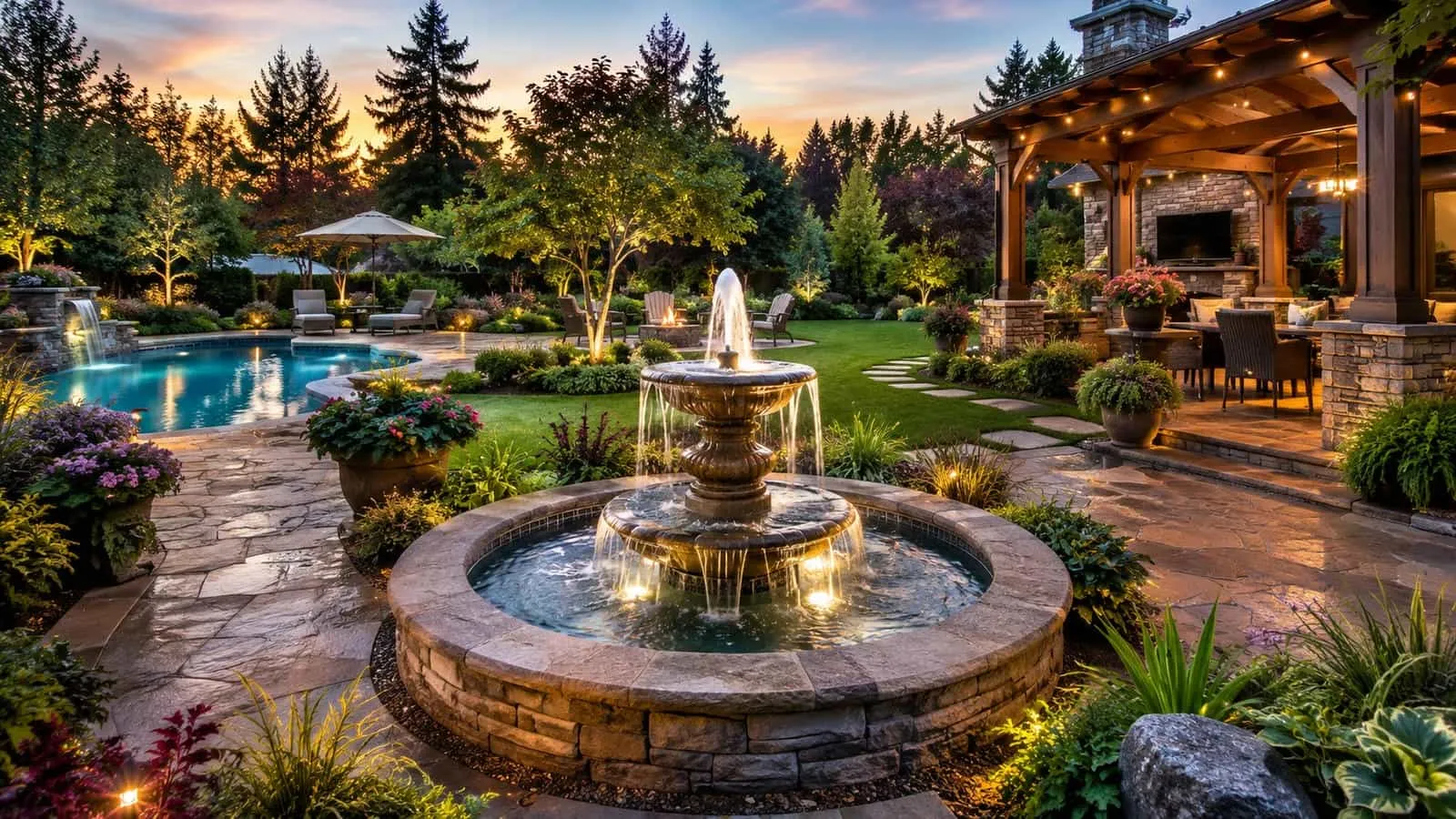
🏡⛲ A backyard fountain works best when it supports the entire property rather than filling a single empty space. A compact bubbling rock may bring movement to a small privacy garden, while a broad tiered fountain can create a focal point across an open lawn. A gentle cascade may improve conversation near an outdoor kitchen, while stronger water sound can soften traffic near a back fence. Use this guide to compare fountain styles, forms, locations, sounds, sizes, materials, safety needs, landscaping relationships, climate exposure and real homeowner situations before planning your backyard water feature.
Explore backyard water fountain ideas for property planning, outdoor living, landscape design, privacy, water sound and year-round care. Compare fountain styles, forms, placement decisions, planting relationships and buying factors before choosing a water feature for your complete backyard. Select any image below to visit its matching image and article section.


A backyard water fountain works best when it is planned as part of the complete property rather than added to an isolated empty space. The patio, lawn, pathways, pool, fire pit, outdoor kitchen, play areas, privacy borders and views from the house all influence where the fountain should stand. Begin by identifying what the backyard needs most, whether that is a stronger focal point, relaxing sound, greater privacy, wildlife activity or a better connection between separate outdoor zones.
Fountain placement, size and sound should reflect how the property is viewed and used. A compact urn, wall fountain or bubbling rock may suit a smaller yard, while a tiered fountain or broad cascade may be needed to remain visible across a deeper lawn. Gentle bubbling works well near dining and conversation areas, while stronger moving water can reach across larger spaces or soften traffic and neighborhood noise. For additional guidance on sight lines, accessibility and practical positioning, explore our complete water fountain placement and location guide.
The fountain should connect naturally with surrounding landscaping and outdoor living spaces without taking over their separate purposes. Trees, shrubs, ornamental grasses and flowering perennials can frame the water feature, improve privacy and soften property boundaries while still allowing easy access to the pump, reservoir and electrical connections for routine maintenance. If you are planning how fountains work with flower beds, pathways, plants and landscape design, explore our garden water fountain landscaping and planting ideas for additional inspiration.
Practical backyard conditions should guide the final choice. Consider children, pets, wildlife, power access, solar exposure, wind, falling leaves, summer evaporation, winter freezing and possible future additions such as a pool, pergola or outdoor kitchen. The best backyard water fountain improves the property without blocking movement, recreation or maintenance, and it should continue working as the landscape and household needs change over time.
A successful backyard water fountain improves the entire property rather than filling one unused corner. The best designs combine useful placement, visible scale, comfortable sound, safe circulation, suitable landscaping and easy maintenance so the fountain supports outdoor living through several seasons and stages of family life.
Use these practical planning principles to choose a backyard fountain that remains attractive, functional and easy to enjoy as the landscape, household and outdoor activities change.
When property layout, viewing distance, water sound, landscaping, safety and seasonal care work together, a backyard fountain becomes part of the complete outdoor experience. It can improve the morning view from the kitchen, create a relaxing destination after work, soften distractions during family gatherings and make separate backyard areas feel connected.

✅ Best For: Backyard water fountains are especially well suited to small suburban yards, large family properties, poolside landscapes, fire pit areas, outdoor kitchens, private seating destinations, open lawns, wildlife gardens, townhouse yards and complete outdoor retreats that need movement, relaxing sound, stronger views or better connections between activity zones.
The best backyard fountain is not simply the largest or most decorative model. It is the fountain that fits the complete property, strengthens important views, supports outdoor activities, produces comfortable sound and remains safe and easy to maintain. Begin with the backyard zone and experience you want to improve, then compare fountain form, size, placement, material, power and water movement.
Every backyard has a different combination of property size, outdoor zones, landscaping, household activity, privacy, noise, weather exposure and maintenance needs. Use the scenarios below to compare backyard water fountain forms, placement strategies, sound levels and realistic lifestyle conditions so you can choose a fountain that improves the complete property rather than filling an isolated empty space.
Open each scenario to discover which backyard water fountain best fits your property layout, outdoor activities, viewing distance and long-term plans. Guidance includes fountain form, placement, water sound, landscaping, safety, power access, weather exposure and maintenance for realistic residential backyards.
Best choice: Vertical fountain, bubbling urn or compact pondless rock fountain
A small backyard needs a fountain that creates a clear focal point without reducing useful lawn, seating or walking space. A narrow vertical fountain, bubbling urn or compact pondless rock design can add movement and sound along a fence, beside a pathway or within an underused corner. Vertical forms are especially helpful because they remain visible while using less ground area.
Position the fountain where it can be viewed from the house and the main outdoor seating area rather than placing it in the center of the yard. Framing it with a few well-scaled plants or a simple privacy screen can help the feature feel established without crowding the property or blocking access to the lawn.
Choose this when you want a strong backyard focal point while protecting limited space for seating, recreation and circulation.
Micro Recommendations: Measure the fountain, surrounding planting and required maintenance space together rather than judging the fountain by its product dimensions alone.
⚠️ Common Mistake: Placing a broad fountain in the middle of a compact yard can divide the lawn, restrict movement and make the entire property feel smaller.
Best choice: Tiered fountain, broad freestanding fountain or pondless waterfall
A large backyard may contain a patio, lawn, garden, pool, fire pit and several paths, so the fountain must remain visible across a greater distance. A substantial tiered fountain, broad freestanding design or pondless waterfall can act as a visual anchor that helps connect separate outdoor rooms without requiring each area to have its own decorative feature.
Look for a location near a transition point where several views meet, such as between the patio and lawn or at the end of a main pathway. The fountain should strengthen the property layout while preserving open recreation areas, access to outdoor structures and clear routes between the house and major backyard destinations.
Choose this when the backyard needs one recognizable feature to connect several activity zones and long viewing distances.
Micro Recommendations: Study the fountain location from the house, patio, lawn and main pathways before installation to confirm that it supports more than one part of the property.
⚠️ Common Mistake: Choosing a fountain that looks substantial in a showroom but disappears when viewed across a deep lawn, mature landscaping or several backyard zones.
Best choice: Low-profile cascade, architectural wall fountain or stable urn fountain
A pool or hot tub already creates strong movement and visual interest, so the fountain should complement the water setting rather than compete with it. A low cascade, architectural wall fountain or stable urn can add a separate layer of sound and design while leaving the pool as the primary recreational feature.
Place the fountain outside the main circulation route around the pool and away from ladders, gates, equipment and narrow deck areas. Control splash carefully so additional water does not create slippery surfaces. Materials should also tolerate strong sun, moisture and any pool chemicals that may reach the fountain through windblown spray.
Choose this when you want the fountain to enhance a poolside retreat without narrowing circulation or creating additional slip hazards.
Micro Recommendations: Position the fountain beyond the busiest pool route and test its spray pattern during windy conditions before adding nearby furniture or decorative planting.
⚠️ Common Mistake: Placing the fountain too close to the pool edge can crowd swimmers, increase slippery areas and make routine cleaning or equipment access more difficult.
Best choice: Medium urn, vertical cascade or illuminated freestanding fountain
A fire pit creates a natural gathering destination, so the fountain should provide visual balance without entering the active seating circle. A medium urn, vertical cascade or subtly illuminated freestanding fountain can add cooling movement and background sound while allowing the fire to remain the main focus of the evening area.
Position the fountain beyond the chairs and outside the route people use to bring in firewood, food or drinks. Maintain enough separation from heat, sparks and fuel storage, and keep electrical cords protected. The fountain should be visible from the seating area without creating an obstacle between people and the fire.
Choose this when you want moving water and firelight to create a balanced backyard destination for evening relaxation.
Micro Recommendations: Face the visible side of the fountain toward the chairs while keeping it beyond the active fire pit clearance and main entrance route.
⚠️ Common Mistake: Installing the fountain between the chairs and fire pit interrupts conversation, narrows access and places the feature too close to heat and sparks.
Best choice: Gentle wall fountain, low bubbling basin or medium urn
An outdoor kitchen and dining area need pleasant water ambience without excessive sound, spray or interference with serving routes. A gentle wall fountain, low bubbling basin or medium urn can provide movement and background sound while allowing family members and guests to hear one another across the table.
Keep the fountain away from the direct path between the house, grill, counters and dining furniture. Wind direction also matters because spray, grease and food debris can travel between the cooking area and the water. A location near the outer edge of the entertaining zone often provides a strong view without disrupting preparation or service.
Choose this when you want relaxing water sound to support meals and entertaining without interfering with cooking or conversation.
Micro Recommendations: Run the fountain during a family meal before finalizing the pump setting because water that seems quiet in an empty yard may feel louder during conversation.
⚠️ Common Mistake: Placing a strong cascade near the dining table can overpower conversation and allow windblown spray to reach chairs, food or serving areas.
Best choice: Stable low fountain, enclosed-reservoir design or securely installed wall fountain
A family backyard needs a fountain that supports safe movement, active play and straightforward cleaning. A broad low fountain, enclosed-reservoir design or securely installed wall fountain is usually more practical than a narrow top-heavy feature. Place it outside running routes, lawn games, pet paths and the space where outdoor chairs are frequently moved.
Protect electrical connections and prevent cords from crossing lawns, walkways or play areas. If pets or wildlife can reach the basin, regular cleaning becomes more important because hair, soil, grass clippings and outdoor debris can enter the water. Young children should always be supervised around any fountain or water feature.
Choose this when stability, protected placement and practical maintenance are more important than delicate decorative detail.
Micro Recommendations: Observe how children, pets and adults move between the house, lawn, play equipment and seating before selecting the fountain location.
⚠️ Common Mistake: Placing a tall narrow fountain beside a running path, ball-play area or backyard entrance increases the risk of impact, tipping and damaged electrical connections.
Best choice: Layered cascade or multi-stream vertical fountain near the property boundary
A backyard exposed to traffic, nearby conversations, air-conditioning equipment or close neighboring properties needs more acoustic coverage than a quiet bubbling bowl can provide. A layered cascade or multi-stream vertical fountain can create a steady sound layer that softens sudden distractions and makes outdoor areas feel more private.
Place the fountain near the direction where unwanted noise enters, but face the moving water toward the main seating or relaxation zone. Fences, screens and evergreen planting can strengthen the effect by shaping sound and limiting direct views. The goal is not complete silence but a more comfortable balance between water and surrounding activity.
Choose this when acoustic comfort, privacy and separation from neighboring activity are primary backyard goals.
Micro Recommendations: Listen from each main chair and from inside the house before fixing the location because fences, walls and wind can change how strongly the water is heard.
⚠️ Common Mistake: Selecting the loudest possible fountain can replace neighborhood noise with overpowering water sound and make conversation tiring during longer gatherings.
Best choice: Shallow birdbath fountain, bubbling rock or low pondless basin
A quiet backyard intended for birdwatching, reading or relaxed retirement living benefits from gentle moving water, accessible cleaning and a natural appearance. A shallow birdbath fountain, bubbling rock or low pondless basin can attract birds while providing soft sound that does not dominate the property.
Place the fountain where wildlife can approach with some nearby shelter but where dense plants will not block access to the pump or fill the reservoir with constant debris. A view from a kitchen, living room or shaded seating area allows the fountain to remain enjoyable even when the backyard is not being actively used.
Choose this when wildlife viewing, manageable care and peaceful everyday enjoyment are the main priorities.
Micro Recommendations: Use wildlife-safe cleaning methods, refresh the water regularly and keep a clear route to the pump so routine care remains manageable.
⚠️ Common Mistake: Surrounding the fountain with dense planting may look natural at first but can increase leaves, seeds and algae while making the pump difficult to reach.
| 🏡 Backyard Goal | ⛲ Recommended Fountain Style | 🔊 Water Sound and Flow | Property Placement and Performance | Buyer Guidance and Planning Insight |
|---|---|---|---|---|
| 🏘️ Small Backyard with Limited Open Space | A slim urn, vertical cascade, compact bubbling rock or wall fountain creates movement without consuming the centre of the property. | Gentle bubbling or controlled vertical flow adds noticeable ambience without overwhelming nearby homes, seating areas or enclosed property boundaries. | Use a fence line, planted corner or pathway edge while preserving the open lawn, house entrance, storage access and primary walking routes. | Best for homeowners seeking a small backyard water fountain that creates a visible focal point without making the property feel crowded or difficult to use. |
| 🗺️ Large Backyard with Multiple Outdoor Zones | A tiered fountain, broad freestanding fountain or pondless waterfall provides enough height, width and movement to remain visible across greater distances. | Moderate cascading sound can reach nearby seating while allowing quieter areas of the property to maintain their own atmosphere. | Place the fountain near a transition between the patio, lawn, garden or pathway where it can connect several views without blocking recreation or circulation. | Ideal for larger properties that need one substantial backyard focal point to visually connect several outdoor rooms and long viewing distances. |
| 🏊 Poolside Relaxation and Backyard Recreation | A low-profile cascade, architectural wall fountain or stable bubbling urn complements a pool without competing with its visual importance. | Controlled flow adds relaxing sound near loungers and seating while limiting windblown spray across slippery pool decks and circulation areas. | Keep the fountain away from ladders, gates, equipment, narrow deck routes and active swimming areas while preserving protected electrical access. | Best for buyers who want a backyard fountain near a pool or hot tub without creating congestion, excess splash or additional safety concerns. |
| 🔥 Fire Pit and Evening Gathering Space | A medium urn, vertical fountain or illuminated freestanding design creates a secondary focal point beyond the active fire pit seating circle. | Moderate water flow provides a cooling contrast without overpowering conversation or competing with the natural sound of the fire. | Position it outside heat, spark and fuel-clearance areas while keeping entrances, chair routes and firewood access open and easy to follow. | Suitable for homeowners creating a layered backyard experience that combines moving water, firelight, seating and relaxed evening entertaining. |
| 🍽️ Outdoor Kitchen, Dining and Entertaining | A controlled wall fountain, bubbling urn or low basin fountain adds movement beyond the dining and food-preparation areas. | Soft to moderate flow creates atmosphere while allowing guests to hear one another and preventing strong spray near food, counters or furniture. | Keep the fountain outside the route between the house, grill, outdoor kitchen and table while considering wind direction and maintenance access. | Ideal for families who want relaxing water sound near backyard meals and gatherings without disrupting cooking, serving or conversation. |
| 🌿 Privacy, Wildlife and Quiet Relaxation | A layered cascade, shallow birdbath fountain, bubbling rock or low pondless basin can support privacy landscaping and natural backyard activity. | Choose steady cascading sound for noise masking or gentle bubbling for birdwatching, reading, meditation and quieter daily enjoyment. | Place it near privacy planting or the direction of unwanted noise while maintaining clear pump access and a useful view from seating or inside the home. | Best for homeowners creating a private backyard retreat that combines relaxing sound, layered landscaping, wildlife value and manageable maintenance. |
| Backyard fountain summary: The best backyard water fountain should match the property size, outdoor zones, household activities and preferred viewing distance. Vertical fountains and compact bubbling forms preserve space in smaller yards, while tiered fountains and pondless waterfalls provide greater visual presence across larger properties. Thoughtful placement protects lawns, paths, pool circulation, entertaining areas, power access and long-term maintenance while helping the fountain connect the backyard as a complete outdoor environment. | ||||
Backyard water fountains can create a stronger focal point, relaxing sound, moving reflections and clearer connections between patios, gardens, lawns, pools and entertaining areas. They also require a stable foundation, safe power access, regular cleaning and enough space around household activities. Comparing the main benefits and practical tradeoffs can help you decide whether a backyard fountain fits your property layout, lifestyle, maintenance expectations and local climate.
| Benefits of Backyard Water Fountains | Limitations and Practical Tradeoffs |
|---|---|
|
|
| Backyard Fountain Tip: Position the fountain where it can strengthen several views and outdoor zones without blocking paths, lawn activities, pool access or routine maintenance. The strongest backyard designs balance visual impact, sound, safety, utility access and long-term property use. | |
💡 Comparison Tip: Evaluate the fountain from several locations rather than from one nearby viewpoint. Check how its size, water sound, splash pattern and surrounding landscaping feel from the house, patio, lawn, pathways and primary backyard seating areas.
Section Summary Snapshot: Comparing backyard water fountains by property size, outdoor zone, sound, viewing distance and maintenance reveals which design will support the complete yard over time. Vertical fountains and bubbling rocks conserve space, while tiered fountains, urns and pondless waterfalls create stronger focal points across larger landscapes. The best choice combines suitable scale, controlled water movement, clear circulation, practical utility access and realistic seasonal care.
Modern backyard water fountains use simple geometry, restrained colours and controlled water movement to connect contemporary architecture with patios, pools, lawns and uncluttered landscaping. Rectangular water walls, smooth concrete bowls, stainless steel cascades and geometric sphere fountains work especially well with large pavers, black fencing, structured planting and clean outdoor furniture.
Problem A decorative or heavily ornamented fountain can make a modern backyard feel visually cluttered and disconnected from the home.
Why it happens Contemporary landscapes depend on clean sight lines, repeated geometry, open space and a limited palette of coordinated materials.
Solution Choose a rectangular water wall, smooth bowl, sphere or narrow vertical cascade, then align it with the home, paving joints, pool edges or major landscape axes.
Modern backyard fountains should create movement without adding unnecessary detail. Smooth concrete basins, charcoal water walls, stainless steel panels and geometric bubbling spheres can provide a clear focal point while preserving the calm appearance of the property. These forms pair naturally with modular seating, large-format pavers, horizontal fencing, trimmed grasses and simple evergreen planting.
Placement should strengthen the structure of the complete yard. Align a wall fountain with a main window, position a narrow cascade at the end of a pathway or place a round bowl where it can soften an otherwise angular patio and lawn layout. Preserve enough open space around the fountain so its shape remains easy to recognize from the house and distant seating areas.
🏙️ Modern Backyard Tip: Repeat one fountain material elsewhere in the property. A charcoal fountain coordinated with black fencing or a concrete bowl matched to large pavers can visually connect distant backyard zones.
Traditional backyard water fountains use balanced proportions, classic materials and recognizable forms to create an established focal point. Tiered fountains, pedestal basins, formal wall fountains and cast stone designs work especially well with symmetrical paths, clipped hedges, brick patios, mature trees and homes with traditional architectural details.
Problem A traditional tiered fountain can look oversized or disconnected when it is placed randomly within an informal backyard.
Why it happens Classic fountains depend on strong sight lines, visual balance and enough surrounding space to support their height, basin width and formal shape.
Solution Position the fountain along a central view, at a pathway intersection or within a balanced planting area where the property layout supports its symmetry.
A traditional fountain can give an open backyard a stronger sense of order and permanence. A two- or three-tier fountain may anchor a central lawn, while a pedestal basin can create a destination at the end of a brick or stone pathway. Cast stone and concrete finishes often work well because their visual weight relates naturally to mature landscaping and established homes.
The fountain does not need to sit in the exact centre of the entire property, but it should connect with an important sight line. Consider the view from the main doors, kitchen window, patio or garden path. Low hedges, repeated planters or balanced planting beds can frame the feature without hiding the basin or restricting maintenance access.
⛲ Traditional Backyard Tip: View the proposed location through the most important door or window. A classic fountain becomes more effective when it completes a strong visual axis from the home.
Rustic backyard water fountains look most natural when stone, aged metal, wood tones and informal water movement work with the surrounding property. Bubbling rocks, weathered urns, copper fountains and short natural cascades complement timber pergolas, split-rail fences, brick fire pits, mature trees and casual family gathering spaces.
Problem A rustic fountain can feel artificial when its finish appears too glossy, lightweight or newly manufactured beside weathered wood and natural stone.
Why it happens Rustic landscapes depend on visible texture, warm colour, irregular form and materials that appear naturally aged by outdoor exposure.
Solution Choose textured stone, copper, dark ceramic or realistic cast materials, then repeat those tones through pathways, fire-pit stone, fencing or outdoor structures.
Rustic fountains should strengthen the comfortable, lived-in character of the entire backyard. Natural bubbling rock water fountain designs work especially well near woodland edges, informal planting beds and natural stone landscaping because their texture and gentle water movement can blend into the surrounding yard. A weathered urn beside a timber pergola or an aged copper fountain near a brick fire pit can create a different rustic focal point without making the landscape feel formal. Gentle bubbling and short irregular cascades usually suit this setting better than polished water sheets.
Place the fountain where natural materials can be appreciated without surrounding it with too many unrelated ornaments. A backdrop of ornamental grasses, evergreens or mature trees can help the feature settle into the property. Preserve a clear route for pump access, winter care and removal of leaves or windblown debris.
🪵 Rustic Backyard Tip: Match the fountain to permanent property materials rather than temporary cushions or seasonal decor. Stone, timber and aged metal provide a stronger long-term connection.
Mediterranean backyard water fountains combine glazed ceramic, warm stone, aged surfaces and expressive shapes. Blue urns, terracotta-inspired fountains, wall basins and tiled water features complement stucco walls, wrought iron furniture, warm paving, pool areas, citrus trees, herbs and layered container gardens.
Problem A colourful ceramic fountain can feel isolated when it becomes the only Mediterranean element within an otherwise unrelated backyard.
Why it happens Mediterranean design depends on repeated warm materials, textured surfaces, pottery, greenery and coordinated colour throughout the property.
Solution Repeat the fountain colour through a limited number of planters or outdoor accents and balance it with stucco, warm stone, wrought iron and drought-tolerant planting.
Ceramic urn fountains are especially effective in Mediterranean-inspired backyards because they combine sculptural form, colour and moving water. Deep blue, turquoise, green and earthy glazed finishes can stand out against warm paving and stucco while reflecting sunlight near patios, outdoor kitchens or poolside seating.
Position a ceramic urn beside a courtyard wall, at the edge of an outdoor dining area or within a controlled group of large containers. Olive, citrus, rosemary, lavender and ornamental grasses can reinforce the style, but the planting should not block the fountain or make refilling and pump care difficult.
🏺 Mediterranean Backyard Tip: Let one colourful fountain provide the strongest accent, then support it with warm neutral hardscaping and repeated greenery across nearby outdoor areas.
Cottage backyard water fountains use traditional shapes, soft water movement and informal planting to create a welcoming property. Birdbath fountains, aged urns, low pedestal basins and small tiered fountains work well with flowering borders, curving paths, painted fences, mature shrubs and casual seating areas.
Problem A cottage fountain can disappear within dense flowers and mature planting or become difficult to clean when vegetation surrounds every side.
Why it happens Informal gardens often contain layered plants, arching stems and changing seasonal growth that gradually cover sight lines and maintenance access.
Solution Select a fountain with enough height to remain visible, preserve an open access side and use lower plants near the basin before transitioning to taller borders.
Cottage-style fountains should appear discovered within the landscape rather than placed on display in an empty area. A shallow birdbath fountain beside a curving path, an aged urn near a painted bench or a small tiered basin framed by flowering perennials can create a memorable destination while supporting birds and everyday backyard enjoyment.
The arrangement can remain informal without becoming difficult to maintain. Use low groundcovers or compact flowers near the foundation and place taller plants farther back. Leave enough open space to lift the pump, clean the basin and manage falling petals, leaves and seeds throughout the growing season.
🌸 Cottage Backyard Tip: Allow the fountain to feel loosely framed rather than completely enclosed. A small opening beside the basin keeps the scene natural while making maintenance much easier.
Zen-inspired backyard water fountains use restrained forms, natural materials and gentle water movement to create a calm outdoor destination. Stone bowls, bamboo-style spouts, bubbling rocks and low basins complement simple paths, neutral seating, ornamental grasses, carefully placed evergreens and uncluttered views from the home.
Problem A peaceful backyard can become visually busy when statues, lanterns, plants, stones and decorative objects are crowded around the fountain.
Why it happens Zen-inspired design depends on restraint, negative space, balanced asymmetry and a limited selection of natural forms and materials.
Solution Choose one simple fountain, use a small number of coordinated plants and stones, and preserve open ground and clear sight lines around the feature.
A Zen backyard fountain should encourage people to pause rather than demand attention from every part of the property. Low stone bowls, bubbling rocks and bamboo-inspired spouts provide enough movement for meditation, reading and quiet reflection without introducing strong ornament. Explore Japanese inspired bamboo and stone fountains to compare traditional water features, stone basins, bamboo designs, shishi odoshi, Zen garden placement and peaceful water movement. Neutral paths and restrained planting allow water and natural texture to remain central.
Position the fountain where it can be appreciated from a quiet bench, meditation area or important indoor window. Use ornamental grasses, ferns, moss-like groundcovers, shaped evergreens and a limited number of natural stones to frame the water. Avoid filling every open area because negative space is an important part of the composition.
🎋 Zen Backyard Tip: Remove one decorative element after the fountain area appears complete. A simpler composition often feels more peaceful and allows the water sound to become the main sensory detail.
Section Summary Snapshot: Choosing the right backyard fountain style begins with matching the design to the home, property layout, landscaping and outdoor lifestyle. Modern yards favour geometric forms, traditional properties support tiered fountains, rustic retreats benefit from weathered texture, Mediterranean spaces suit colourful ceramic, cottage landscapes work with informal planting, and Zen backyards depend on natural simplicity, gentle sound and open space.
Choosing a backyard fountain is less about filling an empty location and more about deciding what role moving water should play across the property. A tall tiered fountain may anchor a deep lawn, while a bubbling rock can create a natural transition between the patio and landscaping. A wall fountain may preserve open space in a compact yard, while a substantial urn or pondless waterfall can connect several outdoor zones within a larger family property. Homeowners considering disappearing water, natural rock cascades and concealed storage can explore our backyard pondless waterfall and reservoir ideas for deeper planning around water movement, hidden reservoirs, placement and long-term care.
Before choosing a form, study the complete backyard layout. Consider doors, windows, pathways, lawn activities, seating, pool circulation, fire-pit clearance, outdoor cooking and the routes children and pets use most often. Water sound is equally important. Bubbling forms create gentle ambience near quiet seating, while tiered or cascading fountains provide broader sound coverage near traffic, mechanical equipment and close neighboring properties.
Foundation conditions, weather exposure and fountain materials also influence long-term performance. Concrete, compacted gravel and reinforced pavers can support substantial fountains, while lightweight resin or fiberglass models are easier to reposition during landscaping projects or seasonal care. Wind, direct sun, mature trees, fences and nearby structures can affect splash, evaporation, debris and sound reflection. Our complete guide to outdoor water fountain types explains how major fountain forms differ in structure, water movement, sound and installation.
Use the comparisons below to focus on the complete property rather than appearance alone. The right backyard water feature should strengthen sight lines, preserve circulation, complement the home, produce comfortable water sound and remain accessible for cleaning and seasonal care. Choosing with future property changes in mind creates a fountain that continues improving the backyard for many years.
Choosing the right backyard fountain means matching the fountain form to property size, outdoor zones, viewing distance, sound goals and long-term maintenance. The most successful forms create a visible focal point while preserving pathways, open lawn, pool circulation, gathering areas and access to the pump, reservoir and electrical connection.
| 🏡 Backyard Priority | ⛲ Recommended Fountain Form | 🎧 Why It Performs Well | 🗺️ Best for Homeowners Who... |
|---|---|---|---|
| Preserve open space in a small or narrow backyard | Wall Fountain or Slim Vertical Fountain | The upright profile uses a fence, privacy screen or exterior wall instead of valuable lawn and circulation space. Downward water movement provides visible activity and steady sound without requiring a broad basin in the centre of the yard. | Ideal for homeowners seeking a space-saving backyard water fountain that improves privacy and ambience without interfering with pathways, play areas, storage access or compact seating zones. |
| Create a natural transition between lawn, patio and landscaping | Bubbling Rock Fountain | A low profile, natural texture and concealed reservoir allow the fountain to blend with planting and hardscaping while preserving open views across the yard. Gentle bubbling adds movement without making the feature appear overly formal. | Often chosen by homeowners who want a natural backyard water feature that connects planted beds, stone paths, lawn edges and casual outdoor living areas. |
| Add a visible focal point without using a broad footprint | Urn or Vase Fountain | The vertical rounded form provides useful height and reflected water movement while occupying less ground area than a wide basin. Urns also coordinate easily with modern, rustic, Mediterranean and traditional landscapes. | Well suited to homeowners who want a versatile backyard fountain visible from the home, patio or pathway without installing a large permanent structure. |
| Soften traffic, neighboring voices or mechanical equipment | Vertical Cascade or Waterfall Fountain | Multiple streams or a continuous water sheet provide broader acoustic coverage than a quiet bubbler. The vertical design can be positioned near a property boundary while directing sound and movement toward the main seating area. | Frequently selected by homeowners prioritizing backyard privacy, noise masking and stronger water ambience near patios, pools, dining areas or close property lines. |
| Create a formal focal point across a large lawn or deep property | Tiered Fountain | Elevated bowls produce layered movement, long-distance visibility and stronger cascading sound. The height and broad silhouette allow the fountain to remain visually important when viewed from the house or across several outdoor zones. | Best for homeowners with adequate property depth, a level foundation and enough clearance to manage splash around paths, seating, lawn activities and surrounding landscaping. |
| Build a substantial natural retreat or destination space | Pondless Waterfall | A concealed reservoir and layered rock cascade create natural sound and landscape depth without requiring an open pond. The feature can connect mature planting, a quiet seating destination and a previously unfinished area of the property. | Ideal for homeowners who want a large backyard water feature with immersive sound, strong visual impact and a natural appearance without maintaining an exposed pond. |
| 🗺️ The best backyard fountain form is rarely determined by appearance alone. Wall fountains preserve space, bubbling rocks integrate with landscaping, urns balance height and footprint, vertical cascades improve sound coverage, tiered fountains create long-distance focal points and pondless waterfalls establish natural destination areas. The right form must also support circulation, household activity, utility access and future property changes. | |||

Backyard fountain size should be judged against the complete visual field rather than the fountain footprint alone. Property depth, mature trees, fences, sheds, patios, pools, pergolas and views from the home all affect how large a fountain appears. Measuring these elements together helps prevent a beautiful feature from disappearing in the landscape or dominating a compact yard.
| 🏡 Backyard Size | ⛲ Recommended Fountain Forms | 🎯 Why They Work Best |
|---|---|---|
| 🏘️ Small Backyards, Townhouse Yards and Narrow Properties | Wall fountains, slim urn fountains, corner cascades, compact bubbling rocks and low pondless basins | These space-saving forms use vertical height, fence lines or narrow landscape edges to create relaxing water movement while preserving lawn, storage access, play space, doors and primary walking routes. |
| 🪑 Medium Family Backyards with Patios, Lawns and Several Activity Areas | Medium urn fountains, pedestal bowls, bubbling rocks, compact tiered fountains and controlled vertical cascades | These forms provide enough presence to connect the patio, lawn, garden and gathering areas while maintaining manageable splash, comfortable viewing distance and practical access for cleaning and seasonal care. |
| 🗺️ Large Backyards, Deep Lots and Multi-Zone Outdoor Properties | Large tiered fountains, architectural water walls, substantial urns, broad cascades and pondless waterfalls | Larger fountains provide stronger visual scale, broader acoustic reach and enough height to remain noticeable across pools, outdoor kitchens, open lawns, fire-pit areas and distant views from the house. |
| 🗺️ Matching the fountain to the complete scale of the backyard creates stronger visual balance, safer circulation and more comfortable water sound. Small properties benefit from vertical and low-profile forms, medium yards support urns and bubbling rocks, and large backyards can accommodate tiered fountains or pondless waterfalls when foundation, splash and maintenance access are carefully planned. | ||
📏 Backyard Size Tip: Mark the proposed fountain footprint with stakes, rope or landscape paint, then study it from the house, patio, lawn and main pathways. Walk the routes used for mowing, entertaining, pool access and children’s activities. This reveals scale and circulation problems that product dimensions alone cannot show.
The most useful backyard water feature supports the activities that already happen across the property. Consider when the yard is used, how many people gather there, whether you need quiet ambience or stronger noise masking and how much maintenance you are willing to perform. Lifestyle and property alignment often matter more than decorative style.
| ☀️ Your Backyard Lifestyle | ⛲ Backyard Fountain Recommendation |
|---|---|
| ☕ Enjoy quiet mornings, reading or peaceful views from the house | Choose a bubbling rock, modest urn or low basin positioned within view of a favourite chair, kitchen window or living area. Gentle water movement creates a calm daily experience without dominating birdsong or quiet conversation. |
| 🍽️ Host family dinners and outdoor gatherings | Select a controlled urn, wall fountain or vertical cascade positioned beyond dining-chair and serving clearance. Moderate flow adds atmosphere while preserving conversation and keeping spray away from food, counters and furniture. |
| 🏊 Use the backyard for swimming and poolside relaxation | Choose a low-profile cascade, architectural wall fountain or stable urn outside the main pool circulation route. Control splash, protect electrical access and select materials that tolerate strong sun, moisture and occasional poolside exposure. |
| 🔊 Want to soften traffic, neighbors or mechanical background noise | Choose a layered vertical fountain or waterfall with adjustable pump flow. Place it near the direction of the unwanted sound and orient the water toward the main seating area to create a more comfortable acoustic layer. |
| 🧹 Prefer uncomplicated maintenance and seasonal care | Look for a self-contained fountain with an accessible pump, removable components, a wide reservoir opening and a durable finish. Resin and fiberglass forms are easier to move, drain and store than heavy multi-piece concrete designs. |
| 👨👩👧👦 Share the backyard with children, pets and active play | Choose a stable low-profile fountain, bubbling rock or enclosed-reservoir design outside running routes, ball-play zones and pet paths. Protect cords, avoid top-heavy forms and maintain clear visibility around the feature. |
| 🔥 Gather around a fire pit during evening conversations | Position a medium urn or vertical fountain beyond the fire-pit seating circle. Moderate sound and reflected light can add atmosphere while preserving heat clearance, chair movement, firewood access and safe walking routes. |
| 🐦 Want to attract birds and create a wildlife-friendly area | Choose a shallow birdbath fountain, bubbling rock or low basin with textured landing areas. Keep the water clean, avoid unsafe treatments and place the fountain near protective planting without surrounding the pump with dense debris-producing growth. |
| 🌿 Want greater privacy and a secluded backyard retreat | Combine a layered cascade or vertical fountain with evergreen hedges, ornamental grasses, fencing or a privacy screen. Position the fountain so both the water face and strongest sound are directed toward the relaxation area. |
| ❄️ Live in a region with freezing winters | Choose a fountain that drains completely, includes a removable pump and uses material appropriate for seasonal exposure. Lightweight models simplify storage, while permanent fountains require reliable covers, drainage and freeze protection. |
| 🗺️ The best backyard fountain supports household routines as much as landscape style. Matching water sound, fountain form, property placement, family activity, wildlife goals, maintenance expectations and seasonal conditions creates an outdoor feature that remains relaxing and practical instead of becoming difficult to manage. | |

A backyard water fountain should continue supporting the property long after installation day. Trees and shrubs mature, families change, outdoor furniture moves and new features such as pools, sheds, pergolas, play equipment or outdoor kitchens may be added. Planning for these changes creates a fountain that continues providing sound, movement and visual structure without limiting how the backyard can develop.
Use these practical backyard fountain planning tips to choose a form and location that remain attractive, accessible and functional through landscape growth, household changes, seasonal weather and future property improvements.
Long-term backyard fountain planning creates a property that feels connected, relaxing and easy to use. When fountain form, sight lines, outdoor zones, landscape growth, utilities, weather exposure and maintenance access are considered together, moving water becomes part of the complete backyard rather than an isolated decorative object.
Section Summary Snapshot: Choosing the right backyard fountain requires matching the form to the complete property. Wall fountains preserve open space, bubbling rocks blend with landscaping, urns balance height and footprint, vertical cascades improve sound masking, tiered fountains create long-distance focal points and pondless waterfalls establish immersive retreats. The best choice also protects circulation, supports household activity, accommodates landscape growth and remains practical through future renovations and seasonal changes.
A backyard fountain rarely feels complete because of the water feature alone. The surrounding lawn, planting beds, paths, fences, patios and outdoor structures determine whether the fountain looks naturally integrated into the property or simply placed in an unused area. Thoughtful landscaping can help moving water connect several backyard zones while strengthening privacy, seasonal interest and views from inside the home.
Backyard planting should support property flow rather than create another isolated garden display. Low plants can soften the fountain foundation without hiding the basin. Medium-height flowers and ornamental grasses can create a transition between the water feature, lawn and pathways. Taller shrubs and evergreens can provide a visual backdrop, improve privacy and help separate a quiet seating destination from more active areas such as a pool, fire pit, play zone or outdoor kitchen. These same landscape features also create excellent settings for wall water fountains for backyard privacy walls, fences, patios and outdoor living spaces, especially where vertical focal points can save ground space while adding relaxing water movement.
Plants also influence how water sound travels across the yard. Dense foliage and soft groundcover can reduce sharp reflections from fences, walls and hard paving, while hedges and privacy screens may redirect sound toward the main seating area. Landscaping cannot replace a fountain with suitable water flow, but it can make the complete acoustic environment feel softer and more comfortable.
Every plant should be selected according to actual backyard conditions. Sun, shade, prevailing wind, fountain splash, soil drainage, mature size and seasonal debris all affect long-term performance. A plant that remains compact beside a pathway may be useful near the fountain, while a shrub that spreads several feet could eventually hide the water, narrow circulation or make the pump difficult to reach.
Use this backyard fountain planting guide to compare low groundcovers, flowering perennials, ornamental grasses, shrubs, evergreens and wildlife-supporting plants that frame moving water without blocking pathways, lawn use, sight lines or maintenance access.
| 🌿 Backyard Planting Area | 🪴 Best Plants to Consider | ⛲ How Plants Improve the Fountain | 💧 Placement and Maintenance Guidance |
|---|---|---|---|
| 🌱 Low Plants Near the Fountain Foundation | Creeping thyme, sedum, dwarf mondo grass, low-growing heuchera, compact ferns, small hostas and restrained groundcovers suited to local conditions. | Low plants soften the transition between the fountain base, surrounding soil, gravel, pavers or lawn while keeping the basin and moving water visible. | Keep foliage below the basin edge and leave at least one open side for pump removal, reservoir cleaning, cord inspection, refilling and winter preparation. |
| 🌼 Flowering Plants Along Paths and Seating Transitions | Salvia, catmint, lavender, heuchera, coneflowers, compact daylilies, hardy geraniums and regionally suitable flowering perennials. | Medium-height flowers add seasonal colour and help connect the fountain with nearby paths, patios, benches and outdoor gathering spaces. | Allow for mature spread so flowers do not lean into the basin, narrow walking routes or release excessive petals and leaves near the pump intake. |
| 🌾 Ornamental Grasses Between Outdoor Zones | Blue fescue, carex, Japanese forest grass, compact switchgrass, feather reed grass and non-invasive fountain grass varieties suited to the climate. | Grasses create movement that echoes flowing water and can soften transitions between the fountain, lawn, privacy screens, patio edges and planted borders. | Choose forms that remain within the available width and position arching blades beyond the main splash zone so foliage does not enter the reservoir. |
| 🌳 Evergreen Privacy Planting Behind the Fountain | Columnar evergreens, boxwood, yew, dwarf cedar, upright juniper and other regionally appropriate evergreen shrubs. | Evergreens create a consistent backdrop, reduce exposed views from neighboring properties and help the fountain remain visually important throughout the year. | Confirm mature width and root spread before planting so shrubs do not crowd the fountain, lift the foundation or block access to electrical and water connections. |
| 🏡 Plants for Backyard Privacy Near Fences and Property Lines | Upright grasses, flowering shrubs, columnar evergreens, serviceberry, compact lilac and clumping bamboo grown responsibly where appropriate. | Layered privacy planting can make the fountain area feel more secluded while softening fences, sheds, neighboring buildings and exposed property boundaries. | Use taller plants behind the fountain rather than directly in front of it, and preserve enough distance for airflow, pruning and maintenance access. |
| ☀️ Plants for Sunny Backyard Fountain Locations | Lavender, salvia, sedum, catmint, yarrow, coneflowers, compact roses, drought-tolerant herbs and ornamental grasses. | Sun-tolerant plants add colour, texture and movement around fountains exposed to open lawns, south-facing fences and bright patio transitions. | Monitor soil moisture because direct sun, reflected heat and wind can dry planting beds quickly while also increasing fountain evaporation. |
| 🌿 Plants for Shaded or Woodland Backyard Areas | Hostas, ferns, heuchera, brunnera, astilbe, Japanese forest grass and shade-tolerant native groundcovers. | Shade plants create layered foliage around fountains beneath mature trees, beside north-facing fences or within protected reading and meditation areas. | Avoid planting so densely that fallen leaves, seeds and moisture remain trapped around the fountain base or continually enter the reservoir. |
| 💦 Plants That Tolerate Occasional Fountain Splash | Ferns, sedges, hostas, astilbe, Japanese forest grass and moisture-tolerant groundcovers appropriate for the local growing zone. | Splash-tolerant plants can soften basin edges and nearby hardscaping where occasional droplets reach the surrounding soil. | Occasional splash is different from permanently wet soil. Confirm drainage and reduce pump flow if nearby planting beds remain constantly saturated. |
| 🦋 Pollinator-Friendly Backyard Fountain Planting | Native asters, coneflowers, salvia, bee balm, catmint, milkweed varieties and other regionally appropriate nectar plants. | Nectar-rich plants combine with moving water to create a more active backyard habitat for butterflies, bees and beneficial insects. | Position flowers beside rather than over the reservoir so petals, leaves and visiting insects do not continually collect near the pump. |
| 🐦 Wildlife-Friendly Plants Near Shallow Fountains | Native shrubs, berry-producing plants, ornamental grasses, small evergreens and layered perennials that provide shelter and landing areas. | Nearby protective planting can help birds feel more comfortable approaching a shallow birdbath fountain or bubbling rock while adding habitat value to the property. | Maintain an open view around the water so birds can watch for danger, and keep dense cover far enough away that predators cannot hide directly beside the basin. |
| 🏊 Plants Around Poolside Backyard Fountains | Compact ornamental grasses, lavender, sedum, low-litter evergreens and durable shrubs suited to sun, reflected heat and occasional moisture. | Controlled planting softens pool hardscaping and connects a separate fountain with the broader backyard without increasing visual clutter. | Avoid plants that drop heavy flowers, berries, needles or leaves into the pool or fountain, and keep roots away from plumbing and paved surfaces. |
| 🔥 Plants Between Fountains and Fire-Pit Areas | Low-litter shrubs, compact grasses, sedum, stonecrop and other plants that remain outside required heat and spark-clearance zones. | Carefully placed planting can create visual separation between water and fire while preserving both features as distinct backyard destinations. | Keep combustible plants, dry grasses and overhanging branches away from the fire feature, and preserve an open route between the seating area and fountain. |
| 🏺 Mediterranean Backyard Fountain Planting | Olive trees where climate permits, rosemary, lavender, citrus, bay laurel, thyme and upright ornamental grasses. | These plants reinforce ceramic urns, warm stone, stucco walls, outdoor kitchens and poolside areas while creating a relaxed courtyard character. | Use well-drained soil and confirm which plants require protected winter storage or seasonal replacement in colder climates. |
| 🎋 Zen-Inspired Backyard Fountain Planting | Ferns, Japanese forest grass, dwarf evergreens, moss-like groundcovers, restrained ornamental grasses and carefully shaped shrubs. | Simple foliage and controlled forms complement stone bowls, bubbling rocks and bamboo-style fountains without making the retreat feel crowded. | Limit the number of plant varieties and preserve open ground, clear sight lines and uncluttered access around the water feature. |
| 🌿 The best landscaping around a backyard fountain uses low plants near the foundation, flowering perennials and grasses through the middle, and taller shrubs or evergreens behind the feature. Match every layer to sunlight, wind, mature size, debris, privacy needs and household activity so the fountain remains visible, accessible and connected to the complete property. | |||
🌱 Backyard Planting Tip: Design around the mature height and width of every plant rather than its size on planting day. Leave open views from the house and seating areas, preserve property circulation and keep enough space to reach the pump, reservoir, electrical connection and foundation without damaging established landscaping.
Begin with the complete property layout before choosing plants. Identify the main view from the house, primary seating area, nearby paths and the outdoor zones the fountain should connect. The water feature should remain visible from the places people use most often, while planting should guide attention toward it rather than form a solid wall that hides the basin.
A practical arrangement often begins with low plants near the foundation, followed by medium-height flowers or ornamental grasses and taller shrubs behind the fountain. This creates foreground, middle-ground and background depth while maintaining the water feature as the visual focal point. An asymmetrical layout usually feels more natural than placing matching plants on every side.
Use larger plants where they serve a clear property function. A columnar evergreen may soften a neighboring wall, a broad shrub may help screen pool equipment and a group of grasses may define the transition between a quiet fountain retreat and an active lawn. Avoid adding plants simply because open soil remains available. Every layer should improve privacy, views, sound, circulation or seasonal interest.
Plant materials should also coordinate with the fountain and permanent backyard surfaces. Glazed containers and warm stone work especially well with Mediterranean urn fountains, where the vessel can become a strong backyard focal point while still blending naturally with patios, paths and layered planting. For a deeper look at vessel shape, bubbling and overflowing water, landscape scale, materials, pumps and hidden reservoirs, explore our backyard urn fountain design ideas. Concrete, dark composite planters and structured grasses reinforce modern landscapes, while weathered stone, native shrubs and informal perennials suit rustic or woodland properties. Repeating a small number of materials and colours helps the fountain feel connected to patios, paths, fences and outdoor structures.
Maintain practical separation between planting, water and utility areas. Loose mulch and soil can wash into the basin during storms or strong fountain splash. Irrigation should not continually soak electrical connections or the fountain foundation. Preserve a stable, open working side where the pump can be removed and the reservoir can be cleaned without stepping through mature plants.
A fountain can strengthen backyard privacy when water sound, planting and screening are planned together. The fountain creates movement and a comfortable acoustic layer, while shrubs, hedges, fencing and ornamental grasses reduce exposed views. This combination can make a townhouse yard, suburban property or outdoor gathering area feel more sheltered without completely enclosing the space.
Place taller planting behind or beside the fountain so it creates a backdrop without blocking the water from the main seating area. Layered evergreens can provide year-round screening, while flowering shrubs and grasses add seasonal texture. A fence or privacy screen may also reflect water sound toward the patio or relaxation zone, so test the fountain volume before deciding on the final pump setting.
Privacy landscaping should not create a hidden maintenance pocket. Leave enough room behind the fountain to inspect cords, remove debris and reach the pump. Dense planting directly against the basin may trap moisture, limit airflow and make routine care difficult. A narrow service path or open side can preserve access without weakening the visual effect.
The goal is not to block every view or eliminate every sound. The strongest backyard retreat feels comfortably separated while remaining open, safe and easy to navigate. Combine moderate water sound with selected planting and screening rather than relying on an oversized fountain or an impenetrable wall of vegetation.
Landscaping around a backyard fountain changes continually. Shrubs widen, trees cast more shade, perennials spread and roots become stronger. Planning for mature growth helps the fountain remain visible, accessible and properly scaled instead of gradually disappearing within the landscape.
Long-term landscaping works best when the fountain, planting, pathways and outdoor zones are planned as one property system. Preserving sight lines, mature spacing, maintenance access and future flexibility allows the fountain to remain a useful backyard focal point instead of becoming hidden or difficult to manage.
Section Summary Snapshot: Landscaping helps a backyard fountain connect patios, lawns, paths, fences and outdoor gathering areas while improving privacy and seasonal interest. Use low plants near the base, flowers and grasses through the middle, and taller shrubs or evergreens behind the fountain. The strongest plan protects views from the home, preserves circulation, limits debris and leaves open access for cleaning, utilities and future property changes.

Backyard seating determines how a fountain is experienced across the property. A tiered fountain positioned beyond a patio can create a strong long distance focal point, while a bubbling rock beside a shaded bench provides gentle close range sound. A fountain near an outdoor dining area should add atmosphere without competing with conversation, directing spray toward food or narrowing routes used for serving. If your primary goal is creating a comfortable entertaining space, explore our patio water fountain ideas for outdoor seating areas to compare fountain layouts designed specifically for patios, conversation spaces and outdoor living.
Begin by identifying the backyard’s main outdoor zones. These may include a patio, pergola, gazebo, pool, hot tub, fire pit, outdoor kitchen, dining area, open lawn, children’s play space, pet route, wildlife corner or pathway connecting the house with a shed or side yard. The fountain should strengthen one or more of these areas without sitting in the path between them.
Sight lines matter as much as available ground space. A fountain may fit neatly against a rear fence but provide little daily value if it disappears behind furniture, landscaping or outdoor structures. Position the visible water surface toward the places people use most often and check whether the fountain remains recognizable from the patio, lawn and important rooms inside the home.
Listening distance should match the fountain form. Quiet bubbling water works well near reading chairs and private retreats, while tiered fountains and vertical cascades can carry across wider properties. Fences, exterior walls, privacy screens and covered structures may reflect water sound, while open lawns and layered planting can soften it.
Views from the house extend the value of the fountain beyond the main outdoor season. A water feature aligned with a kitchen, dining room, living room or bedroom window can provide movement and reflected light during rain, colder weather or times when the yard is not in active use. Subtle landscape lighting can preserve this view during evening gatherings without turning the backyard into a bright commercial display.
The strongest location works from several perspectives. It should be attractive from outdoor seating, visible from at least one useful indoor viewpoint and positioned outside important circulation routes. It must also remain practical to refill, clean, winterize and service after surrounding plants and outdoor activities change.
| 🏡 Backyard Viewing Location | ⛲ Best Fountain Placement | 👀 Viewing and Sound Experience | 💡 Property Planning Tip |
|---|---|---|---|
| Patio Sectional or Conversation Area | Position an urn, wall fountain, bubbling rock or vertical cascade beyond one end of the seating group or across the main viewing direction. | The fountain creates a visible focal point and balanced water sound during conversation, reading and relaxation without occupying the centre of the furniture arrangement. | Face the moving water toward the seating and preserve clear routes between the house, patio, lawn and nearby outdoor zones. |
| Outdoor Dining and Kitchen Area | Place a gently bubbling urn, controlled wall fountain or low cascade beyond chair clearance and outside the main cooking and serving route. | Moderate water sound adds atmosphere during meals while helping soften distant traffic, pool equipment or neighboring activity. | Keep the fountain away from food preparation, grease, open flames and locations where wind can carry spray toward the table or counters. |
| Reading Bench or Quiet Backyard Corner | Use a bubbling rock, small urn, shallow basin or compact cascade beside but not directly against the bench or chair. | Close-range water movement creates a calm and intimate soundscape suited to reading, coffee, meditation and quiet time after work. | Test the sound while seated and preserve enough room to reach the fountain without moving the bench or disturbing nearby plants. |
| Pergola, Gazebo or Covered Backyard Retreat | Position a contained wall fountain, narrow cascade or bubbling urn near the outer edge or at the end of the main sight line. | Roofs, privacy panels and structural posts can frame the fountain and make the water sound richer across the protected seating area. | Begin with lower pump flow and maintain distance from cushions, curtains, rugs and electrical accessories that may be affected by reflected spray. |
| Kitchen, Dining Room or Living Room Window | Align the fountain with an important interior view rather than placing it only where it looks attractive from the lawn. | Visible water movement, reflected daylight and subtle evening illumination allow the fountain to improve the property even when no one is outdoors. | Check the view from standing and seated positions inside the house, and consider how mature shrubs may eventually block the water. |
| Main Door or Backyard Entrance | Position the fountain where it creates an attractive first view without narrowing the landing, steps or route into the yard. | Moving water creates a welcoming transition from the home into the complete outdoor environment. | Preserve the full door swing and enough width for people carrying food, cushions, tools, toys or gardening supplies. |
| Pool or Hot Tub Seating Area | Place a low-profile cascade, stable urn or architectural fountain beyond the main pool circulation route and outside splash-sensitive access points. | The fountain adds a separate layer of movement and sound while supporting poolside relaxation and views from loungers or covered seating. | Keep the feature away from ladders, gates, equipment, slippery deck routes and electrical connections associated with the pool. |
| Fire Pit and Evening Gathering Area | Position a medium urn, vertical fountain or illuminated cascade beyond the fire-pit seating circle. | Water sound provides a cooling contrast to the fire while reflected movement adds depth to evening gatherings. | Maintain adequate heat and spark clearance and prevent the fountain from narrowing chair routes, fuel access or emergency movement. |
| Privacy Fence or Close Property Boundary | Use a vertical fountain, wall design or layered cascade near the direction of unwanted views and noise while facing the water toward the main seating area. | Consistent water sound can make conversations feel less exposed while the fountain and surrounding landscaping soften an unattractive boundary. | Confirm that sound remains reasonable for neighbors and that wind does not direct spray onto shared fencing or the adjoining property. |
| Open Lawn or Central Property View | Place a medium or large tiered fountain, substantial urn or architectural form where it can anchor a long sight line without dividing usable lawn. | A properly scaled fountain remains visible from the house and several outdoor zones while adding structure to a broad or unfinished landscape. | Preserve mowing routes, drainage, recreation space and enough distance from ball-play areas, pets and children’s activities. |
| Curved Path or Garden Transition | Position a bubbling rock, urn or low pedestal fountain where a pathway changes direction or opens into another outdoor zone. | The water feature becomes a destination and helps connect the patio, lawn, planted areas and quiet seating without blocking movement. | Leave sufficient path width and avoid placing plants where mature growth will hide the fountain or reduce access to the basin. |
| Large Backyard with Multiple Activity Zones | Position a substantial tiered fountain, broad cascade, architectural wall or pondless waterfall where several zones can share the same focal point. | A larger water feature can visually connect dining, lounging, swimming, gardening and fire-pit areas while providing wider acoustic coverage. | Avoid placing it where people must cross the splash zone or walk around a broad basin to move naturally between activities. |
| 🏡 The strongest backyard fountain viewing areas connect outdoor seating, dining spaces, pools, lawns, pathways and important house windows into one property-wide experience. A well-positioned fountain remains visible from useful locations, creates comfortable sound and preserves dry, open circulation without blocking doors, play areas, cooking routes or maintenance access. | |||
A fountain should never force people to cross a wet surface, step over electrical cords or leave a natural route between outdoor zones. Observe how the household moves between the house, patio, lawn, pool, fire pit, outdoor kitchen, shed, side yard and play areas before choosing a final location. These everyday movement patterns matter more than creating a perfectly symmetrical landscape.
Backyard routes also change with activity. Dining chairs are pulled away from tables, fire-pit seating is moved during gatherings, pool equipment is carried across the deck and lawn games require more open space than expected. Include these changing footprints when measuring the area around a fountain.
Children and pets often follow different paths than adults. A location that looks clear during a quiet inspection may sit directly in a running route, ball-play area or path used between the house and lawn. Stable low-profile forms or enclosed-reservoir fountains are often easier to integrate into active family yards than top-heavy designs with broad open basins.
Electrical connections should follow a protected perimeter or approved underground route whenever possible. Avoid running cords across lawns, pathways, pool decks or areas used by mowing equipment. A hidden cord is not necessarily a safe cord if it becomes difficult to inspect after plants mature.
Fountain maintenance requires a temporary working area. You may need to kneel beside the reservoir, remove the pump, carry water, clear leaves or install a seasonal cover. Leave one practical access side even when the other edges are softened with shrubs, grasses or decorative stone.
👣 Walk the Complete Backyard Before Installation: Enter from the house, move toward every seating area, walk to the pool, fire pit, grill, shed and side yard, then repeat the route while carrying a tray, garden tool or pool equipment. The best fountain location improves the view and sound without changing these natural property routes.
👀 Check Every Important Sight Line: Sit in the primary outdoor chairs and look through the main house windows before finalizing placement. The fountain should provide a clear view of moving water from positions used regularly instead of looking attractive from only one standing location.
🎧 Listen Across the Property: Run the fountain at several pump settings and listen from the patio, dining table, pool seating, fire pit and indoor doorway. Fences and walls may amplify the sound, while open lawns, distance and planting may reduce it.
💦 Observe Wind and Splash: Check the fountain during more than one weather condition. A site that remains dry on a calm day may direct water toward walkways, pool decks, windows, fences or outdoor furniture when the wind changes.
Section Summary Snapshot: Thoughtful backyard fountain placement connects patios, dining areas, pergolas, pools, fire pits, lawns, pathways and indoor windows into one complete outdoor experience. Clear sight lines, suitable listening distance and protected traffic routes make the fountain easier to enjoy from several locations. Planning around household movement, splash, utilities, children, pets and seasonal access keeps the water feature attractive and practical.
Backyard fountain sound is created by more than the fountain itself. Water movement, pump flow, property size, surrounding surfaces, landscaping, wind and listening distance all shape the outdoor experience. A softly bubbling rock may create a peaceful reading destination near a shaded bench, while a taller cascade can carry sound across a lawn toward a patio or fire-pit area affected by traffic and neighborhood noise. For a deeper explanation of bubbling, cascading and falling water, sound projection, listening distance, pump flow and environmental noise, explore our backyard water fountain sound and noise control guide.
Fountain design has the strongest influence on tone and volume. Low bubbling produces rounded, close-range notes, while several spillways and taller drops create brighter, more energetic sound. Adjustable pumps allow the flow to change with the backyard routine, including quiet mornings, outdoor dining, poolside relaxation or larger family gatherings. Similar-sized fountains can sound very different depending on how the water moves and where it lands.
The complete property also changes how sound travels. Fences, exterior walls, pool surrounds, stone patios and hard pathways reflect water sound, while lawns, hedges, shrubs, ornamental grasses and soft furnishings help absorb sharper notes. Pergolas, gazebos and covered patios may contain or redirect the sound toward nearby seating. Wind can carry sound away from one zone while pushing spray toward another.
Always judge a backyard fountain from the locations where people spend time. Listen from the patio, dining table, pool loungers, fire pit, reading bench and main doorway. A fountain that sounds balanced across the important outdoor zones will support relaxation, conversation and privacy without becoming too loud near one area or disappearing within the larger property.
Backyard water fountain sound changes with fountain form, water-drop height, pump speed, reservoir design and the surface receiving the flow. Comparing soft bubbling, gentle trickling, layered cascades, tiered splashing and waterfall sound helps homeowners match the fountain to property size, seating distance, outdoor activities and unwanted background noise.
| 💧 Water Movement | 🎧 Acoustic Character | 🏡 Best Backyard Placement | 💬 Conversation Comfort | 🗺️ Best for Homeowners |
|---|---|---|---|---|
| Soft bubbling from a bowl, sphere, birdbath or compact urn | Quiet, rounded water notes remain close to the fountain and create gentle sensory movement without wide acoustic projection. | Best beside a reading bench, morning coffee area, meditation corner, wildlife garden or small townhouse seating space. | Excellent for close conversation because the sound usually remains below normal speaking volume. | Ideal for homeowners seeking a quiet backyard fountain for relaxation, birds, compact spaces and calm daily routines. |
| Gentle trickling across short channels or narrow spillways | Continuous flowing notes create wider coverage than bubbling while maintaining a calm and consistent rhythm. | Well suited to patios, pergolas, outdoor dining areas, pathway destinations and medium-sized residential yards. | Comfortable around meals and conversation when the fountain remains several feet beyond the nearest chairs. | Often chosen by homeowners who want noticeable backyard water sound without the sharper splash of a tiered design. |
| Layered cascades with several short water drops | Overlapping tones create richer sound, natural depth and more effective acoustic coverage across several connected outdoor zones. | Effective near pergola seating, privacy landscaping, medium lawns, pools and family gathering spaces. | Most comfortable when seating is positioned at a moderate distance and pump flow remains adjustable. | Best for homeowners seeking stronger ambience, visual movement and moderate backyard noise masking. |
| Tiered splashing between elevated bowls | Bright, lively notes travel farther and create a traditional fountain sound with greater visual and acoustic energy. | Best across broad lawns, central landscape areas, large patios and formal backyard focal points with generous splash clearance. | Dining and conversation areas should remain farther away so the fountain does not dominate speaking voices. | Ideal for homeowners who want a statement fountain visible and audible across a deeper or larger property. |
| Broad waterfall, pondless cascade or vertical water-wall flow | Continuous low and high tones provide broad sound coverage and the strongest ability to soften traffic, pool equipment and neighborhood activity. | Effective near property boundaries, privacy screens, outdoor kitchens, large seating areas and backyards affected by road noise. | Comfortable when flow is adjustable and the fountain is placed beyond the immediate dining or conversation circle. | Best for homeowners prioritizing backyard privacy, traffic-noise masking and an immersive outdoor retreat. |
| 🎧 Choosing the right backyard fountain sound means matching water movement with property size, listening distance and daily activity. Soft bubbling supports close relaxation, gentle trickling suits dining and quiet gathering areas, layered cascades provide moderate privacy, and waterfalls or larger tiered fountains create broader sound coverage across deeper or noisier backyards. | ||||

Backyard materials influence how fountain sound travels. Concrete patios, brick walls, stone paths, glass doors, pool surrounds and solid fencing reflect higher-frequency splash notes. This can make a modest fountain sound more noticeable in a small enclosed yard or when it sits close to several hard property surfaces.
Soft outdoor materials absorb some of this reflection. Upholstered cushions, outdoor rugs, lawn areas, fabric privacy panels and padded seating can reduce harsh echoes and make cascading water feel warmer. Soft furnishings should remain outside the splash zone so improved acoustic comfort does not create moisture or mildew problems.
Landscaping changes the sound environment throughout the property. Broad leaves, ornamental grasses, hedges and layered shrubs break up hard reflections while adding natural movement. Evergreen privacy planting behind a fountain can soften sound traveling toward a fence, while open lawn allows sound to disperse more freely across the yard.
Pergolas, gazebos and covered patios require special attention. A roof can reflect sound downward, while side walls and privacy screens may contain it within the seating area. Begin with a lower pump setting than expected and increase the flow only after listening from the chairs, nearby pathways and adjacent outdoor zones.
Open lawns and large uncovered backyards allow sound to disperse over greater distances. A quiet bubbler may be difficult to hear from the house or fire pit when wind, traffic or pool equipment is present. A wider spillway, several short drops or a vertical cascade can provide greater acoustic reach without requiring an oversized fountain.
Structures and furniture can also interrupt the sound path. High-backed sectionals, sheds, pool enclosures and dense hedges may block or redirect water noise. Positioning the visible water face toward the main listening zone often creates clearer sound than increasing pump speed or selecting a much larger fountain.
Adjusting backyard fountain sound is often easier and less expensive than replacing the water feature. Small changes to pump flow, water level, landing surfaces, tubing, orientation and placement can create softer water rhythm, stronger privacy or more comfortable sound across several outdoor zones.
Use these practical adjustments to fine-tune the sound for a small yard, patio, pool area, outdoor dining space, fire-pit zone or larger family property.
Fine-tuning backyard fountain sound improves more than water flow. It creates a more comfortable property for coffee, meals, reading, swimming, entertaining and privacy. The best setting produces enough sound to be enjoyed without excessive splash, mechanical noise or competition with conversation.

Not every backyard fountain sound comes from moving water. Mechanical humming, rattling, clicking, sputtering and hollow reservoir echoes may indicate low water, trapped debris, pump vibration, loose tubing or uneven installation. Identifying the source prevents unnecessary replacement of a fountain that may only need cleaning or adjustment.
A humming pump may be touching the reservoir wall, operating with insufficient water or transmitting vibration through a hollow fountain body or rigid foundation. The noise may seem stronger near a fence, deck, wall or paved surface because these structures carry and reflect vibration.
Rattling often develops when the fountain is not level, decorative stones shift against the pump or tubing taps the shell. Check the base, internal components and water path before increasing pump speed or replacing equipment.
Sputtering usually indicates a clogged intake, trapped air, low water or an obstructed tube. Remove leaves, grass clippings and debris, refill the reservoir and confirm that the pump remains fully submerged.
Harsh splashing can result from excessive pump flow, an empty receiving basin, a tilted fountain or wind disturbing the stream. Lower the flow and observe where the water lands before moving the complete feature.
Hollow echoes may occur when water strikes a thin resin basin or nearly empty reservoir. Maintaining the correct water depth or adding an approved landing material can create a fuller and less metallic tone.
Backyard water fountains can make traffic, neighboring conversations, air conditioners, pool equipment and general outdoor activity feel less distracting by adding a pleasant layer of continuous sound. They do not physically block noise or make a property soundproof, but they can redirect attention toward moving water and improve the perceived privacy of seating and gathering areas.
A small bubbling fountain works best when the listener is close and the unwanted sound is moderate. It is unlikely to soften loud road noise across a deep property. Layered cascades, vertical fountains, broad spillways and pondless waterfalls provide stronger acoustic coverage because they move more water and create several overlapping tones.
Placement is critical. Position the fountain between the main listening area and the direction of the unwanted noise whenever practical. A vertical fountain beside a privacy fence may help a townhouse backyard, while a broader cascade may suit a larger yard near a road or mechanical equipment.
Landscaping can strengthen the effect. Hedges, shrubs, fences and privacy screens help frame the fountain and define the listening zone, while lawns and layered planting soften harsh reflections. The water face should remain directed toward the seating rather than toward an empty lawn or adjoining property.
Avoid solving one sound problem by creating another. Water that masks traffic may interfere with dining or conversation when the fountain is too close. Adjustable pump flow allows a stronger setting during busy periods and a quieter setting during meals, reading or relaxed evenings.
🎵 Backyard Sound Tip: Choose the desired water sound and listening distance before choosing the decorative shape. A beautiful fountain that feels too loud, too quiet, too sharp or too mechanical across the property may become less enjoyable over time.
Section Summary Snapshot: Backyard fountain sound is shaped by water-drop height, pump flow, reservoir depth, material, property size, fences, patios, landscaping, wind and listening distance. Soft bubbling supports close relaxation, while layered cascades, tiered fountains and waterfalls provide broader noise masking. Adjusting water level, pump speed, vibration and splash surfaces helps moving water support conversation, privacy and complete-property comfort.

Choosing the right backyard fountain size involves more than comparing product height and width. Fountain scale is influenced by the complete property, including the house, fences, mature trees, lawn, patios, pathways, pool, pergola, shed and other outdoor structures. A fountain that appears substantial in a product image may disappear across a deep yard, while the same design can overwhelm a compact townhouse property.
Basin width often affects backyard circulation and lawn use more than fountain height. A tall narrow urn may fit beside a path or privacy border, while a low fountain with a broad basin can divide a lawn, narrow a pool route or interfere with active family areas. Always compare the widest measurement with the space needed for people, pets, mowing equipment and seasonal maintenance.
Visible water movement contributes to visual scale. A narrow bubbling stream feels quieter and lighter than water spilling across several tiers or a broad waterfall face. Tiered fountains, architectural water walls and pondless cascades can appear larger than their listed dimensions because the moving water, sound and splash zone extend beyond the physical structure.
Surrounding features should also guide the choice. A low fountain may disappear behind shrubs, outdoor furniture or pool fencing, while an oversized fountain can compete with the house, block important views or dominate a modest landscape. The most balanced design remains visible from primary seating and indoor windows without becoming a barrier between backyard zones.
Viewing distance changes how much detail can be appreciated. Compact fountains with subtle texture and quiet bubbling work well near a reading bench, small patio or garden transition. Larger silhouettes, brighter cascades and stronger vertical forms are easier to see across open lawns or from kitchen, dining and living-room windows.
Foundation conditions affect how large and heavy a fountain can safely be. Reinforced concrete pads, compacted bases and properly installed pavers can support substantial water features when level and stable. Soil, lawn and sloped locations may require excavation, drainage improvement or professional foundation preparation before a large fountain is installed.
The fountain should look balanced without limiting the backyard’s purpose. A family property used for children, pets and recreation needs more open space than a formal courtyard designed mainly for viewing. Scale should reflect both appearance and the amount of daily activity surrounding the water feature.
Use these backyard fountain sizing tips to balance water-feature scale with property depth, landscape features, viewing distance, foundation strength and everyday outdoor use.
Choosing the correct backyard fountain size means balancing visual proportion, property depth, outdoor-zone layout, foundation strength and listening distance instead of simply selecting the tallest design available. Comparing common residential conditions helps homeowners choose a fountain that looks intentional and remains practical.
| 🏡 Backyard Condition | 📏 Recommended Fountain Scale | 🗺️ Why It Works Best |
|---|---|---|
| Very Small Backyard or Compact Townhouse Yard | Wall fountain, slim urn, compact bubbling bowl or narrow corner cascade | Preserves limited lawn and pathway space while creating close-range sound without blocking doors, storage access or seating. |
| Narrow Backyard With Close Property Lines | Vertical wall fountain, slender vase fountain or protected cascade | Uses height instead of width and can support privacy or noise masking while keeping the central route between the house and rear yard open. |
| Small Suburban Backyard With Patio and Lawn | Compact urn, bubbling rock, pedestal bowl or low cascade | Provides visible water movement without dividing the lawn or overpowering nearby seating, planting and pathways. |
| Medium Family Backyard With Several Activity Zones | Medium urn, compact tiered fountain, vertical cascade or substantial bubbling rock | Creates enough visual presence to connect the patio, lawn, garden and gathering areas while preserving circulation and recreation space. |
| Backyard With Pergola, Gazebo or Covered Retreat | Medium contained fountain with adjustable water flow | Provides sufficient visual weight near the structure while limiting excessive sound reflection and wind-driven splash around furniture. |
| Backyard With Outdoor Kitchen and Dining Area | Narrow urn, wall fountain or medium bubbling feature | Adds atmosphere beyond dining and serving clearance without occupying cooking routes or overpowering conversation. |
| Backyard With Pool or Hot Tub | Low architectural cascade, broad wall fountain or stable medium urn | Provides a visible focal point around the pool zone while preserving gates, equipment access, loungers and safe deck circulation. |
| Large Backyard With Open Lawn | Large urn, tiered fountain, broad cascade or architectural water feature | Creates enough scale and acoustic reach to remain noticeable across longer sight lines without disappearing within the landscape. |
| Deep Property Viewed Mainly From the House | Medium or large fountain with visible upper-level water movement | Remains noticeable through windows and across the lawn while creating a strong destination at the far end of the property. |
| Natural or Woodland Backyard | Medium bubbling rock, natural stone cascade or pondless waterfall | Blends with trees and layered planting while providing enough water movement and sound to remain noticeable within a textured landscape. |
| Windy or Highly Exposed Backyard | Low bubbling fountain, contained urn or protected wall fountain | Lower water drops reduce airborne splash and irregular flow while maintaining a stable visual presence in changing weather. |
| 📏 Correct backyard fountain size balances height, basin width, property depth, viewing distance, outdoor-zone circulation, foundation strength and splash. Compact forms suit small yards, medium urns and cascades connect family properties, and larger tiered, architectural or waterfall fountains require deeper landscapes and stronger foundations. | ||
Begin by measuring the proposed location rather than relying on the complete backyard dimensions. Record the available width and depth after accounting for pathways, patios, lawns, pool circulation, play areas, mature plants and permanent outdoor structures.
Mark the listed fountain footprint with stakes, rope, landscape paint or cardboard. Include the basin at its widest point rather than measuring only the central column. Leave the outline in place temporarily and walk through the backyard as you normally would.
Test routes between the house, patio, lawn, pool, fire pit, outdoor kitchen, shed and side yard. Move chairs, carry a serving tray, push a lawn mower and consider how children and pets use the property. These tests reveal whether the fountain will interfere with realistic movement.
Add maintenance clearance on at least one side. You should be able to kneel, remove the pump, refill the reservoir, clear debris and reach electrical or water connections. A fountain that fits only when pushed tightly against fencing or dense plants may become difficult to own.
Estimate the practical splash zone. Fountain shape, pump flow, drop height and wind influence how far droplets travel. Protect patios, pool decks, pathways, outdoor furniture and slippery surfaces by leaving more separation than the fountain dimensions alone suggest.
Confirm the total filled weight and foundation requirements before installation. Include the empty fountain, water, decorative stone and any supporting base. Large permanent fountains may require excavation, compacted aggregate, reinforced concrete or professional evaluation.
📏 Backyard Scale Tip: Photograph the marked fountain outline from the patio, lawn, main pathway and important house windows. This makes it easier to judge whether the proposed fountain feels too small, properly balanced or visually dominant before buying.
Section Summary Snapshot: Choosing the right backyard fountain size creates a property that feels balanced, connected and easy to use. Match fountain height and basin width with property depth, surrounding structures, viewing distance, circulation, splash and foundation strength. Compact fountains suit small yards, while larger urn, tiered, architectural and waterfall designs need deeper landscapes and stronger visual support.

Backyard fountain material affects much more than decorative style. It influences filled weight, wind stability, water sound, surface temperature, freeze-thaw performance, installation difficulty and how easily the feature can be relocated during future landscaping or property renovations. Heavy stone and concrete create permanent focal points, while resin and fiberglass provide more flexibility for smaller yards, decks, side-yard transitions and changing outdoor layouts.
Material choice should reflect where the fountain sits within the complete backyard. A concrete tiered fountain may anchor an open lawn or formal pathway, while a lightweight urn may work better near a deck or movable seating zone. Poolside fountains need surfaces that tolerate moisture, cleaning products and possible mineral deposits. Fountains near children, pets or active lawn areas should also resist impact and remain stable on their foundations.
| 🪨 Material | 🏡 Main Backyard Strength | ⚠️ Main Limitation | 🗺️ Best Property Fit |
|---|---|---|---|
| Resin | Lightweight, affordable and available in realistic stone, urn, tiered, wall and contemporary backyard fountain styles. | May require anchoring or seasonal protection in strong wind and can fade or feel visually light within a large landscape. | Ideal for small backyards, decks, rental properties, seasonal layouts and homeowners who may relocate the fountain as the property changes. |
| Concrete or Cast Stone | Provides substantial visual weight, strong wind resistance and a permanent architectural appearance across broad lawns and formal outdoor zones. | Requires a level foundation, careful delivery and sufficient access for installation, repair or future removal. | Best for permanent landscape centres, large patios, circular paths, formal backyards and statement fountains viewed from the house. |
| Natural Stone | Offers authentic texture, natural colour variation and grounded water sound that blends with trees, paths, retaining walls and layered landscaping. | Often costs more and may require professional handling because of weight, irregular shape and foundation requirements. | Well suited to woodland properties, rustic backyard retreats, bubbling rocks, pondless cascades and landscapes using natural materials. |
| Glazed Ceramic | Adds rich colour, reflective glaze and decorative contrast beside outdoor kitchens, Mediterranean landscaping, patios and poolside seating. | Can crack when trapped water freezes and may need draining, covering or protected winter storage in colder climates. | Ideal for sheltered backyard zones, courtyard-inspired areas, colourful planting schemes and compact bubbling-urn fountains. |
| Copper or Stainless Steel | Creates clean lines, reflective water movement and a strong connection with modern architecture, pool areas and structured landscapes. | May show mineral marks, water spotting or changing patina, and exposed metal can become hot in direct sunlight. | Best for modern backyards, outdoor kitchens, minimalist landscapes, poolside walls and architectural privacy features. |
| Fiberglass | Supports taller urns, broad wall fountains and larger forms without the structural weight of concrete or natural stone. | Surface realism, ultraviolet resistance, finish quality and long-term durability vary between manufacturers. | Useful for raised decks, townhouse yards, properties with narrow access and locations where heavy installation equipment cannot reach. |
| 🪨 The best backyard fountain material balances property style, filled weight, foundation strength, climate, wind, pool exposure and long-term care. Resin and fiberglass support flexible placement, concrete and stone create permanent visual strength, ceramic adds colour, and copper or stainless steel supports modern backyard design. | |||
This section provides a backyard-focused overview. For deeper comparisons covering structural weight, water sound, freeze protection, mineral deposits, surface cleaning and long-term durability, visit the complete outdoor water fountain materials guide.
Section Summary Snapshot: Choosing the right backyard fountain material creates a water feature that fits the property, architecture, foundation and climate. Resin, fiberglass, concrete, cast stone, natural stone, ceramic and metal provide different advantages for mobility, weather resistance, sound and maintenance. Matching the material to the backyard zone supports safer installation, dependable performance and long-term visual balance.

Backyard fountain maintenance begins with complete-property placement. A water feature may create a beautiful view across the lawn, but routine care becomes difficult when shrubs, fences, pool equipment, furniture or changing outdoor zones block the basin and pump. Leaving one practical service side open allows refilling, debris removal and pump inspection without disturbing the landscape.
Power and water access require more planning in a full backyard than beside a small patio. Electric pumps may sit farther from the house and should never rely on unsuitable cords stretched across lawns, pathways or children’s play routes. A nearby exterior faucet, hose connection or planned water line makes refilling easier during hot, sunny and windy weather when exposed fountains lose water quickly.
Pump size should match the fountain height, tubing length, water lift and number of spillways. A pump that is too weak may create uneven flow, while an oversized pump can cause splash, water loss and unnecessary noise. Adjustable flow provides useful control for quiet dining, larger gatherings, wildlife visits and changing wind conditions. For deeper help matching pump capacity to the complete water feature, use our backyard fountain pump sizing and flow guide to compare GPH, head height, delivered flow, tubing resistance and adjustable pump performance.
Solar backyard fountains can reduce the need for long electrical routes and work well in open sunny areas away from the house. The solar panel must still receive dependable direct sunlight, and shade from trees, fences, pergolas and future plant growth may reduce performance. Battery backup, panel location, pump capacity and reservoir size all affect reliability. For a detailed comparison, explore our solar water fountain guide with panel and battery planning.
Electrical cords should never cross lawn-mowing routes, pool decks, pathways, gates, play areas or locations where water collects. Use outdoor-rated equipment and protected connections, and follow local electrical requirements. When a permanent fountain is far from the house, a properly installed outdoor receptacle or buried electrical supply is usually safer and more attractive than temporary extension cords.
Plan power before installing hardscaping or mature plants. Future patios, pools, outdoor kitchens and privacy screens can make utility access more difficult. If the fountain location is far from outdoor electrical service or receives strong sunlight, compare solar or electric backyard fountain power before committing to a permanent electrical route. A long-term backyard fountain design should allow the pump, cord and connection to be inspected without digging through landscaping or removing permanent structures.
Plug an electric backyard fountain into a GFCI-protected outdoor receptacle and use only outdoor-rated cords, connectors and pump equipment. Keep every connection elevated, protected from splash and positioned outside normal walking, mowing and play routes.
The pump, tubing, intake screen and flow control should remain reachable after shrubs mature and outdoor furniture is arranged. A narrow maintenance path behind or beside the fountain provides dependable access without stepping through planting beds. Easy access encourages regular cleaning and allows weak flow, vibration or debris buildup to be corrected before the pump is damaged.
Reservoir capacity matters in exposed backyard locations. Larger basins usually require less frequent refilling than shallow decorative bowls, but they may hold more debris and add substantial filled weight. Match the reservoir to sun exposure, wind, fountain flow, wildlife use and the distance to the nearest water source.
| ⚙️ Maintenance Task | 🏡 Why It Matters | 📅 Suggested Timing | ✅ Practical Backyard Tip |
|---|---|---|---|
| Check the Water Level | Low water can cause the pump to draw air, weaken circulation, create sputtering and operate under unnecessary strain. | Check weekly and more often during heat, drought, wind or periods of strong fountain flow. | Keep a hose connection, watering can or planned water supply within reasonable reach of the fountain. |
| Remove Leaves, Grass and Outdoor Debris | Leaves, grass clippings, seeds, pollen, insects and soil can block the intake, cloud the water and reduce pump performance. | Inspect weekly and after mowing, storms, strong wind, pruning or heavy seasonal leaf drop. | Direct mower discharge away from the basin and avoid placing the fountain directly beneath high-debris trees. |
| Inspect the Pump and Intake | A clean intake supports dependable circulation, balanced water sound and longer pump life. | Check every few weeks or whenever the flow becomes weak, uneven, noisy or interrupted. | Preserve an open maintenance side so the pump can be reached without moving furniture or cutting through mature plants. |
| Clean the Basin and Water Channels | Cleaning controls algae, mineral deposits, wildlife residue and slippery buildup that can alter flow and appearance. | Perform deeper cleaning every few weeks as sunlight, water hardness, wildlife and debris exposure require. | Use material-safe methods for resin, fiberglass, concrete, stone, ceramic, copper or stainless steel. |
| Inspect Cords and Connections | Damaged or poorly routed electrical components create risks around wet ground, lawn equipment, pets and backyard traffic. | Inspect during routine cleaning and after storms, landscaping work, furniture changes or fountain restarts. | Keep outdoor-rated connections away from standing water, pool circulation, mower routes, pets and children’s play areas. |
| Check the Foundation and Level | Soil movement, frost heave and erosion can tilt the fountain, change the water path and create uneven structural stress. | Inspect each spring, after severe weather and whenever water begins spilling unevenly. | Correct drainage and foundation movement before increasing pump flow or adding shims to a permanent installation. |
| Prepare for Winter | Trapped water and freezing temperatures can damage pumps, tubing, bowls, seals and porous fountain materials. | Complete before the first sustained freezing temperatures arrive. | Drain, remove, store, cover or protect components according to the material, climate and manufacturer instructions. |
| ⚙️ A low-maintenance backyard fountain combines accessible pump parts, safe power, convenient water supply, stable support and protection from lawn and tree debris. Regular refilling, cleaning, cord inspection and seasonal preparation preserve dependable circulation while reducing pump strain, slippery surfaces and avoidable repairs. | |||

Regular backyard fountain cleaning protects water movement, quiet pump operation and the appearance of the complete property. Outdoor fountains may collect more debris than patio or indoor features because they are exposed to lawns, mature trees, storms, insects, wildlife and seasonal landscaping work.
Use these practical maintenance steps to protect water flow, pump performance, surrounding surfaces and the fountain’s long-term appearance.
These backyard fountain maintenance steps support clean water, comfortable sound and dependable pump performance through changing seasons and everyday property use. Whether the fountain sits beside a pool, along a pathway, across an open lawn or near a private seating retreat, regular debris control helps it remain attractive without becoming a constant chore.
Plan service access at the same time as fountain placement, landscaping and utility routing. A narrow stepping-stone path, gravel strip or concealed opening behind shrubs can provide access to the pump, basin and electrical connection. This allows plants and outdoor features to frame the visible sides without trapping the fountain inside a maintenance pocket.
Consider the equipment needed for future care. You may need to carry a hose, bucket, pump, cover or cleaning supplies across the yard. The maintenance route should remain firm, reasonably dry and wide enough to use without stepping through planting beds, pool circulation or active family areas.
🧽 Maintenance Tip: The easiest backyard fountain to maintain is not always the smallest. A simple design with an accessible pump, broad reservoir, adjustable flow and clear service route may require less effort than a compact fountain with narrow channels, hidden parts and mature plants blocking access.
This section provides a backyard-focused overview of fountain power, pumps, water access and routine care. For detailed schedules, algae control, mineral-deposit removal, pump troubleshooting and winter protection, visit the complete outdoor water fountain maintenance guide.
Section Summary Snapshot: Easy backyard fountain maintenance begins with safe outdoor power, dependable circulation, convenient water access and a clear route to the pump and reservoir. Positioning the fountain away from mower paths, heavy tree debris, play areas and difficult landscaping makes routine care easier. Regular refilling, cleaning, pump inspection and seasonal protection preserve reliable water flow and long-term outdoor performance.
A backyard water fountain rarely looks, sounds or performs exactly the same throughout the year. Spring may reveal an open landscape before trees and shrubs leaf out, while summer growth can change shade, sight lines, wind movement and maintenance access. Autumn fills lawns and basins with leaves and seeds, and winter determines whether the fountain can remain outdoors or must be drained, covered or moved into protected storage.
Regional climate should influence fountain material, water-drop height, reservoir size and property placement before installation. Open lawns may experience stronger wind than sheltered patios, dark stone and pool decking can increase reflected heat, and fountains beneath mature trees collect more organic debris. In colder regions, repeated freezing and thawing can damage pumps, tubing, glazed ceramic, cast stone and other water-holding parts.
Seasonal backyard use also changes around the fountain. Spring may focus on planting and cleanup, summer may bring outdoor dining, pool use and family gatherings, and autumn may shift attention toward fire pits and late-season seating. Planning for changing activity zones, mature plant growth, lawn maintenance and year-round service access keeps the fountain connected to the complete property rather than becoming an isolated seasonal decoration.
This seasonal backyard fountain comparison explains how spring thaw, summer heat, autumn debris and winter freezing affect water levels, pump circulation, foundation stability and surrounding landscape use. Matching maintenance with each season protects resin, fiberglass, stone, ceramic and metal fountains while preserving clear water, balanced sound and an attractive backyard focal point.
| 🍃 Season | 🏡 Backyard and Weather Conditions | ⛲ Fountain Care Priorities | ✅ Best Seasonal Guidance |
|---|---|---|---|
| Spring | Snowmelt, wet soil and frequent rain may expose drainage problems, frost movement, uneven foundations or winter damage around the fountain. | Stored fountains may contain dust and mineral residue, while permanent models need pump, tubing, cord, basin and foundation inspection. | Clean the fountain, test every water channel and confirm that frost heave, erosion or saturated soil has not changed its level or stability. |
| Summer | Direct sunlight, warm wind, lawn irrigation and high outdoor use increase evaporation while trees and shrubs create deeper seasonal shade. | Falling water levels can strain the pump, concentrate minerals and alter sound. Warm water, strong light and organic debris can encourage algae. | Refill frequently, keep the pump submerged, reduce excessive splash and monitor how lawn watering, pool activity and prevailing wind affect the basin. |
| Autumn | Leaves, seeds, grass clippings and fading plants collect across the yard as stronger winds and cooler nights reduce regular fountain use. | Organic debris can block the intake, stain the reservoir and settle inside narrow spillways before temperatures begin falling below freezing. | Remove debris frequently, trim surrounding plants and begin draining, covering or storage before the first sustained freeze. |
| Winter | Snow, ice, frozen soil and repeated temperature changes expose permanent fountains and foundations to moisture and structural stress. | Trapped water can expand inside bowls, pumps, tubing and hidden channels, causing cracks, weakened seams or displaced fountain sections. | Drain every water-holding area, protect or store the pump and follow material-specific winter care for stone, concrete, ceramic, resin and metal. |
| 🍂 Seasonal backyard fountain maintenance protects circulation, foundation stability, fountain materials and property safety. Spring inspection prepares the feature for operation, summer refilling controls evaporation, autumn cleaning prevents blockages and winter shutdown reduces freeze damage. Matching care with seasonal weather keeps the backyard fountain attractive and dependable. | |||
Every outdoor backyard fountain responds differently to sun, shade, wind, rain, lawn irrigation, snow and seasonal temperature changes. Understanding how these conditions affect splash, evaporation, algae, drainage, pump performance and surrounding outdoor zones helps homeowners choose a better location and simplify long-term care.
Wind can push fountain spray toward lawns, pathways, pool decks, outdoor seating and neighboring property while increasing evaporation. Low bubbling designs, broad catch basins, adjustable pumps and sheltered placement usually provide better control than tall jets or exposed tiered fountains in windy backyards.
Wind affects backyard fountain placement because air movement changes across the property. Open lawn areas, side-yard corridors and spaces between houses may create stronger gusts than sheltered patios or planted privacy zones. A fountain that remains contained on a calm morning may direct fine spray toward walkways, fences or seating during an afternoon breeze.
Tall jets, narrow receiving bowls and elevated tiers generally lose more water than bubbling urns or compact cascades with broad reservoirs. Strong water movement may create better long-distance sound, but it can also increase refilling frequency, expose nearby surfaces to mineral spotting and create slippery circulation areas.
Observe seasonal wind before completing the surrounding hardscape or landscape design. Lowering pump speed, rotating the water outlet or moving the fountain behind a planted screen can often improve splash control without removing the sound and movement that make the backyard feel relaxing.
🌬️ Splash-Control Tip: Test several pump settings before relocating the fountain. A modest reduction in flow may protect pathways, furniture and neighboring areas while preserving useful sound.
Backyard fountains in full sun create bright reflections but may experience warmer water, faster evaporation and more visible algae. Partial shade can reduce heat and water loss, while deep tree cover may increase leaves, pollen and wildlife debris or limit the performance of solar-powered pumps.
Full sunlight makes moving water visible from the house and across the yard. However, heat reflected from concrete, pool decking, stone walls and dark fences can raise basin temperature, increase evaporation and encourage algae when grass clippings, pollen or organic debris remain in the water.
Partial shade often creates a useful balance for outdoor backyard fountains. Morning sun with afternoon protection can maintain attractive reflections while reducing the strongest heat around seating, pathways and water-sensitive landscaping.
Deep shade beneath mature trees creates different maintenance concerns. Leaves, seeds and bird activity can increase debris, damp surfaces may dry slowly, and solar fountain panels may receive too little direct light for dependable circulation. Homeowners hoping to encourage regular bird visits often prefer moving water birdbath fountain designs because the shallow basin, gentle bubbling water and open visibility create a safer place for birds to drink and bathe.
☀️ Sunlight Tip: Morning light with partial afternoon shade often provides a practical balance between sparkling water, manageable evaporation and cooler backyard conditions.
Heavy rain can overflow fountain reservoirs, wash soil and lawn debris into the water and create erosion or puddles near electrical connections. Proper grading, stable foundations, protected wiring and post-storm inspections help preserve safe circulation and reliable fountain performance.
Heavy rainfall can raise water levels quickly and wash mulch, soil, grass, leaves and fertilizer residue toward an exposed fountain. This material may cloud the water, block the pump intake or settle around narrow channels and spillways.
The surrounding property should direct runoff away from the fountain foundation, electrical supply and heavily used paths. Lawn slope, downspout discharge, pool drainage, irrigation and low areas all influence where water travels during storms.
Severe weather can shift lightweight fountains, topple nearby decor and drop branches into the reservoir. Saturated ground beneath an improperly prepared base may also cause tilting, rocking or uneven water flow.
🌧️ Drainage Tip: Observe where stormwater travels through the backyard before installing the fountain. Correct grading and placement are easier than repeatedly repairing erosion or flooded electrical areas.
Backyard fountains should be drained before sustained freezing weather because trapped water can expand inside bowls, pumps, tubing and hidden reservoirs. Winter protection depends on material, construction and local climate, with lightweight fountains often stored indoors and heavy permanent fountains drained and covered outside.
Water expands when it freezes and can create pressure inside basins, spillways, tubing, pumps and decorative channels. Repeated freezing and thawing may crack bowls, weaken seams, damage finishes or shift sections that must remain level.
Concrete, cast stone and natural stone can hold moisture within porous surfaces. Glazed ceramic may crack when water enters small openings, while copper, stainless steel and coated metal fountains need complete drainage and finish-specific protection.
Lightweight resin and fiberglass fountains are usually easier to move into a garage or shed. Large backyard fountains often remain in place and need complete drainage, protected openings and a fitted breathable cover that sheds snow and rain without trapping condensation.
The foundation should also be inspected before and after winter. Frost heave can change level support beneath permanent fountains, especially when drainage is poor or the base sits on soil rather than a properly prepared pad.
❄️ Winter-Care Tip: A fountain cover cannot protect water left inside the reservoir, tubing or pump. Complete drainage remains the most important step for preventing freeze-related damage.

Frame the fountain with spring bulbs, summer perennials, autumn grasses and evergreen shrubs that provide structure during winter. Keep low plants close to the basin, medium-height landscaping beside it and taller privacy plants behind it. This layered arrangement preserves water views, connects outdoor zones and keeps pump access open throughout the year.
Consider mature size, leaf drop and seasonal dieback before planting. A shrub that frames the fountain in spring may block the water by late summer, while ornamental grasses may collapse into the reservoir after heavy snow. The strongest landscape plan remains attractive without increasing debris or hiding maintenance components.
Follow these seasonal backyard fountain maintenance steps to protect circulation, surrounding landscaping, property routes and the fountain’s appearance as weather and household activities change.
These practical checks help prevent pump, splash, debris, drainage and freeze-related problems while keeping the complete backyard ready to enjoy.
Seasonal backyard fountain care becomes easier when it follows the natural rhythm of the property. Spring inspection, summer refilling, autumn cleanup and winter shutdown preserve clear water, dependable pump performance and a relaxing focal point near patios, lawns, pools, paths and private seating areas.
🍂 Seasonal Planning Tip: Evaluate the fountain location under several seasonal conditions whenever possible. A sunny spring location may become deeply shaded by summer growth, while a peaceful autumn setting may sit beneath heavy leaf drop, drifting snow or spring runoff.
Seasonal backyard fountain care should support the complete property rather than becoming a separate maintenance burden. For detailed cleaning schedules, pump protection, winter shutdown procedures and material-specific guidance.
Section Summary Snapshot: Backyard fountain performance changes with sunlight, heat, wind, rainfall, lawn debris, mature landscaping, snow and freezing weather. Spring inspection, summer refilling, autumn cleaning and winter protection preserve dependable circulation. Climate-appropriate materials, controlled splash, effective drainage and accessible landscaping keep the fountain connected to the complete backyard throughout the year.

Backyard water fountains create disappointing results when they are treated as isolated decorations instead of features within a complete residential property. A fountain that looks impressive in a product photograph may disappear across a deep lawn, overpower a compact townhouse yard or interrupt the routes connecting the house, patio, pool, fire pit, outdoor kitchen and garden.
Poor planning can also turn routine fountain ownership into an ongoing inconvenience. A pump hidden behind mature shrubs, a cord crossing a mowing route, a basin placed beneath heavy leaf drop or a permanent fountain installed where future renovations are planned can create problems that were not obvious during the initial purchase.
The strongest backyard fountain ideas begin with realistic household use. Homeowners should consider where children play, how pets move through the property, where guests gather, which windows overlook the yard, how sound travels toward neighboring homes and how maintenance equipment will reach the fountain.
Fountain placement, water sound, scale, filled weight, wind exposure, electrical access, reservoir capacity and surrounding landscape should support one another. When these decisions are planned together, the fountain can connect multiple outdoor rooms and help the backyard feel peaceful, functional and intentionally designed.
| ⚠️ Common Mistake | ❌ Why It Creates Problems | ✅ Better Backyard Fountain Decision |
|---|---|---|
| Choosing the Fountain Only by Appearance | The fountain may look attractive online but create the wrong sound, scale, splash pattern, weight or maintenance level for the property. | Compare exact dimensions, filled weight, material, water movement, pump access, power requirements and climate suitability before purchasing. |
| Ignoring the Complete Backyard Layout | The fountain may block routes between the house, patio, lawn, pool, garden, fire pit, shed or side yard. | Map every major outdoor zone and preserve comfortable circulation before selecting the fountain location. |
| Choosing the Wrong Fountain Scale | A small fountain may disappear across a large property, while an oversized tiered design can dominate a compact backyard. | Compare fountain height, basin width and visible water movement with property depth, surrounding structures and viewing distance. |
| Ignoring Views From Inside the House | The fountain may be hidden behind shrubs, furniture or structures even though the main opportunity is an attractive indoor view. | Evaluate the location from kitchen, dining, living-room and bedroom windows before installation. |
| Blocking the Pump or Reservoir | Refilling, cleaning and pump inspection may require moving furniture, cutting plants or stepping through wet soil. | Preserve a discreet service side and a stable maintenance route to the pump, tubing, reservoir and power connection. |
| Placing the Fountain Beneath Heavy Debris | Leaves, seeds, pollen, grass clippings and wildlife debris can clog the pump, stain the basin and increase algae. | Use partial shade without placing the fountain directly beneath dense branches or beside mower discharge. |
| Allowing Excessive Water Splash | Escaping water can wet pool decks, paths, furniture and lawn edges while increasing evaporation and slippery surfaces. | Choose adjustable flow, a wide reservoir, lower drops or sheltered placement suited to the yard’s prevailing wind. |
| Overlooking Filled Weight and Foundation Support | A heavy fountain may settle into soil, shift on an unstable base or become uneven after rain, erosion or frost heave. | Calculate operating weight and prepare a level, stable and well-drained foundation suitable for the fountain material. |
| Routing Power Across Lawns and Paths | Exposed cords can create trip hazards and conflict with lawn mowers, pets, children, pool circulation and property maintenance. | Plan safe outdoor power before placement and use a qualified professional when permanent electrical work is needed. |
| Ignoring Children and Pets | Deep reservoirs, unstable structures, exposed cords and slippery surfaces can create avoidable safety concerns. | Choose stable fountains with shallow or enclosed reservoirs and keep them away from active play and pet-running routes. |
| Placing the Fountain Too Close to Other Features | Heat, grease, chlorine, heavy traffic or water conflict may occur near fire pits, outdoor kitchens, pools and hot tubs. | Preserve practical separation while keeping the fountain visible and audible from the intended outdoor zone. |
| Forgetting Drainage and Winter Protection | Runoff, saturated soil, trapped water and freeze-thaw cycles can damage foundations, pumps, bowls and porous materials. | Plan drainage, winter shutdown, storage or covering before choosing and permanently installing the fountain. |
| ⚠️ Most backyard fountain mistakes can be prevented during complete-property planning. Compare the water feature with outdoor zones, sight lines, sound, foundation strength, household activity, electrical access, landscape growth, maintenance routes and seasonal weather before installation. | ||
Open each common backyard water fountain mistake below for focused planning guidance. These nine problems cover the most important buying, placement, scale, foundation, power, maintenance, sound, safety and seasonal decisions homeowners should evaluate before adding a fountain to the complete property.
Choosing a backyard fountain by appearance alone can lead to poor scale, unsuitable sound, excessive maintenance or difficult installation. Compare exact dimensions, filled weight, material, water pattern, power source, reservoir capacity, pump access and viewing distance before deciding whether the fountain fits the property.
An outdoor fountain may look impressive in a staged product photograph yet perform very differently within a real residential backyard. A tall tiered fountain may send spray toward pathways, a narrow reservoir may require frequent refilling and a large cast-stone design may need professional delivery, equipment access and a reinforced foundation.
Product images often show the fountain without familiar objects that reveal its true size. Mark the listed height and full basin footprint within the proposed location, then compare that outline with the house, fences, mature trees, pergola, gazebo, pool, shed, lawn and primary outdoor seating.
The best backyard water fountain is not simply the most decorative model. It should support the homeowner’s priorities, whether those include relaxing water sound, privacy, traffic-noise masking, wildlife visits, poolside atmosphere, outdoor entertaining or an attractive view from inside the home.
A quiet reading corner may need a compact bubbling fountain, while a large entertaining property may require a stronger silhouette and broader water sound. Define how the fountain should make the backyard feel before comparing products.
👀 Buying Tip: Define the desired backyard mood, sound level, viewing distance and maintenance tolerance before selecting a fountain style.
Backyard fountain placement should account for routes between the house, patio, lawn, pool, fire pit, outdoor kitchen, garden, shed and side yard. It should also preserve important indoor views, mature-landscape clearance and space for future patios, structures or family needs.
Backyards function as collections of connected outdoor rooms. Family members may cross the lawn to reach a play area, guests may move between dining and fire-pit seating, and maintenance equipment may need access to fences, gardens, pools and storage buildings.
A fountain installed without mapping these routes can create a bottleneck. Broad basins may divide open lawns, narrow pathways or force people onto wet and uneven surfaces. A permanent feature can also interfere with later deck expansion, pool construction, privacy landscaping or outdoor-kitchen improvements.
Indoor sight lines deserve equal attention. Many homeowners enjoy their backyard most often from kitchen, dining and living-room windows. A fountain hidden behind furniture, hedges or summer foliage loses much of its emotional and decorative value.
Mature landscaping can create another long-term conflict. Newly planted shrubs and ornamental grasses may appear properly spaced during installation but later hide the water, block the pump or fill the reservoir with organic debris.
The strongest location creates a visual or acoustic link between outdoor areas without obstructing movement. It should remain visible, accessible and useful as plants mature and household needs change.
🗺️ Layout Tip: Mark the complete fountain footprint and walk every normal backyard route before installation. Review the same location from important indoor windows.
The right backyard fountain size depends on property depth, basin width, surrounding structures, mature trees and intended viewing distance. A compact fountain may disappear from the house, while an oversized architectural fountain can dominate a small suburban yard and reduce useful outdoor space.
Fountain scale should be evaluated against the entire backyard rather than the empty location where the feature will stand. A small bubbling urn may feel substantial beside a nearby bench but almost disappear when viewed across the lawn from a kitchen or living-room window.
Large tiered, freestanding and architectural fountains provide stronger visual presence, but their basins, foundations and splash zones occupy more property space than the product height alone suggests. An oversized fountain may divide a lawn or compete with the house, pergola and surrounding landscape.
Mark both the proposed height and basin width before purchasing. Review the temporary outline from indoor rooms, outdoor seating, pathways and the far end of the yard to understand how the completed fountain will appear at realistic viewing distances.
Fine texture and gentle bubbling are easiest to appreciate at close range. Across a deeper property, a clearer silhouette and visible upper water movement are usually easier to see.
📏 Scale Tip: Select fountain size according to the primary viewing location, not only how the feature looks while standing directly beside it.
Blocking backyard fountain pump access makes refilling, cleaning and troubleshooting unnecessarily difficult. Dense plants, muddy soil, leaves, pollen and grass clippings can further increase maintenance. Preserve a stable route and open service side so the pump, intake, tubing, reservoir and electrical connection remain reachable.
Landscaping helps a backyard fountain appear integrated into the property, but dense planting can become a maintenance barrier. Homeowners may postpone care when reaching the pump requires stepping through wet soil, cutting shrubs or moving heavy containers.
Trees, lawn maintenance and wildlife introduce debris that is less common around indoor or protected patio fountains. Leaves, seeds, pollen, grass clippings, insects and feathers can settle in the reservoir, clog the intake and contribute to algae or unpleasant water.
Fountain access should remain practical after rain, irrigation and winter weather. A narrow gravel strip, stepping-stone route or concealed hard surface can provide year-round access without becoming visually prominent.
The maintenance side should also allow removable pumps and parts to be carried back to the house, garage or shed. This becomes especially important when a large backyard fountain is positioned far from the home.
Convenient access helps homeowners correct reduced water flow, debris buildup, pump vibration and low water before minor problems damage the circulation system.
🛠️ Maintenance Tip: Design the service route before landscaping around the fountain. Open access is much harder to recover after shrubs and grasses mature.
Backyard fountain flow should match prevailing wind, reservoir size, listening distance, outdoor activities and neighboring homes. Excessive flow can create splash and water loss, while water that is too quiet may disappear across a large property. Adjustable pumps provide better control for changing conditions.
Fountain water may remain contained during calm weather but drift beyond the reservoir when wind crosses an open lawn or travels between nearby homes. Repeated water loss can expose the pump, create muddy soil, leave mineral deposits and make pathways or pool decks slippery.
Water sound also changes with drop height, pump flow, basin depth, fountain material and surrounding fences or walls. Hard surfaces reflect sound, while lawns, shrubs and layered landscaping absorb part of it.
A gentle trickle may disappear across a large backyard, while a strong cascade can overpower dining, conversation or quiet evenings in a compact townhouse property. Noise masking works best when the fountain is positioned between the unwanted sound and the area where people relax.
Neighbor proximity should be considered before selecting the final flow setting. Water that feels peaceful during an active afternoon may seem much louder after surrounding traffic and household activity become quiet.
Test the fountain during normal afternoon wind and from the main seating area. The ideal setting contains the water while providing enough sound for the intended backyard zone.
💦 Flow Tip: Place dry cardboard around the fountain while testing it during a typical breeze. Darkened areas reveal fine spray that may otherwise be difficult to see.
A backyard fountain needs a level, well-drained foundation capable of supporting the fountain, water and decorative materials. Soft soil, unstable pavers, poor drainage and frost movement can cause leaning, uneven flow, structural stress and continuous overflow.
Filled fountain weight may be substantially greater than the empty product weight shown during shopping. Water, decorative stone and internal components add load, while narrow feet may concentrate that weight within a small area.
Placing a permanent fountain directly on lawn or uncompacted soil can lead to settling after rain or irrigation. Poor property drainage may wash soil away from one side of the foundation and gradually change the fountain’s level.
Fountain bases can also be affected by downspout discharge, pool drainage, lawn irrigation and stormwater moving across the property. These sources should be redirected before they undermine a permanent installation.
Cold-climate backyards must account for frost heave. Repeated freezing and thawing may lift or shift an improperly prepared foundation even when the fountain structure remains undamaged.
Even a small tilt can make one side overflow while another receives too little water. A properly prepared foundation improves appearance, circulation, safety and long-term durability.
🧱 Foundation Tip: Prepare the supporting base before fountain delivery. Correcting an unstable foundation after a heavy fountain is assembled can be difficult and expensive.
Backyard fountain power and water access should be planned before installation. Electrical cords should not cross lawns, paths, gates, pool decks, play zones or mower routes. Solar panels need dependable sunlight, and the reservoir should remain within practical reach of a hose or water source.
A visually ideal fountain location can become impractical when the nearest suitable outdoor receptacle or water source is too far away. Long visible cords interrupt the landscape design and create hazards for people, pets and lawn equipment.
Confirm the outdoor outlet location, pump-cord length, shutoff access and the complete route between the power supply and fountain. Connections should remain protected from runoff, irrigation, fountain overflow and accidental damage.
Solar backyard fountains may reduce cord concerns, but they introduce different placement requirements. The solar panel must receive dependable direct sunlight that will not later be blocked by trees, pergolas, fences or expanding privacy landscaping.
Water access also affects maintenance. A fountain located far from the house may become frustrating to refill during hot or windy weather, especially when the reservoir is small or the water display produces substantial evaporation.
Discreet power and convenient water access preserve the visual calm of the property while preventing temporary cords, long hoses and difficult refilling routines.
🔌 Utility Tip: Measure the supplied pump cord and hose distance before deciding where the fountain belongs. Never assume both utilities will reach conveniently.
Backyard fountains should be selected according to how children, pets and guests use the property. Stable construction, shallow or enclosed reservoirs, protected power and controlled splash reduce hazards. The fountain should also remain safely separated from pools, fire pits, outdoor kitchens and active recreation routes.
A fountain positioned within an active ball-play zone may be struck repeatedly, while a narrow tall design can become unstable if climbed on or pushed. Deep open reservoirs require greater attention than shallow or enclosed self-contained fountain designs.
Pets may drink from the fountain, enter the basin, chew exposed cords or run through wet surrounding areas. Cleaning products should therefore be selected carefully when pets, birds or other wildlife may access the water.
Poolside fountain placement must protect gates, equipment access, steps and heavily used deck routes. Additional splash may increase wet surfaces around areas already exposed to frequent water.
Fire-pit areas benefit from the visual contrast of fire and water, but fountain materials, pumps and cords should remain away from high heat, flames and smoke. Outdoor kitchens introduce grease, food debris and heavy serving traffic that can increase cleaning or create circulation conflicts.
No decorative water feature replaces adult supervision around young children. Place the fountain where it can be observed from common seating and important indoor windows rather than hiding it behind dense landscaping.
The best family backyard fountain provides beauty and relaxing sound without becoming an obstacle inside recreation, pool, pet, cooking or gathering zones.
👨👩👧👦 Safety Tip: Observe how the household actually uses the backyard before choosing the fountain location. Everyday activity reveals conflicts that an empty-property plan may miss.
Backyard fountain winter care should be completed before sustained freezing temperatures. Drain basins, reservoirs and tubing, clean or remove the pump and follow material-specific guidance because trapped water can expand inside concrete, stone, ceramic, resin, fiberglass and metal components.
Water left inside pumps, spillways, tubing and porous fountain materials can freeze and expand. Repeated temperature changes may cause cracked bowls, surface flaking, damaged seals and fountain sections that no longer align correctly.
Winter requirements should influence the original buying decision. Lightweight resin and fiberglass fountains may be moved into a garage or shed, while heavy concrete and cast-stone models usually remain outside and require complete drainage and a fitted breathable cover.
Hidden reservoirs and narrow water channels must also be emptied. A fountain cover cannot prevent freeze damage when water remains trapped inside the structure.
Access matters when the fountain is positioned far from the house. Snow, ice and frozen soil can make the service route unsafe, so shutdown should occur while the backyard remains easy to navigate.
Draining the fountain before pathways become icy makes the work safer and allows pumps, tubing and removable pieces to be cleaned for an easier spring restart.
❄️ Winter-Care Tip: Schedule fountain shutdown well before the normal first hard freeze so draining, cleaning and storage are never rushed.
Mark the proposed fountain footprint and evaluate it from the house, patio, lawn, pool, pathways and important windows. Walk normal family, pet and maintenance routes, identify power and water access and consider mature landscaping before installation. A temporary outline can reveal scale, splash, circulation and service problems before the fountain is filled or permanently positioned.
⚠️ Most Important Mistake: Do not treat the fountain and backyard as separate decisions. The water feature shares property space, sight lines, sound, utilities, drainage, household activity and maintenance access with every other outdoor zone. Plan the fountain as part of the complete backyard.
Section Summary Snapshot: Common backyard fountain mistakes usually begin with choosing by appearance alone, ignoring property flow, using the wrong scale or blocking pump access. Excessive splash, unsafe power, unstable foundations, children, pets, heavy debris, poor sound planning and delayed winter care can also reduce safety and reliability. Evaluating the complete property before installation creates a more attractive and manageable backyard fountain.
A backyard fountain should be evaluated as part of the complete residential property rather than as a separate decorative purchase. Its scale, sound, water pattern, weight and finish must work with lawns, patios, pools, fire pits, outdoor kitchens, garden paths, play areas, privacy borders, mature trees and the views people enjoy from inside the home.
Use the checklist below before ordering a fountain or preparing its location. Confirming the practical details early can prevent poor scale, obstructed sight lines, excessive splash, unstable foundations, unsafe utility routes, difficult pump access and a fountain that conflicts with how family members, guests and pets use the backyard.
The best backyard water fountain is not always the largest, most expensive or most decorative model. It is the fountain that fits the property, provides the desired visual and acoustic effect and remains realistic to own through changing weather, mature landscape growth and future backyard improvements. Homeowners comparing the backyard with patios, front yards, courtyards, gardens or other exterior settings can use our guide to outdoor fountain choices for complete residential properties to compare fountain size, water movement, sound, power, materials, installation, climate exposure and long term ownership across the entire outdoor property.
After completing this backyard fountain buying checklist, our guide to the best water fountains for different spaces and budgets compares popular fountain forms, materials, sizes and ownership considerations to help narrow the final choice with greater confidence.
| ✅ Buying Decision | 🔎 What to Confirm | 🏡 Best Backyard Planning Approach |
|---|---|---|
| Backyard Zone and Fountain Purpose | Decide whether the fountain will support a patio, pool, fire pit, outdoor kitchen, garden path, open lawn, privacy area or quiet retreat. | Choose the location and fountain form according to the experience the outdoor zone should provide. |
| Property Size and Fountain Scale | Confirm fountain height, basin width, property depth, surrounding structures and distance from the main viewing position. | Use compact fountains in small backyards and stronger silhouettes with visible water movement across larger properties. |
| Backyard Style and Fountain Design | Decide whether the property is modern, traditional, rustic, cottage, Mediterranean, Japanese, naturalistic or family-oriented. | Match the fountain form, finish and material with the home, fencing, landscaping, hardscape and outdoor architecture. |
| Property Flow and Outdoor Activity | Check routes between the house, patio, lawn, pool, garden, play area, outdoor kitchen, fire pit and side yard. | Keep the fountain outside main walking, mowing, recreation and serving routes while preserving strong visibility. |
| Viewing Distance and Sight Lines | Identify the main views from indoor windows, outdoor seating, dining areas, pathways and the opposite side of the property. | Position visible water movement where it can become a meaningful backyard focal point rather than disappearing behind landscaping. |
| Water Sound and Flow | Decide whether the goal is soft bubbling, gentle trickling, layered cascading or stronger traffic and neighborhood noise masking. | Match water-drop height and pump flow with listening distance, conversation needs, neighboring homes and surrounding surfaces. |
| Splash Zone and Wind Exposure | Review water-drop height, basin width, prevailing wind and proximity to paths, seating, pool decks, fences and property boundaries. | Choose adjustable flow, a broad reservoir or lower bubbling water where containment and dry circulation areas are priorities. |
| Fountain Material | Compare resin, fiberglass, ceramic, metal, concrete, cast stone and natural stone by weight, durability and climate suitability. | Select a material that matches local weather, desired permanence, landscape design and winter-protection plan. |
| Filled Weight and Foundation | Calculate the combined weight of the fountain, water, pump, decorative stone and removable components. | Prepare a stable, level and well-drained base capable of resisting settling, erosion and local frost movement. |
| Electrical or Solar Power | Identify the outdoor receptacle, pump-cord route, shutoff point or dependable location for a solar panel. | Keep connections away from lawns, paths, pool traffic and standing water, and verify direct sunlight for solar fountains. |
| Water Supply and Reservoir Capacity | Determine how the fountain will be refilled and how often its reservoir may need attention during hot or windy weather. | Choose a practical reservoir size and keep the fountain within convenient reach of a hose or other water source. |
| Pump and Maintenance Access | Confirm whether the pump, tubing, intake and reservoir will remain reachable after landscaping matures. | Preserve one open service side and a stable route for cleaning, refilling and removing fountain components. |
| Sun, Shade and Outdoor Debris | Review direct sun, reflected heat, tree shade, pollen, grass clippings, seeds, leaves and wildlife activity. | Use partial shade where helpful without placing the fountain beneath the heaviest debris or mower discharge. |
| Children, Pets and Wildlife | Review reservoir depth, fountain stability, electrical protection and active household routes through the yard. | Choose a stable design with shallow or enclosed water and position it away from running, ball play and energetic pet activity. |
| Winter and Seasonal Care | Determine whether the fountain will remain outside, be drained in place, covered, dismantled or moved into storage. | Plan pump removal, complete drainage and material-specific protection before sustained freezing temperatures arrive. |
| Future Backyard Changes | Consider mature landscaping, expanding roots, later pool or patio projects and changing family activities. | Position permanent fountains where they can continue supporting the property as landscaping and outdoor-living needs evolve. |
| ✅ The strongest backyard fountain purchase balances appearance with property scale, outdoor zones, viewing distance, sound, splash control, filled weight, foundation support, utilities, family safety, maintenance and seasonal weather. Confirming these details before ordering creates an outdoor water feature that remains attractive, dependable and enjoyable. | ||
Use stakes, cardboard, garden hose, marking paint or outdoor objects with similar dimensions to recreate the proposed fountain within the backyard. Include the full basin, foundation and expected splash zone rather than marking only the central column.
Review the temporary outline from indoor windows, patio seating, the pool, garden paths and the opposite side of the lawn. Walk normal household, pet and maintenance routes around it. This simple test can reveal whether the fountain will disappear within the property, dominate a small backyard, interrupt movement or conflict with future landscaping.
✅ Final Buying Check: Do not purchase the fountain until you know which backyard zone it will serve, where it will be viewed from, how much it weighs when filled, how it will be powered and refilled, how the pump will be reached and what will happen during winter. These practical answers are as important as the fountain’s appearance.
The best backyard water fountain depends on property size, intended viewing distance, desired sound, surrounding outdoor zones, household activity and maintenance expectations. The fountain types below cover practical choices for small suburban yards, large properties, patios, lawns, poolside areas, privacy borders, natural landscaping and outdoor entertaining spaces.
Bubbling backyard fountains suit homeowners who want gentle water movement, controlled splash and relaxing background sound. Bubbling urns, spheres, bowls and rock-style fountains fit quiet reading corners, garden transitions, patio edges and smaller properties where a tall spray would feel excessive.
🛒 Shop Top-Rated Bubbling Backyard Water Fountains on Amazon →
Tiered backyard fountains create a taller focal point, visible water movement and layered cascading sound. They work well within central landscape zones, larger lawns, formal gardens and entertaining-focused properties where the fountain can be viewed from several outdoor areas and inside the home.
🛒 Shop Top-Rated Tiered Backyard Water Fountains on Amazon →
Solar backyard water fountains provide moving water without routing a power cord across the lawn or installing a nearby receptacle. They work especially well in sunny garden borders, wildlife areas, open patios and distant backyard zones where electrical access is limited.
Large freestanding, architectural and broad-basin fountains provide the visual weight needed for deep lawns, expansive landscapes, poolside settings and properties divided into several outdoor rooms. They can become a central destination that connects patios, pathways, gardens and views from the house.
Section Summary Snapshot: A complete backyard water fountain buying checklist should confirm the intended outdoor zone, property scale, sight lines, water sound, splash, material, foundation, utilities, maintenance access, family safety and winter care. Bubbling fountains support quiet retreats, tiered fountains create classic focal points, solar fountains allow flexible sunny placement and large fountains provide stronger property-wide impact.
These backyard water fountain FAQs answer common planning, placement, size, sound, power, maintenance, wildlife, safety and winter-care questions. Use them to compare outdoor fountain options and avoid problems before purchasing or installing a water feature.
The best backyard water fountain fits the property size, outdoor zone, viewing distance, preferred sound and maintenance routine. Bubbling fountains suit quiet areas and small yards, tiered fountains provide stronger visual presence, solar fountains help where electrical access is limited and large architectural fountains suit deeper properties.
Place a backyard fountain where it can be seen or heard from an important seating area or indoor window without blocking paths, lawn use, pool circulation or maintenance routes. The strongest location often connects two or more outdoor zones while remaining close enough to safe power and convenient water access.
A small backyard usually benefits from a compact bubbling urn, sphere, narrow freestanding fountain, wall fountain or low-profile cascade. The fountain should provide visible movement without dominating the lawn, narrowing paths or reducing useful seating and recreation space.
A fountain for a large backyard needs enough height, basin width, contrast and visible water movement to remain noticeable across the property. The correct size depends on the viewing distance, house scale, mature trees, fencing, pergolas and whether the fountain will anchor one zone or connect several outdoor rooms.
A backyard fountain can help soften traffic, air-conditioning and neighborhood noise when its water sound is positioned between the unwanted sound and the seating area. Combining the fountain with fences, hedges, ornamental grasses or privacy screens can strengthen the sense of separation without making the property feel closed in.
A backyard fountain should be loud enough to support relaxation or soften unwanted noise without overpowering conversation or disturbing nearby properties. Gentle bubbling suits close seating and small yards, while broader cascades can project across larger lawns or privacy areas.
Choose an electric backyard fountain when dependable flow, stronger pump performance or nighttime operation is important. Choose solar when the location receives reliable direct sunlight and running power across the property would be difficult. Battery-backup solar models can provide more consistent circulation during temporary shade.
Reduce backyard fountain splash by lowering the pump setting, adjusting the nozzle, repositioning stones or using a broader receiving basin. Test the fountain during normal afternoon wind because fine droplets may escape during breezy conditions even when the water remains contained on a calm morning.
Backyard fountains can be safer around children and pets when they have shallow or enclosed reservoirs, stable construction, protected electrical connections and controlled splash. Keep the fountain outside running and ball-play routes, and supervise young children around every outdoor water feature.
A backyard fountain can attract birds and other wildlife when it provides accessible shallow water, gentle movement and a safe landing area. Position it near protective planting without hiding it beneath heavy debris, and avoid water treatments that could harm animals that drink or bathe in the basin.
Backyard fountains are easier to maintain when the reservoir and pump are accessible, the water capacity matches the climate and the location avoids heavy leaves, pollen and grass clippings. Regular refilling, debris removal, pump cleaning and seasonal inspections prevent most common circulation problems.
Backyard fountain durability depends on material quality, climate, foundation, maintenance and winter protection. Concrete, cast stone and natural stone provide weight and permanence, metals offer architectural character, and quality resin or fiberglass provides weather resistance with easier seasonal movement.
Whether a backyard fountain can remain outside depends on its material, construction and local winter climate. Heavy stone and concrete fountains may remain in place after complete drainage and covering, while lightweight resin, fiberglass and ceramic models are often easier to move into protected storage.
The best backyard water fountain becomes part of the complete outdoor-living experience. It connects lawns, patios, pools, landscaping, pathways, privacy areas and views from the home while providing relaxing movement and sound. Choose the backyard lifestyle first, then match the fountain size, form, material, power source, water pattern and placement with the real property.
A successful fountain should remain visible without blocking circulation, audible without overpowering conversation and accessible without disrupting landscaping. Stable support, controlled splash, protected utilities, family safety and realistic seasonal care help the water feature remain attractive and dependable for years.