
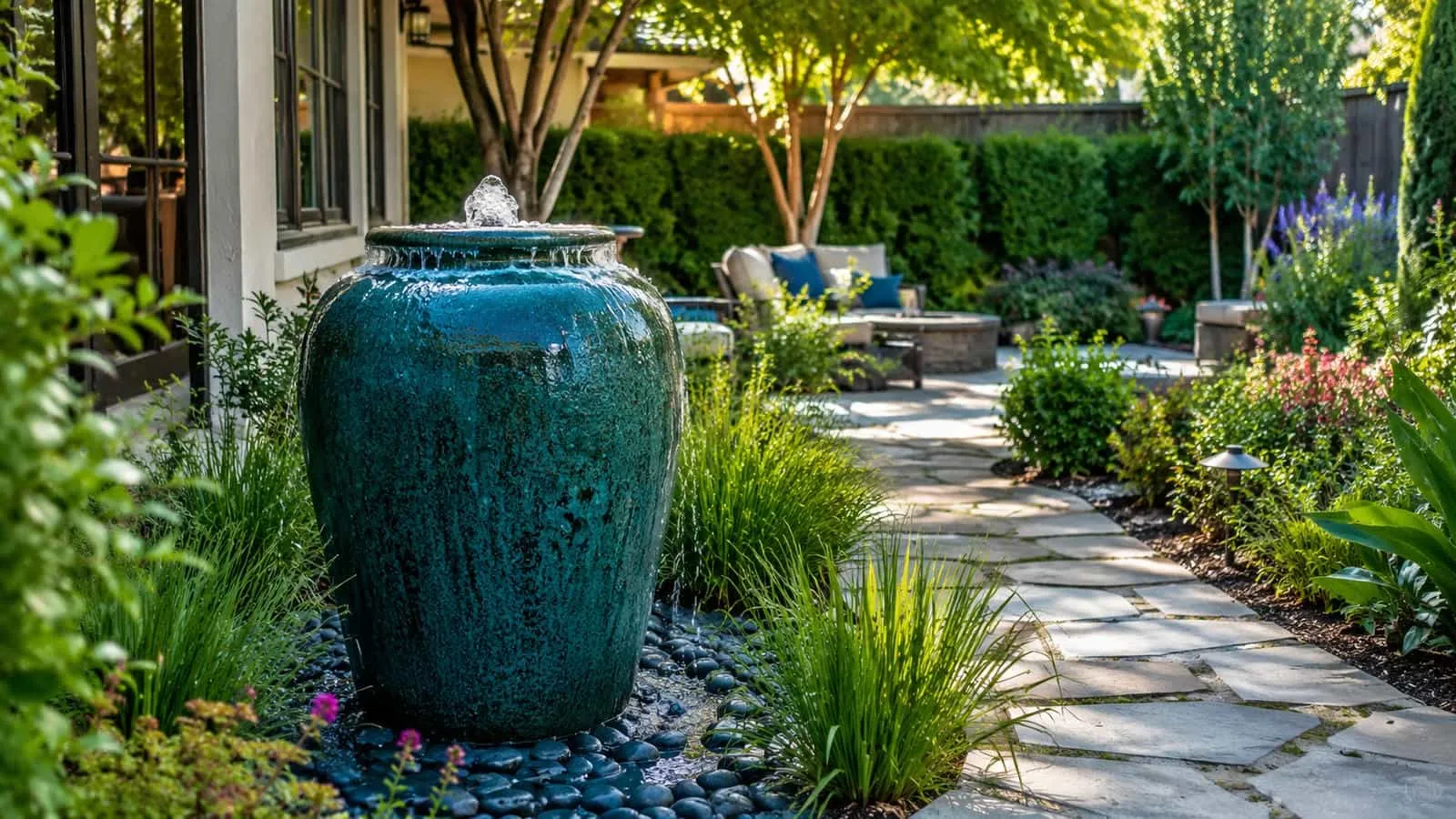
🏺⛲ A successful urn water fountain is more than a decorative pot with water coming from the top. The urn height, width, opening, shoulder shape, surface texture, material, pump output, tubing, reservoir and surrounding catch area all affect how the water rises, travels, sounds and returns to the system. A smooth glazed ceramic urn can create a very different water pattern from a rough stone look vessel, while a tall narrow urn creates different pump and scale demands than a broad rounded fountain. Use this guide to compare bubbling urn fountains, pondless systems, materials, sizes, placement, water sound, pumps, installation, landscaping and cold weather care before choosing the right fountain for your space.
Explore urn water fountain ideas for patios, garden beds, front entrances and backyard retreats. Compare bubbling and overflowing urns, fountain size, placement, sound, ceramic and stone look materials, garden landscaping, pumps and hidden reservoirs before choosing an outdoor water feature. Select any image below to explore that section of the guide.


An urn water fountain works best when the decorative vessel and the water system are chosen together. Urn height, width, opening, surface texture and surrounding catch area all influence how the fountain looks and performs. A smooth glazed ceramic urn may encourage water to sheet across the surface, while a textured stone look urn can break the same flow into rivulets and droplets, changing both the visual effect and the sound.
Start with the space and desired water movement rather than color alone. A small patio may suit a compact bubbling urn with gentle flow, while a front entrance or larger garden can support a taller architectural urn or broader vessel with stronger overflowing water. Quiet bubbling works well near conversation and reading areas, while water that travels farther down the urn or drops onto decorative stone can create a stronger outdoor fountain sound.
Many outdoor bubbling urn fountains use a hidden reservoir beneath decorative stone or gravel. A submersible pump moves water through tubing inside the urn, water exits at the top and then returns to the concealed basin. The reservoir and catch area can be wider than the urn itself, so the true installation footprint matters beside patios, paths and steps. Before choosing the location, consider wind, drainage, walking clearance, electrical access and pump maintenance. Our water fountain placement and spacing guide covers these site decisions in greater detail.
Material, maintenance and climate should also influence the final choice. Glazed ceramic, cast stone, concrete and lightweight composite urn fountains differ in weight, water behavior, weather exposure and winter care. An urn is also only one type of outdoor water feature. If you are still comparing urns with tiered fountains, bubbling rocks, wall fountains or birdbath designs, explore our water fountain types comparison guide before narrowing your choice.
A successful urn fountain balances the decorative vessel with the water system beneath it. The best design looks proportional in the landscape, produces the type of water movement and sound you want, keeps returning water inside the catch area and leaves practical access to the pump, tubing and reservoir.
Use these five planning principles before choosing an outdoor urn water fountain.
When urn shape, water flow, pump performance, reservoir size, placement and climate work together, the fountain feels intentional rather than decorative only. That is the standard to use throughout this guide.

✅ Best For: Urn water fountains are especially well suited to patios, courtyard gardens, front entrances, garden beds, walkway focal points, pergola areas, backyard retreats and landscapes where you want vertical form and moving water without the visual weight of a large exposed fountain basin.
The best urn water fountain is not simply the most attractive vessel. Choose one whose size fits the space, whose water movement produces the sound and appearance you want, and whose material, pump, reservoir and catch area suit the installation. Start with the location and desired experience, then compare urn shape, flow, materials and fountain systems.
An urn water fountain works by recirculating water from a reservoir through a submersible pump and tubing to an outlet near the top of the vessel. The water bubbles, overflows or travels down the urn, then returns to a visible basin or hidden reservoir where the pump sends it through the system again.

The basic water path is simple: reservoir → pump → tubing → urn outlet → vessel surface → reservoir. A submersible fountain pump sits in the water supply and pushes water upward through tubing hidden inside the urn. Water reaches an opening near the top, then bubbles, overflows or spreads across the vessel before returning to the lower basin.
This continuous loop is why most urn fountains do not need a constant supply of new water. The same water is reused until some is lost through normal evaporation, splash or wind. The reservoir only needs occasional refilling so the pump remains safely submerged.
Urn water features generally use one of two layouts. A self-contained urn fountain stores water in a visible or built-in basin and usually keeps the pump within the fountain structure. This style can work well on patios and other areas where digging for an underground basin is unnecessary.
A pondless or disappearing urn fountain hides the reservoir below the vessel. Water flows down the urn, disappears through river rock or decorative gravel and collects in a concealed basin. This creates the appearance of water vanishing into the landscape while still operating as a closed recirculating system. For deeper planning around disappearing water features, reservoir systems and hidden basins, see our pondless water fountain planning guide.
The hidden reservoir does much more than store water. It supports the pump, provides operating water capacity and receives every drop returning from the urn. A structural grate or fountain basin cover supports the vessel and decorative stone while allowing water to pass through into the reservoir below.
The catch area is especially important with overflowing urn fountains. The visible urn may be only two feet wide, but water can travel farther as it follows the rounded shoulders, breaks into droplets or moves in the wind. If the hidden basin footprint is too narrow, water lands outside the recirculating system and the fountain appears to lose water rapidly even though the reservoir itself is not leaking.
The pump supplies the energy that creates the water display. Water moves through tubing inside the urn and exits through a bubbler, fitting or opening near the top. Taller urns require the pump to lift water farther, while narrow tubing, fittings and outlet restrictions can reduce the amount of water that actually reaches the top.
Pump strength should therefore match the desired water pattern, not simply the decorative vessel. A small bubbling urn may need only restrained delivered flow, while a broad urn designed to overflow evenly across the rim may require more water. Adjustable flow is valuable because it lets the finished fountain be tuned for appearance, sound and splash control.
A successful urn fountain must return nearly all of its moving water to the reservoir. Pumping water upward is only half of the system. The vessel shape, level foundation, pump flow, catch footprint, decorative stone and wind exposure determine whether the water actually makes it back.
This is one of the most useful ways to diagnose an urn fountain that needs frequent refilling. Before assuming there is a leak, watch the entire water path. Check whether one side of the urn receives more flow, whether droplets are landing outside the basin and whether wind is moving water beyond the decorative stone. A small adjustment to level or flow can sometimes correct the problem.
⚙️ Urn Fountain System Rule: Do not evaluate only the decorative urn. A dependable bubbling or pondless urn fountain depends on the complete recirculating loop, including the pump, tubing, top outlet, reservoir capacity, structural support and the area where water returns below the fountain.
Section Summary Snapshot: An urn water fountain recirculates water from a reservoir through a pump and internal tubing to an outlet near the top of the vessel. The water then bubbles or overflows down the urn and returns to a visible or hidden basin. Reliable operation depends on adequate reservoir capacity, matched pump flow, a level vessel and a catch area wide enough to return the moving water to the system.
Urn fountain styles differ mainly in how water leaves the vessel and travels across or away from it. Bubbling urns create gentle movement, overflowing urns send water over the rim, textured vessels break flow into rivulets, spouting urns create stronger vertical movement, and cascading or multi-urn designs add layered water motion and sound.
The term urn fountain describes the vessel form, but it does not fully describe the water behavior. Two urns of similar size can produce very different effects because opening width, rim design, shoulder shape, surface texture and pump flow change how water leaves the vessel and returns to the reservoir.
That makes water movement one of the best ways to compare urn fountain styles. The pattern affects appearance, sound, splash, water loss and catch-area requirements, so choosing the water behavior first often makes the final vessel decision easier.
Bubbling urn fountains keep most water movement near the top of the vessel, making them well suited to patios, small gardens and quiet seating areas. Lower bubble height usually means softer sound, less splash and easier water containment.
Water rises through the top opening and may barely crest the rim or spread a short distance across the urn. Adjustable flow is especially useful because small changes affect bubble height, surface coverage, sound and splash.
Overflowing urn fountains send water over the rim and down the vessel. Smooth glazed ceramic can encourage a thin continuous sheet, while broader shoulders spread the flow farther around the urn and increase the catch area needed below.
This style creates more visible movement than a restrained bubbler because a larger portion of the urn becomes active. It works especially well in contemporary, Mediterranean and courtyard settings where moving water highlights the vessel finish.
Textured urn fountains divide water into rivulets and droplets as flow follows grooves, rough surfaces and small irregularities. This creates a more natural-looking pattern and often a more distinct trickling sound than smooth glazed sheet flow.
Cast stone, rough ceramic and stone-look urns can redirect the same water volume into many narrow paths. Because the return pattern is less uniform, these designs benefit from adjustable flow and enough reservoir coverage around the widest part of the urn.
🔎 Specialty Urn Fountain Styles: The designs below cover stronger vertical water, grouped vessels, disappearing reservoirs and closely related vessel-fountain terminology.
Spouting urn fountains create a concentrated stream or vertical jet, while open-bowl urns retain a visible water surface near the top. Both create stronger visual movement than a low bubbler and can produce more noticeable splash and sound.
Spouting designs are easier to see from farther away but are more exposed to wind. Open-bowl urns create a more traditional garden appearance and may resemble classical pottery or amphora-style fountains.
Cascading and multi-urn fountains use two or more vessels at different heights so water moves between them or several urns operate as one coordinated feature. These arrangements create layered movement and greater visual presence than a single urn.
Triple urn fountains work especially well in courtyards and larger garden beds. The main planning issue is the complete collection area because returning water may come from several vessels and directions.
Pondless urn fountains hide the reservoir beneath decorative stone so returning water appears to disappear into the landscape. Architectural urns may be integrated with walls, entrances, masonry or formal hardscape.
These designs remove the need for an exposed lower pond while keeping the urn as the focal point. Reservoir capacity, foundation support, drainage and pump access still need to be planned as part of the complete system.
Urn fountain, vase fountain, jar fountain, pot fountain, planter fountain and amphora fountain are closely related terms. They usually describe vessel shape or styling rather than completely different recirculating fountain systems.
A tall narrow vessel may be sold as a vase fountain, a rounded form as an urn or jar fountain and a classical handled design as an amphora fountain. Compare actual size, material, water movement, pump and reservoir design instead of relying on the marketing name alone.
| 🏺 Urn Fountain Style | 💧 Water Movement | 🎧 Typical Sound | 💦 Splash Tendency | 🌿 Best Setting |
|---|---|---|---|---|
| Bubbling Urn | Gentle water rising near the top | Soft and close range | Low | Patios, reading areas and small gardens |
| Overflowing Glazed Urn | Water sheets down smooth surfaces | Soft continuous trickle | Low to moderate | Courtyards, entrances and contemporary gardens |
| Textured Trickling Urn | Rivulets and droplets | More distinct trickling | Moderate | Natural and cottage-style landscapes |
| Spouting Urn | Vertical or concentrated stream | Stronger and brighter | Moderate to higher | Larger gardens and visible focal points |
| Cascading Multi-Urn | Water moves between several vessels | Layered sound | Moderate | Courtyards and larger landscape beds |
| Pondless Urn Fountain | Water disappears into a hidden reservoir | Depends on flow and landing surface | Depends on catch area | Patios, entrances and modern gardens |
💧 Urn Fountain Style Rule: Choose the water movement before the decorative finish. Bubbling, sheeting, trickling, spouting and cascading fountains can have very different sound, splash, pump and reservoir requirements even when the vessels appear similar.
Section Summary Snapshot: Urn fountain styles are defined by both vessel shape and water behavior. Bubbling urns provide gentle movement, smooth glazed vessels encourage sheet flow, textured surfaces create rivulets, spouting designs add stronger vertical movement and multi-urn groups create layered flow. Compare water pattern, splash, sound and reservoir coverage before choosing the style that best fits your outdoor space.
The best urn water fountain depends on where it will go, how much water sound you want, available installation space, reservoir size, material, pump access and seasonal care. Use these eight real-world urn fountain scenarios to quickly match bubbling, overflowing, pondless, ceramic and DIY designs to patios, entrances, gardens and backyard living spaces.
Start with the homeowner problem rather than choosing an urn by color or shape alone. The scenarios below are designed as rapid decision support, connecting the fountain style, water movement and mechanical system to the conditions that matter most in each setting.
Open the situation that most closely matches your outdoor space. Each scenario identifies the best urn style, the main water or installation priority and the mistake most likely to cause problems.
Best choice: Compact glazed bubbling urn with gentle adjustable flow
A small patio needs vertical interest without sacrificing seating or walking space. A narrow or moderately rounded urn works well when the top bubble stays controlled and the hidden reservoir fits comfortably within the available footprint.
⚠️ Watch For: A small visible urn may still require a wider hidden reservoir than expected.
Best choice: Medium or tall architectural urn with controlled overflow
Front entrances benefit from strong vertical form, but the urn should not crowd steps, doors or the normal visitor route. Match the finish to the architecture and keep water movement controlled around paving.
⚠️ Watch For: An urn that looks proportional from the street can still feel oversized beside the doorway.
Best choice: Rounded bubbling urn with low flow and limited water drop
Quiet seating areas usually work best with water that stays close to the vessel. A restrained bubble and smooth glazed surface can create a softer continuous trickle without overpowering conversation, birds or reading.
⚠️ Watch For: More pump flow does not automatically create more relaxing sound.
Best choice: Broad overflowing or textured urn with stronger controlled water movement
A yard exposed to traffic or neighbourhood noise may benefit from more acoustic presence. Broader urns, textured surfaces and controlled water landing on decorative stone can create stronger, more noticeable water sound.
⚠️ Watch For: Excessive flow can increase splash and refill demand without adding useful sound.
Best choice: Ceramic or textured urn over a hidden reservoir
A pondless urn works well in planting beds because the water storage disappears below decorative stone. Keep planting low around the vessel and preserve direct access to the pump and reservoir opening.
⚠️ Watch For: Mature plants can eventually hide the urn or block maintenance access.
Best choice: Glazed ceramic urn with concealed reservoir and compact catch area
A pondless ceramic setup keeps the vessel as the main visual feature while decorative gravel hides the basin. Moderate sheet flow can highlight glaze color and shape without introducing a broad exposed pool.
⚠️ Watch For: Attractive ceramic still requires planning for mineral buildup and freezing weather.
Best choice: Weather-appropriate urn with easy drainage and accessible pump
Cold-climate owners should plan winter care before buying. The vessel and tubing need a dependable drainage strategy, while the pump should be easy to remove or protect. Lightweight composite urns may simplify seasonal handling where protected storage is available.
⚠️ Watch For: Trapped water inside the vessel or tubing can create serious freeze damage.
Best choice: Structurally sound vessel matched to suitable pump, tubing and reservoir
A decorative planter can become a distinctive DIY urn fountain when it can safely accept tubing, sealing and water exposure. Check cracks, drainage holes, structural strength and the reservoir plan before modifying the vessel.
⚠️ Watch For: A rare or expensive planter may not be worth risking for a DIY conversion.
Start with the conditions that are hardest to change: available space, viewing distance, desired sound, climate and reservoir footprint. Then choose the urn shape, material and water movement that fit those limits.
✅ Scenario Engine Recommendation: If two scenarios fit, combine their practical requirements. A small patio in a cold climate, for example, may need the compact size and gentle flow of the patio scenario together with the drainage, material and winter-access priorities of the cold-climate scenario.
Urn fountain size is easy to misjudge because product listings often emphasize height, yet height is only one part of the finished water feature. A tall narrow vase fountain can feel lighter and occupy less visual space than a shorter rounded urn with broad shoulders and a large diameter.
A better comparison separates visible height, visual mass and installation footprint. Visible height tells you how tall the fountain stands. Visual mass describes how substantial the urn appears because of body width, shoulder width, shape, color and texture. Installation footprint includes the urn base, decorative stone, water return area and hidden reservoir below.
Viewing distance also changes the decision. A compact bubbling urn can feel substantial beside patio seating but disappear when viewed across a large backyard. The best size is the one that remains balanced from the places where the fountain will actually be seen.
There is no universal small, medium or large urn fountain measurement that fits every property. Judge the fountain against surrounding hardscape, available negative space, viewing distance, mature planting and the working reservoir footprint rather than relying on urn height alone.
| 🏡 Outdoor Setting | 👁️ Viewing Distance | 📐 Recommended Presence | 🏺 Urn Shape That Fits | Size Planning Guidance |
|---|---|---|---|---|
| Small patio or seating area | Close | Small to moderate | Tall narrow or compact rounded urn | Preserve room around chairs, doors and walking routes. Narrow vertical forms provide visual height without excessive floor space. |
| Front entrance or courtyard | Close to moderate | Moderate | Architectural, glazed or slim vessel urn | Use enough height to create a focal point while keeping the widest part of the urn and return area clear of steps and paths. |
| Typical garden bed | Moderate | Medium | Rounded ceramic or stone-look urn | Plan around mature plant height so the fountain remains visible after grasses, shrubs and perennials fill in. |
| Large backyard garden | Moderate to long | Medium to strong | Broad-bodied or tall sculptural urn | Use enough width, silhouette or visible water movement for the fountain to remain recognizable from farther away. |
| Open landscape focal point | Long | Strong | Large urn or grouped vessels | Choose enough visual mass to anchor the open space without overwhelming surrounding architecture and planting. |
👀 Garden Delights Urn Scale Test: Mark the full reservoir and decorative stone footprint on the ground, then use a stake, box or temporary object to represent the urn height and widest body dimension. View it from the patio, windows, pathways and seating areas before choosing the final fountain size.

Use the planning factors below to compare urn size more accurately. Each one changes either how large the fountain looks or how much physical space the complete installation requires.
Judge urn fountain size by height, maximum body diameter, shoulder width and visual mass rather than height alone. Tall narrow urns usually feel lighter, while shorter broad-bodied vessels can occupy considerably more visual and physical space.
Shape changes perceived size because the widest part of the urn often creates the strongest silhouette. Broad shoulders spread visual weight horizontally, while narrow vase forms preserve more negative space around the fountain.
Finish also matters. Dark textured surfaces can appear heavier than pale smooth glaze, and water covering much of the vessel can make the complete fountain appear larger than the same urn operating with a restrained top bubble.
📐 Visual Mass Tip: Compare both height and widest body dimension before buying. Those two measurements give a more realistic impression of fountain scale than height alone.
A compact urn can feel substantial when viewed from a few feet away but visually disappear across a large garden. Longer viewing distances usually require greater body width, stronger contrast, a clearer silhouette or more visible water movement.
Close patio views allow smaller bubbling urns to work well because color, texture and water movement are experienced at short range. Across a larger backyard, surrounding plants, furniture and landscape structures compete for attention, so the urn needs enough visual presence to remain readable.
Check important indoor views as well. If the fountain should be visible from a kitchen or living room window, evaluate the proposed height and width from that real sightline before installation.
A pondless urn fountain often requires substantially more space than the visible vessel suggests. The hidden reservoir, structural grate, decorative stone, pump chamber, service opening and water catch area all contribute to the true installation footprint.
This matters most beside paths, patio edges and narrow garden beds. An urn may physically fit the visible opening while leaving too little room for the basin, returning water or maintenance access.
Measure the actual reservoir first, then confirm that decorative stone extends far enough around the vessel to collect normal overflow. Keep the pump access opening reachable without moving the urn or dismantling permanent hardscape.
Plan urn fountain scale around mature landscaping rather than nursery-sized plants. Shrubs, grasses and perennials can eventually hide the vessel, block water movement and restrict service access if the fountain is sized and positioned only for the garden's first season.
Keep lower plants near the base, medium plants beside the urn and taller shrubs or grasses behind it. This preserves the fountain silhouette while allowing planting to frame the water feature naturally.
Background contrast also affects perceived scale. Light ceramic or pale cast stone urns stand out against darker planting, while darker glazed or stone-look fountains can read more clearly against pale siding, gravel or masonry.
🌿 Mature Landscape Tip: Leave enough open space for the urn to remain visible and serviceable several years after the surrounding planting reaches its mature height and spread.
Fountain scale is partly visual. A restrained top bubble concentrates movement near the opening, while stronger overflow makes more of the vessel visually active. Water spreading across broad shoulders or down the sides can make the same urn feel larger and more prominent.
Smooth glazed urns may create a continuous sheet that emphasizes the full silhouette, while textured stone-look vessels break water into rivulets and droplets across a wider area. Consider the planned water movement when deciding how much visual presence the finished fountain will have.
✅ Best Size Rule: Do not choose the tallest urn that fits. Choose the fountain whose height, width, shoulder shape, water movement and reservoir footprint leave enough negative space for the patio, garden, architecture and surrounding plants to remain visually balanced.
Section Summary Snapshot: Choose urn water fountain size by comparing visible height, maximum diameter, shoulder width, visual mass, viewing distance, mature planting, water movement and the complete hidden reservoir footprint. A tall narrow urn can work beautifully in a compact space, while a shorter broad vessel may need considerably more room. Judge the complete fountain from real viewing positions before buying.
The best place for an urn water fountain is where it can be seen and heard without crowding seating, pathways or entrances. Strong locations include patio corners, garden beds, courtyards, walkway turns and front entrances. Also check seating distance, wind, splash, drainage, outdoor power, mature planting, window views and pump access before installation.
Urn fountain placement should begin with the way the space is actually used. A fountain near seating should be close enough for water sound to reach listeners without placing splash, pump noise or constant movement directly beside a chair. A fountain farther into the garden needs a clearer sightline and enough visual presence to remain noticeable from the house or patio.
The location also affects everyday operation. Wind can carry water outside a hidden reservoir, nearby trees can increase debris, direct sun can increase evaporation, and dense planting can restrict access to the pump. Good placement balances appearance, sound, water containment and maintenance instead of solving only one of those needs.
Outdoor urn fountains work in many settings because their vertical shape creates a focal point without requiring a large visible pond. Compare each location by viewing distance, seating distance, splash exposure, walking clearance, reservoir space and service access before deciding where the urn belongs.
| 📍 Placement Area | 👁️ Visual Role | 🎧 Sound Relationship | Best Placement Guidance |
|---|---|---|---|
| Patio Corner | Vertical focal point near outdoor living | Close listening distance | Keep the fountain clear of chairs, doors and main walking routes while containing returning water inside the reservoir area. |
| Front Entrance | Arrival and curb appeal focal point | Controlled background water sound | Protect steps, paving, the front door and normal visitor movement while keeping the urn visible from the approach. |
| Garden Bed | Layered landscape feature | Sound blends with planting and open space | Use lower plants near the urn and taller plants behind it while preserving reservoir and pump access. |
| Walkway Bend | Destination or discovery point | Water may be heard before seen | Keep decorative stone, splash and planting outside usable path width. |
| Courtyard | Central or offset architectural feature | Walls can strengthen water sound | Use controlled flow and enough negative space so the urn does not overwhelm the enclosed setting. |
| Open Garden Focal Point | Long-distance landscape anchor | More visible water can add acoustic presence | Choose a clear backdrop and enough urn scale for the fountain to remain recognizable from the main viewing distance. |
👀 Garden Delights Placement Walk: View the proposed urn location from the house, patio, main seating area, path and entrance. Then walk toward it. A strong location should remain attractive from several important angles without blocking movement or creating obvious maintenance problems.
Front entrance urn fountains need a slightly different balance than backyard or patio installations because they are viewed from the street, driveway, walkway and front door. House scale, curb appeal, path clearance and controlled splash all become more important in this setting. For entrance-specific examples, see our front yard water fountain ideas.
Keep enough open space around the urn for its silhouette and moving water to remain readable. Dense shrubs or tall grasses can hide even a well-sized fountain when viewed from farther away. Background contrast can help without increasing fountain size: light stone stands out against dark foliage, while charcoal or cobalt urns can read clearly against pale siding or masonry.
Check the fountain from the views that matter most before installation. If the urn disappears behind plants, furniture or another landscape feature, adjust the position or backdrop before assuming a larger fountain is necessary.
Wind direction can turn a well-contained urn fountain into a high-refill feature. Water traveling across broad shoulders or breaking into droplets is more vulnerable to crosswind than restrained bubbling close to the vessel.

Centered placement works best where architecture, a courtyard or straight path creates a strong visual axis. Offset placement often feels more natural beside curved paths, patios and asymmetrical garden beds where the urn needs to balance the landscape rather than occupy its mathematical center.
A tall architectural urn can work beautifully at the end of a formal path, while the same vessel may feel forced in an informal garden. Use the visual center created by furniture, pathways, windows and planting rather than measuring only the physical center of the space.
Keep garden planting low enough around the urn to show the vessel and moving water while using taller plants behind it for framing. Plan around mature plant size so shrubs, grasses and perennials do not eventually hide the fountain or block access to the reservoir.
Decorative gravel, river stone and restrained planting can soften the basin edge without covering the water return area. Leave at least one practical side open for refilling, pump access and seasonal maintenance.
Place a patio urn fountain close enough for water sound to reach seating but far enough away that splash, pump noise and constant movement do not dominate conversation. The ideal distance depends on flow strength, walls, wind and background noise.
Gentle bubbling can usually sit closer to chairs than stronger overflowing water. Evaluate the location while seated and during the time of day the patio is normally used, because traffic, neighbours and wind can change how the fountain sounds. For broader planning around furniture clearance, outdoor dining, pergolas and seating areas, explore our patio water fountain placement ideas.
Position an urn fountain where it can also be enjoyed through important windows when possible. Check sightlines from kitchens, dining areas, living rooms and entrances so the vessel remains visible without blocking a valued garden view.
Indoor views matter even when the fountain is turned off for winter. The urn, stone and surrounding planting should still create an attractive composition without relying on moving water.
📍 Urn Fountain Placement Rule: Choose the location where the vessel looks balanced, the water can be seen and heard, splash remains contained, paths stay open, drainage and outdoor power are practical, mature plants will not hide the fountain and the pump and reservoir remain easy to reach.
Section Summary Snapshot: Place an urn water fountain where sightlines, seating distance, sound and landscape balance work without crowding paths, furniture or entrances. Check prevailing wind, splash return, drainage, outdoor power, reservoir access, mature planting and important window views before installation. The best placement makes the fountain easy to experience, easy to maintain and naturally connected to the surrounding outdoor space.
Urn fountain sound comes from the complete water path rather than the pump alone. Gentle bubbling stays quiet, smooth water moving over glazed ceramic creates a softer continuous trickle, textured surfaces break flow into more distinct rivulets, and water falling onto decorative stone creates stronger splash notes. Urn shape, surface texture, flow and drop distance determine the final sound.
Urn fountains sound different from tiered fountains or waterfalls because much of the water may remain in contact with the vessel. Water rises from the top opening, spreads across the shoulders, travels down the urn and then returns to stone or a hidden reservoir. Each stage changes the sound.
The urn therefore acts as part of the sound-producing system. Opening size affects the top bubble, shoulder shape affects how water spreads, surface texture controls whether water stays together or breaks into rivulets, and the final drop determines how strongly returning water can be heard.
| 💧 Water Movement | 🎧 Sound Character | 🏺 How the Urn Creates It | ⚙️ Main Control |
|---|---|---|---|
| Gentle top bubble | Quiet and close range | Water rises only slightly and remains near the top opening. | Low pump flow and bubble height |
| Smooth glazed overflow | Soft continuous trickle | Water remains attached to smooth ceramic while traveling down the vessel. | Even shoulder flow and surface coverage |
| Textured urn flow | Varied trickles and droplets | Surface irregularities divide the water into smaller rivulets. | Texture and delivered water volume |
| Water leaving the urn | Brighter and stronger splash | Water separates from the vessel and falls through open air. | Drop distance and flow |
| Water landing on stone | Crisp broken splash | Returning droplets strike gravel or decorative rock above the reservoir. | Stone surface and exposed drop |
Urn shape controls the route water follows. A narrow opening concentrates the top bubble, broad shoulders spread water outward and a rounded body may encourage water to separate farther from the vessel before returning below.
That is why two urn fountains with similar pumps and height can sound different. A narrow vase-style urn may keep most water close to the surface and remain relatively quiet, while a broad rounded urn can produce more exposed droplets near its widest point and create stronger sound at the base.
🏺 Shape and Sound Tip: If an urn produces less sound than expected, inspect the water path before assuming it needs a larger pump. The vessel may simply be keeping most of the water attached to its surface.
Smooth glazed ceramic allows water to travel with fewer interruptions, so moderate flow can form a more continuous film and create softer, more uniform sound. This works well on patios and quiet courtyards where the visual movement of water matters more than acoustic strength.
Rough cast stone, concrete and textured stone-look urns divide water into smaller paths. Rivulets split and reconnect as they move down the surface, producing more varied trickling and individual droplets without necessarily requiring much more pump output.
Urn fountain sound can often be tuned without replacing the fountain. Make small adjustments and listen from the actual seating or viewing area so improvements in sound do not create excessive splash or water loss.

Mechanical noise should be separated from desirable water sound. Pump vibration can create humming, while sputtering may result from low reservoir water, restricted pump intake or air entering the water line. Uneven overflow can also create one loud side and one nearly dry side.
Harsh splashing often means too much water is separating from the urn or falling too far before reaching the reservoir. Reduce flow gradually and confirm that the vessel is level. A slight tilt can concentrate water on one side, increasing noise, splash and water loss.
If the pump or tubing touches a hard reservoir wall, vibration can travel through the fountain. Keep the pump submerged and isolated from hard contact so mechanical hum does not overpower the softer water sound.
🎵 Urn Fountain Sound Test: Listen from the place where you will normally sit rather than only beside the fountain. Adjust the flow until the water is clearly audible without overpowering comfortable conversation or sending unnecessary splash outside the return area.
If fountain sound is a major part of your outdoor planning, our water fountain sound and flow guide covers listening distance, environmental noise, water drop, receiving surfaces and acoustic comfort in greater detail. This section stays focused on the urn-specific relationship between vessel shape, surface texture, water attachment and the final return drop.
Section Summary Snapshot: Urn fountain sound depends on how water rises from the opening, spreads across the shoulders, travels over the vessel and returns to the reservoir. Gentle bubbling and smooth glazed flow stay softer, while textured surfaces, separated droplets and water landing on stone create stronger acoustic detail. Adjust flow, bubble height and drop distance without creating excessive splash or mechanical noise.
The best urn fountain material depends on appearance, weight, water movement, climate and maintenance. Glazed ceramic creates rich color and smooth sheeting water, while cast stone and concrete provide substantial weight and textured flow. GFRC, resin and fiberglass can create larger stone look urns with less weight. Surface finish matters because it changes how water travels down the vessel.
Material is especially important with an urn water fountain because the vessel becomes part of the water display. Water does not simply fall from one bowl to another. It may spread across the shoulder, cling to the body, divide into narrow streams or break into droplets before returning to the reservoir. The surface it travels across can therefore change the appearance and sound of the same pump flow.
Weight matters too. A large cast stone or concrete urn can provide excellent stability and visual permanence, but it needs a dependable foundation and may be difficult to reposition after installation. A similarly sized GFRC, fiberglass or resin urn can provide substantial visual scale with much less physical weight, which can make installation and seasonal handling easier.
| 🪨 Urn Material | 🎨 Visual Character | ⚖️ Weight | 💧 Water Interaction | ❄️ Climate and Maintenance |
|---|---|---|---|---|
| Glazed Ceramic | Rich color, reflective glaze and strong decorative character | Moderate to heavy depending on vessel size | Smooth glaze often helps water cling and spread into more continuous sheets | Mineral deposits can be visible on dark glaze, and freezing conditions require careful winter planning |
| Fired Pottery or Terracotta | Warm Mediterranean, cottage and traditional garden character | Moderate | Less polished surfaces can create softer irregular water paths | Porosity and freeze exposure deserve special attention, especially where trapped moisture can freeze |
| Cast Stone | Substantial, architectural and traditional stone appearance | Heavy | Textured surfaces can divide water into natural looking rivulets and droplets | Requires a strong level base and careful cold weather protection from trapped water |
| Concrete | Solid, understated and suitable for traditional or modern landscapes | Heavy | Surface texture can produce broken trickling rather than perfectly smooth sheeting | Stable once installed but difficult to move, with freeze and moisture management important in cold climates |
| GFRC | Can reproduce concrete and stone forms with thinner sections and detailed finishes | Lighter than conventional solid concrete | Water behavior depends largely on the final surface texture and coating | Useful when substantial urn scale is wanted without the full weight of traditional concrete |
| Fiber Resin or Fiberglass | Available in stone look, ceramic look and contemporary finishes | Light to moderate | Molded texture can imitate stone while smoother finishes support more even water movement | Easier to move and winterize, although long term durability depends heavily on construction quality |
| Natural Stone | Authentic texture, variation and strong landscape presence | Very heavy | Natural irregularities create unique rivulets and broken water paths | Excellent for permanent installations but may require substantial support and professional handling |
| Metal or Copper | Architectural, contemporary or aged patina character | Varies by construction | Smooth metal can create clean flowing water while shaped surfaces alter the water path | Finish changes, water spotting and heat from direct sun may affect appearance and care |
| The best urn fountain material is the one that provides the appearance and water movement you want while matching foundation capacity, climate exposure, winter care and the amount of maintenance you are comfortable providing. | ||||
Two urns made from different materials can create noticeably different water patterns even when their size and pump output are similar. A smooth glazed ceramic urn encourages water to stay together and slide across the vessel. When the urn is level and the top outlet distributes water evenly, much of the surface can develop a thin reflective layer that emphasizes the glaze and shape.
Rough cast stone, concrete and textured stone look finishes interrupt that water film. Small ridges, pores and surface changes redirect the flow into separate rivulets. Some streams stay attached to the urn while others divide into droplets. This creates a more natural looking water pattern and can also produce a more varied trickling sound.
Problem A homeowner chooses an urn for its color but expects the water to move like it did on a different fountain.
Why it happens Glaze, texture, shoulder shape and surface irregularities change how water spreads and separates.
Solution Evaluate both the urn material and its surface finish when deciding whether you want smooth sheeting water, irregular trickles or more visible droplets.
Material color affects how easily normal fountain deposits can be seen. Dark cobalt, charcoal and black glazed urns can make pale mineral residue highly noticeable as water evaporates from the surface. Light stone finishes may hide some pale deposits more effectively, although algae and darker organic staining can become easier to see.
This does not necessarily make one material lower maintenance than another. It changes what maintenance is visually noticeable. A fountain chosen for a flawless glossy finish may need more frequent surface wiping than a textured stone look urn where minor marks blend into the material. Consider the appearance you expect between cleanings, not only how the urn looks when brand new.
🪨 Material Selection Tip: Choose the surface behavior as carefully as the material name. If you want smooth reflective water traveling across the complete urn, look toward a consistent glazed or sealed surface. If you prefer broken rivulets, droplets and a more natural stone character, a textured finish may produce the better water display.
For a broader comparison of fountain materials, including structural weight, durability, weather exposure and long term care across many fountain styles, use our water fountain materials and durability guide . The important distinction for an urn water fountain is that the material and surface finish directly influence the visible water path across the vessel.
Section Summary Snapshot: Urn fountain materials affect weight, visual style, water movement, maintenance and climate suitability. Glazed ceramic can create colorful reflective surfaces and smoother water flow, while cast stone and concrete produce heavier architectural forms and more textured rivulets. GFRC, resin and fiberglass reduce weight for larger vessels. Compare surface finish, foundation needs, mineral visibility and winter care before choosing.
An urn fountain pump must deliver enough water after lifting it from the reservoir to the outlet at the top of the vessel. Urn height, tubing diameter, outlet size and desired bubbling or overflowing water pattern all affect delivered flow. A properly matched hidden reservoir keeps the pump submerged, catches returning water and provides accessible space for flow adjustment and maintenance.
The mechanical system of an urn water fountain is simple in concept, but the components must be matched correctly. In a typical pondless urn fountain, a submersible pump sits inside a hidden water reservoir below the decorative stone. The pump pushes water through tubing that rises inside the vessel. Water reaches the top outlet, bubbles or overflows across the urn and then returns through the surrounding stone to the reservoir.
The important measurement is not only the pump's advertised flow rate. The pump must still deliver useful water after pushing it upward through the urn and overcoming resistance in the tubing, fittings and outlet. A tall vase fountain therefore places different demands on a pump than a short broad vessel, even when both fountains use similar amounts of visible water.
This is why the pump, tubing, outlet and reservoir should be treated as one system. Oversizing one component does not automatically correct a poorly matched system. A powerful pump connected to restrictive tubing may waste capacity, while a large outlet supplied by too little delivered flow may produce weak or uneven water movement.
| 🏺 Urn Fountain Type | ↕️ Pump Demand | 🔄 Tubing and Outlet | 💦 Desired Water Pattern | ⚠️ Main System Concern |
|---|---|---|---|---|
| Small Bubbling Urn | Lower to moderate | Shorter lift with a relatively small outlet | Gentle rounded bubble at the top | Too much flow can create unnecessary splash and water loss. |
| Tall Narrow Urn | Moderate to higher | Longer tubing run and greater vertical lift | Top bubbling or controlled overflow | A pump that looks adequate by GPH alone may deliver too little water at the top of the urn. |
| Broad Glazed Urn | Moderate to higher | Outlet must distribute enough water across the wider shoulder | Smooth sheeting or full surface overflow | Weak delivered flow may wet only part of the vessel instead of creating balanced coverage. |
| Textured Stone Look Urn | Moderate | Flow should support several rivulets without excessive spray | Broken trickling water over the exterior | Too much flow can overwhelm the texture and push water outside the catch area. |
| Large Pondless Urn Fountain | Moderate to high | Larger system may need more tubing capacity and reservoir volume | Strong bubbling, overflow or visible falling water | Pump output, reservoir capacity and catch footprint must all support the larger water display. |
| The correct urn fountain pump is the one that delivers the desired water pattern at the actual outlet after accounting for vertical lift, tubing resistance and the complete recirculating system. | ||||
A hidden reservoir does more than make an urn fountain look pondless. It stores the recirculating water, supports the pump and receives water returning from the vessel. The basin also needs a structural grate capable of supporting the urn and decorative stone while leaving an accessible opening for the pump.
Reservoir capacity affects how forgiving the fountain is between refills. Water is continually lost through evaporation, splash and wind. If the basin holds very little water, a modest drop in level can expose the pump intake or cause the pump to draw air. A larger practical water reserve gives the fountain more operating margin during hot, dry or windy conditions.
The reservoir also has to sit beneath a catch area wide enough to collect the returning water. If water flows beyond the basin perimeter, it is no longer part of the recirculating system. The fountain then appears to be mysteriously losing water even though the pump itself is functioning correctly.
Tubing carries water from the submerged pump through the urn, and its size affects how easily that water can move. Very restrictive tubing, unnecessary bends and small fittings increase resistance. The taller the urn, the more important it becomes to evaluate the complete path rather than selecting a pump by its maximum advertised GPH alone.
Outlet design matters at the other end of the system. A small bubbler opening can create visible movement with relatively modest delivered flow. A wider outlet or broad overflowing top must divide the available water across a larger area. If there is not enough delivered flow, the water may favor one side of the urn instead of spreading evenly across the rim or shoulder.
Adjustable flow is especially useful with urn fountains because a small change in pump output can change the entire display. Lower flow may create a restrained top bubble and quiet sound. Increasing the flow can spread water across more of the vessel, strengthen the sound and create a more dramatic overflow.
The best setting is not automatically the highest setting. Stop increasing flow when additional water creates more splash, wind loss or reservoir demand without improving the appearance. A properly adjusted bubbling urn should keep most returning water inside the designed catch area while producing the movement and sound you actually want.
Pump access should be planned before decorative stone is placed. The service opening needs to remain large enough to reach the pump, intake screen, tubing connection and flow control without moving the urn. A hidden basin is useful only when its mechanical components remain serviceable.
⚙️ Urn Fountain Pump Rule: Choose the water display first, then match the pump, vertical lift, tubing, outlet and reservoir to produce it. Buying a pump only from its maximum GPH rating can be misleading because the actual flow reaching the top of the urn may be considerably lower once the complete system is operating.
For detailed calculations involving GPH, head height, vertical lift, tubing resistance and delivered pump flow, use our urn fountain pump flow and sizing guide . This urn section focuses on how the pump, reservoir, tubing and outlet work together within the complete decorative water feature rather than repeating the full technical pump selection process.
Section Summary Snapshot: A reliable urn fountain system matches the pump to the vessel height, tubing, outlet and desired water pattern while using a reservoir large enough to keep the pump submerged and capture returning water. Adjustable flow allows bubbling and overflow to be fine tuned for sound, appearance and splash control. Keep the pump, valve and service opening accessible so the hidden system remains practical to maintain.
A reliable urn fountain installation begins with a firm level foundation, properly supported reservoir, controlled drainage, safe outdoor power and accessible pump system. The urn must remain level for balanced water flow, while the hidden basin, tubing, decorative stone and service opening should stay reachable for testing, adjustments and future maintenance.

Plan the hidden system before placing the decorative urn. A pondless installation may include a compacted foundation, underground reservoir, structural grate, pump chamber, tubing, flow valve, outdoor electrical connection, decorative stone and water catch area. Once a heavy urn is positioned, correcting problems underneath becomes much harder.
Mark the complete fountain footprint rather than only the urn base. Confirm that the reservoir fits, returning water falls inside the catch area and the pump opening remains accessible. Also check nearby paths, walls and planting before excavation or final landscaping.
| 🛠️ Installation Area | ✅ What to Check | ⚠️ Main Risk | 🏺 Urn Fountain Guidance |
|---|---|---|---|
| Foundation | Level, compacted and load bearing | Settlement or tilted urn | Verify the base before filling or operating the fountain. |
| Reservoir and Grate | Correct position, capacity and load support | Movement, sagging or poor water storage | Support the urn over a load-rated portion of the basin. |
| Tubing | Clear route from pump to top outlet | Kinks or restricted flow | Route tubing before final vessel placement. |
| Drainage | Rain and overflow move away safely | Puddling, erosion or saturated soil | Keep runoff away from paths and foundations. |
| Outdoor Power | Suitable protected electrical connection | Unsafe cords or electrical exposure | Plan the power source before final landscaping. |
| Service Access | Pump, valve and reservoir opening remain reachable | Maintenance requires dismantling the fountain | Keep stone and mature planting clear of the access area. |
Leveling matters especially with overflowing urn fountains because even a small tilt can send most of the water down one side. Uneven flow can create an unbalanced appearance, concentrated splash and water loss outside the reservoir.
Use a firm base capable of carrying the combined weight of the urn, water, reservoir structure and decorative material. Heavy cast stone and concrete vessels place greater demands on supporting soil than lightweight composite urns. Poorly compacted ground can settle later and move the fountain out of level.
📐 Leveling Check: If water suddenly favors one side of the urn, verify the vessel and foundation level before increasing pump flow or replacing mechanical components.
A pondless urn transfers vessel weight through the support grate and reservoir below. Make sure the basin and grate are intended to carry the complete load, including the urn, water and decorative stone.
Keep the service opening separate from the main load whenever the system allows. The access panel should remain removable so the pump can be reached without shifting a heavy urn.
Normal fountain water should return to the reservoir, but rain, cleaning water and occasional overflow still need a safe drainage path. Avoid low areas where water can collect around the basin, soften supporting soil or repeatedly saturate nearby planting.
Grade the surrounding area so excess water moves away from paths, retaining walls and house foundations. Decorative stone helps return fountain water to the basin, but it does not replace proper site drainage.
Most outdoor urn fountains use an electric submersible pump. Plan the power source before excavation and landscaping so cords do not cross walking routes or sit where water regularly collects. If the urn will sit far from an outlet or in a sunny part of the yard, compare the solar vs electric fountain power comparison before committing to the electrical layout.
Use equipment intended for outdoor fountain use and appropriate ground-fault protection. Permanent electrical work or new outdoor receptacles should follow local requirements and be completed by a qualified professional where necessary.
A pondless urn can look completely natural after stone and planting conceal the basin, but the pump, tubing and flow controls still require service. Position the reservoir opening where it can be reached without moving the urn.
Operate the fountain before placing every final stone or completing the surrounding landscape. Fill the reservoir, start the pump and watch the complete water path from the top outlet across the vessel and back into the hidden basin.
🛠️ Urn Fountain Installation Rule: Build and support the hidden system first, test the water second and finish the landscaping last. Confirm foundation level, reservoir support, drainage, pump access and water return before decorative stone makes corrections more difficult.
Section Summary Snapshot: Install an urn water fountain on a firm level foundation with a reservoir and structural grate capable of supporting the complete fountain. Plan tubing, drainage, outdoor power and pump access before setting the vessel, then test water flow, splash and reservoir return before finishing decorative stone. Proper installation keeps the urn stable, balanced and practical to maintain.
Urn fountain landscaping works best when the vessel, water movement, plants and surrounding hardscape feel like one design. Use taller plants behind the fountain, medium plants beside it and low groundcovers or decorative stone near the base. Modern gardens benefit from clean lines, Mediterranean gardens from warm glazed vessels, cottage gardens from softer planting and natural gardens from restrained stone and texture.
A successful garden urn fountain should look connected to the landscape without disappearing inside it. The vessel provides vertical form, color and texture, while moving water adds another layer of visual activity. Plants and hardscape should support those qualities rather than cover the urn or compete with the water. For broader ideas involving flower beds, pathways, plant combinations and complete landscape layouts, explore our garden water fountain design guide.
Start by deciding how much of the vessel should remain visible. A sculptural cobalt ceramic urn may look strongest with generous open space around the body, while a textured stone look urn can blend more naturally into grasses, gravel and larger landscape stone. In both cases, avoid packing plants tightly around the fountain simply because the garden bed has available space.
The finished landscape should also preserve practical access. Keep at least one side of a pondless urn open enough to reach the reservoir, pump or service panel. Good landscaping can conceal the mechanical system without making routine fountain care difficult.
Plant height is one of the simplest ways to control how an urn fountain sits in a garden bed. Use lower plants around the base, medium height plants beside the vessel and taller shrubs or ornamental grasses behind it. This creates depth while preserving the urn silhouette and moving water.
Urn fountains can work in many landscape styles because the vessel itself can range from smooth and architectural to aged and rustic. Match the urn form, finish, water movement and surrounding materials to the character of the garden rather than forcing one decorative style into every setting.
Modern urn fountain landscaping works best with simple vessel shapes, restrained planting, repeated materials and generous negative space. Smooth charcoal, cream or dark glazed urns pair naturally with large pavers, decorative gravel, ornamental grasses and clipped evergreens while controlled bubbling water adds movement without weakening clean contemporary lines.
Keep the material palette limited. A tall cylindrical urn beside large rectangular pavers, gray gravel and repeated grasses often looks stronger than the same fountain surrounded by many unrelated stones, flower colors and garden ornaments. The empty space around the vessel becomes part of the design.
◼️ Modern Urn Fountain Tip: Repeat one or two hardscape materials already used on the patio, walkway or home so the fountain feels architectural rather than added as a separate garden decoration.
Mediterranean urn fountains pair naturally with glazed ceramic, terracotta inspired finishes, warm stone, gravel courtyards and drought tolerant planting. Cobalt, turquoise, cream and earth toned urns can create strong focal points among lavender, rosemary, ornamental grasses and stone paving while bubbling or overflowing water adds cooling movement.
Mediterranean landscapes can support more color than modern gardens, but restraint still matters. One strong glazed urn may create more impact than several competing pottery colors. Warm flagstone, gravel, stucco, masonry and simple iron accents can reinforce the courtyard character without making the area visually crowded.
🌞 Mediterranean Urn Fountain Tip: Let the glazed vessel provide the strongest color, then use warmer neutral hardscape and restrained planting to keep the water feature visually clear.
Cottage garden urn fountains look best when the vessel feels settled naturally among flowers and informal planting. Weathered stone, cream ceramic and softer glazed urns can work beside curved paths, lavender, catmint, roses and flowering perennials when low plants remain near the base and taller flowers stay behind the water feature.
Avoid allowing the relaxed cottage style to become uncontrolled around the fountain. Dense summer growth can hide the vessel, block the water display and make pump maintenance difficult. Keep the immediate base simpler than the surrounding border so the urn still reads as a deliberate focal point.
🌸 Cottage Urn Fountain Tip: Let flowers soften the edges of the installation, but preserve a visible portion of the urn body and one clear service route throughout the growing season.
Natural and Japanese inspired urn fountain landscaping emphasizes texture, restraint and balance. Stone look vessels, weathered finishes and quiet bubbling water work well with river rock, gravel, mossy textures, ferns, dwarf evergreens and carefully spaced plants when enough open space remains around the fountain.
The goal is not to hide the urn completely. Use natural materials to connect it to the setting while preserving a readable vessel shape. Japanese influenced designs often benefit from fewer plant varieties, more open gravel or stone and gentle water movement rather than dense flowering beds or excessive ornaments.
🪨 Natural Urn Fountain Tip: Repeat the color and texture of nearby stone instead of surrounding the fountain with many new materials. A restrained palette usually makes the feature feel more established.
Hardscape visually connects the urn with the surrounding garden and can also help define the water return area of a pondless fountain. River rock creates a softer natural appearance, while pea gravel and decomposed granite work well in casual or Mediterranean settings. Large pavers and clean stone edging support modern designs, while flagstone and cobble can provide a warmer traditional character.
Keep the hardscape proportional to the vessel. A large urn surrounded by only a narrow ring of stone can look unfinished, while an oversized gravel field around a compact fountain may make the urn appear too small. Extend the material far enough to visually anchor the water feature while preserving planting and useful garden space.
🌿 Urn Fountain Landscaping Rule: Frame the urn instead of burying it. Keep low planting and decorative stone near the base, place medium plants beside the vessel and use taller plants behind it. The complete fountain should remain visible, balanced and accessible even after the surrounding landscape reaches mature size.
Section Summary Snapshot: Urn fountain landscaping should connect the vessel, water movement, plants and hardscape without hiding the feature. Modern gardens benefit from clean geometry and negative space, Mediterranean gardens from glazed urns and warm stone, cottage gardens from informal flowers and natural gardens from restrained textures. Use layered planting, appropriate hardscape and open service access to keep the fountain attractive and practical as the landscape matures.
Urn fountain lighting should reveal the moving water and vessel texture without creating glare. The best effects usually come from soft uplighting, side lighting, backlighting or light placed just below the rim. Warm landscape lighting works well for stone and pottery finishes, while carefully aimed light can make glazed ceramic, flowing water and textured urn surfaces stand out after dark.

An urn fountain can look very different at night because light catches the water as it moves over the rim, shoulder and outer surface. During the day, color and material may create most of the visual interest. After dark, the direction of the light becomes more important because it determines whether the urn looks dimensional or flat.
Avoid trying to flood the entire fountain with bright light. One or two carefully placed fixtures often create a stronger effect than several intense lights. The goal is to show enough of the vessel, water and surrounding garden to make the fountain readable without turning it into the brightest object in the yard.
Low uplighting can emphasize raised texture, curves and water trails on cast stone, concrete and stone look urns. Position the fixture slightly off center rather than directly in front so small shadows develop across the surface. This helps rough textures appear deeper while allowing water running down the vessel to catch highlights.
Glazed ceramic urn fountains behave differently because their smoother surfaces reflect more light. A softer side angle can reveal the glaze and water sheen without creating a bright reflection that distracts from the fountain itself.
Water is often easiest to see when light crosses it rather than shining directly toward the viewer. A fixture positioned behind or beside the urn can make the top bubble, thin overflow and separated droplets more visible against a darker background.
Fountain lighting should never shine directly into nearby chairs, dining areas or windows. Check the fixture from the places people normally sit and from important indoor views before finalizing the angle. A light that looks attractive while standing beside the urn may become uncomfortable when viewed from across the patio.
Shielded fixtures, lower mounting positions and narrower aiming angles usually provide better control. Keep cords and electrical components suitable for outdoor landscape use, and plan permanent lighting connections according to local electrical requirements.
💡 Urn Fountain Lighting Tip: Light the water and surface texture, not the fixture. If you notice the lamp before you notice the bubbling water, glaze or stone texture, reduce the brightness or change the angle.
Section Summary Snapshot: Urn fountain lighting works best when it highlights water movement, vessel texture and garden form without creating glare. Use low uplighting for textured stone surfaces, soft side lighting for glazed ceramic and backlighting to reveal bubbling or falling water. Keep fixtures discreet and aim them away from seating and windows so the fountain remains a comfortable evening focal point.
Urn fountain maintenance centers on keeping the reservoir full, the pump intake clear, the top outlet open and the vessel surface free from algae and mineral buildup. Pondless urn fountains also need regular checks for leaves in the decorative stone, water escaping beyond the hidden basin and reduced flow caused by debris, low water or restricted tubing.

An outdoor urn water fountain is usually easier to maintain when small problems are corrected before they affect circulation. Check the water level, top outlet, visible water pattern and decorative stone regularly. If the bubbling becomes weak, uneven or noisy, look for low water, leaves, sediment or restricted pump flow before assuming the pump needs replacement.
Pondless urn fountains deserve extra attention because most of the working system is hidden. Leaves and flower petals can settle between decorative stones and eventually reach the reservoir, while fine debris can collect around the pump intake. Keeping the visible catch area clean helps protect the mechanical system below.
Water level is one of the most important maintenance checks. Evaporation, wind and normal splash gradually reduce the amount of water in the reservoir. If the level falls too far, the pump may begin drawing air, the top bubble may sputter and circulation can weaken.
Refill before the pump begins struggling. Hot weather, direct sun and exposed windy locations may require more frequent checks than a sheltered courtyard fountain. A sudden increase in water loss can also signal that flow has changed and water is now landing outside the hidden basin.
| 🧽 Maintenance Task | 🔍 What to Check | 📅 Practical Timing | ⚠️ Problem It Helps Prevent |
|---|---|---|---|
| Check Reservoir Water | Confirm the pump remains properly submerged. | Weekly and more often during hot or windy weather. | Sputtering, air intake and weak water flow. |
| Remove Leaves and Debris | Clear the urn opening, decorative stone and water return area. | Weekly and after storms or heavy leaf drop. | Blocked pump intake and restricted circulation. |
| Wipe Urn Surfaces | Look for algae, mineral film and visible water marks. | As buildup becomes visible. | Staining and difficult surface deposits. |
| Inspect Pump Intake | Remove sediment and debris restricting the pump. | Every few weeks or when flow weakens. | Reduced output and unnecessary pump strain. |
| Check Water Return | Watch every side of the urn and surrounding catch area. | Whenever flow is adjusted. | Water tracking outside the reservoir. |
Algae and mineral deposits appear differently depending on the urn material and color. Dark glazed ceramic may show pale mineral spots quickly, while lighter stone look finishes can disguise some white deposits but make green or dark organic staining more noticeable.
Clean deposits before they become heavy and follow the care requirements for the specific ceramic, stone, concrete, resin or composite surface. Avoid aggressive methods that could damage glaze, sealers or decorative finishes. Pay special attention to the rim and shoulder because repeated evaporation can leave visible mineral lines along the normal water path.
Weak urn fountain flow does not always mean the pump is failing. Leaves, sediment and fine organic material can restrict the intake, while buildup inside the top outlet or tubing can reduce the amount of water reaching the vessel. Check the simplest restrictions first.
Some water loss from an outdoor urn fountain is normal, but unusually frequent refilling deserves attention. Strong pump flow can push water farther from the vessel, wind can redirect droplets and an undersized catch area can allow returning water to miss the hidden reservoir.
Watch the fountain while it is operating rather than looking only for leaks. Water tracking down one side, splashing beyond the decorative stone or blowing away from the reservoir can explain substantial loss. Reduce the flow or correct the water return path before assuming the reservoir itself is leaking.
🧽 Urn Fountain Maintenance Tip: Changes in water flow are useful warning signs. If a fountain that normally produces an even bubble suddenly becomes weaker, uneven or noisy, check water level, debris, pump intake and the top outlet before making larger adjustments.
For detailed cleaning methods, algae control, mineral deposit removal, pump troubleshooting and broader fountain care, use our water fountain cleaning and maintenance guide . The main urn-specific priority is keeping the complete water path clean from the hidden reservoir and pump to the top outlet and back across the vessel into the catch area.
Section Summary Snapshot: Urn fountain maintenance is easiest when water levels, debris and pump flow are checked before problems grow. Keep the hidden reservoir full, clear leaves from decorative stone, clean the pump intake and top outlet and remove algae or mineral buildup from the vessel. If water loss increases, inspect splash, wind and the return path before assuming the fountain has a leak.
Urn fountain winter care should prevent water from freezing inside the vessel, tubing, pump or hidden reservoir where expansion can damage vulnerable components. In cold climates, drain the fountain before sustained freezing weather, disconnect or remove the pump when appropriate, keep the urn dry, prevent rain and snow from collecting inside it and follow the specific winter care requirements for ceramic, cast stone, concrete, resin or composite materials.

Winter preparation should begin before repeated overnight freezing becomes normal. Turn off the pump, drain the visible urn and remove as much standing water as the fountain design allows. Pay close attention to low points inside the vessel, tubing connections, pump chambers and decorative stone areas where water can remain after the fountain appears empty.
Pondless bubbling urn fountains can be deceptive because the reservoir is hidden underground. The vessel may look dry while water remains inside tubing, around the pump or in exposed plumbing. The exact winter shutdown depends on the system design, but the goal is simple: do not leave water trapped where freezing expansion can place pressure on vulnerable components.
Freeze damage occurs when trapped water expands inside pores, cracks, joints, plumbing or enclosed spaces. One hard freeze may cause a problem, but repeated freeze and thaw cycles can be especially stressful because water repeatedly enters small openings, freezes and expands.
Urn fountains have several areas where this matters: the vessel interior, rim, shoulder, base opening, tubing path, top bubbler outlet and hidden reservoir components. Keeping these areas drained and dry reduces the risk of cracking, surface damage and separated fittings during winter.
Problem An urn fountain develops cracks, loose fittings or surface damage after winter.
Why it happens Water remained trapped inside the vessel, plumbing or porous material and expanded repeatedly as temperatures moved above and below freezing.
Solution Drain the complete water path before winter and prevent new rain, snow or meltwater from collecting inside vulnerable areas.
| 🏺 Urn Material | ❄️ Main Winter Concern | 💧 Water Risk | 🛡️ Winter Care Priority |
|---|---|---|---|
| Glazed Ceramic | Cracking or glaze damage if water enters vulnerable areas and freezes. | Standing water inside the vessel or around openings can create freeze pressure. | Drain thoroughly and move to protected storage when the product and size allow. |
| Cast Stone | Freeze thaw stress in porous or exposed areas. | Water absorbed into surfaces or trapped in bowls and recesses can expand. | Keep dry, prevent standing water and follow the manufacturer's cold weather guidance. |
| Concrete | Cracking, surface scaling or damage around joints and openings. | Repeated freezing of trapped moisture can increase long term stress. | Drain completely and prevent new water accumulation during winter. |
| GFRC or Composite | Cold weather performance varies by construction and finish. | Water trapped in plumbing or internal cavities may still freeze. | Protect the fountain system even when the vessel itself is relatively weather resistant. |
| Resin or Fiberglass | Usually lighter and easier to relocate, but pumps and plumbing remain vulnerable. | Water left in tubing, fittings or reservoirs can still cause damage. | Drain and store components according to the product instructions. |
The pump and tubing deserve their own winter check. Disconnect power before servicing the fountain and remove the pump when the system or manufacturer recommends seasonal storage. Clean debris from the intake before storage so old organic material does not dry inside the pump.
Drain accessible tubing and make sure water cannot remain trapped in vertical or low sections. A hidden reservoir may stay in place through winter, but exposed plumbing, valves and pump components should not be left with water inside if freezing conditions can reach them.
A fountain cover can reduce snow, rain and debris entering a drained vessel, but covering is most useful after the urn is already dry. A cover should not become a way of sealing standing water inside the fountain.
Smaller ceramic, pottery, resin or fiberglass urn fountains may be easier to move into a protected garage, shed or other suitable storage area. Very large cast stone or concrete urns are more likely to remain outdoors, making complete drainage and protection from new water accumulation especially important.
Spring startup is a good time to inspect the urn before filling the reservoir. Look for cracks, loose fittings, displaced decorative stone, damaged tubing and debris around the pump chamber. Reinstall or reconnect stored components only after the system has been checked.
Fill the reservoir before starting the pump, then watch the complete water path from the top outlet back to the hidden basin. Confirm that the urn remains level and that winter movement has not changed the splash pattern or water return area.
❄️ Cold Climate Urn Fountain Rule: Winter protection is mostly about trapped water. Drain the vessel, plumbing and exposed mechanical areas before freezing weather, then keep new rain, snow and meltwater from collecting where it can freeze again.
Section Summary Snapshot: Urn fountain winter care should remove trapped water before freezing temperatures arrive and protect the vessel, pump, tubing and reservoir from repeated freeze thaw stress. Ceramic, cast stone, concrete and composite urns have different material concerns, but every system benefits from thorough drainage, dry winter conditions and protected mechanical components. Inspect and test the complete fountain again before restarting it in spring.
Choose a DIY urn fountain when you want maximum customization and are comfortable matching the vessel, pump, tubing, reservoir and waterproof connections yourself. A complete fountain kit reduces component guesswork, while a ready-made urn fountain offers the simplest setup. Larger pondless systems may justify professional installation when weight, excavation, drainage or electrical work becomes more demanding.

There are four practical ways to create an outdoor urn water fountain: convert a decorative vessel yourself, buy a matched fountain kit, choose a ready-made self-contained feature or use professional installation for a larger custom project.
The visible urn may look similar in each case, but the amount of mechanical planning is different. DIY projects require you to match the pump, tubing, reservoir and support system. Kits reduce that uncertainty, ready-made fountains reduce installation decisions further, and professional systems become more useful as weight and permanent site work increase.
| 🏺 Urn Fountain Option | 🛠️ Installation Effort | 🎨 Customization | ⚙️ Component Matching | 💰 Cost Character |
|---|---|---|---|---|
| DIY Existing Urn or Planter | Highest homeowner involvement | Very high | You select pump, tubing and reservoir | Flexible, but mistakes can add cost |
| Complete Pondless Fountain Kit | Moderate | Moderate to high | Main components are matched as a system | Higher package price but fewer compatibility decisions |
| Ready-Made Self-Contained Fountain | Lower | Lower | Most components are already matched | Convenience is included in the purchase price |
| Professional Custom Installation | Lowest homeowner effort | Very high | System designed around the vessel and site | Highest potential installed cost |
A DIY urn fountain offers the greatest design freedom because you choose the vessel, pump, tubing, outlet and reservoir. It works best when the urn is structurally sound, suitable for water and safe to modify without damaging a valuable decorative piece.
The main challenge is building a reliable recirculating system. Tubing must move water through the vessel without restriction, penetrations need appropriate sealing and a pondless installation requires a reservoir and support grate capable of carrying the urn.
🛠️ DIY Urn Fountain Tip: Before drilling ceramic, stone or valuable pottery, confirm that the vessel can be modified safely and that the risk of cracking or permanent damage is acceptable.
A complete urn fountain kit reduces mechanical guesswork by pairing a decorative vessel with compatible pump, tubing and reservoir components. Pondless kits are especially useful when you want a disappearing water feature without selecting each working part separately.
The main advantage is compatibility. You still need a level foundation, drainage, outdoor power and pump access, but the basin and pump are selected for a known fountain size and operating range.
A ready-made urn fountain is often the simplest option for homeowners who want moving water without designing a hidden reservoir or plumbing system. Many self-contained designs include the basin and pump within the fountain structure.
These work well on patios and smaller garden areas where excavation is unnecessary. The tradeoff is less customization, so compare reservoir capacity, pump access and availability of replacement parts before buying.
Professional installation becomes more valuable when an urn is large, heavy or integrated into permanent landscaping. Large reservoirs, difficult excavation, custom masonry, substantial foundations or new electrical work can move the project beyond a simple homeowner installation.
Professional help can also reduce risk when the vessel is difficult to move or when correcting foundation, drainage or support problems later would be expensive.
Urn fountain cost should be judged by the complete installed system rather than the decorative vessel alone. A pondless fountain may also require a pump, reservoir, tubing, structural grate, excavation, foundation material, decorative stone, drainage and outdoor electrical access.
Choose DIY when customization matters and you are comfortable planning the entire recirculating system. Choose a fountain kit when you want matched pondless components. Choose ready-made when simpler installation is the priority. Consider professional installation when vessel weight, excavation, drainage, foundation or electrical work makes the project more complex.
🏺 Urn Fountain Buying Tip: Compare the complete installed cost, not only the price of the urn. A cheaper vessel that still needs a pump, basin, support grate, tubing and site work can ultimately cost more than a kit that already includes several major components.
Section Summary Snapshot: DIY urn fountains offer maximum customization but require careful pump, tubing, sealing and reservoir planning. Complete kits reduce component matching, while ready-made fountains simplify installation. Large custom systems may benefit from professional help. Compare project skill, vessel weight, complete installed cost, maintenance access and long-term ownership before choosing the best urn fountain approach.
Common urn fountain mistakes include choosing by appearance alone, using the wrong scale, installing an undersized reservoir, running excessive pump flow, leaving the urn out of level and blocking service access. Most problems can be prevented by evaluating vessel size, water return, foundation, wind exposure, pump access and seasonal conditions before installation.

Urn fountains can appear simple because the plumbing is hidden, but that hidden system makes planning especially important. A beautiful ceramic or cast stone urn can still perform poorly if the pump is mismatched, the reservoir is too small, the foundation is uneven or returning water misses the catch area.
The goal is to identify these problems before they become part of the permanent installation. Small errors such as a slight tilt, narrow catch area or blocked service opening can create uneven flow, frequent refilling or difficult maintenance later.
| ⚠️ Mistake | ❌ What You Notice | 🔍 Likely Cause | ✅ Better Solution |
|---|---|---|---|
| Choosing by Appearance Alone | The urn looks attractive but does not suit the space or desired water behavior. | Scale, sound, reservoir and maintenance needs were ignored. | Evaluate the complete fountain system before choosing the vessel. |
| Wrong Urn Scale | The fountain disappears in the garden or crowds a patio. | Size was judged from product photos instead of real viewing distance. | Compare height, body width, visual mass and reservoir footprint on site. |
| Excessive Pump Flow | Water splashes outside the basin and refilling becomes frequent. | Flow exceeds what the urn and catch area can contain. | Reduce flow and confirm returning water reaches the reservoir. |
| Pump Too Weak | The top bubble is weak or surface coverage is incomplete. | Delivered flow is too low after lift and tubing resistance. | Evaluate head height, tubing and desired outlet flow. |
| Reservoir Too Small | Water level falls quickly or the pump begins drawing air. | Too little operating water volume. | Use a reservoir sized for the complete water return system. |
| Urn Not Level | Water runs heavily down one side. | Foundation or vessel has shifted. | Correct the level before changing pump flow. |
| Blocked Pump Access | Routine maintenance requires moving stone or plants. | The service opening was hidden too permanently. | Keep pump and valve access reachable. |
Judge an urn by complete dimensions and viewing distance rather than a product photograph. A tall narrow fountain may have less visual mass than a shorter broad urn, while the hidden reservoir can make the installation footprint much larger than the visible vessel.
Mark the proposed height, widest body dimension and basin footprint before buying. View the outline from the patio, windows and main pathway so you can identify both undersized and oversized choices before installation.
Frequent refilling does not always mean the reservoir is leaking. Excess flow, wind, an uneven urn or a catch area that is too narrow can send returning water outside the recirculating system.
Test the fountain at several flow settings and during normal wind conditions. Inspect the surrounding ground for consistently wet areas that show where water is escaping.
Pump selection should not be based on maximum GPH alone. Urn height, vertical lift, tubing resistance and outlet size all affect delivered flow, while the reservoir must hold enough water to keep the pump submerged during normal evaporation and splash.
Too much delivered flow creates splash and too little produces weak bubbling. Treat the pump, tubing, urn and reservoir as one recirculating system, then use adjustable flow for final tuning.
Poor placement can create several problems at once. An uneven foundation causes one-sided overflow, mature plants can hide service access and a reservoir too close to a walkway may create repeated splash concerns.
Plan the maintenance side as carefully as the viewing side. Leave room to remove the pump, reach the valve and refill or clean the reservoir without moving the urn or cutting back mature landscaping.
⚠️ Urn Fountain Problem-Solving Rule: Diagnose the complete system before replacing parts. Check reservoir water level, urn level, pump intake, delivered flow, water return, wind exposure and service access. Many problems that look like pump failures or leaks actually begin somewhere else in the fountain system.
Section Summary Snapshot: Most urn fountain problems can be prevented before installation. Compare vessel scale, pump flow, reservoir capacity, foundation level, splash return, wind exposure and service access as one system. If problems appear later, check water level, leveling and return flow before replacing components. Careful planning keeps bubbling and pondless urn fountains balanced, reliable and easier to maintain.
Choose an urn water fountain by working through the space, viewing distance, vessel size, water movement, sound, material, reservoir, pump flow, maintenance and climate in that order. The best urn fountain is not simply the most attractive vessel. It is the complete water feature that fits the landscape, keeps water contained, remains serviceable and matches how you want the outdoor space to look and feel.

The final buying decision becomes much easier when the fountain is chosen in the right order. Start with the property and desired experience before choosing a specific glazed ceramic, cast stone or bubbling urn design. Once homeowners fall in love with a vessel, it becomes easy to force the patio, garden bed or entrance to fit the fountain instead of choosing a fountain that naturally fits the space.
Think of the urn as only one part of the purchase. A complete outdoor urn fountain may also include the pump, tubing, hidden reservoir, structural grate, decorative stone, foundation, power access and maintenance route. The best choice is the one where those visible and hidden parts work together without creating unnecessary splash, awkward service access or seasonal problems. If you are still comparing an urn with other outdoor fountain families, our outdoor water fountain planning guide provides the broader property-level comparison.
| ✅ Decision | 🏺 What to Evaluate | ⚠️ Warning Sign |
|---|---|---|
| 1. Space | Patio, garden bed, courtyard, front entrance or backyard location | The fountain crowds walking, seating or planting space |
| 2. Viewing Distance | Main patio, pathway, window or entrance view | The urn looks too small or visually overpowering |
| 3. Fountain Size | Height, maximum diameter, visual mass and reservoir footprint | Only the advertised height has been considered |
| 4. Water Movement | Bubbling, overflowing, sheeting, trickling or stronger falling water | The water pattern does not fit the desired look or splash zone |
| 5. Sound | Quiet bubbling, soft trickling or stronger water sound | The fountain is too loud or too quiet for the listening distance |
| 6. Material | Ceramic, cast stone, concrete, GFRC, resin or stone look finish | The material does not fit weight, climate or maintenance needs |
| 7. Reservoir | Water capacity, catch footprint and pump access | The basin is too small or difficult to service |
| 8. Pump and Flow | Vertical lift, tubing, outlet and adjustable delivered flow | The pump is selected by maximum GPH alone |
| 9. Maintenance | Refilling, pump cleaning, mineral buildup and service access | Routine care requires moving the urn or dismantling landscaping |
| 10. Climate | Wind, heat, freezing temperatures and winter shutdown | The fountain cannot be protected realistically in local conditions |
Measure more than the urn height. Compare maximum body width, shoulder shape, surrounding negative space and the complete hidden reservoir footprint. A small patio may suit a tall narrow bubbling urn because it adds vertical interest without using much visible width, while a larger landscape may need a broader vessel or stronger water movement to remain noticeable from a distance.
Mark the proposed footprint on the ground and view it from the places where the fountain will actually be seen. This simple test helps prevent buying a large urn that crowds a seating area or a compact water feature that disappears inside a deep garden bed.
Decide whether you want gentle bubbling, smooth overflow, broken trickles or more noticeable falling water before choosing the final urn shape. Water movement changes appearance, sound, splash and water loss at the same time.
Quiet reading areas usually benefit from restrained bubbling or soft flow over a smooth vessel. Larger gardens or spaces where some background sound is desirable may support stronger overflow or water dropping onto decorative stone. Adjustable pump flow provides useful flexibility after installation.
Glazed ceramic provides strong color and smooth water movement, while cast stone and concrete create greater visual weight and textured flow. GFRC, resin and composite urn fountains can provide a stone look with less weight. The right choice also depends on how the material will be handled during maintenance and protected during freezing weather.
In colder climates, winter care should influence the purchase before the fountain reaches the garden. If a vessel cannot realistically be moved indoors, make sure its material and installation can be winterized without leaving trapped water in vulnerable areas.
A beautiful urn can become frustrating when the pump is difficult to reach or the reservoir is constantly running low. Check whether the fountain includes a matched pump and basin, whether the flow can be adjusted and whether the pump can be removed without moving the vessel.
For pondless urn fountains, confirm that the catch area is wide enough to collect water from every side of the urn. Also consider refill frequency, decorative stone access, tubing replacement and future pump service. These ownership details usually matter more after the first season than the difference between two similar decorative finishes.
✅ Final Urn Fountain Rule: Choose the outdoor experience first and the decorative vessel second. When size, water movement, sound, material, reservoir, pump, maintenance and climate all fit the property, the fountain is far more likely to remain enjoyable after the initial visual appeal has worn off.
Section Summary Snapshot: Choose an urn water fountain by evaluating the real space first, then viewing distance, vessel scale, water movement, sound, material, reservoir, pump flow, maintenance and climate. Measure the complete installation rather than the urn alone and confirm that the hidden system remains accessible. The best bubbling, pondless or garden urn fountain is the one that looks balanced, operates reliably and remains practical to own.
An urn water fountain is a decorative vessel designed to circulate moving water through a pump system. Water may bubble from the top, overflow across the urn surface or flow into a visible or hidden basin. Outdoor urn fountains are commonly used as vertical focal points in patios, courtyards, entrances, garden beds and backyard landscapes.
A bubbling urn fountain uses a recirculating pump to move water from a reservoir through tubing inside the urn to an outlet near the top. Water bubbles upward, flows over the vessel and returns to the basin. In a pondless urn fountain, the returning water passes through decorative stone into a hidden reservoir before being pumped upward again.
Most recirculating urn fountains need a reservoir or basin to store the water that feeds the pump. Self-contained urn fountains may incorporate the reservoir into the fountain itself, while pondless bubbling urn fountains usually use a hidden basin beneath the vessel and decorative stone. The reservoir must hold enough water to keep the pump submerged and collect returning flow.
The correct urn fountain pump depends on the vessel height, vertical lift, tubing diameter, outlet size and desired water pattern. Do not choose a pump from maximum GPH alone because delivered flow decreases as water is lifted upward. Tall urns and broad overflowing designs generally need more delivered flow than small fountains with a gentle top bubble.
The best urn fountain location provides a clear view, suitable scale, controlled splash and practical access to power, water and the pump. Strong locations include patio corners, courtyard focal points, front entrances, garden beds, pathway turns and areas visible from important windows. Leave enough open space around the vessel for water return and maintenance.
Urn water fountains can range from very quiet to moderately noticeable depending on pump flow, vessel shape, surface texture and where the water lands. A gentle top bubble creates soft close range sound, while water flowing over textured surfaces or dropping onto decorative stone produces more distinct trickling and splash notes.
How often an urn fountain needs water depends on reservoir capacity, temperature, sunlight, wind and splash. Check the water level at least weekly during normal operation and more often during hot, dry or windy weather. If the fountain suddenly needs much more water than usual, inspect the flow pattern to see whether water is escaping outside the reservoir.
Whether a ceramic urn fountain can remain outdoors during winter depends on the specific vessel, glaze, construction and local climate. In freezing regions, trapped water can expand and damage ceramic surfaces or internal components. Drain the fountain thoroughly, prevent new water from collecting and move the urn into protected storage when the product instructions recommend it.
Reduce urn fountain splash by lowering pump flow, keeping the vessel level and making sure the reservoir catch area extends far enough around the returning water. Wind can also move droplets beyond the basin, so test the fountain during normal outdoor conditions. The best setting creates visible water movement without constantly losing water outside the recirculating system.
Many planters and decorative garden urns can be converted into fountains when the vessel is structurally sound and suitable for water use. A DIY conversion may require a pump, tubing, sealed plumbing opening and either a self-contained basin or hidden reservoir. Confirm that drilling or sealing will not damage an expensive ceramic, pottery or stone vessel before modifying it.
The best urn water fountain combines the right vessel with the right water system and landscape setting. Choose the space first, then match urn size, water movement, sound, material, pump, reservoir and maintenance needs to the property. Plan for splash, wind, mature landscaping and winter conditions before installation so the finished bubbling, overflowing or pondless urn fountain remains attractive, reliable and practical to own.