
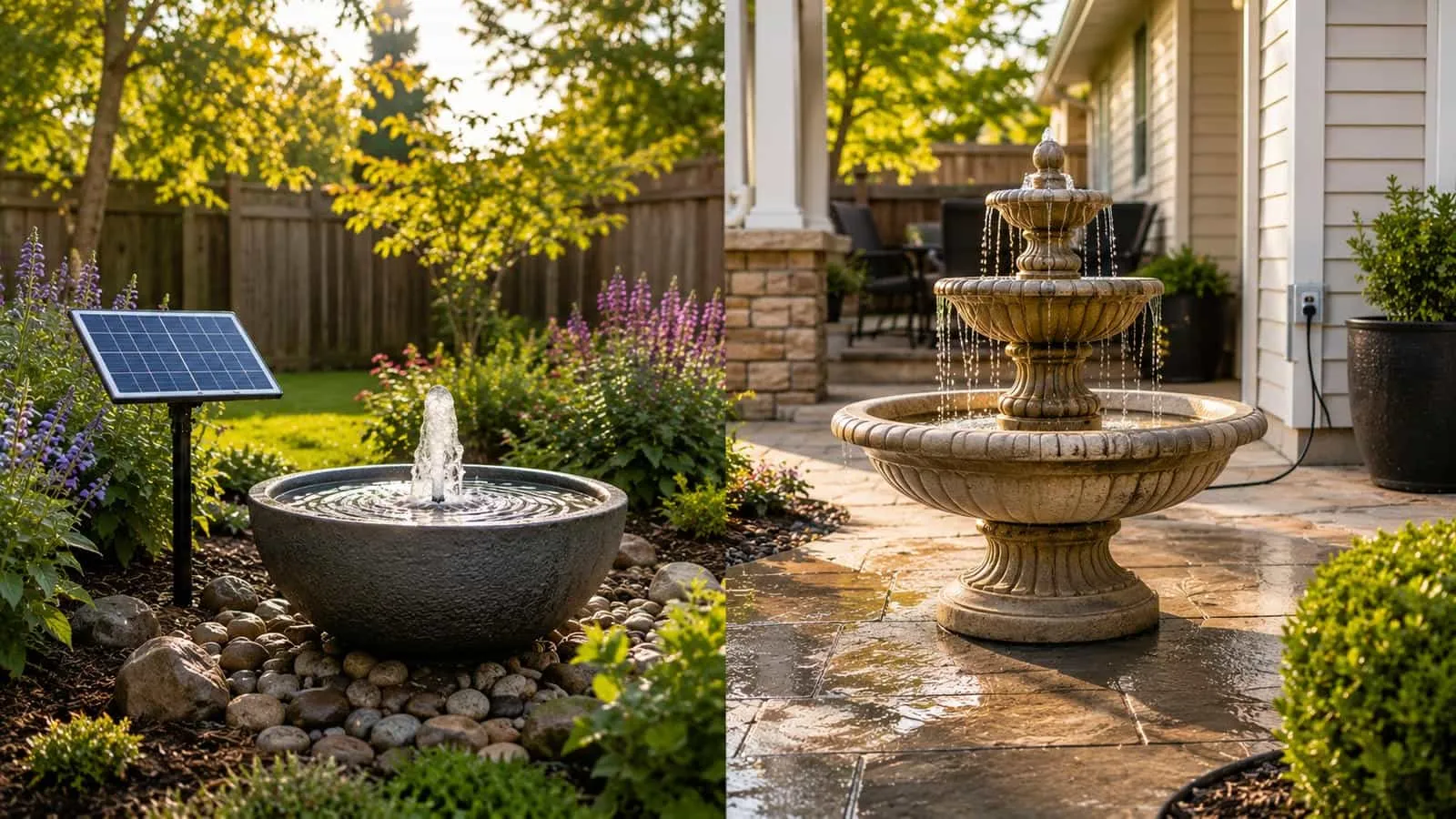
⚖️ Solar vs Electric Water Fountains at a Glance: Which Power Source Is Better?
Neither solar nor electric water fountains are best for every yard. Solar usually wins for placement freedom and locations without an outlet. Electric usually wins for dependable flow, shade, larger pumps and evening use. Battery solar sits between them by storing limited energy for changing light and some after-sunset operation.

Which Is Better, a Solar or Electric Water Fountain?
Solar is usually the stronger choice for sunny birdbaths, garden beds and remote landscape areas where electrical access is inconvenient. Direct solar flow can change as available sunlight changes.
Electric is usually better when steady circulation, stronger pump performance, shade tolerance or evening operation matters more. Battery solar offers a middle option by combining outlet-free placement with limited stored energy, although runtime still depends on charging conditions, battery capacity and pump demand.
Solar vs Battery Solar vs Electric Water Fountains: Sunlight, Water Flow, Pump Power and Placement Compared
Use this comparison to match the power source to sunlight, fountain size, placement, runtime and ownership needs.
| ⚡ Comparison Factor | ☀️ Direct Solar Fountain | 🔋 Battery Solar Fountain | 🔌 Electric Water Fountain |
|---|---|---|---|
| Outdoor Electrical Outlet | Not required. | Not required for normal solar operation. | Requires suitable outdoor electrical power. |
| Direct Sunlight Dependence | High. | Needed for charging, but stored energy can help. | None. |
| Performance in Shade | Flow may weaken. | Stored energy can bridge shorter shaded periods. | Shade does not affect pump power. |
| Cloudy Weather Performance | Flow may weaken, cycle or stop. | Battery energy can help temporarily. | Generally remains consistent. |
| Nighttime Operation | Generally stops after sunlight is gone. | Limited operation while stored charge remains. | Can operate whenever powered on. |
| Water Flow Consistency | Can change with sunlight. | Usually steadier while battery power remains. | Most predictable. |
| Fountain Pump Strength | Best for lower-demand fountains. | Low to moderate demand, depending on system size. | Broadest pump range. |
| Large Fountain Suitability | More limited. | Possible with properly matched equipment. | Usually the strongest choice. |
| Remote Garden Placement | Excellent. | Excellent with added stored energy. | Depends on electrical access. |
| Separate Solar Panel Placement | Panel can sometimes sit in stronger sun nearby. | Can improve charging when the fountain sits in partial shade. | Not applicable. |
| Running Energy Cost | No household electricity for normal operation. | No household electricity for normal solar charging. | Uses electricity while running. |
| Battery Replacement | None on direct-solar systems. | Battery may eventually need replacement. | No solar battery required. |
| Cord and Cable Planning | Panel cable may still be required. | Panel, controller and battery cables may be required. | Electrical cord or installed connection required. |
| Installation Flexibility | High with good solar exposure. | High with reliable charging conditions. | Depends more on power access. |
| Small Accent Fountains | Excellent in sunny locations. | Useful when steadier operation is preferred. | Excellent when consistent flow matters. |
| Dependable Daily Operation | Best when daytime variation is acceptable. | Better when some stored runtime is useful. | Best for predictable schedules. |

⚡ Best Solar vs Electric Water Fountain Choice for Your Yard
- ☀️ Choose Solar for Placement Freedom: Best for sunny fountains away from convenient electrical power.
- 🔌 Choose Electric for Reliable Water Flow: Best for shade, stronger pump demands and dependable evening operation.
- 🔋 Choose Battery Solar for Added Flexibility: Best when remote placement matters but some stored runtime is also useful.
- ⛲ Match Power to Fountain Size: Smaller low-lift fountains favor solar more easily; larger tiered or higher-demand fountains increasingly favor electric.
- 🏡 Let the Yard Decide: Compare sunlight, outlet access, fountain size, desired flow and operating schedule before choosing.
Section Summary Snapshot: Solar is strongest for sunny, remote locations; electric is strongest for dependable flow, larger pumps, shade and evening use; battery solar provides a middle option with limited stored energy. Match the power source to the actual fountain location and performance needs rather than treating one system as universally better.
Compare direct solar, battery solar and electric fountains for sunlight, steady flow, remote placement and dependable outdoor operation.
Choose the power style that creates relaxing water movement where you want it most.
🛒 Compare Solar and Electric Water Fountains on Amazon
⚙️ How Solar and Electric Water Fountain Power Works: Panels, Batteries, Pumps and Electrical Supply
Solar and electric water fountains can use similar recirculating pumps, but they receive energy differently. Direct solar sends available solar energy from the panel to the pump, battery solar adds rechargeable storage, and an electric fountain receives power from an outdoor electrical supply. That difference affects how consistently each system can operate when sunlight changes.

☀️ How a Direct Solar Fountain Pump Uses Sunlight
A direct solar water fountain uses a photovoltaic panel to convert sunlight into electrical energy for the fountain pump. In a direct-drive system, that energy reaches the pump without first being stored in a battery. Stronger solar input can support stronger pump output, while reduced sunlight can weaken, interrupt or stop water movement.
Without energy storage, the pump cannot draw on solar electricity collected earlier. The fountain therefore responds more directly to current solar panel exposure.
🔋 How a Solar Fountain With Battery Backup Stores Energy
Battery solar adds rechargeable energy storage between the solar panel and fountain pump. Depending on the system design, solar energy can charge the battery so stored power is available when sunlight temporarily decreases or direct sun is no longer reaching the panel.
Stored energy is finite. Runtime depends on battery capacity, charging conditions, pump demand and system controls, and rechargeable batteries can gradually lose storage capacity as they age.
⚡ Direct Solar vs Battery Solar vs Electric Fountain Power Path
Follow the energy path to see the practical difference between the three systems.
| ⚡ Power System | Energy Path | Stored Energy | What Changes Operation |
|---|---|---|---|
| ☀️ Direct Solar | Solar panel → fountain pump | None unless a battery is included | Available sunlight and panel exposure |
| 🔋 Battery Solar | Solar panel → controller or battery → fountain pump | Limited rechargeable battery storage | Sunlight, battery charge and pump demand |
| 🔌 Electric | Outdoor electrical supply → fountain pump | Not normally needed | Power availability, controls and schedule |
🔌 How an Electric Water Fountain Pump Receives Power
An electric water fountain normally uses a submersible or purpose-designed pump connected to suitable outdoor electrical power. Because the pump does not depend on sunlight or battery charge, it can receive predictable power whenever the fountain is switched on.
Electric systems also support a broad range of pump sizes, adjustable flow controls and timers. The pump still needs to match the fountain's water lift and circulation requirements; electricity does not make an incorrectly sized pump suitable.
⚙️ Fountain Power System Rule: Do not assume every solar fountain stores energy. Direct solar uses available solar power, battery solar adds limited storage, and electric fountains rely on an electrical supply. Know which system you are buying before comparing flow, cloudy-weather performance or runtime.
Section Summary Snapshot: Direct solar powers the pump from current sunlight, battery solar adds rechargeable storage, and electric fountains receive power independently of sunlight. These three energy paths explain the differences in flow consistency, placement and operating time discussed throughout the rest of the guide.
☀️ Solar Water Fountains in Sunlight, Shade and Cloudy Weather
Solar fountain performance depends on useful sunlight reaching the solar panel. Direct solar flow can weaken or stop as light decreases, while battery solar can use stored energy for some interruptions. With a separate panel, the fountain itself may sit in partial shade while the panel remains in stronger sunlight.

☀️ How Much Sun Does a Solar Water Fountain Need?
There is no universal number of sunlight hours that works for every solar fountain. Performance depends on panel size, panel angle, pump demand, fountain design and battery storage when included. A small bubbling fountain generally requires less available energy than a taller or stronger water display. For a deeper look at panels, batteries, placement and everyday solar operation, see our complete solar water fountain guide.
Focus on useful solar exposure at the panel. Trees, rooflines, fences and buildings can create changing shade, so observe the intended panel location during the hours when you want the fountain operating.
☁️ What Happens to a Solar Fountain When Clouds Pass?
Direct solar fountains respond to the energy available from the panel at that moment. As cloud cover reduces solar input, pump output may weaken, become intermittent or stop.
Battery solar can use stored energy through some temporary cloud or shade, but the battery still depends on adequate charging and cannot provide unlimited backup.
🌤️ Solar Fountain Performance in Sun, Partial Shade and Cloud Cover
| 🌤️ Yard Condition | ☀️ Direct Solar | 🔋 Battery Solar | 🔌 Electric |
|---|---|---|---|
| Strong Direct Sun | Usually strongest solar pump performance. | Supports operation and battery charging. | Operates normally regardless of sunlight. |
| Partial Shade | Flow may weaken as panel exposure drops. | Stored energy may help temporarily. | Shade does not affect pump power. |
| Passing Clouds | Flow may rise and fall. | Battery storage can smooth some interruptions. | Cloud cover does not affect operation. |
| Deep or Long Shade | Often a poor fit unless the panel can be relocated. | Limited if the battery cannot recharge adequately. | Usually the more dependable choice. |
🌞 The Fountain Can Sit in Shade While the Solar Panel Sits in Sun
If the system uses a separate panel and enough cable length, the fountain can sometimes remain beside a patio, under light tree cover or in a partly shaded garden while the panel sits several feet away in stronger sunlight.
- ☀️ Prioritize Sun at the Panel: The panel is the component collecting energy for the pump.
- 🌳 Watch Moving Shade: Trees, buildings and fences can change panel exposure during the day.
- 📏 Check Cable Reach: Make sure the supplied cable reaches the intended sunny panel location.
- 🔋 Battery Solar: Stored energy can help through changing light but still requires adequate charging.
🔌 When Shade Makes an Electric Fountain the Better Choice
Electric power becomes more practical when the preferred fountain location and all reasonable solar-panel positions remain shaded for much of the day. It is also stronger when steady water flow matters more than outlet-free placement.
☀️ Sunlight Decision Rule: Evaluate the panel location before accepting or rejecting solar. A shaded fountain may still work with a separate panel in stronger sun. If no practical panel location receives useful sunlight, electric power is usually more dependable.
Section Summary Snapshot: Direct solar works best with useful panel exposure, battery solar can bridge some changing light, and a separate panel can make partial-shade fountain placement possible. Deep shade with no practical sunny panel location generally favors electric power.
💧 Solar vs Electric Fountain Pump Strength, Water Flow and Performance
Electric fountains generally provide the most consistent pump output because their power does not change with sunlight. Direct solar flow can rise or fall as solar energy changes, while battery solar can improve short-term stability. Fountain height, water lift, pump capacity and adjustable flow also affect how much water reaches the fountain outlet.

💧 Which Produces More Consistent Water Flow, Solar or Electric?
Electric pumps usually have the advantage when consistent water flow is the priority. A suitable electrical supply provides predictable power, which matters for tiered fountains, taller displays and features where changing circulation alters the intended appearance.
Solar can still work very well for smaller fountains, but the power source should be matched to the water movement the fountain actually requires.
☀️ Why Solar Fountain Water Flow Can Change With Sunlight
A direct solar pump uses the energy available from its panel at that moment. Clouds, moving shade or weaker sunlight can lower pump output, producing a shorter spray, softer bubbling or slower circulation.
Changing flow does not automatically mean the pump is defective; it can simply reflect changing solar input.
🔋 What Battery Solar Improves About Fountain Flow
Battery solar can make flow steadier when stored energy is available, helping the pump through passing clouds or temporary shade.
- 🔋 Stored Energy: Can bridge short drops in direct solar output.
- ☀️ Charging Still Matters: Battery support cannot compensate indefinitely for poor solar exposure.
- ⚙️ Pump Demand Matters: Larger pumps use stored energy faster than small low-flow pumps.
📏 How Fountain Height and Water Lift Affect Pump Performance
A low bubbling fountain requires less water lift than a tall tiered fountain. As vertical lift increases, the amount of water a pump can deliver at the outlet can decrease.
This is described as head height and becomes especially important with taller fountains or stronger cascades. For detailed pump capacity, delivered flow and head height guidance, see our water fountain pump sizing guide.
⚙️ Solar, Battery Solar and Electric Fountain Performance Compared
| 💧 Performance Factor | ☀️ Direct Solar | 🔋 Battery Solar | 🔌 Electric |
|---|---|---|---|
| Flow Consistency | Can change with solar exposure. | Steadier while stored energy is available. | Usually the most predictable. |
| Pump Range | Commonly suited to lower-demand fountains. | Can support more demand depending on system size. | Broadest residential pump range. |
| Greater Water Lift | Requires careful panel and pump matching. | Battery support helps, but system limits remain. | Often better for taller or higher-demand fountains. |
| Adjustable Flow | Available on some systems. | Useful while adequate stored power remains. | Generally offers the widest adjustment range. |
🎧 How Water Flow Changes Fountain Sound, Splash and Appearance
Stronger flow can create a taller spray, louder water sound and more splash, while weaker flow can turn a pronounced cascade into a quieter trickle. This means changing solar output can also change how the fountain looks and sounds.
Maximum flow is not always better. The goal is enough water movement to create the intended effect without excessive splash or water loss.
💧 Fountain Performance Rule: Small, low-lift fountains can work very well with solar power. Taller fountains, stronger cascades and displays needing steady adjustable flow usually strengthen the case for electric power, while battery solar can provide a middle option when charging conditions are adequate.
Section Summary Snapshot: Electric usually provides the most consistent flow and broadest pump range. Direct solar output can change with sunlight, while battery solar can improve short-term stability. Fountain height, water lift, flow adjustment, sound and splash should all be considered when matching the pump and power source.
📍 Solar vs Electric Fountain Placement, Outdoor Outlets and Cord Planning
Solar fountains offer greater placement freedom because they do not need a nearby electrical outlet, but the panel still needs useful sunlight. Electric fountains work reliably in shade but depend on suitable outdoor power and safe cord routing. Check sunlight, outlet access, cable reach and walking routes before choosing the final fountain location.

☀️ Solar Fountain Placement Freedom for Gardens, Yards and Remote Locations
Solar is especially useful for remote garden beds, front yards, landscape islands, birdbath areas and other locations far from household electrical power. It can avoid the need to add permanent electrical service simply to operate a small fountain.
The main limit is the solar panel. It still needs useful sunlight, although a separate panel can increase flexibility when cable length allows the panel and fountain to sit in different locations.
🔌 How Outdoor Outlet Access Affects Electric Fountain Placement
Electric fountains can operate in shade, covered patios and courtyards without depending on sunlight, but the location needs practical access to suitable outdoor power. Existing electrical access can make placement simple; adding new service can change both cost and practicality.
🏡 Solar vs Electric Fountain Placement by Yard Location
| 📍 Fountain Location | ☀️ Solar Advantage | 🔌 Electric Consideration | ✅ Best Guidance |
|---|---|---|---|
| Remote Garden Bed | No nearby outlet needed. | New power may be difficult or costly. | Solar is attractive with good panel sunlight. |
| Patio Near the House | Can avoid a visible electrical cord. | An existing outlet can simplify electric use. | Compare shade, outlet distance and runtime needs. |
| Front Yard | Useful where electrical access is limited. | Permanent power may require more planning. | Solar works well when panel placement stays sunny and practical. |
| Shaded Courtyard | Works best if a separate panel reaches stronger sun. | Shade does not reduce electric pump power. | Electric often wins when outdoor power is nearby. |
⚡ Electric Fountain Cords, Outdoor Power and GFCI Protection
Keep electric fountain cords and connections away from walking routes, mowing areas and places where they can be damaged. Do not treat an ordinary indoor extension cord as a permanent outdoor fountain solution.
Use electrical equipment suitable for outdoor conditions and appropriate ground-fault protection where required. If new outdoor electrical service is needed, follow local requirements and use a qualified electrician when appropriate.
✅ Choose the Fountain Power Source Before Finalizing Placement
- ☀️ Check Solar Exposure: Confirm useful panel sunlight during the hours you want the fountain running.
- 🔌 Locate Outdoor Power: Measure the practical distance to suitable electrical access.
- 📏 Check Cable Reach: Solar panel cables and electric cords can both limit equipment placement.
- 🚶 Protect Walking Routes: Keep cords and cables away from pathways, mowing areas and traffic.
For broader guidance on views, sound, splash, surfaces and landscape fit, see our choosing the best fountain location guide.
📍 Placement Planning Rule: Check sunlight, outdoor power, cable distance and safe routing at the same time you evaluate how the fountain will look and sound. Do not choose the visual location first and solve the power problem afterward.
Section Summary Snapshot: Solar offers strong freedom for remote locations but still needs useful panel sunlight. Electric works reliably in shade but depends on suitable outdoor power and safe cord routing. The best location balances appearance, sunlight, electrical access and practical cable reach.
💰 Solar vs Electric Water Fountain Costs: Purchase, Power and Long Term Ownership
Solar fountains are not automatically cheaper than electric fountains. Direct solar avoids purchased electricity, battery solar adds eventual battery replacement, and electric fountains use power while running. The better value depends on equipment, pump demand, operating time, outdoor electrical access and whether new electrical service is needed.

💵 What Changes the Upfront Cost of a Solar or Electric Fountain?
A direct solar fountain may include a panel, pump and controller, while battery solar adds rechargeable storage and charging controls. An electric fountain normally includes a pump and cord but also needs suitable outdoor electrical access.
Location can change the total considerably. Electric may be inexpensive beside an existing outlet, while a remote fountain could require new electrical service that costs far more than the electricity the pump eventually uses.
⚖️ Direct Solar vs Battery Solar vs Electric Fountain Costs
| 💰 Cost Factor | ☀️ Direct Solar | 🔋 Battery Solar | 🔌 Electric |
|---|---|---|---|
| Power Equipment | Panel, pump and controller. | Adds rechargeable battery and controls. | Pump, cord and suitable outdoor power. |
| Ongoing Energy Cost | No purchased electricity for normal operation. | No purchased electricity for normal solar charging. | Uses electricity while the pump runs. |
| Replacement Costs | Pump or solar components may wear out. | Adds eventual battery replacement. | Pump or electrical components may wear out. |
| Installation Cost | Often low with simple panel placement. | Similar placement flexibility with added battery equipment. | Low near existing power; potentially higher if new service is needed. |
⚡ How Much Does an Electric Water Fountain Cost to Run?
Electric fountain operating cost depends on pump wattage, operating hours and the local electricity rate. Multiply pump wattage by daily runtime, convert that energy use to kilowatt hours and apply the local rate. Because pumps, schedules and utility prices vary, there is no meaningful universal monthly cost.
Example: A 25 watt pump running 8 hours per day uses about 0.2 kilowatt hours daily, or roughly 6 kilowatt hours over 30 days. The actual monthly cost depends on the local electricity price.
🔋 Battery Replacement Is Part of Solar Fountain Ownership
Rechargeable battery capacity gradually declines with age, charging cycles, temperature and system design. When capacity becomes too low, replacement may be needed to restore cloudy-weather or evening runtime.
Pumps can also eventually need replacement in both solar and electric fountains, so long-term cost should include equipment wear as well as energy use.
✅ Which Costs Less Over Time, Solar or Electric Water Fountains?
It depends on the installation. Electric can be economical beside existing outdoor power, while solar becomes more attractive when a remote fountain would otherwise require costly electrical work. Battery solar usually adds upfront cost but also adds stored-energy capability.
💰 Cost Comparison Rule: Compare the complete ownership path: fountain, pump, solar panel, battery when included, electrical access, installation, operating schedule and likely replacement parts.
Section Summary Snapshot: Direct solar avoids purchased electricity, battery solar adds eventual battery replacement, and electric adds operating energy cost. Existing outdoor power can make electric inexpensive, while new electrical installation can make remote solar placement more economical.
🌙 Solar vs Electric Fountain Operation During the Day, at Night and on a Schedule
Direct solar fountains normally run when enough sunlight reaches the panel and stop when usable solar energy disappears. Battery solar can extend operation while stored energy remains. Electric fountains provide the most predictable daytime, evening and scheduled operation because runtime does not depend on sunlight.

☀️ Solar vs Electric Fountain Operation During the Day
Daytime use is where direct solar fountains fit best. When the panel receives adequate light, the pump can operate without a nearby outlet or purchased electricity, although flow may change with clouds or shade.
Battery solar can smooth some light changes, while electric provides consistent operation regardless of sun exposure. The better daytime choice depends on whether placement freedom or predictable flow matters more.
🌙 Do Solar Water Fountains Work at Night?
A solar fountain works after sunset only when stored energy is available. Direct solar normally stops, while battery solar may continue for a limited period based on charge, pump demand and system design.
| 🕒 Operating Period | ☀️ Direct Solar | 🔋 Battery Solar | 🔌 Electric |
|---|---|---|---|
| Bright Daylight | Runs with adequate solar input. | Can operate and charge when conditions allow. | Operates normally when switched on. |
| Cloudy Afternoon | Flow may weaken or stop. | Stored energy may maintain operation. | Clouds do not affect pump power. |
| After Sunset | Normally stops. | May continue while battery charge remains. | Can continue when powered on. |
| Scheduled Evening Use | Poor fit without daylight. | Possible when battery runtime is sufficient. | Usually the most predictable choice. |
✨ Best Fountain Power for Patio Dinners and Evening Entertaining
Evening use can make electric power more attractive. If fountain sound is part of patio dinners, outdoor seating or landscape lighting, predictable operation after sunset may matter more than outlet-free placement.
Battery solar can also work when enough stored energy is available, but homeowners should compare expected runtime rather than assuming the battery will operate all night.
🔄 Does a Water Fountain Need to Run Continuously?
🔄 Does an Outdoor Water Fountain Need to Run 24 Hours a Day?
Many decorative fountains do not need nonstop operation simply because the power source allows it. Match runtime to when the fountain is enjoyed while following the fountain and pump manufacturer's instructions.
⏱️ Electric Fountain Timers and Scheduled Operation
⏱️ Using a Timer or Schedule With an Electric Water Fountain
A suitable outdoor timer or control can run an electric fountain during mornings, afternoons or evening patio time while reducing unnecessary runtime. Any timer or control should be appropriate for the fountain and outdoor electrical setup.
🌙 Fountain Runtime Rule: Choose around when you want the fountain operating. Direct solar fits daytime use best, battery solar adds limited stored runtime, and electric is the most predictable choice for regular evening, nighttime or scheduled operation.
Section Summary Snapshot: Direct solar favors daylight operation, battery solar can extend runtime while charge remains, and electric provides the most reliable evening and scheduled use. Base the choice on when the fountain will actually be enjoyed rather than assuming it must run continuously.
⛲ Best Solar or Electric Power Source by Water Fountain Size and Type
Small birdbaths, bubbling accents and remote garden fountains can work very well with solar power when sunlight is adequate. As fountain size, water lift and pump demand increase, electric power usually becomes more practical. Battery solar can suit smaller fountains that need added runtime or steadier operation.

⚖️ Best Solar or Electric Power Choice for Different Fountain Types
Different fountain designs place different demands on the pump. A small birdbath may need only gentle circulation, while a tall tiered fountain must lift and redistribute more water. If you are still deciding which fountain style fits your yard, compare the different types of water fountains before choosing the power source. Use the table below as practical buying guidance.
| ⛲ Fountain Type | ⚙️ Typical Power Demand | 🔋 Best Power Choice | ✅ Why It Fits |
|---|---|---|---|
| Small Birdbath Fountain | Low demand and modest water lift. | Solar or Battery Solar | Well suited to sunny remote locations and gentle circulation. |
| Outdoor Tabletop Fountain | Very low to low demand. | Solar or Electric | Solar fits sunny tables; electric gives steadier patio operation. |
| Small Bubbling Fountain | Low to moderate flow with short lift. | Solar, Battery Solar or Electric | All three can work when matched to location and desired bubbling strength. |
| Urn Fountain | Low to moderate for small urns; higher for stronger overflow. | Battery Solar or Electric | Small urns can use solar; larger overflowing designs favor steadier power. |
| Tiered Fountain | Moderate to high due to multi-level water lift. | Electric | Consistent output helps maintain balanced spillways and circulation. |
| Wall Fountain | Moderate and influenced by lift height. | Electric or Battery Solar | Electric suits permanent installations; battery solar may fit smaller outdoor designs. |
| Large Garden Fountain | High demand with greater circulation and lift. | Electric | Provides the broadest pump range and most dependable flow. |
| Remote Landscape Accent | Usually low to moderate. | Solar or Battery Solar | Avoids running electrical service across the yard when good sunlight is available. |
☀️ Why Smaller Water Fountains Often Match Solar Power Well
Solar is especially attractive for fountains with modest pump demand, short water lift and good sunlight. Birdbaths, small bubbling features and compact garden accents often fit this profile, while battery solar can add steadier operation through changing light.
🔌 Why Larger and Taller Fountains Usually Favor Electric Power
As fountain height, water volume and circulation demand increase, dependable pump output becomes more important. Tiered fountains, larger urns, wall fountains and major garden focal points often benefit from the wider pump range and steady power available with electric systems.
✅ Match the Power Source to the Fountain, Not Just the Yard
- ☀️ Low Demand and Remote: Solar is strongest for smaller fountains with good sunlight and no convenient outlet.
- 🔋 Need More Runtime: Battery solar can make a small or moderate fountain more dependable through changing light.
- 🔌 Higher Pump Demand: Larger, taller and multi-level fountains increasingly favor electric power.
⛲ Fountain Type Decision Rule: The larger and more demanding the water display becomes, the stronger the case for electric power. Smaller remote fountains strengthen the case for solar, while battery solar fills the middle when placement freedom and added runtime both matter.
Section Summary Snapshot: Small birdbaths, bubbling fountains and remote accents can work very well with solar power. Larger urns, tiered fountains, wall fountains and major garden features increasingly favor electric power as pump demand and water lift rise.
Compare compact solar fountains, bubbling accents, tiered fountains and larger electric designs for different pump and water-flow demands.
Match fountain size with dependable power for peaceful, balanced water movement outdoors.
🛒 Explore Solar and Electric Fountain Types on Amazon
🐦 Solar vs Electric Water Fountains for Birds and Backyard Wildlife
Solar fountains work well for sunny birdbaths and remote wildlife areas because they need no nearby outlet and usually use small pumps. Electric fountains are stronger when shaded placement, steady circulation or adjustable flow matters more. The best choice depends on sunlight, basin depth, spray pattern, water loss and desired runtime.

💧 Why Moving Water Matters in a Birdbath or Wildlife Fountain
A small pump keeps water moving instead of leaving the basin still. The power decision comes down to the circulation the location needs: gentle daytime bubbling may suit a sunny birdbath, while a shaded wildlife garden may benefit from steadier electric flow.
☀️ Why Solar Birdbath Fountains Work Well in Sunny Wildlife Areas
- 🔌 No Nearby Outlet Needed: Easy to place in garden beds, lawns or wildlife areas away from the house.
- ⚙️ Small Pump Demand: Gentle bubbling and low sprays often require modest pump output.
- ☀️ Daytime Operation Fits the Use: Solar operation can align well with daytime bird activity.
⚠️ Solar Birdbath Fountain Problems: Spray, Shade and Water Loss
A spray that is too strong for a shallow basin can throw water outside the birdbath, especially in wind, increasing refill frequency. Shade can also reduce direct solar pump output.
Small nozzles may become restricted by debris or mineral buildup, so a gentle bubbler or low spray is often more practical than maximizing fountain height.
🔌 When an Electric Birdbath Fountain Makes More Sense
Electric power is attractive when the birdbath sits in shade, steady circulation matters or better flow control is needed. Adjustable output can also help keep splash inside a shallow basin.
✅ Solar or Electric Birdbath Fountain: Which Power Source Fits Best?
For a sunny birdbath in a remote part of the yard, solar is often the simplest choice. For a shaded wildlife garden near suitable outdoor power, electric can provide steadier circulation and better flow control. Battery solar fits between them when useful sunlight is available but more consistent runtime is preferred.
For deeper guidance on basin depth, gentle water movement, wildlife placement, cleaning and fountain design, see our birdbath water fountain guide.
🐦 Wildlife Fountain Decision Rule: Use the gentlest water pattern that keeps water moving without emptying the basin. Solar favors sunny remote locations; electric favors shade and consistent adjustable circulation.
Section Summary Snapshot: Solar birdbath fountains work well in sunny wildlife areas with small pump demands and no nearby outlet. Electric provides steadier circulation and better flow control, especially in shade. Watch spray height, basin depth, water loss and nozzle condition with either system.
❄️ Solar vs Electric Water Fountains in Summer, Rain, Wind and Winter
Weather affects solar and electric fountains differently. Heat and wind increase water loss for either type, while clouds can reduce direct solar output. Freezing weather shifts the concern to protecting pumps, batteries, plumbing and vulnerable fountain materials. Follow manufacturer cold-weather guidance rather than assuming either system can remain operating through winter.

☀️ Summer Heat, Sun Exposure and Fountain Water Loss
Hot weather increases evaporation in both solar and electric fountains. Sunny conditions can improve solar panel output but also warm shallow basins and increase water loss, especially in birdbaths and compact fountains with smaller reservoirs.
🌧️ How Wind, Rain and Cloudy Periods Affect Fountain Operation
Wind can carry spray beyond the basin and increase water loss, particularly with higher sprays and shallow birdbaths. Long cloudy periods can weaken direct solar output and reduce battery charging, while electric pump performance remains independent of cloud cover.
❄️ Solar vs Electric Water Fountains in Freezing Weather
Freezing temperatures shift attention from power source to equipment protection. Water left in pumps, tubing, plumbing or vulnerable fountain materials can freeze and expand. Solar systems may also have panels, controllers and batteries with specific temperature or storage requirements.
📦 Solar Panel, Battery and Fountain Pump Winter Storage
- ☀️ Solar Systems: Follow product guidance for the panel, pump, controller and rechargeable battery.
- 🔌 Electric Systems: Protect pumps, cords, connections and exposed electrical components as required.
- 💧 Both Power Types: Prevent trapped water from freezing inside pumps, tubing and vulnerable fountain areas.
For complete cleaning, seasonal shutdown, pump care and cold-weather preparation, use our complete fountain maintenance guide.
❄️ Seasonal Ownership Rule: Solar is more affected by prolonged cloud cover, while electric provides steadier power. In freezing climates, both systems need appropriate protection, with battery solar adding battery-storage considerations.
Section Summary Snapshot: Heat and wind increase water loss, clouds can reduce solar output and battery charging, and freezing weather requires protection for fountain components. Seasonal care matters more than the power source once temperatures drop below freezing.
🏡 Solar or Electric Water Fountain? Best Choice for Real Yard Scenarios
Choose solar for sunny fountain locations away from electrical power, electric for shade, stronger pump demands and reliable evening use, and battery solar when remote placement still matters but stored energy is useful for changing light or limited after-sunset operation.
Start with the yard condition that is hardest to change: sunlight, outlet access, fountain size or when you want the water running. Open the scenario that most closely matches your property.
Match your fountain location and intended use to the closest scenario for a direct solar, battery solar or electric recommendation.
☀️ Sunny Garden Fountain With No Nearby Electrical Outlet
Best choice: Solar
A sunny garden bed, landscape island or remote part of the yard strongly favors solar when the panel can receive useful sunlight and adding electrical service would be inconvenient.
- ☀️ Advantage: Excellent placement freedom.
- 💧 Tradeoff: Direct solar flow can change with sunlight.
🌳 Shaded Patio Fountain Beside an Outdoor Outlet
Best choice: Electric
A shaded patio near suitable outdoor power removes electric's main placement disadvantage and provides consistent pump operation despite tree, roofline or structural shade.
- 🔌 Advantage: Reliable flow without solar exposure.
- 🌳 Best Fit: Covered patios, courtyards and shaded seating areas.
🐦 Small Birdbath Fountain in a Sunny Yard
Best choice: Solar
A sunny birdbath usually needs modest pump output, making solar a practical way to create daytime moving water without running an electrical cord into the wildlife area.
- 🐦 Advantage: Low pump demand and easy remote placement.
- 💦 Watch For: Keep spray low enough to stay inside the basin.
⛲ Large Tiered Fountain as the Main Landscape Focal Point
Best choice: Electric
Large tiered fountains usually need greater water lift, stronger circulation and steady flow across several levels, making electric power the more practical choice.
- ⚙️ Advantage: Broader pump range for higher demand.
- 💧 Best Fit: Displays that need consistent spillways and circulation.
🌙 Patio Fountain Used for Evening Entertaining
Best choice: Electric or properly sized battery solar
For patio dinners, landscape lighting or evening seating, electric provides the most predictable runtime. Battery solar can also work when stored capacity matches the intended evening schedule.
- 🌙 Electric: Best for dependable evening operation.
- 🔋 Battery Solar: Useful when outlet-free placement still matters.
🌿 Remote Garden Fountain Where New Electrical Service Would Be Expensive
Best choice: Solar deserves serious consideration
When a fountain is far from the house, electrical installation can cost more than the pump's future energy use. With good sun and reasonable pump demand, solar can avoid that infrastructure expense.
- 💰 Advantage: Can avoid new outdoor electrical service.
- ☀️ Confirm First: Make sure the panel has useful sun exposure.
🌤️ Partly Sunny Yard Where You Still Want a Solar Fountain
Best choice: Battery solar with a separately positioned panel
Partial shade does not automatically rule out solar. The fountain can remain in the preferred location while a separate panel sits in stronger sunlight, and battery storage can help through short periods of cloud or shade.
- 🌞 Panel Strategy: Put the panel in the strongest practical sunlight.
- 🔋 Battery Advantage: Stored energy can reduce short-term interruptions.
✅ How to Choose Between Solar, Battery Solar and Electric Fountain Power
Start with the hardest conditions to change. Strong sun and no nearby outlet favor solar. Shade, larger pump demands and reliable evening use favor electric. Battery solar fits when remote placement still matters but changing light or limited after-sunset operation must also be managed.
- ☀️ Choose Solar: Sunny, remote and lower-demand fountain locations.
- 🔋 Choose Battery Solar: Remote locations needing added runtime or help through changing sunlight.
- 🔌 Choose Electric: Shade, larger fountains and predictable flow or operating schedules.
🏡 Scenario Engine Recommendation: If more than one scenario fits your yard, combine the requirements. A remote fountain in partial shade, for example, may need solar placement freedom, a separate panel and battery storage. Choose the system that solves the hardest real condition at the fountain location.
Section Summary Snapshot: Solar is strongest for sunny remote locations, electric for shade, larger fountains and reliable schedules, and battery solar for situations needing both placement freedom and stored energy. Match the power source to the actual yard rather than choosing by reputation alone.
✅ Final Solar vs Electric Water Fountain Recommendation
Choose solar when placement freedom matters most and useful sunlight is available. Choose electric when dependable flow, stronger pump options, shade tolerance or evening operation matters more. Choose battery solar when you want solar placement freedom plus stored energy for changing light or limited after-sunset use.
⚡ Which Fountain Power Source Should You Choose?
- ☀️ Choose Direct Solar: Best for sunny gardens, remote locations, smaller water features and places where adding electrical power would be inconvenient.
- 🔋 Choose Battery Solar: Best when solar placement freedom still matters but you want stored energy for passing clouds, changing shade or limited evening use.
- 🔌 Choose Electric: Best for shade, larger fountains, stronger pump demands, consistent flow and dependable daytime or evening schedules.
🏡 Final Garden Delights Recommendation: Compare the actual fountain location, sun exposure, outdoor outlet access, fountain size, required flow, operating schedule and installation cost. The best power source is the one that solves the hardest conditions in your yard while delivering the water movement and runtime you actually want.
Compare solar, battery-assisted solar and electric water fountains after matching the power source to your yard, fountain size, sunlight, pump requirements and preferred operating time.
Choose the design that gives you the placement, water movement and everyday reliability that matter most for your outdoor space.
🛒 Find Your Water Fountain on Amazon
❓ Solar vs Electric Water Fountain Frequently Asked Questions
Solar is better when placement freedom, no nearby outlet and low energy use matter most. Electric is usually better for dependable flow, stronger pump choices, shade and evening operation. Battery solar sits between them by adding limited stored energy while keeping solar placement flexibility.
- ☀️ Solar: sunny, remote locations.
- 🔌 Electric: steady flow and higher pump demand.
- 🔋 Battery solar: added protection from changing light.
They can, but performance depends on available solar energy. Direct solar flow may weaken or stop as light decreases. Battery solar can use stored energy for a limited period, although adequate sunlight is still needed for recharging.
- ☁️ Direct solar flow may change with clouds.
- 🔋 Battery power can bridge shorter cloudy periods.
- 🔌 Electric flow is not affected by cloud cover.
Direct solar fountains generally stop after usable sunlight disappears. Battery solar may continue after sunset while stored charge remains. Electric provides the most predictable nighttime operation when regular evening use is important.
- ☀️ Direct solar normally stops without sunlight.
- 🔋 Battery solar may provide limited nighttime runtime.
- 🌙 Electric is best for dependable evening use.
Solar fountains perform best when the panel receives useful sunlight, but the fountain itself does not always need full sun. With a separate panel and enough cable reach, the fountain can sometimes sit in partial shade while the panel remains in a sunnier location.
- 🌞 Prioritize sunlight at the panel.
- 🌤️ Partial shade can reduce direct solar output.
- 📍 A separate panel increases placement flexibility.
Not necessarily. Cost depends on pump wattage, daily runtime and the local electricity rate. A small pump running part of the day may use relatively little electricity, while adding new outdoor electrical service can cost more than ongoing power use.
- ⚡ Higher pump wattage increases energy use.
- ⏱️ Shorter schedules reduce operating cost.
- 🔌 Existing outdoor power can reduce installation expense.
Some solar pumps can create strong water movement, but electric systems generally offer a wider range of pump capacities and more consistent power. Larger fountains with greater water lift or circulation demands often favor electric operation.
- 💧 Small solar fountains can produce strong bubbling or spray.
- ↕️ Greater water lift increases pump demand.
- 🔌 Electric offers the broadest residential pump range.
Sometimes. A separate panel can be positioned in stronger sunlight while the fountain remains in shade, and battery solar may help through temporary low-light periods. If every practical panel location stays heavily shaded, electric is usually more dependable.
- 🌤️ Partial shade does not always rule out solar.
- ☀️ Look for a sunnier separate-panel location.
- 🔌 Deep shade usually favors electric.
Solar is often ideal for a small sunny birdbath because pump demand is low and no nearby outlet is required. Electric can be better in shade or when steady adjustable circulation matters. With either system, keep the water pattern gentle enough to remain inside the basin.
- 🐦 Sunny remote birdbath: solar often fits well.
- 🌳 Shaded birdbath near power: electric may be better.
- 💦 Gentle flow reduces splash and water loss.
Solar vs Electric Water Fountain Final Summary
Solar, battery solar and electric fountains each solve a different homeowner problem. Choose direct solar for sunny locations where placement freedom matters most, battery solar when stored energy adds useful flexibility, and electric when dependable flow, larger pump capacity, shade tolerance or evening operation is the priority. The best choice comes from matching the power source to the actual fountain, yard and operating schedule.