
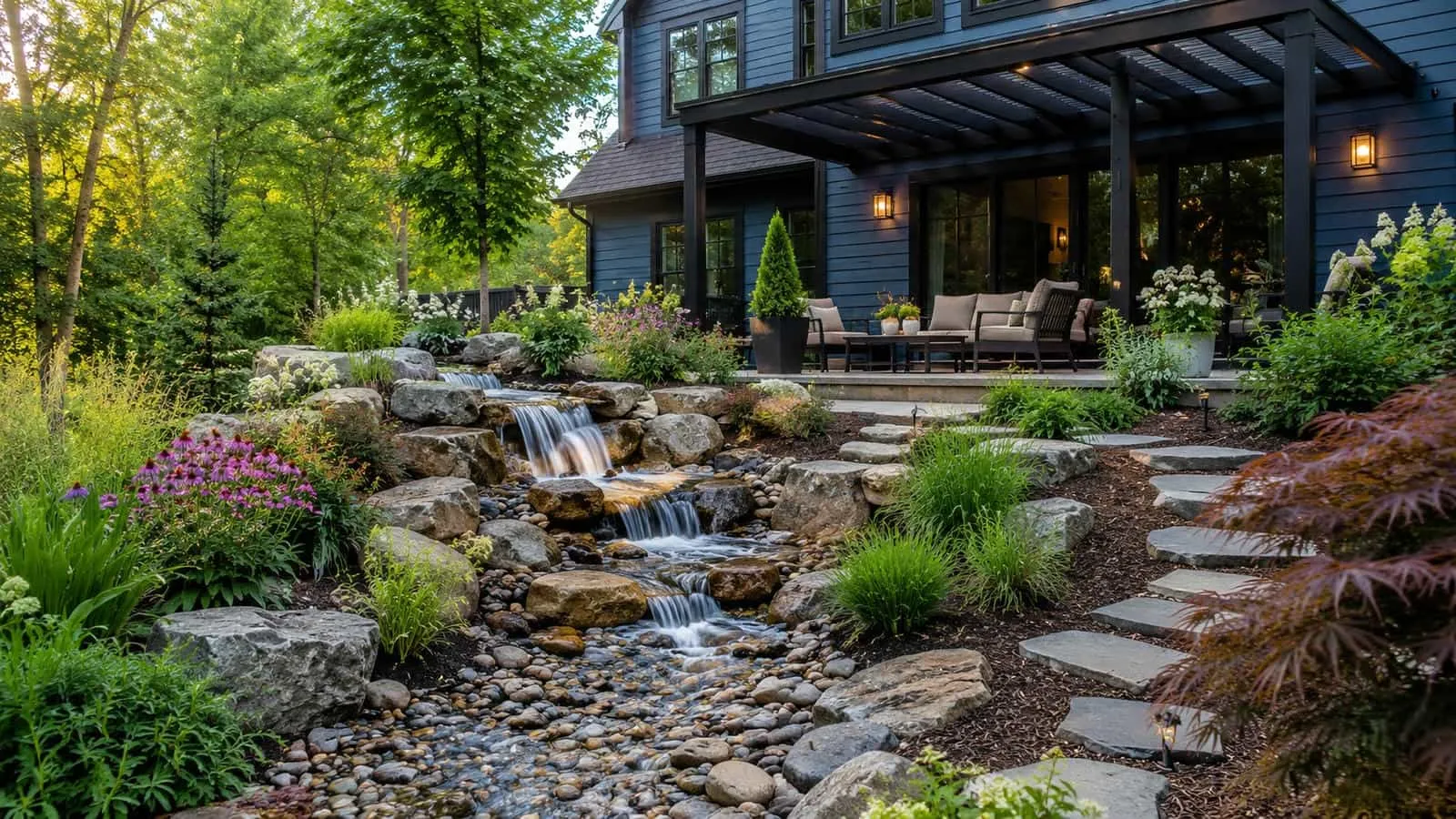
💦🌿 A pondless water feature works by making the moving water visible while keeping most of the water storage and circulation system below the landscape. Water may fall through a natural stone waterfall, travel through a stream, spill from a fountain or disappear directly into a gravel collection area. Below that surface, a hidden reservoir stores the returning water while a pump sends it through plumbing to the beginning of the feature again. Use this guide to compare pondless waterfalls, disappearing fountains, concealed reservoirs, water flow, sound, size, placement, landscaping, installation, maintenance and buying decisions before planning a pondless fountain system for your yard.
📌 Pondless Water Fountain Ideas for Backyard Design, Waterfalls, Landscaping and Hidden Water Systems
Explore pondless water fountain ideas for designing backyards, patios and garden landscapes with disappearing waterfalls, streams and concealed water systems. Compare fountain styles, placement, landscaping, flow, common problems and planning decisions before choosing a pondless water feature. Select an image below to explore that pondless water feature topic.


🏆 Best Pondless Water Fountains for Backyards, Patios, Gardens and Residential Landscapes
A pondless water fountain should be chosen as a complete outdoor feature rather than only by the appearance of the waterfall, fountain or stream. The visible water needs to fit the yard while the concealed system remains practical below the finished landscaping.
For the best overall pondless water feature, a compact waterfall with one or two natural stone drops and a short disappearing stream gives many homeowners a strong balance of movement, sound and landscape impact. It can fit beside a patio, pergola, pathway or garden border without requiring an exposed pond.
Homeowners wanting stronger movement and more noticeable sound will usually prefer a pondless waterfall. A single drop creates one clear focal point, while several modest cascades can produce a more natural, layered effect on sloped properties.
A small pondless water feature works better where space is limited. Disappearing urns, vase fountains and compact spillways can bring moving water to townhouse patios, narrow side yards, front gardens and seating areas without consuming valuable walking or planting space.
Natural landscapes can support a pondless waterfall with a short stream. Stone, gravel, river rock, grasses and restrained planting help the watercourse feel connected to the garden while extending visible movement through the landscape.
Modern landscapes often benefit from a cleaner architectural pondless fountain using a simple spillway, geometric vessel or restrained vertical water element. Limited planting, clean stone and open space help these features complement contemporary patios, courtyards and entrances.
Near patios and outdoor seating, prioritize controlled movement and comfortable sound. Lower waterfalls and spillways can provide enough water presence without dominating conversation or constantly spraying nearby paving and furniture.
Homeowners prioritizing lower maintenance pondless water features usually benefit from simpler layouts. Short waterfalls, limited stream length and straightforward service access are generally easier to inspect than complicated watercourses with many turns and hidden areas.
Sloped yards are naturally suited to waterfalls because existing grade can support believable downward movement. Flat yards can still use pondless designs, but compact disappearing fountains or restrained elevation often look more natural than oversized artificial hills.
Front yards and entrance gardens usually work best with proportional features such as disappearing urns, small waterfalls or architectural fountains that add movement without crowding the main walkway.
The best option depends less on choosing the largest waterfall than on matching the feature to the property. Homeowners comparing broader fountain styles can explore our different types of water fountains before deciding whether a pondless system is the right fit.
For broader backyard focal-point ideas beyond disappearing water systems, see our backyard water fountain design ideas.
Compare pondless waterfall kits, disappearing fountain systems and hidden reservoir water features for patios, gardens and backyards.
Look for adjustable water flow, practical reservoir capacity, accessible pump components and a layout that fits your available space.
🛒 Shop Pondless Water Features on Amazon
💦 What Makes a Pondless Water Fountain Work Well?
A successful pondless water feature balances the visible waterfall, fountain or stream with the concealed system below it. The feature should fit the yard, circulate water reliably and remain practical to inspect and maintain.
- 🏞️ Choose the Pondless Feature Form First: Use a waterfall for stronger falling water, a short stream for landscape movement, a disappearing urn for compact spaces or an architectural fountain for modern settings.
- 💧 Plan Where the Water Disappears: The lower gravel or stone collection area should return water efficiently to the concealed system.
- 🎧 Match Water Sound to the Setting: Stronger cascades suit larger or noisier spaces, while controlled spillways usually work better near conversation areas.
- 📐 Match Scale to the Available Yard: Small patios and front gardens need restrained features, while larger landscapes can support wider waterfalls and short streams.
- 💦 Allow Enough Reservoir Capacity: The hidden storage system needs enough usable water for the operating feature and its circulating volume.
- ⚙️ Keep the Pump Vault Accessible: Conceal equipment without burying the service point beneath permanent stone or planting.
- 🌿 Use Landscaping to Support the Water Feature: River rock, boulders, grasses, shrubs and groundcovers should connect the feature to the yard without blocking water or service access.
- 🍂 Consider Leaves and Debris: Heavy tree cover can increase cleaning around waterfalls, streams and gravel collection areas.
- ❄️ Plan for Seasonal Access: Keep important service areas reachable for cold-weather preparation and spring startup.
When feature form, water movement, scale, hidden storage and landscape placement are planned together, a pondless water fountain can provide the sight and sound of moving water while keeping most mechanical components out of view.

✅ Best For: Pondless water fountains work especially well in suburban backyards, patio landscapes, pergola seating areas, front entrance gardens, sloped yards, garden pathways, naturalistic landscapes, modern courtyards and smaller outdoor spaces where homeowners want moving water without maintaining an exposed pond.
Best Pondless Water Fountains for Residential Landscapes Summary
The best pondless water fountain matches available space, property grade, preferred movement, sound and maintenance expectations. Waterfalls create stronger movement, short streams suit natural landscapes, disappearing urns fit compact spaces and architectural fountains complement modern settings. Proportion, dependable circulation and practical service access matter more than choosing the largest feature.
Compare pondless waterfall systems, disappearing fountains and concealed reservoir water features for different residential landscapes.
Look for adjustable flow, accessible pumps, practical reservoir capacity and a feature size that fits your outdoor space.
🛒 Browse Pondless Water Features on Amazon
🔎 Pondless Water Feature Scenario Engine: Match the Right Fountain, Waterfall or Stream to Your Yard
A pondless waterfall that suits a sloped backyard may overwhelm a compact patio, while a disappearing urn may fit a front entrance but provide too little movement for a naturalistic garden. These scenarios match feature type, scale, sound, placement, landscaping and service needs to realistic residential settings.
Open each scenario to compare pondless feature type, scale, water movement, sound, placement, landscaping and maintenance access. The goal is to choose a design that fits the property while keeping the concealed system practical to operate and service.
🏡 Pondless Water Feature for a Small Suburban Backyard
Best choice: Compact disappearing fountain or short pondless waterfall with a small concealed reservoir
A small backyard needs visible water movement without losing too much lawn, patio or garden space. A disappearing urn, one low waterfall drop or short spillway can fit beside a pathway or patio while preserving furniture and walking room.
Keep the watercourse short and landscaping restrained. Gravel, river rock, ornamental grasses and low planting can blend the collection area into the garden without making service access difficult.
Choose this when you want moving water and a disappearing-water effect without giving up a large part of a small yard.
- 💦 Feature and Scale: Compact disappearing fountain, single-drop waterfall or very short stream.
- 🌊 Water and Sound: Gentle flow or one controlled cascade with low to moderate sound.
- 📍 Placement and Landscaping: Patio edge, pathway corner or compact bed with gravel, river rock and low planting.
- 💧 Reservoir and Access: Compact concealed system with straightforward pump and water-level access.
⚠️ Watch For: An oversized waterfall or long stream can consume valuable yard space and add unnecessary complexity.
🪑 Pondless Water Feature Beside a Patio or Outdoor Seating Area
Best choice: Low pondless waterfall or disappearing fountain with adjustable flow and controlled splash
A pondless fountain near a patio should be easy to hear without spraying furniture or walking surfaces. Low waterfalls, narrow spillways and disappearing vessels usually provide better control than tall cascades placed close to conversation areas.
Judge the sound from the actual seating position. Hard paving and walls can strengthen reflected sound, while planting may soften it.
Choose this when comfortable water sound and visible movement matter more than dramatic waterfall height.
- 💦 Feature and Scale: Small to medium waterfall, spillway or disappearing fountain proportional to the patio.
- 🎧 Water and Sound: Controlled spilling water that remains noticeable without overpowering conversation.
- 📍 Placement and Landscaping: Patio edge or nearby garden bed with stone, gravel and restrained planting.
- ⚙️ Reservoir and Access: Keep service points outside the main furniture and walking layout.
⚠️ Watch For: Excessive flow or waterfall height can make a close-range feature louder and wetter than expected.
🌾 Pondless Waterfall and Stream for a Natural Garden Landscape
Best choice: Natural stone pondless waterfall with a short disappearing stream and concealed lower reservoir
Naturalistic gardens can support more visible water movement because stone, gravel and planting blend naturally with the watercourse. Several modest cascades and a short stream can make moving water feel integrated into the garden.
Use irregular stone transitions, river rock, grasses, ferns and groundcovers while keeping the downhill water path visually believable.
Choose this when you want the water feature to feel like part of the garden rather than a separate fountain ornament.
- 🏞️ Feature and Scale: Medium waterfall with several natural stone drops and a short stream.
- 🌊 Water and Sound: Multiple small cascades with varied movement and moderate natural sound.
- 🌿 Placement and Landscaping: Garden border or pathway turn with river rock, grasses, ferns and groundcovers.
- 💧 Reservoir and Access: Concealed lower system with practical access through the surrounding landscaping.
⚠️ Watch For: Extending the stream farther than the landscape needs adds liner, maintenance and more potential water-loss points.
⛰️ Pondless Waterfall for a Sloped Backyard
Best choice: Multi-cascade pondless waterfall that uses the existing grade and disappears into a lower gravel collection area
A sloped backyard is one of the strongest settings for a pondless waterfall because the property already provides believable elevation. Several smaller drops can follow the grade instead of relying on one oversized artificial waterfall mound.
Each cascade and transition should continue guiding water toward the lower collection area.
Choose this when the property already provides elevation and you want to turn that slope into a moving-water feature.
- 🏞️ Feature and Scale: Medium or larger multi-cascade waterfall that follows existing grade.
- 🎧 Water and Sound: Layered sound from several modest drops instead of one high fall.
- 📍 Placement and Landscaping: Existing slope near a pathway, garden border or viewing area with natural stone.
- 💧 Reservoir and Access: Lower concealed system positioned where returning water naturally collects.
⚠️ Watch For: Natural slope does not guarantee proper water return. Poor grading can still send water outside the intended system.
🏙️ Modern Pondless Water Feature for a Minimalist Landscape
Best choice: Architectural disappearing fountain or clean spillway feature with a concealed gravel reservoir
Modern landscapes usually suit simple geometry and controlled water movement. A rectangular spillway, tall vessel or restrained architectural fountain can add moving water while the lower basin remains hidden beneath gravel or stone.
Keep the material palette limited with clean gravel, large-format paving, structural grasses and simple planting.
Choose this when you want a disappearing water feature that complements modern architecture without looking rustic or overly decorative.
- 💦 Feature and Scale: Architectural spillway, disappearing vessel or geometric fountain sized to nearby paving.
- 🌊 Water and Sound: Controlled sheet flow, spilling water or restrained vertical movement.
- 📍 Placement and Landscaping: Courtyard, modern patio or entrance bed with gravel and limited planting.
- ⚙️ Reservoir and Access: Fully concealed system with a discreet but practical service point.
⚠️ Watch For: Too many stone types, plants or decorative materials can weaken the clean architectural character.
🌼 Pondless Water Fountain for a Front Yard or Entrance Garden
Best choice: Compact disappearing urn fountain, restrained spillway or small pondless waterfall near the main approach
A front-yard pondless feature should have enough presence to be seen from the driveway or walkway without competing with the house. Urns, compact waterfalls and simple architectural fountains work especially well in entrance landscapes. For broader planning around house scale, curb appeal, walkway relationships, architecture, landscaping, lighting and seasonal exposure, explore our front entrance fountain ideas for residential landscapes .
Position the feature where it is visible from the main approach while keeping wet stone and gravel away from narrow walking routes.
Choose this when the water feature should strengthen the entrance landscape while staying proportional to the house and walkway.
- 🏡 Feature and Scale: Small to medium disappearing fountain or restrained waterfall.
- 🌊 Water and Sound: Clearly visible movement with controlled sound.
- 📍 Placement and Landscaping: Entrance garden, walkway bend or front planting bed with gravel, stone and small shrubs.
- 💧 Reservoir and Access: Conceal the underground system while keeping routine service practical.
⚠️ Watch For: Fast-growing shrubs can eventually hide the water and block service access. Plan for mature plant size.
🧽 Lower Maintenance Pondless Water Feature for Easier Routine Care
Best choice: Simple disappearing fountain or short pondless waterfall with generous reservoir capacity and easy pump access
A lower-maintenance pondless feature should use a short, dependable water path and straightforward service access. A simple waterfall, disappearing vessel or short spillway is usually easier to inspect than a long stream with multiple hidden turns and cascades.
Position the feature away from heavy leaf fall, lawn clippings and excessive irrigation overspray. Gravel, larger stone and restrained planting can simplify cleanup.
Choose this when easy access and predictable care matter more than creating the most complicated watercourse.
- 💦 Feature and Scale: Simple small to medium disappearing fountain, short waterfall or compact spillway.
- 🌊 Water and Sound: Adjustable, controlled flow with enough movement to remain visually interesting.
- 📍 Placement and Landscaping: Position away from heavy tree debris and lawn maintenance using gravel and limited planting.
- ⚙️ Reservoir and Access: Generous usable storage with direct pump-vault access.
⚠️ Watch For: Pondless does not mean maintenance free. Debris, water level, mineral buildup and pump cleaning still need periodic attention.
✅ How to Choose Between Pondless Water Feature Scenarios
Start with the property rather than the fountain style you like most. Compare available space, slope, desired water movement, sound, placement and maintenance access before choosing a waterfall, disappearing fountain, short stream or architectural feature.
- 📏 Match the Feature to the Space: Compact yards usually need shorter water features, while larger landscapes can support more width, cascades or stream length.
- 🌊 Match Water Movement to the Experience: Gentle spilling water suits patios, while multiple cascades create stronger movement and sound in larger landscapes.
- 💧 Keep the Hidden System Practical: Gravel, stone and planting should conceal mechanical components without blocking inspection or service.
The strongest pondless water fountain is not automatically the longest stream or tallest waterfall. It is the feature that fits the yard, creates the desired experience and remains practical to maintain.
✅ Scenario Engine Recommendation: If two scenarios describe your property, combine their practical requirements. A small sloped backyard, for example, may need the compact footprint of the small-yard scenario together with the grade planning of the sloped-yard scenario.
📊 Pondless Water Feature Comparison by Water Movement, Sound, Space, Hidden Reservoir and Maintenance
| 💦 Pondless Feature Type | 🌊 Water Movement and Sound | 📏 Space and Reservoir Demand | ⚙️ Installation and Maintenance | 🏡 Best Setting and Buyer Guidance |
|---|---|---|---|---|
| 🏞️ Pondless Waterfall | One or more visible waterfall drops create strong falling water and moderate to noticeable sound. | Needs enough room for elevation, a lower collection area and a concealed reservoir sized for operating water and normal losses. | Moderate installation complexity. Pump access, grading, water return and splash control need to remain practical. | Best for backyards, slopes and garden settings where visible cascading water is the main priority. |
| 🌿 Pondless Waterfall with Stream | Combines waterfall drops with moving stream water, creating changing sound and a longer visual experience. | Requires more landscape length, liner area and operating water than a compact waterfall. | More complex because stream grade, edges and water return must work across a longer watercourse. | Best for natural gardens and medium backyards where the water feature can move through the landscape. |
| 💧 Disappearing Fountain | Water spills, bubbles or rises from a fountain element before disappearing into gravel or decorative stone. | Usually compact, with much of the reservoir located directly below the visible feature. | Often simpler than a waterfall and stream system when the basin, pump and fountain outlet remain accessible. | Best for patios, small gardens, side yards and spaces where a large waterfall would be impractical. |
| 🏺 Urn or Vase Pondless Fountain | Water typically bubbles from the top and flows over the vessel before returning through gravel below. | Uses a relatively compact footprint while adding stronger vertical presence than a low disappearing fountain. | Moderate installation. The vessel needs stable support, dependable plumbing and convenient pump access. | Best for front entrances, patios, courtyards and garden beds where decorative vertical interest matters. |
| 🪨 Bubbling Rock Pondless Fountain | Water emerges through stone and spreads across the surface, usually producing gentle bubbling and trickling sound. | Can fit small or medium spaces depending on rock size, while the concealed reservoir sits below surrounding gravel. | Stone weight and support can increase installation difficulty, although a simple single rock system can be straightforward to maintain. | Best for natural landscapes where stone should remain the main visible fountain element. |
| 🏙️ Architectural Pondless Fountain | Spillways, geometric vessels and clean fountain outlets create controlled sheet flow, spilling water or restrained vertical movement. | Footprint varies, but many designs use a compact concealed basin beneath gravel, stone or structured paving. | Installation depends on the fountain form and surrounding hardscape. Service access should remain discreet but reachable. | Best for modern patios, courtyards and front landscapes with clean lines and restrained planting. |
| Pondless water feature comparison summary: Choose a pondless waterfall for stronger cascading water, a waterfall with stream for longer movement, a disappearing fountain for compact spaces, an urn fountain for decorative height, a bubbling rock for natural stone character or an architectural fountain for modern landscapes. | ||||
Compare pondless waterfall systems, disappearing fountains, urn water features and concealed reservoir fountain designs.
Choose according to visible water movement, available space, reservoir needs, installation complexity and maintenance access.
🛒 Compare Pondless Water Features on Amazon
⚖️ Advantages and Disadvantages of Pondless Water Fountains and Water Features
Pondless water fountains can provide waterfalls, streams and decorative fountain movement without leaving a large exposed pond at the bottom of the system. Their tradeoffs include hidden reservoir sizing, pump access, water loss, excavation, grading and seasonal maintenance. The right balance depends on the property, desired water experience and complexity the homeowner is prepared to maintain.
| Benefits of Pondless Water Fountains | Limitations and Practical Tradeoffs |
|---|---|
|
|
| Pondless Water Feature Tip: Choose the system according to visible water movement, available grade, reservoir capacity, pump access and landscape scale before focusing only on appearance. A simpler pondless fountain with reliable water return and accessible equipment is often easier to own long term. | |
💡 Comparison Tip: Do not compare pondless water features by overall appearance alone. A short waterfall, waterfall with stream, disappearing urn and architectural fountain can occupy similar landscape space while creating very different sound, water movement, reservoir demand and installation complexity.
Section Summary Snapshot: Compare pondless water features by visible water movement, sound, footprint, reservoir demand, installation and maintenance. Pondless waterfalls provide stronger cascading water, streams extend the visual experience, disappearing fountains fit compact spaces, urns add height, bubbling rocks emphasize natural stone and architectural fountains suit modern landscapes.
💧 Types of Pondless Water Fountains and Water Features with Waterfalls, Streams, Disappearing Fountains and Hidden Reservoirs

🏞️ Pondless Waterfalls for Backyards, Slopes and Natural Garden Landscapes
🏞️ Pondless Waterfalls with Cascading Water, Hidden Reservoirs and Natural Stone Landscaping
Pondless waterfalls create falling water without an exposed pond. Water moves across stone cascades into a gravel collection area and concealed reservoir below. They suit homeowners who want stronger movement, noticeable waterfall sound and a natural backyard focal point.
Problem A waterfall may create more splash or sound than expected.
Why it happens Flow, waterfall width, drop height, stone shape and wind affect how falling water lands.
Solution Match waterfall height and flow to the collection area, yard scale and preferred sound level.
🏞️ Best Pondless Waterfall Ideas
One broad drop creates a strong focal point, while several smaller cascades add layered movement and often fit suburban slopes more naturally than one oversized waterfall.
- 🌊 Choose the Waterfall Character One drop feels bold, while several cascades create more varied movement.
- 🎧 Plan Sound with Drop Height Taller drops generally create stronger impact sound and more splash.
- 💧 Protect Reliable Water Return Falling water should consistently land inside the collection zone.
- 📍 Use Natural Grade Where Possible Existing slope can create believable movement with less artificial elevation.
🏞️ Pondless Waterfall Tip: Choose waterfall scale for the yard and viewing distance, not maximum height. A lower cascade with good stone placement can still provide strong movement and sound.
🌿 Pondless Waterfalls with Streams for Natural Backyards and Garden Pathways
🌿 Pondless Waterfalls with Streams, Natural Stone Cascades and Disappearing Water
A pondless waterfall with a stream extends the visible watercourse between the upper waterfall and hidden reservoir. Water can pass through cascades, shallow stream sections and stone transitions before disappearing into gravel, creating more landscape movement but requiring more space and grading.
Problem A stream can lose water along its edges.
Why it happens Longer watercourses create more turns, elevation changes and stone transitions.
Solution Keep the stream proportional to the yard and maintain a dependable downhill return path.
🌿 Best Pondless Waterfall and Stream Ideas
A short stream beside a curved pathway can make a medium backyard feel more connected as the viewer follows moving water through stone, grasses and restrained planting.
- 🌊 Use Streams for Visual Length A short watercourse can connect different parts of the landscape.
- 📐 Keep the Grade Dependable Water should continue moving toward the lower collection area.
- 🪨 Use Stone to Direct Water Boulders and cobblestones can shape turns, width and visible flow.
- 🍂 Expect More Debris Collection Longer streams provide more places for leaves and sediment to settle.
🌿 Pondless Stream Tip: Add stream length only when it improves the landscape experience. Shorter streams are often easier to fit and maintain in residential yards.
💧 Disappearing Water Fountains for Small Backyards, Patios and Compact Gardens
💧 Disappearing Water Fountains with Concealed Basins for Patios, Pathways and Small Gardens
Disappearing fountains create bubbling, spilling or flowing water above a concealed basin. Water passes through gravel or stone instead of collecting in a visible pool, making these compact pondless fountains useful near patios, pathways and smaller gardens.
Problem A compact fountain can lose water when flow spreads beyond the collection area.
Why it happens Splash, wind and poorly directed outlets can carry water outside the hidden basin.
Solution Keep water movement proportional to the collection zone and use controlled pump flow.
💧 Best Disappearing Fountain Ideas
Compact disappearing fountains work well beside covered patios, townhouse gardens and pathways where a larger waterfall would require too much space or elevation.
- 📏 Use Compact Forms in Tight Spaces Most of the basin can remain below the visible fountain.
- 💦 Control Splash Carefully Water should return inside the collection zone instead of nearby paving.
- ⚙️ Keep Pump Access Simple Decorative stone should not prevent routine pump service.
- 🪴 Frame with Restrained Landscaping Gravel, low grasses and smaller shrubs can integrate the fountain without hiding it.
💧 Disappearing Fountain Tip: This form works especially well when moving water is wanted but space or slope is limited.
🏺 Urn and Vase Pondless Fountains for Front Entrances, Patios and Decorative Gardens
🏺 Urn and Vase Pondless Fountains with Vertical Water Flow and Hidden Reservoirs
Urn and vase pondless fountains use a decorative vessel as the main visible feature. Water rises from the top, flows down the vessel and disappears through gravel into a concealed reservoir, adding vertical interest without requiring the length of a waterfall and stream.
Problem Water from a tall vessel can splash beyond the hidden basin.
Why it happens Vessel height, outlet flow, wind and surface shape affect where water lands.
Solution Use controlled flow and enough collection area around the base.
🏺 Best Pondless Urn and Vase Fountain Ideas
A ceramic urn can create a strong front entrance focal point, while textured stone-look vessels fit naturally beside patios and garden seating. Grouped vessels add movement but require more plumbing and reservoir capacity. Because these fountains return water through gravel or stone into concealed storage below, vessel height, overflow pattern, collection area and hidden basin design all need to work together. For a deeper look at these systems, explore our disappearing urn fountain and reservoir guide.
- ⬆️ Use Vertical Form for Visual Presence Urns add height without requiring a large horizontal footprint.
- 💧 Control Water Across the Vessel Flow should stay close enough to the surface for reliable return.
- 🧱 Provide Stable Support Tall or heavy vessels need a dependable base above the reservoir structure.
- 📍 Use Them Near Main Viewing Areas Entrances, courtyards and patio edges make strong settings.
🏺 Urn Fountain Tip: Match vessel height, colour and finish to the architecture so the fountain looks integrated rather than oversized or overly decorative.
🪨 Bubbling Rock Pondless Fountains for Natural Stone Gardens and Compact Landscapes
🪨 Bubbling Rock Pondless Fountains with Natural Stone, Surface Flow and Hidden Reservoirs
Bubbling rock pondless fountains use a drilled stone or boulder as the main visible element. Water rises through the rock, spreads across its surface and returns through gravel to a concealed reservoir. They are a specialized pondless form where stone creates most of the visible water movement.
Problem A bubbling rock may be chosen for appearance without considering weight or water behaviour.
Why it happens Rock shape, outlet position and texture affect how water moves across the stone.
Solution Match the rock, flow, support and collection area before installation.
🪨 Best Bubbling Rock Pondless Fountain Ideas
Bubbling stones work well where natural rock should remain the focal point. Low boulders fit beside paths and patios, while larger stones can anchor naturalistic gardens.
- 🪨 Let Stone Remain the Main Feature The boulder should provide the design identity.
- 🌊 Expect Surface Flow Most visible water movement stays on or immediately around the rock.
- 🧱 Consider Stone Weight Large natural boulders may require stronger support and installation access.
- 💧 Keep the Hidden Basin Accessible Gravel can conceal the reservoir while preserving pump access.
🪨 Bubbling Rock Fountain Tip: Bubbling rock fountains are one specialized pondless design. For rock type, drilled stone, water behaviour and landscape integration, see our bubbling rock water fountain guide.
🏙️ Modern Architectural Pondless Water Features for Courtyards, Patios and Contemporary Homes
🏙️ Modern Architectural Pondless Water Features with Spillways, Geometric Forms and Concealed Reservoirs
Modern architectural pondless water features use spillways, geometric vessels, walls or structured fountain elements above concealed reservoirs. Controlled sheets, narrow spills and vertical streams work particularly well with modern paving, courtyards and restrained landscaping.
Problem A modern fountain can lose its clean appearance when equipment access is added later.
Why it happens Pumps and plumbing still need service access even in minimal designs.
Solution Integrate discreet access into the gravel or hardscape layout from the beginning.
🏙️ Best Modern Pondless Water Feature Ideas
A narrow spillway beside a covered patio can create controlled sheet flow, while a geometric fountain near a front entrance adds vertical movement without needing a natural stream.
- 📐 Use Simple Geometric Forms Fountain lines should relate to nearby architecture and paving.
- 🌊 Control the Water Pattern Sheet flow and narrow spills depend on consistent flow and a level outlet.
- 🪴 Limit the Material Palette Gravel, restrained plants and simple hardscape maintain a clean appearance.
- ⚙️ Hide Equipment Without Trapping It Pumps and reservoirs should disappear visually while remaining serviceable.
🏙️ Architectural Pondless Fountain Tip: Keep the design simple and allow the moving water to provide the visual interest. Too many materials or decorative elements can weaken the architectural effect.
Section Summary Snapshot: Choose pondless water feature types by water movement, available space, sound and landscape style. Waterfalls create stronger falling water, streams extend movement through natural gardens, disappearing fountains fit compact spaces, urns add vertical interest, bubbling rocks emphasize natural stone and architectural fountains suit contemporary landscapes.
Compare pondless waterfall systems, disappearing fountains, urn water features and concealed reservoir fountain designs.
Choose the form that matches your available space, desired water movement, landscape style and maintenance expectations.
🛒 Explore Pondless Water Feature Types on Amazon
💧 How Do Pondless Water Fountains Work with Hidden Reservoirs, Pumps, Waterfalls and Recirculating Water?
A pondless water fountain is a closed recirculating system. The homeowner sees a waterfall, stream, fountain vessel, spillway or other moving water above ground, while most water storage, pumping and plumbing remain concealed below gravel, stone or landscaping.
The cycle begins in a hidden reservoir. A submersible pump pushes stored water through plumbing toward an upper delivery point such as a waterfall spillway, fountain outlet, urn or architectural feature.
Gravity then carries the water through the visible feature. It may fall through cascades, move along a streambed, spill across stone or flow over a decorative fountain surface before reaching the lower collection zone.
At the bottom, water passes through gravel, river rock or another concealed intake surface and returns to the underground reservoir. The pump draws from that stored water and begins the cycle again.
This is what makes the system pondless: moving water remains visible, while the main stored water volume is hidden below the landscape instead of ending in a permanent exposed pond.
Compare pondless waterfall pumps, hidden reservoir components, pump vaults, tubing and water flow controls.
Match the circulation system to waterfall height, stream length, reservoir capacity and desired water movement.
🛒 Compare Pondless Water Feature Components on Amazon
🔄 Pondless Water Feature Cycle from Hidden Reservoir to Waterfall and Back Again
The easiest way to understand a pondless water feature is to follow the water through the system. The visible fountain form may change, but the basic cycle remains the same.
| 🔄 Water Cycle Stage | 💧 What Happens | ⚙️ Why It Matters |
|---|---|---|
| Hidden Reservoir | Water is stored below the visible landscape. | Provides operating water without a large exposed pond. |
| Submersible Pump | The pump draws water from the reservoir and sends it into the plumbing. | Pump output influences visible flow, movement and sound. |
| Plumbing and Water Line | Tubing or pipe carries water toward the upper delivery point. | Connects the hidden water storage with the visible fountain. |
| Upper Water Delivery Point | Water enters a spillway, fountain outlet, urn or other release point. | Establishes where visible moving water begins. |
| Waterfall, Fountain or Stream | Gravity carries water through cascades, across stone or along a streambed. | Creates the visible movement and sound of the feature. |
| Gravel Collection Area | Water passes through decorative gravel, river rock or another concealed surface. | Creates the disappearing-water effect. |
| Reservoir Return | Water returns below the collection surface into underground storage. | Allows the same water to be pumped through the cycle again. |
| 🔄 The pondless cycle is hidden reservoir to pump to plumbing to the upper outlet, then through the visible water feature and back through the collection area into the reservoir. | ||
💧 Water Cycle Tip: Water return matters just as much as pump flow. Water that splashes or escapes outside the lined collection area cannot return to the hidden reservoir.
⚙️ Pondless Water Fountain Components Beneath the Waterfall, Stream and Gravel
The visible waterfall or fountain is only one part of the system. Reliable operation also depends on water storage, pumping, plumbing, support components, water collection and equipment access.
| ⚙️ Pondless Component | 💧 Main Function | 🔧 Planning Consideration |
|---|---|---|
| Visible Water Feature | Creates the waterfall, fountain, stream or spillway. | Height, width and length influence flow, sound and splash. |
| Spillway or Water Outlet | Releases water into the visible feature. | Outlet size and position influence the water pattern. |
| Plumbing | Carries water from the reservoir to the upper feature. | Must support the required flow and remain protected. |
| Submersible Pump | Circulates water through the system. | Pump selection depends on desired flow and elevation. |
| Hidden Reservoir | Stores operating water below the landscape. | Usable water volume must support the complete feature. |
| Support Structure | Supports gravel and decorative stone above the reservoir. | Must suit the loads and pondless feature design. |
| Pump Vault | Provides access to the submerged pump. | Keep the service opening reachable after landscaping. |
| Lower Collection Zone | Collects returning water above the concealed reservoir. | Should capture normal water flow and splash. |
💦 Where Does the Water Go in a Pondless Waterfall or Disappearing Fountain?
Water in a pondless waterfall does not normally drain into the ground. It flows into a gravel or stone collection area and passes into a concealed reservoir below. The pump then sends the stored water back to the beginning of the waterfall or fountain.
From normal viewing angles, water can appear to vanish into river rock or gravel. In reality, the water is being collected beneath that surface inside the contained recirculating system.
Liner, reservoir structures and supporting components keep the water inside the intended path while supporting the decorative stone above. A separate pump vault keeps the pump submerged and accessible.
Water that escapes over a stream edge, splashes outside the collection area or runs behind poorly placed stone cannot return to the reservoir. That type of loss can sometimes be mistaken for unusually fast evaporation.
💦 Disappearing Water Tip: Water should disappear visually, not from the system. The lower collection area should remain hidden while still returning circulating water reliably to the reservoir.
🔧 Pondless Water Level, Flow Control and Pump Maintenance Access
The hidden reservoir must hold enough water to keep the pump submerged while part of the system's water is circulating through waterfalls, streams, fountain vessels and plumbing.
Evaporation, splash and wind gradually lower the reservoir level. Longer streams and larger exposed water surfaces can increase these losses, which is why usable reservoir volume matters.
Flow control lets homeowners adjust how the feature behaves. More flow can create stronger movement and sound but may also increase splash, while reduced flow can create a calmer effect.
Pump access should remain practical after stone and landscaping are complete. The equipment can be concealed without making routine cleaning or replacement difficult.
🔧 Pump Access Tip: Use a dedicated pump vault or service opening so routine pump care does not require removing waterfall stone or dismantling the finished landscape.
Section Summary Snapshot: Pondless water fountains store water inside a hidden reservoir and recirculate it through a pump, plumbing and visible waterfall, fountain or stream. Gravity returns the water to a lower gravel collection area, where it disappears underground and re-enters the reservoir. Reliable water return, adequate storage and accessible equipment keep the system practical.
Compare pumps, pondless reservoirs, pump vaults, tubing and water circulation components for waterfalls and disappearing fountains.
Match pump flow, reservoir capacity and service access to the size and movement of your pondless water feature.
🛒 Explore Pondless Water Feature Systems on Amazon
🏞️ Pondless Waterfalls, Streams and Disappearing Water Features for Backyard Landscapes

Pondless waterfalls and streams make moving water part of the landscape instead of concentrating it around one fountain element. Water may travel through a single waterfall, several cascades or a shallow stream before reaching the lower disappearing collection area.
A single drop pondless waterfall creates one clear focal point. Multiple cascades divide the elevation into smaller drops, while a waterfall with a stream adds horizontal movement that can connect pathways, planting beds and other parts of the yard.
Longer watercourses require more careful grading and water return. Every stream edge, cascade and stone transition should keep directing water toward the concealed reservoir rather than allowing it to escape outside the lined system.
The strongest residential design is usually proportional rather than oversized. Waterfall form, stream length, natural slope and stone placement should create believable movement without adding unnecessary complexity.
🌊 Comparing Pondless Waterfall and Stream Designs by Movement, Sound and Landscape Space
Pondless watercourse layouts create different visual experiences. The best choice depends on available elevation, horizontal space, viewing distance and how much complexity makes sense for the property.
| 🏞️ Water Feature Form | 🌊 Visible Water Movement | 🎧 Sound Character | 📏 Space and System Demand | 🎯 Best Residential Use |
|---|---|---|---|---|
| Single Waterfall Drop | Water falls from one main spillway or stone edge. | Creates focused waterfall sound. | Uses less horizontal space but still needs a suitable splash and return area. | Small backyards, garden corners and compact focal points. |
| Multiple Waterfall Cascades | Water moves through several smaller drops. | Produces layered sound and varied movement. | Requires more elevation planning and stone placement. | Sloped yards and natural garden landscapes. |
| Short Pondless Stream | Water moves through a shallow stone-lined channel. | Creates softer flowing and trickling sound. | Needs additional landscape length and dependable downhill return. | Pathways, garden borders and medium backyards. |
| Waterfall with Short Stream | Combines falling water with horizontal movement. | Mixes stronger waterfall sound with quieter stream flow. | Requires more watercourse planning than a compact waterfall. | Naturalistic gardens where water should extend through the landscape. |
| Longer Residential Stream | Extends moving water through several landscape zones. | Sound changes along small drops and shallow channels. | Requires more space, liner, grading and maintenance. | Larger properties where extra watercourse length serves a clear landscape purpose. |
| Disappearing Waterfall Ending | Water appears to vanish into gravel or river rock. | Keeps waterfall sound while hiding the lower reservoir. | Requires a collection area that captures normal flow and splash. | Pondless designs where no exposed lower pond is wanted. |
| 🏞️ Choose a single waterfall for a compact focal point, several cascades for layered movement or a waterfall and stream when the property has enough space and slope for a longer watercourse. | ||||
🌊 Watercourse Planning Tip: Do not extend a stream simply because space is available. Additional length adds liner, grading, debris collection and more places where water can escape the intended return path.
📐 How Waterfall Height, Width and Stream Length Change a Pondless Water Feature
Waterfall dimensions influence appearance and water behavior. Greater drop height creates stronger impact, while waterfall width changes how pump flow spreads across the outlet. Stream length extends moving water horizontally through the garden.
| 💦 Design Factor | 🌊 Effect on Water Movement | 🎧 Sound and Splash Effect | 🔧 Pondless System Guidance |
|---|---|---|---|
| Waterfall Drop Height | Greater vertical distance increases water impact. | Taller drops generally create stronger sound and splash. | Use only the height needed for the landscape and desired effect. |
| Waterfall Width | Wider edges spread flow, while narrow openings concentrate it. | Broad flow sounds different from a concentrated waterfall. | Match width to available water flow. |
| Multiple Cascades | Water changes direction and elevation through several drops. | Creates layered sound and varied movement. | Follow natural grade instead of forcing identical steps. |
| Stream Length | Extends visible moving water through more of the landscape. | Adds quieter flowing sound between falls. | Longer streams add liner area and maintenance points. |
| Rock Placement | Stone redirects water and creates channels and small drops. | Rough stone breaks flow while smoother surfaces create cleaner movement. | Use stone to guide water toward the reservoir. |
| Property Slope | Natural grade helps gravity move water through the watercourse. | Greater elevation can create more opportunities for falling water. | Use existing slope where practical instead of creating unnecessary artificial height. |
🪨 Creating a Natural Looking Pondless Waterfall and Stream
A natural pondless waterfall should look as though gravity has shaped the watercourse. Stone, slope and stream direction should make the water movement feel connected to the property rather than forced into an artificial mound.
- 🏞️ Use the Existing Slope Natural grade helps the waterfall blend into the property.
- 🪨 Vary Stone Size and Position Dominant rocks with smaller supporting stone usually look more believable than rows of identical pieces.
- 🌊 Change Water Movement Naturally Mix cascades, shallow sections and gentle turns instead of repeating identical drops.
- 💧 Keep the Return Path Continuous Every section should eventually direct water toward the lower collection area.
- 🌿 Blend Stream Edges into the Landscape River rock, grasses and low planting can soften edges without hiding the water.
A short, believable waterfall and stream can create more visual impact than a long watercourse that feels forced into the yard.
💦 How the Disappearing Waterfall Collection Area Returns Water to the Hidden Reservoir
At the end of the watercourse, visible water returns to the hidden system. It may fall onto river rock, cross cobblestone or enter a gravel collection area where it appears to disappear below the landscape.
Beneath the decorative surface, the water enters the concealed reservoir. The collection area should capture normal flow and splash so circulating water remains inside the system.
Decorative stone can hide the reservoir, but it should not interfere with water return or make the pump vault difficult to access.
💦 Disappearing Waterfall Tip: If the feature suddenly needs more frequent topping up, inspect stream edges, waterfall splash and the lower return area before assuming evaporation is the only cause.
Section Summary Snapshot: Pondless waterfalls and streams can use single drops, multiple cascades, short streams or combined watercourses before disappearing into a gravel collection area. Waterfall height influences impact, width changes flow appearance, stream length extends visible movement and slope and stone placement help guide water reliably back toward the hidden reservoir.
Compare pondless waterfall kits, spillway systems, stream components and hidden reservoir water features for residential gardens.
Choose a system that matches your available slope, waterfall form, stream length and maintenance expectations.
🛒 Explore Pondless Waterfall Systems on Amazon
🎧 Pondless Water Movement, Flow and Sound for Waterfalls, Streams and Disappearing Fountains
Water movement determines much of the character of a pondless water fountain. A gentle trickle across stone feels very different from a broad sheet of water, several small cascades or a faster moving stream.
Sound is created when water interacts with stone, gravel, streambeds and lower surfaces. Taller drops usually create stronger impact, while several smaller cascades can produce layered sound. Rough stone breaks water into smaller channels, while smoother surfaces create cleaner sheets and more continuous flow. For a deeper comparison of water drop, landing surfaces, pump flow, cascade strength and listening distance, explore our pondless waterfall sound, flow and cascade acoustics guide.
The loudest waterfall is not always the best choice. Near patios, gazebos and conversation areas, moderate water sound often works better. Across a larger backyard or near traffic noise, stronger cascades may help create a more noticeable acoustic backdrop.
💦 Pondless Water Movement Styles from Gentle Trickles to Strong Cascades
| 💦 Water Movement | 🌊 Visual Effect | 🎧 Typical Sound | 🏡 Best Use |
|---|---|---|---|
| Gentle Trickle | Water moves slowly across stone or a fountain surface. | Soft and subtle. | Patios, courtyards, small gardens and quiet seating areas. |
| Small Cascade | Water falls over one modest stone edge. | Noticeable but controlled waterfall sound. | Small and medium backyards where visible movement is important. |
| Multiple Waterfall Drops | Water moves through several cascades. | Layered sound from several impact points. | Sloped yards, natural gardens and larger residential features. |
| Broad Sheet Flow | Water spreads evenly across a wider spillway. | Fuller and more continuous water sound. | Architectural pondless fountains and contemporary patios. |
| Stream Movement | Water moves through shallow channels, bends and stone transitions. | Softer flowing and trickling sound. | Garden pathways and waterfall-with-stream systems. |
| Bubbling Water | Water rises gently from a vessel, stone or fountain outlet. | Soft bubbling and low trickling sound. | Urns, disappearing fountains and compact garden features. |
| 🎧 Gentle trickles and bubbling suit close seating, small cascades create stronger movement, multiple drops produce layered sound and streams extend softer water sound through the landscape. | |||
🎧 Water Sound Tip: Judge the fountain from the actual patio, bench, gazebo or window. Water can sound much stronger beside a cascade than it does from the place where people will actually sit.
⚙️ How Pump Flow, Head Height and Waterfall Width Affect Pondless Water Movement
Pump flow controls how much water enters the visible feature, but waterfall appearance also depends on elevation, spillway width and the shape of the watercourse. A powerful pump will not create a balanced waterfall if the flow is spread too widely or directed poorly.
| ⚙️ Flow Factor | 🌊 Effect on Water | 🎧 Sound Relationship | 🔧 Homeowner Planning Guidance |
|---|---|---|---|
| Pump Flow | More flow creates thicker, faster or wider moving water. | Higher flow generally produces stronger sound. | Adjustable flow makes final tuning easier. |
| Head Height | Greater elevation and plumbing resistance reduce delivered flow. | Lower delivered flow can make a waterfall sound thinner than expected. | Consider actual elevation and plumbing, not only the pump rating. |
| Waterfall Width | Wider edges spread available water across a broader surface. | Broad flow can create a fuller sound when enough water is available. | Match spillway width to delivered flow. |
| Drop Height | Water gains more falling distance. | Greater height generally increases impact sound. | Use only enough elevation to create the desired effect. |
| Rock Arrangement | Stone redirects, divides and changes where water lands. | Several small drops can create layered sound. | Use stone to shape water naturally. |
| Stream Length | Longer streams extend moving water through the landscape. | Add softer flowing sound between waterfall areas. | Use extra length only when it improves the landscape experience. |
🌿 How Stone, Patios, Walls and Plants Change Pondless Waterfall Sound
The same pondless waterfall can sound very different depending on its surroundings. Concrete patios, stone walls and fences can reflect water sound toward seating, while shrubs, grasses and other softer landscape elements can reduce some reflected sound.
Stone inside the feature changes sound too. Water landing on a broad flat rock creates a different tone from water falling onto gravel or flowing through a shallow stream. Rough stone can divide water into several lighter trickles.
Because these relationships are site specific, there is no universal waterfall height or pump setting that creates ideal sound everywhere. The most practical approach is to allow flow adjustment and judge the finished feature from normal listening locations.
🌿 Landscape Sound Tip: Hard paving and walls can make a modest waterfall sound stronger than expected. In enclosed patios or courtyards, begin with controlled flow and increase it only if needed.

✅ Final Pondless Water Flow and Sound Check
- 🌊 Watch the Complete Water Path Confirm that the waterfall and stream movement looks balanced from normal viewing areas.
- 🎧 Listen from Real Seating Positions Check the sound from patios, gazebos, benches and nearby rooms.
- ⚙️ Adjust Flow Before Changing Structure Small pump adjustments can noticeably change waterfall thickness and sound.
- 📐 Match Width to Available Water A waterfall that is too wide for delivered flow can look weak.
- 🪨 Use Stone to Shape Water Naturally Rock placement can divide flow and create more varied sound.
Section Summary Snapshot: Pondless water movement ranges from gentle trickles and bubbling fountains to broad spillways, streams and multiple cascades. Pump flow, head height, waterfall width, drop height, stone arrangement and nearby surfaces all influence how the feature looks and sounds. The best setting is one that matches the yard, viewing distance and places where people actually spend time.
Compare adjustable pumps and pondless waterfall components for controlling stream flow, cascading water and sound.
Choose flow that suits waterfall width, elevation, hidden reservoir requirements and the outdoor seating environment.
🛒 Explore Pondless Waterfall Pumps on Amazon


⚙️ Pondless Water Feature Pumps, Plumbing and Power for Waterfalls, Streams and Disappearing Fountains

The pump is the working heart of a pondless water feature because it sends water from the concealed storage system to the top of the waterfall, stream or fountain. Choosing a pump by advertised flow alone can be misleading because real elevation and plumbing resistance reduce delivered performance.
A submersible pondless waterfall pump typically sits inside a pump vault and sends water through flexible tubing or pipe toward the upper spillway or fountain outlet. From there, gravity carries water through the visible feature.
Pump sizing should begin with the desired water effect. A compact disappearing fountain needs far less delivered flow than a broad waterfall or several cascades. More pump capacity is not automatically better because excessive flow can increase noise, splash and operating cost.
Plumbing matters for the same reason. Long lines, tight bends and restrictive pipe can reduce the amount of water reaching the top of the feature. The important distinction is between the pump’s maximum rating and the flow actually delivered through the installed system.
⚙️ Pondless Pump Selection Tip: Choose the pump for the complete water feature. Consider waterfall width, elevation, stream length, plumbing route and desired water movement rather than selecting by reservoir size alone.
📊 Pondless Waterfall Pump Sizing, Flow Rate and Head Height
Pondless pump sizing becomes easier when three factors are separated: desired water movement, vertical lift and plumbing resistance.
| ⚙️ Pump Factor | 💧 What It Means | 🌊 Effect on the Feature | 🔧 Planning Guidance |
|---|---|---|---|
| Flow Rate | The amount of water the pump can move. | Influences waterfall thickness, stream movement and fountain strength. | Match flow to the visible effect rather than automatically choosing maximum output. |
| Head Height | The elevation and system resistance the pump must overcome. | Greater head generally reduces delivered flow. | Measure the real vertical rise to the highest delivery point. |
| Waterfall Width | The distance across which the delivered water spreads. | Wider spillways need more water for a full looking sheet or cascade. | Match width to delivered flow. |
| Stream Length | Extends the amount of water circulating through the visible feature. | Can increase overall system demand. | Include the complete watercourse when estimating pump requirements. |
| Plumbing Resistance | Pipe length, fittings and restrictions resist moving water. | Excessive resistance can weaken delivered flow. | Use a practical route and avoid unnecessary restrictions. |
| Flow Control | A valve or adjustable pump setting changes delivered flow. | Allows the finished feature to be tuned after startup. | Useful for balancing movement and sound. |
| ⚙️ Pondless pump size should be based on the flow the finished feature needs after elevation and plumbing resistance are considered, not only the pump’s maximum rating. | |||
🌊 Flow Rate Tip: An adjustable pump provides useful flexibility. Start with enough capacity for the design, then fine tune the visible waterfall or fountain after the system is operating. For deeper pump calculations involving actual head, plumbing resistance and delivered water at the waterfall, use our pondless waterfall pump head and flow guide to compare GPH, vertical lift, tubing resistance and real operating performance.
🚰 Pondless Water Feature Plumbing, Water Lines and Flow Control
Pondless water feature plumbing creates the hidden connection between the pump and the visible waterfall or fountain. Flexible tubing is common in residential designs because it can follow curved landscape routes, while other systems may use rigid pipe where appropriate.
Water-line diameter matters because restrictive plumbing can reduce delivered flow even when the pump appears adequately sized.
Keep the route practical. Avoid unnecessary bends, pinched tubing and locations where future inspection would require dismantling major stonework.
Flow controls allow the feature to be adjusted after startup. Lower flow can soften an aggressive waterfall, while additional flow can strengthen a weak cascade within the pump’s operating range.
🔧 Pondless Pump Vault Access for Cleaning and Future Pump Replacement
The pump vault should remain accessible because the submersible pump is a serviceable mechanical component. Intakes can collect debris, and the pump may eventually need cleaning or replacement.
Decorative gravel can conceal the access cover while still allowing the homeowner to locate and open it. Avoid placing permanent stone, dense shrubs or hardscape directly over the service chamber.
🔧 Pump Access Tip: Before finishing the landscape, confirm that the pump can be removed without moving the waterfall, major stones or permanent hardscape.
⚡ Electric Power and GFCI Protection for Pondless Water Features
Larger pondless waterfalls commonly use electric pumps because continuous power is useful when moving substantial water through elevation and longer circulation paths. Power access should therefore be considered during site planning rather than after construction.
Outdoor fountain power should use weather-appropriate equipment and ground-fault protection where required. Electrical requirements vary, so permanent outdoor electrical work may warrant qualified professional help.
Keep cords and connections away from normal pathways, digging zones and lawn-maintenance routes.
☀️ Can Pondless Water Fountains and Waterfalls Use Solar Pumps?
Solar power can work for smaller pondless fountains and gentle water features, but it becomes more difficult as waterfall height, stream length and flow demand increase.
Direct solar systems usually vary with available sunlight, while battery-assisted systems can provide more consistent operation but add charging, battery-capacity and replacement considerations.
Solar is generally best suited to gentle bubbling, small spillways and compact disappearing fountains rather than large waterfalls requiring strong continuous flow.
For broader solar comparisons, see our solar water fountain planning guide.
✅ Pondless Pump, Plumbing and Power Final Check
- ⚙️ Match Pump Flow to the Feature Size the pump for the intended waterfall, stream or fountain effect.
- 📈 Account for Head Height Elevation and plumbing resistance reduce delivered flow.
- 🚰 Use Practical Plumbing Avoid unnecessarily restrictive pipe and difficult service routes.
- 🎚️ Include Flow Control Adjustable flow makes the finished water movement easier to tune.
- 🔧 Protect Pump Access Keep the pump vault reachable for cleaning and replacement.
- ⚡ Plan Electrical Power Early Consider safe outdoor power before excavation and landscaping are complete.
- ☀️ Use Solar Where Scale Allows Solar is generally better suited to smaller pondless fountains than high-flow waterfalls.
Section Summary Snapshot: Pondless water feature performance depends on pump flow, head height, plumbing resistance and a dependable power source. Practical pipe sizing, adjustable flow and accessible pump vaults help waterfalls, streams and disappearing fountains circulate reliably without unnecessary complexity.
Compare submersible pumps, pondless waterfall pump systems, tubing and adjustable flow components for waterfalls, streams and disappearing fountains.
Match the pump to elevation, plumbing route, feature size and desired water movement.
🛒 Compare Pondless Waterfall Pumps on Amazon
📍 Where to Place a Pondless Water Fountain for Backyards, Patios, Pathways and Front Yard Landscapes
Pondless water feature placement should begin with how the yard is actually used. The best location should provide a useful view, appropriate water sound and enough room for the visible feature, underground system and maintenance route.
Think first about where the water will be experienced. A waterfall visible from a kitchen window adds daily visual interest, while one beside a patio brings moving water into outdoor meals and conversation. If the seating area itself is the main design priority, our patio water fountain outdoor living ideas explore fountain sound, scale and placement around decks, pergolas and conversation spaces. A feature along a pathway can create a destination discovered while moving through the garden.
The underground footprint also matters. Reservoir excavation, pump access, plumbing and power can make an attractive above-ground location impractical if the site is crowded by hardscape, mature roots or narrow access.
Natural grade can help determine the right feature. Slopes suit waterfalls and cascades, while flatter yards may work better with low waterfalls, disappearing urns or architectural fountains.
🏡 Best Pondless Water Feature Locations for Different Residential Yards
Different locations serve different goals. Patios emphasize close viewing and sound, entrances emphasize curb appeal and sloped yards can use existing elevation for more natural waterfall movement.
| 📍 Location | 💧 Best Pondless Feature | ✅ Main Advantage | 🔧 Placement Consideration |
|---|---|---|---|
| Backyard Garden | Waterfall, short stream or disappearing fountain | Flexible viewing, planting and reservoir placement. | Keep the feature connected to patios, windows or garden routes where it will actually be enjoyed. |
| Patio Edge | Low waterfall, urn or disappearing fountain | Brings water movement close to outdoor living. | Keep splash and service access outside furniture and walking areas. |
| Near Garden Seating | Gentle cascade or compact disappearing fountain | Creates close-range water sound and a clear focal point. | Keep the sound comfortable enough for conversation. |
| Front Yard or Entrance | Urn, architectural fountain or compact waterfall | Adds movement and curb appeal near the main approach. | Preserve clear walkways and discreet service access. |
| Side Yard | Narrow disappearing fountain, cascade or short stream | Gives an overlooked passage more visual interest. | Confirm enough width remains for excavation, maintenance and normal movement. |
| Sloped Backyard | Multi-cascade pondless waterfall | Uses natural elevation for believable falling water. | Keep the watercourse directed toward the lower collection area. |
| Garden Pathway | Short waterfall, disappearing stream or compact fountain | Creates changing views as people move through the garden. | Keep wet gravel and service areas outside the walking surface. |
| Courtyard | Architectural fountain, urn or restrained waterfall | Enclosed surroundings make modest water movement noticeable. | Hard walls can strengthen sound, so adjustable flow is helpful. |
| Woodland Garden Edge | Natural waterfall with short stream | Blends naturally with shade, stone and woodland planting. | Expect more leaves and organic debris around the watercourse. |
| 📍 The best pondless water feature location combines visibility and sound with practical reservoir space, safe walking routes and dependable maintenance access. | |||
👁️ Viewing Tip: Stand at the kitchen window, patio, doorway and main garden path before choosing the final location. A pondless feature visible from several everyday areas usually provides more value than one hidden in a distant corner.
👁️ Pondless Water Feature Viewing Direction and Water Sound near Patios and Seating
Orient the strongest cascade, spillway or decorative vessel toward the places where the feature will normally be seen instead of toward an unused fence line.
Distance affects sound too. Water close to seating can remain noticeable at lower flow, while a feature across a larger yard may need stronger movement. Nearby walls, fences and paving can also reflect sound.
Match the location to the experience you want. Gentle flow often suits conversation areas, while several controlled cascades can help create a stronger acoustic backdrop in a larger or noisier yard.
⛰️ Pondless Waterfall Placement on Slopes, Flat Yards and Different Grades
Natural slope can make pondless waterfall placement easier because gravity already supports downward movement. Several smaller cascades can follow the grade toward the lower collection area without requiring one oversized mound.
Flat properties can still support attractive pondless features, but the form should suit the site. A disappearing urn, architectural fountain or low waterfall may look more natural than a tall waterfall built on an artificial hill.
Excavation access also matters. Tight spaces beside foundations, mature trees or permanent hardscape can make underground construction more difficult than the visible fountain footprint suggests.
⛰️ Slope Tip: Use existing elevation when it improves appearance and water return. Avoid creating extra waterfall height when it only adds grading and splash problems.
🌤️ Sun, Shade, Wind and Tree Debris Around Pondless Water Features
Environmental exposure changes maintenance needs. Full sun and wind can increase water loss, while heavy tree cover may add leaves, seeds and small branches to streams and collection areas.
Shade can be useful, but a location directly beneath a large debris-producing tree may require substantially more cleaning. Balance appearance with realistic seasonal maintenance.
🚶 Pondless Fountain Drainage, Splash Zones and Safe Walking Routes
Keep surrounding drainage separate from the recirculating water feature so rain and irrigation do not continually wash soil, mulch or lawn debris into the collection area.
Splash zones should stay away from narrow paths, steps and heavily used patio surfaces. Leave enough room for people to pass comfortably without stepping onto wet gravel, reservoir covers or service openings.
🚶 Walking Route Tip: Outline the proposed feature with a garden hose, then walk the normal route beside it. Make sure the reservoir footprint and splash zone do not make the path feel narrow or awkward.

👨👩👧 Pondless Water Feature Placement Around Children and Pets
A pondless design removes the large exposed pool of a traditional pond, but wet stone, gravel, electrical equipment and changes in grade still need practical planning around children and pets.
Keep the feature outside major running and play routes where possible, and keep service openings secure and walking surfaces clear.
Pets may drink from or investigate the water, so landscaping and access covers should remain appropriate for the household. Pondless should not be treated as automatically risk free.
❄️ Pondless Water Fountain Placement for Cold Climates and Winter Exposure
In cold climates, consider winter wind, drifting snow and freeze-and-thaw exposure before choosing the location.
Pump-vault and service access should remain practical during winter preparation and spring startup. Detailed winter care is covered later in the guide; placement mainly needs to preserve seasonal access.
✅ Pondless Water Feature Placement Final Check
- 👁️ Check Main Viewing Angles Make sure the feature can be enjoyed from the house, patio or garden routes where people spend time.
- 🎧 Consider Sound Direction Keep the water close enough for the desired sound without overwhelming seating areas.
- ⛰️ Use Natural Grade Wisely Let existing slope support waterfall movement where practical.
- 💧 Allow Underground Space Remember that the reservoir footprint may extend beyond the visible fountain.
- ⚙️ Protect Service Access Leave a practical route to the pump and hidden system.
- ⚡ Confirm Power Access Plan suitable power before excavation and landscaping are complete.
- 🍂 Evaluate Tree Debris Heavy overhead trees can increase seasonal cleaning.
- 🚶 Preserve Walking Routes Keep wet stone, gravel and service covers outside normal pathways.
- ❄️ Plan Seasonal Access Keep winter preparation and spring startup practical.
Section Summary Snapshot: Place pondless water fountains where moving water can be seen and heard while underground components and maintenance access remain practical. Patios emphasize close-range sound, slopes support waterfalls, pathways create discovery and entrance gardens add curb appeal. Also consider excavation, drainage, debris, walking routes, power and winter exposure.
Compare disappearing fountains, pondless waterfall systems and compact outdoor water features for different residential locations.
Choose a feature that fits the available space, grade, viewing direction, sound preference and maintenance access.
🛒 Explore Pondless Water Features on Amazon
🌿 Pondless Water Feature Landscaping with River Rock, Plants, Pathways and Natural Garden Design
Pondless water feature landscaping should make the waterfall, stream or disappearing fountain look connected to the property rather than placed on top of it. Stone, planting and pathways can soften the hidden reservoir area, guide the eye toward moving water and create transitions between the feature and the rest of the garden.
Start with the watercourse and stone structure before filling the area with plants. Boulders, river rock, cobblestone and gravel help define waterfall edges, stream transitions and the lower disappearing water zone. These materials also have a mechanical role because returning water must continue moving through the collection area toward the concealed reservoir.
Plants should frame the feature instead of hiding it. Ornamental grasses can provide height and movement behind a waterfall, ferns can soften shaded stone edges and groundcovers can connect gravel to surrounding beds. Shrubs and evergreens can add background structure, but mature growth should not block the stream, pump vault or important viewing angles.
Leave deliberate negative space around some parts of the water feature. Open gravel, visible river rock and low planting allow the eye to follow the moving water. They also make it easier to inspect the collection area and reach equipment when maintenance is needed.
🪨 River Rock, Gravel, Boulders and Cobblestone Around Pondless Water Features
Stone is one of the most useful landscape materials around a pondless fountain because it can perform several jobs at once. Large boulders can frame a waterfall, river rock can soften stream edges and gravel can conceal parts of the underground reservoir while still allowing returning water to pass downward. Homeowners comparing stone with concrete, cast stone, resin, ceramic or metal fountain construction can use our water fountain materials for outdoor durability to compare weight, weather resistance, maintenance and long-term placement.
| 🌿 Landscape Material | 🏡 Visual Role | 💧 Pondless Feature Benefit | 🔧 Planning Guidance |
|---|---|---|---|
| River Rock | Creates a natural transition around streams, waterfalls and disappearing water zones. | Helps conceal the lower collection area while allowing water to return below the surface. | Mix sizes naturally rather than creating a uniform band of identical stone. |
| Decorative Gravel | Creates open negative space and clean transitions around pondless fountains. | Can disguise reservoir surfaces and service zones. | Keep the pump vault identifiable beneath removable gravel or a planned access cover. |
| Landscape Boulders | Add visual weight and help natural waterfalls feel connected to surrounding grade. | Can guide the watercourse and visually hide liner edges. | Use a few dominant stones rather than surrounding every section with equal-size boulders. |
| Cobblestone | Adds smaller-scale texture between larger rocks and gravel. | Works well through shallow stream sections and lower collection zones. | Avoid packing stone so tightly that debris removal or water return becomes difficult. |
| Stepping Stones | Connect the water feature with nearby paths and viewing areas. | Provide a practical approach for enjoying or maintaining the feature. | Keep walking surfaces outside normal waterfall splash and wet gravel zones. |
| Mulch and Lawn Edges | Create transitions from the stone water feature into surrounding beds or lawn. | Help visually define the pondless feature footprint. | Keep loose mulch and soil away from places where runoff could wash debris into the reservoir. |
| 🪨 Pondless landscaping materials should do more than decorate the feature. Stone, gravel and pathways should help frame moving water, conceal mechanical areas and preserve reliable water return and maintenance access. | |||
🌱 Best Plants Around Pondless Waterfalls, Streams and Disappearing Fountains
The best plants around a pondless water feature are those that reinforce its scale and garden style without covering the water. Plant choice should also reflect sun, shade, moisture conditions and the mature size of the surrounding landscape.
- 🌾 Ornamental Grasses Add Height and Movement Use grasses beside or behind waterfalls where their foliage can soften stone without covering the main cascade.
- 🌿 Ferns Soften Shaded Waterfall Edges Ferns work naturally around shaded stone, woodland-style streams and partially covered garden locations.
- 🍃 Groundcovers Connect Stone to Planting Beds Low groundcovers can soften transitions between river rock, paths and planted areas while leaving water visible.
- 🌲 Evergreens Add Year-Round Structure Compact evergreens can form a background for pondless fountains without depending entirely on seasonal flowers.
- 🌸 Flowering Perennials Add Seasonal Colour Place flowers in supporting groups instead of surrounding every edge of the watercourse with dense colour.
- 🌱 Native Plants Can Support Naturalistic Designs Regionally suitable native plants can help a pondless waterfall blend into the surrounding garden when their mature size fits the feature.
🌿 Planting Tip: Plan around mature plant size. A newly planted grass or shrub may look small today but can eventually hide a waterfall, block a pathway or make the pump vault difficult to reach.
🚶 Pondless Water Feature Landscaping with Pathways and Stepping Stones
Pathways can make a pondless waterfall feel like part of the way people experience the garden. A curved path beside a short stream creates changing views of the water, while stepping stones can lead toward a bench, gazebo or viewing point without forcing visitors directly into the splash zone.
The path does not need to follow the entire watercourse. Allowing the stream to appear, disappear behind planting and then become visible again can make a relatively short pondless feature feel more connected to the landscape.
Paths also create maintenance routes. Someone will eventually need to reach the pump vault, remove debris or inspect stream edges, so the landscape should provide a practical way to approach the system without stepping through dense planting.
💧 How to Hide a Pondless Reservoir and Pump Vault with Landscaping
One of the main visual advantages of a pondless water feature is that much of its mechanical system can disappear beneath the garden. River rock, gravel, low groundcovers and carefully positioned accent stones can disguise the reservoir edge and pump access area.
Concealment should never become permanent burial. Pump vault covers, water level inspection points and removable service areas need to remain reachable. Large shrubs, aggressive roots and permanent stonework should not be installed directly over equipment that may eventually need cleaning or replacement.
A useful rule is to hide the mechanical system from normal viewing angles while keeping it obvious enough to the homeowner who maintains the feature.
⚙️ Reservoir Concealment Tip: Before planting around the hidden reservoir, make sure you can still open the pump vault, inspect the water level and remove the pump without disturbing established landscaping.
🌿 Using Negative Space to Keep Pondless Water Feature Landscaping Natural
Negative space is especially important around pondless waterfalls because the feature already contains visual movement, stone texture and flowing water. Filling every open area with plants can make the landscape feel crowded and hide the shape of the watercourse.
Leave areas of visible river rock, gravel or low planting beside key cascades and stream sections. These open spaces make moving water easier to see and help larger rocks feel intentional rather than buried in vegetation.
Negative space also improves practical access. Open gravel near the lower collection area or pump vault gives the homeowner somewhere to stand when checking water levels, cleaning the pump or removing seasonal debris.

This section focuses specifically on making the landscape support the pondless system. For broader garden fountain planning involving complete beds, outdoor rooms and landscape layouts, explore our garden water fountain landscaping guide.
Section Summary Snapshot: Landscape pondless water features with boulders, river rock, gravel, cobblestone, pathways, ornamental grasses, ferns, groundcovers, shrubs and restrained flowering plants. Use landscaping to frame waterfalls, connect streams to the yard and conceal reservoir edges, while preserving negative space, dependable water return, pathway clearance and direct pump access.
Compare pondless waterfalls, disappearing fountains and concealed reservoir water features that can be integrated with stone, gravel, pathways and planting.
Choose a feature style and scale that can become part of the surrounding landscape without blocking water return or maintenance access.
🛒 Explore Pondless Water Features on Amazon
📏 Choosing Pondless Water Feature Size and Scale for Small Yards, Patios and Backyard Landscapes

Pondless water feature size is about proportion, not simply fitting the largest possible system into the yard. The visible water should relate naturally to the home, patio, pathways and planting while leaving enough space for underground components and future access.
Small yards often work best with compact disappearing fountains or short waterfalls. Medium backyards can support several cascades or a short waterfall-and-stream combination, while larger properties can use additional watercourse length when it strengthens the landscape.
Scale should also be judged from normal viewing distance. A tall waterfall beside close seating can feel oversized, while a very small fountain at the far end of a large yard may visually disappear.
🏡 Pondless Water Feature Size for Small Gardens, Patios, Front Yards and Larger Backyards
| 🏡 Landscape | 💧 Suitable Pondless Form | 📏 Scale Priority | ⚠️ Common Oversizing Problem |
|---|---|---|---|
| Small Garden | Disappearing fountain, urn or compact waterfall | Preserve planting and walking space. | A long stream can consume most usable garden space. |
| Patio Edge | Low waterfall or compact architectural fountain | Keep the feature proportional to close viewing and seating. | Excessive height can make the feature feel overpowering. |
| Front Garden | Urn, vase, disappearing fountain or restrained waterfall | Complement the entrance without crowding the walkway. | Oversized stone or long streams can dominate the front landscape. |
| Medium Backyard | Multi-cascade waterfall or waterfall with short stream | Balance visible water with lawn, patios and planting. | Using every available foot for water reduces usable outdoor space. |
| Large Landscape | Waterfall and stream combination | Add length only where it improves the overall landscape experience. | Long watercourses can become unnecessarily complex. |
| 📏 Scale the pondless feature to the property rather than the largest system that can physically fit. Leave room for people, planting, pathways and future maintenance. | |||
🌊 Pondless Waterfall Height and Width Compared with Yard Scale
Waterfall height increases visual emphasis, but too much elevation can make a small yard feel artificial. In compact landscapes, several modest drops often look more natural than one tall waterfall built on a large mound.
Waterfall width affects proportion in another direction. Broad spillways can suit larger landscapes, while narrower waterfalls often fit patios and garden borders better.
Judge height and width together with the home, patio, surrounding planting and normal viewing distance rather than selecting them as isolated dimensions.
🌊 Waterfall Scale Tip: View the proposed waterfall from the patio or house. A feature that looks modest while standing beside it can appear much larger from the places where it will actually be seen.
🌿 Choosing Pondless Stream Length without Overbuilding the Water Feature
Stream length can make a pondless feature feel larger because moving water extends through more of the garden. A short stream may be enough to connect a waterfall with a pathway or planting area.
Longer is not automatically better. Extend the watercourse only while it adds a useful view, landscape connection or water experience.
💧 Pondless Reservoir Footprint, Excavation Space and Maintenance Access
The underground reservoir can require more space than the visible disappearing-water area suggests. This hidden footprint is especially important in narrow side yards, patio edges and front gardens.
Check for nearby foundations, pathways, utilities and established landscaping, and leave enough finished access for future pump service.

👁️ Pondless Water Feature Viewing Distance, Sound Distance and Landscape Proportion
A pondless fountain should remain visually clear from the places where it will actually be enjoyed. Small urns work well at close range, while larger waterfalls can remain visually strong across a medium backyard.
The same principle applies to sound. Features near seating generally need less height and flow than water features placed farther away.
Plant scale should reinforce the same proportion. Large shrubs can overwhelm a small fountain, while undersized planting can make a larger waterfall feel disconnected from the landscape.
✅ Pondless Water Feature Size and Scale Final Check
- 📏 Check the Full Feature Footprint Include the waterfall, stream, collection area and underground system.
- 🌊 Keep Waterfall Height Proportional Use enough elevation for visual interest without creating an oversized mound.
- 💦 Match Width to Available Flow Wider waterfalls need enough water to look intentional.
- 🌿 Use Only Useful Stream Length Extend the watercourse when it improves the landscape experience.
- 👁️ Judge Scale from Viewing Areas Check the feature from patios, windows, paths and seating.
- 🚶 Protect Path Clearance Keep normal movement through the yard comfortable.
- ⚙️ Preserve Maintenance Access Leave practical space to reach the underground system after landscaping.
Section Summary Snapshot: Choose pondless water feature size according to the complete landscape, not just empty space. Compact fountains suit patios and small gardens, medium waterfalls fit typical backyards and longer waterfall-stream combinations need larger properties. Balance overall footprint, waterfall height and width, stream length, viewing distance, paths, planting and underground access.
Compare compact disappearing fountains, pondless waterfall systems and waterfall-with-stream designs for different residential spaces.
Choose a feature size that matches the yard, underground footprint, viewing distance and available maintenance access.
🛒 Explore Pondless Water Feature Sizes on Amazon
🧱 Pondless Water Feature Installation Planning for Reservoirs, Waterfalls, Streams, Foundations and Drainage

Pondless water feature installation should be planned as one connected system rather than a series of unrelated construction steps. The visible waterfall, stream, urn or disappearing fountain depends on the underground reservoir, liner, plumbing, support system and service access working together.
Before excavation, determine where the visible water begins and ends, where the underground system fits and how the complete watercourse will return water to the lower collection area.
Site conditions also matter. Existing slope, soil, drainage, paths, electrical access, mature trees and excavation room can determine what type and scale of pondless feature is practical.
This section focuses on homeowner planning rather than detailed excavation, electrical or structural instructions. Large excavations, permanent electrical work and heavy boulder placement may require experienced professional help.
📍 Pondless Water Feature Site Assessment, Layout and Grade Planning
Mark the complete feature before digging, including the waterfall or fountain, stream, lower collection area and underground footprint. This shows whether the design leaves enough room for paths, planting, seating and construction access.
Grade should support the intended direction of water. Natural slopes can simplify waterfall layouts, while flat yards may require restrained elevation changes rather than an oversized artificial mound.
Also study natural drainage. Rainwater and irrigation should not continually wash soil or mulch into the pondless system or redirect runoff toward foundations, patios or other vulnerable areas.
📍 Site Layout Tip: Use a garden hose, marking paint or temporary stakes to outline the watercourse and underground footprint before excavation. Check the proposed scale from the house, patio and main garden paths.
💧 Pondless Reservoir Location, Excavation and Underground Water Storage Planning
The reservoir normally sits near the lowest point of the watercourse so gravity can return water toward the collection area. Its location must also leave enough room for the pump vault, support components and plumbing.
Underground utilities, foundations, mature roots and limited equipment access can make some sites more difficult than they appear above ground.
Larger excavations should be planned with professional help when soil conditions, equipment requirements or local regulations make the work more complex.
🧱 Pondless Water Feature Underlayment, Liner and Reservoir Support Structure
Underlayment and liner create the contained water path connecting the waterfall or stream with the lower collection area. They help keep circulating water inside the pondless system rather than allowing it to escape into surrounding soil.
The reservoir also needs a support system capable of carrying the stone, gravel and landscape above the stored water. Depending on the design, this may use reservoir blocks, grating or another purpose-built support structure.
Match these underground components to the visible feature. A small disappearing urn has different support requirements from a waterfall with large stone and a longer stream.
🧱 Support Planning Tip: Decorative gravel should not be expected to replace a properly planned support system. The structure below must carry the finished landscape while allowing water to return into storage.
🔧 Pondless Plumbing, Pump Vault, Waterfall Spillway and Streambed Planning
Plumbing carries water from the pump to the beginning of the visible feature. Use a practical route that avoids unnecessary restrictions while protecting the water line from damage.
Keep the pump vault accessible from above. Decorative gravel can conceal the opening, but routine pump cleaning or replacement should not require dismantling the waterfall.
Water may enter the visible feature through a waterfall spillway, fountain outlet or similar delivery point. From there, the streambed and cascades should direct it naturally toward the lower collection area.
🔧 Plumbing and Access Tip: Before permanent stone is installed, confirm that the pump, important water-line connections and flow controls remain reachable without disturbing major landscape features.
🌧️ Pondless Water Feature Drainage, Water Return and Final Landscape Grade
Pondless installation involves two water systems: circulating fountain water and natural surface drainage from rain or irrigation. Both should be considered before final grading.
The recirculating watercourse should remain inside its contained footprint, while surrounding runoff should move around the installation instead of carrying soil and debris into it.
Final grading should also protect nearby paths, patios and foundations. Standing water after rainfall can reveal a landscape drainage problem even when the pondless fountain itself is operating correctly.
| 🧱 Installation Area | ⚠️ What Can Go Wrong | ✅ Planning Priority |
|---|---|---|
| Site Layout | The finished feature crowds paths, patios or planting. | Mark the complete visible and underground footprint before excavation. |
| Reservoir Location | Poor positioning complicates water return or service access. | Position the underground system where the watercourse and maintenance route work together. |
| Underlayment and Liner | Water can escape when the contained watercourse is incomplete. | Connect the visible watercourse and lower collection area within the recirculating system. |
| Support Structure | An unsuitable system may not support finished landscape loads. | Match structural components to the actual pondless design. |
| Plumbing Route | Restricted or inaccessible pipe can reduce flow and complicate repair. | Use a protected, practical route. |
| Pump Vault | Permanent stone or planting can block pump service. | Keep a recognizable removable access point. |
| Waterfall and Stream | Poor stone placement can send water outside the contained watercourse. | Test the complete water path before final landscaping. |
| Surrounding Drainage | Rain or irrigation can wash debris into the feature or collect beside hardscape. | Preserve a sensible drainage route around the installation. |
| 🧱 A dependable pondless installation coordinates site layout, excavation, liner, structural support, plumbing, pump access, water return and surrounding drainage before decorative landscaping conceals the system. | ||

✅ Pondless Water Feature Installation Checklist Before Final Landscaping
- 📍 Confirm the Final Layout Check the feature from normal viewing areas before permanent stonework is finished.
- 💧 Verify the Lower Collection Area Make sure returning water reaches the underground system as intended.
- 🌊 Test the Complete Watercourse Watch every waterfall drop, stream edge and return area while the pump runs.
- 💦 Check for Splash Loss Adjust flow or stone placement where water repeatedly leaves the collection footprint.
- ⚙️ Verify Pump Vault Access Confirm the pump remains removable after decorative gravel is installed.
- 🔧 Inspect Plumbing Access Keep important water-line connections and controls serviceable.
- 🌧️ Review Drainage and Grade Make sure rainfall and irrigation have a sensible route around the finished feature.
- 🧱 Confirm Structural Stability Check support components and major stone before landscaping conceals them.
- 🌿 Add Final Landscaping Last Complete permanent gravel, paths and planting after the system operates correctly.
- 👷 Use Professional Help Where Needed Large excavation, permanent electrical work and heavy stone placement may require experienced contractors or specialized equipment.
This section focuses on installation planning specific to pondless systems. For broader location decisions around patios, pathways and gardens, see our water fountain placement planning guide.
Section Summary Snapshot: Plan pondless water feature installation around site layout, excavation, underlayment, liner, structural support, pump access, plumbing, watercourse construction and drainage. Test the entire recirculating system before final stone and planting conceal it, and use professional help where project complexity requires it.
Compare pondless reservoir systems, pump vaults, waterfall spillways, plumbing and recirculating components for disappearing fountains, waterfalls and streams.
Choose installation components according to feature size, water movement and long-term service access.
🛒 Explore Pondless Water Feature Components on Amazon
🧽 Pondless Water Feature Maintenance, Cleaning and Seasonal Care for Waterfalls, Streams and Hidden Reservoirs

Pondless water features can be simpler to maintain than some exposed garden ponds because there is no large open body of water to manage. Most routine care focuses on the visible waterfall or stream, the lower collection area and the accessible pump.
They are not maintenance free. Leaves can settle behind stone, sediment can collect in slower areas, algae and biofilm can grow on wet surfaces and hard water may leave mineral deposits along spillways and fountain outlets.
Water level should also be checked regularly so the pump remains properly supplied. Learn the normal refill pattern for the feature rather than waiting until visible flow begins to weaken.
Good access makes this work easier. A reachable pump vault and clear route along the visible watercourse allow routine cleaning before small problems affect circulation.
🧽 Routine Pondless Water Feature Cleaning and Water Care
Routine care should focus on debris, water level, pump performance and anything that interferes with the normal return of water through the feature. Regular inspection is usually easier than waiting for a noticeable decline in flow.
- 🍂 Remove Leaves and Organic Debris: Clear leaves, seeds, grass clippings and plant material from waterfalls, streams and gravel before they break down.
- 💧 Check Water Level: Top up the system before the pump begins drawing air or visible flow becomes noticeably weak.
- ⚙️ Watch Pump Performance: Reduced circulation can indicate low water, intake debris, plumbing restriction or an obstruction in the watercourse.
- 🌊 Inspect the Return Area: Keep gravel and stone reasonably clear where disappearing water enters the concealed system.
- 🪨 Clean Heavy Surface Buildup: Remove algae, biofilm or mineral deposits when they become slippery, unattractive or begin changing water movement.
- 🔧 Keep Service Access Open: Do not allow mature plants or decorative materials to block the pump vault.
🌊 How to Clean a Pondless Waterfall, Stream and Gravel Collection Area
Pondless waterfalls and streams collect leaves differently from a single fountain outlet. Debris can lodge behind stone, sediment can settle in slower sections and organic material can accumulate where water disappears through gravel.
Remove loose debris before it becomes heavily decomposed, especially around narrow channels and cascades where leaves can redirect water.
Natural stone does not need to look freshly scrubbed at all times. Focus cleaning on buildup that interferes with flow, creates slippery surfaces or adds excessive organic material to the system.
🌊 Stream Cleaning Tip: If waterfall flow suddenly favours one side, inspect nearby leaves, gravel and small stones before changing the pump. Minor obstructions can noticeably redirect water.
🪨 Pondless Water Feature Algae, Biofilm and Hard Water Mineral Deposits
Algae and biofilm are most noticeable on continuously wet stone, stream edges and fountain surfaces. Warm, sunny conditions can encourage growth, while heavily shaded locations may experience more leaf debris instead.
Hard water can leave pale mineral deposits where splashing water repeatedly dries, especially along spillways, stone edges and fountain openings.
Cleaning methods should match the fountain material. Natural stone, concrete, ceramic, metal and manufactured surfaces can react differently to cleaners and scrubbing.
🪨 Surface Cleaning Tip: Focus on deposits that affect flow, create slippery surfaces or noticeably change appearance. Outdoor stone does not need to be stripped of every natural sign of weathering.
⚙️ Pondless Pump Intake, Hidden Reservoir and Water Level Maintenance
Check the pump and reservoir whenever visible flow changes. Weak circulation can result from low water, debris around the intake, restricted plumbing or an obstruction elsewhere in the watercourse.
Inspect the pump through the service vault rather than disturbing finished waterfall stone. Remove accumulated leaves or sediment around the intake and note unusual debris inside the lower system.
Some topping up is normal in an outdoor water feature. A sudden change in refill frequency, however, deserves investigation rather than automatically being treated as normal evaporation.
⚙️ Pondless Pump Tip: When the waterfall weakens, check water level, pump intake, accessible plumbing and visible return areas before assuming the pump needs replacement.
🌦️ Pondless Water Feature Care Through Spring, Summer, Autumn and Winter
| 🌦️ Season | ⚠️ Main Pondless Concerns | 🧽 Priority Maintenance | ✅ Homeowner Guidance |
|---|---|---|---|
| 🌷 Spring | Winter debris, pump condition, shifted gravel and changes along stream edges | Inspect the system, clean the pump intake, restore water level and test the watercourse | Restart with controlled flow and inspect the feature before surrounding plants fill in. |
| ☀️ Summer | Lower water levels, algae and warm-weather buildup | Check water level more often and remove excessive surface growth | Learn the normal refill pattern so unusual changes are easier to recognize. |
| 🍁 Autumn | Falling leaves, seeds, needles and organic material | Increase debris removal and inspect the lower collection area and pump intake | Remove leaves before they decompose and settle deeper into the system. |
| ❄️ Winter | Freezing conditions affecting pumps, plumbing and exposed water areas | Prepare the feature according to climate, equipment design and manufacturer guidance | Winter operation should match the specific system rather than following one rule for every pondless waterfall. |
| 🌦️ Pondless care changes through the year: inspect and restart in spring, monitor water level and buildup in summer, control leaves in autumn and prepare equipment for freezing conditions in winter. | |||

❄️ How to Winterize a Pondless Water Feature or Waterfall in Cold Climates
Winter preparation depends on climate, pump design, reservoir configuration, plumbing and whether the feature is intended to operate during freezing weather.
The main concern is water trapped where freezing expansion can damage pumps, plumbing or other components. Follow manufacturer guidance when deciding whether equipment should remain installed, be removed or receive other protection.
Streams and waterfalls also need attention because ice can redirect circulating water outside the normal return path.
Cold-weather care should consider the surrounding landscape too, including snowmelt and winter precipitation entering the feature.
❄️ Winter Pondless Waterfall Tip: If the waterfall operates during freezing weather, periodically confirm that ice has not redirected water beyond the normal stream or collection area.
✅ Pondless Water Feature Maintenance Checklist
- 💧 Maintain Water Level: Top up the system before the pump begins drawing air.
- 🍂 Remove Leaves and Debris: Keep organic material from building up in waterfalls, streams and gravel return areas.
- ⚙️ Clean the Pump Intake: Inspect it when circulation becomes noticeably weaker.
- 🌊 Inspect Water Return: Make sure stream edges and cascades continue directing water toward the concealed system.
- 🪨 Control Heavy Algae and Biofilm: Clean buildup when it becomes slippery or changes water movement.
- 🚰 Watch Hard Water Deposits: Prevent mineral buildup from restricting spillways or outlets.
- ☀️ Monitor Summer Water Levels: Check the feature more often during hot, dry or windy weather.
- 🍁 Increase Autumn Cleaning: Remove leaves before they decompose inside the concealed system.
- ❄️ Prepare for Freezing Weather: Protect pumps, plumbing and vulnerable components according to climate and equipment requirements.
This section focuses on care specific to pondless waterfalls, streams and hidden reservoir systems. For broader fountain cleaning, pump care and water maintenance information, visit our water fountain maintenance and cleaning guide.
Section Summary Snapshot: Pondless water feature maintenance includes removing leaves and sediment, checking water levels, cleaning pump intakes, maintaining waterfalls and streams, and controlling algae, biofilm and hard-water deposits. Spring focuses on startup, summer on water checks, autumn on debris and winter on freeze protection. Pondless systems can simplify some routine care, but they are not maintenance free.
Compare pondless waterfall and disappearing fountain systems with accessible pumps, concealed reservoirs and serviceable recirculating components.
Choose designs that make water-level checks, pump cleaning, debris removal and seasonal maintenance easier over the long term.
🛒 Explore Pondless Water Feature Systems on Amazon
⚠️ Common Pondless Water Feature Problems and Mistakes with Reservoirs, Pumps, Water Loss and Drainage
Pondless water feature problems often begin with planning decisions that seem unrelated at first. A reservoir can be too small for the amount of water circulating through a stream, a pump can create more flow than the waterfall can contain or a poorly graded edge can allow water to escape even though the equipment is working correctly.
The best way to prevent these problems is to think of the waterfall, stream, hidden reservoir, pump, plumbing, liner, collection area and surrounding landscape as one system. A change in one part can affect water level, flow, splash and maintenance somewhere else.
| ⚠️ Pondless Mistake | ❌ Why It Causes Problems | ✅ Better Approach |
|---|---|---|
| Undersized Reservoir | Too little usable water remains after the waterfall, stream, plumbing and structural components are operating. | Size the reservoir around usable operating volume and the complete watercourse rather than excavation size alone. |
| Wrong Pump Size | Too little delivered flow creates a weak waterfall, while excessive flow can increase splash, sound and water loss. | Match pump performance to head height, plumbing resistance, waterfall width and desired flow. |
| Poor Water Return | Water can leave the lined stream or collection zone instead of returning to the concealed reservoir. | Test every cascade, stream edge and disappearing area before permanent landscaping is completed. |
| Excessive Splash | Tall drops, excessive pump flow, wind and poor stone placement can send water beyond the reservoir footprint. | Adjust flow, landing surfaces and waterfall edges so most moving water remains inside the return area. |
| Assuming Every Water Loss Is Evaporation | A stream edge, liner problem or overspray can slowly remove water while appearing similar to normal evaporation. | Learn normal seasonal refill patterns and investigate sudden increases in water use. |
| Blocking Pump Access | Permanent stone and mature planting can turn routine pump cleaning or replacement into a major project. | Keep the pump vault discreet but directly accessible. |
| Poor Drainage | Rain and irrigation runoff can wash sediment into the feature or collect around nearby patios and foundations. | Plan surrounding property drainage separately from the fountain's recirculating water. |
| Incorrect Grade | Low or outward-sloping areas can allow stream water to escape the liner. | Shape the watercourse so gravity consistently directs water toward the lower collection area. |
| Visible Liner | Exposed liner weakens the natural appearance and may indicate incomplete stone or edge transitions. | Conceal liner with properly positioned stone and gravel without interfering with water return. |
| Unnatural Rock Placement | Rows of identical stones or unsupported waterfall edges can make the feature look artificial and redirect water poorly. | Use varied stone scale and allow rock placement to support both appearance and the intended water path. |
| Excessive Debris | Leaves and organic material can restrict streams, gravel return areas and pump intakes. | Remove debris before it breaks down and reaches the hidden reservoir. |
| Pump Running Dry | Low reservoir water can allow the pump to draw air and interrupt reliable circulation. | Maintain the operating water level and investigate unusually fast water loss. |
| Overcomplicated Stream Design | Unnecessary length and bends increase liner area, exposed water, operating volume and maintenance points. | Keep the watercourse only as complex as the landscape and homeowner experience justify. |
| Poor Winter Preparation | Freezing water can affect pumps, plumbing and water paths in climates with sustained cold. | Prepare the system according to climate, equipment design and manufacturer recommendations. |
| ⚠️ Most pondless water feature problems are easier to prevent than repair. Reservoir capacity, pump flow, grade, liner, water return, splash control and maintenance access should be planned as one connected system. | ||
⚠️ Most Important Pondless Water Feature Tip: If a pondless waterfall suddenly needs much more water than usual, do not automatically blame evaporation. Inspect splash zones, stream edges, liner transitions and the lower collection area for water escaping the recirculating system.
Section Summary Snapshot: Prevent pondless water feature problems by matching reservoir capacity and pump flow to the complete watercourse, keeping water inside the lined return area and preserving pump access. Good grading, controlled splash, natural rock placement, debris removal and realistic winter preparation help prevent frequent refilling, weak flow and difficult maintenance.
⚖️ Pondless Water Features vs Ponds, Bubbling Rock Fountains and Traditional Basin Fountains
| 💧 Water Feature | 👁️ Visible Water | 📦 Water Storage | 🎧 Sound and Movement | 🧽 Maintenance Character | 🏡 Best Fit |
|---|---|---|---|---|---|
| Pondless Water Feature | Waterfalls, streams, urns or other moving water without a large exposed pool | Concealed underground reservoir | Can range from quiet spilling water to stronger waterfall sound | Pump, reservoir, debris, water level and exposed watercourse still need care | Homeowners who want moving water without maintaining an exposed pond |
| Traditional Garden Pond | Large exposed body of water | Water is visibly stored in the pond | Can be still, gently circulating or combined with waterfalls | May include broader water-quality, plant and wildlife management | Landscapes where an open water habitat or pond experience is part of the goal |
| Bubbling Rock Fountain | Water primarily emerges from and moves across the rock | Often uses a hidden reservoir | Bubbling, trickling and low flowing water | Pump, reservoir and wet stone need routine care | Gardens where a natural stone focal point is the main design goal |
| Exposed Basin Fountain | Fountain plus visible bowl or basin | Water is stored in the visible basin | Spilling, spraying or cascading depending on design | Basin cleaning and visible water care remain part of ownership | Formal patios, courtyards, entrances and traditional garden settings |
💧 Pondless Water Feature vs Traditional Garden Pond
The main difference is water storage. A traditional pond makes the stored water part of the landscape, while a pondless system conceals most of that water below gravel, stone or another collection surface.
This changes the homeowner experience. A pond can support stronger wildlife and aquatic planting opportunities, while a pondless waterfall places more emphasis on moving water, sound and landscape integration without a large exposed pool.
Pondless does not automatically mean easier in every respect. Pumps, reservoirs, streams, water levels and debris still require attention. The better choice depends on whether the homeowner wants an open-water ecosystem or primarily the visual and acoustic experience of moving water.
🪨 Pondless Waterfall vs Bubbling Rock Fountain
A bubbling rock fountain can technically be one type of pondless feature, but the defining visual element is different. In a bubbling rock design, the drilled stone or boulder creates the primary water movement. In a broader pondless waterfall system, the disappearing reservoir can support waterfalls, streams, spillways, urns and other forms.
Choose a bubbling rock when natural stone itself should be the focal point. Choose a pondless waterfall or waterfall-and-stream system when the moving watercourse should play the larger visual role.
For deeper rock-specific planning, see our bubbling rock water fountain guide.
⛲ Pondless Fountain vs Traditional Exposed Basin Fountain
A disappearing urn or architectural pondless fountain can create the appearance of water vanishing into gravel rather than collecting in an exposed bowl. Traditional fountains make the basin part of the visible design.
Neither approach is universally better. Visible basins can provide traditional character and make the stored water part of the fountain's appearance. Concealed reservoirs can create cleaner visual transitions where the homeowner prefers stone, gravel or planting around the fountain.
⚖️ Comparison Tip: Decide first whether you want to see the stored water. If an open pond or decorative basin is part of the desired experience, choose it intentionally. If moving water is the priority and you prefer the storage system to disappear, a pondless design becomes more attractive.
Section Summary Snapshot: Pondless water features emphasize moving water while concealing most stored water underground. Ponds provide an exposed water body with greater habitat potential, bubbling rock fountains make stone the primary fountain element and traditional fountains keep water visible in a basin. Choose according to the type of water experience, landscape appearance, maintenance and space you actually want.
✅ Pondless Water Fountain Buying and Planning Checklist for Waterfalls, Reservoirs, Pumps and Backyard Installation
Choose a pondless fountain as a complete water feature system rather than starting with appearance alone. First decide whether the property is better suited to a waterfall, waterfall with stream, disappearing urn, architectural fountain or another concealed-reservoir design.
Then work below the visible surface. Reservoir capacity, pump performance, plumbing, excavation, drainage and equipment access affect how reliably the finished feature operates long after the stone and landscaping are complete.
Complete the checklist before purchasing equipment or beginning excavation. It can reveal problems such as a stream that is too long for the space, insufficient reservoir volume, difficult pump access or a waterfall that creates more sound and splash than the location can comfortably handle. If you are still deciding whether a pondless system is the right fountain category for your property, compare our best water fountains for different spaces before making the final choice.
| ✅ Planning Decision | 🔎 What to Confirm | 💧 Strong Pondless Approach |
|---|---|---|
| Available Space | Include visible water, reservoir, paths, landscaping and maintenance routes. | Match the total system footprint to usable yard space. |
| Property Slope | Check natural elevation and where gravity can return water. | Use existing grade when it supports believable waterfall movement. |
| Feature Type | Compare waterfall, stream, disappearing fountain, urn and architectural forms. | Choose the form that solves the actual landscape and lifestyle goal. |
| Waterfall Height and Stream Length | Consider sound, splash, visible scale and operating water. | Use only enough height and length to improve the water experience. |
| Water Movement and Sound | Decide between gentle trickling, cascades, broad flow or stronger waterfall sound. | Use adjustable flow where practical. |
| Splash | Check drop height, wind and landing surfaces. | Keep active water inside the designed collection footprint. |
| Hidden Reservoir | Evaluate usable water volume rather than outside dimensions alone. | Allow enough operating reserve for the complete watercourse. |
| Pump and Flow Control | Consider head height, plumbing resistance and desired flow. | Match delivered pump performance to the actual feature. |
| Plumbing and Pump Vault | Confirm practical routing and equipment access. | Keep major service points reachable after landscaping. |
| Electrical or Solar Access | Consider dependable power and realistic solar exposure where applicable. | Use solar mainly where system scale and sunlight make it practical. |
| Excavation and Foundation | Review soil, access, underground obstacles and support needs. | Use professional help where excavation or structural demands justify it. |
| Drainage and Grade | Check rainwater, irrigation and surrounding runoff. | Keep yard drainage and fountain circulation compatible but separate. |
| Landscaping | Consider mature plant size, stone, gravel and pathways. | Frame the water without blocking reservoir or pump access. |
| Children and Pets | Review wet stone, grade changes and service openings. | Keep the feature outside major running and play routes where practical. |
| Tree Debris | Observe seasonal leaves, seeds and needles. | Avoid unnecessary debris directly above streams and collection areas. |
| Climate and Winter Care | Consider freezing conditions, equipment requirements and seasonal access. | Choose a system that can be realistically prepared for local winters. |
| DIY or Professional Installation | Consider excavation, electrical work, large stone and system complexity. | Use professional help where the project exceeds safe homeowner planning and assembly. |
| Complete Project Budget | Include reservoir, pump, plumbing, excavation, power, stone, landscaping and future replacement parts. | Compare total project cost rather than only the visible fountain price. |
| ✅ The best pondless water fountain balances visible water movement with hidden reservoir capacity, pump performance, landscape space, installation, maintenance and climate. Choose the complete system rather than solving each component after construction begins. | ||
✅ Final Pondless Buying Check: Do not choose the final system until you know where it will go, how much moving water and sound you want, where the reservoir fits, how the pump will be serviced and how the feature will be maintained through the seasons.
Compare pondless water feature systems for backyard waterfalls, streams, disappearing fountains and concealed reservoir installations.
Choose according to available space, desired water movement, reservoir capacity, pump requirements and long-term access.
🛒 Explore Pondless Water Features on Amazon
Section Summary Snapshot: Before choosing a pondless water feature, confirm space, slope, feature form, waterfall height, stream length, sound, splash, reservoir capacity, pump flow, power, excavation, drainage, landscaping, maintenance access, climate and total cost. The strongest system fits both the visible landscape and the concealed mechanical requirements below it.
❓ Pondless Water Fountain Questions and Answers
A pondless water fountain is a recirculating water feature that creates visible moving water without storing it in a large exposed pond. Water disappears through gravel, stone or another collection area into a concealed reservoir and is pumped back to the waterfall, stream or fountain outlet.
- 💧 Most water storage remains below the visible landscape.
- ⚙️ A pump continually recirculates the stored water.
- 🏞️ Visible forms can include waterfalls, streams, urns and architectural fountains.
A pondless water feature works by pumping water from a hidden reservoir through plumbing to the top of a waterfall, stream or fountain. Gravity carries the water through the visible feature, and it eventually passes through a collection area and returns to the underground reservoir.
- ⚙️ The submersible pump starts the circulation cycle.
- 🌊 Water travels through the visible waterfall, fountain or stream.
- 🔄 The same stored water is recirculated through the closed-loop system.
Water in a pondless waterfall flows into a lower collection area where it passes through gravel or stone and enters a hidden reservoir below the landscape. The pump draws water from this reservoir and sends it back to the top of the waterfall.
- 💧 The water does not normally disappear into the surrounding soil.
- 🪨 Decorative gravel can hide the collection area.
- 🔄 Water continually returns to the same recirculating system.
No. A pondless waterfall does not require a traditional exposed pond. Instead, the falling water is collected in a concealed reservoir beneath gravel or stone and pumped back to the top of the waterfall.
- 🏞️ The visible feature can still include waterfalls and streams.
- 💧 Water storage remains largely underground.
- 🌿 The lower collection area can blend into surrounding landscaping.
Pondless water features can have relatively manageable routine maintenance because they do not require a large exposed pond, but they are not maintenance free. The pump, reservoir, waterfall or stream, water level and debris collection areas still need periodic inspection and cleaning.
- 🍂 Remove leaves and organic debris regularly.
- ⚙️ Keep the pump intake accessible and clean.
- 💧 Monitor reservoir water levels during hot and windy weather.
There is no universal refill schedule for a pondless fountain. Water loss depends on temperature, sunlight, wind, waterfall height, stream surface area, splash and reservoir capacity. Check the operating water level regularly and learn the normal refill pattern for the specific feature.
- ☀️ Hot weather can increase evaporation.
- 💨 Wind can increase both evaporation and overspray.
- ⚠️ Sudden increases in water use may indicate a leak or poor water return.
A properly circulating pondless waterfall provides less large, still exposed water than a traditional pond, which can reduce some mosquito breeding opportunities. However, stagnant water can still collect in clogged areas, containers or nearby landscape depressions.
- 🌊 Keep waterfall and stream circulation operating as intended.
- 🍂 Remove debris that creates small stagnant pockets.
- 💧 Check surrounding containers and drainage areas for standing water.
A pondless water feature removes the large exposed body of water found in a traditional pond, which can reduce one water-related concern, but it should not be considered risk free. Wet stone, grade changes, electrical equipment and service openings still require sensible planning.
- 👨👩👧 Keep the feature outside major running and play routes where practical.
- 🪨 Watch for slippery wet stone around walking areas.
- ⚙️ Keep pump vault and reservoir access covers secure.
Pondless waterfall pump size depends on the desired flow, waterfall width, vertical lift, plumbing length and resistance rather than one universal pump rating. The pump should provide the required flow after the system's actual head height and plumbing conditions are considered.
- 📈 Greater lift generally reduces delivered pump flow.
- 🌊 Wider waterfalls usually require more water for a full appearance.
- 🎚️ Adjustable flow can make final tuning easier.
Yes, some smaller pondless fountains can use solar pumps when the available solar system can provide enough lift and flow. Solar is generally easier to apply to compact disappearing fountains than large waterfalls requiring strong, consistent circulation.
- ☀️ Direct solar output can change with sunlight and cloud cover.
- 🔋 Battery-assisted systems can provide steadier operation in some installations.
- 🔌 Larger waterfalls often benefit from dependable electric pump power.
Clean a pondless waterfall by removing leaves and loose debris from cascades, streambeds and the lower collection area, then inspect the pump intake and reservoir. Clean heavy algae, biofilm or mineral buildup when it affects appearance, creates slippery surfaces or changes water flow.
- 🍂 Remove organic debris before it breaks down.
- ⚙️ Inspect the pump when waterfall flow becomes weak.
- 🪨 Use cleaning methods suitable for the actual fountain material.
Winterize a pondless water feature according to the local climate, reservoir design, pump and plumbing requirements. In sustained freezing conditions, protect vulnerable equipment and prevent trapped water from freezing where expansion could damage pumps, plumbing or fountain components.
- ⚙️ Follow the pump manufacturer's winter storage or operating guidance.
- 💧 Protect vulnerable plumbing and areas where water can remain trapped.
- ❄️ If the feature runs in winter, watch for ice redirecting water outside the return area.
Pondless Water Fountains Final Summary
The best pondless water fountain is the one that fits the real property and works as a complete recirculating system. Start with the yard, available space and slope, then decide whether a waterfall, waterfall with stream, disappearing fountain, urn or architectural feature provides the right scale and visual experience.
Water movement and sound should match how the outdoor space is used. Gentle spilling water can work well near patios and seating, while multiple cascades can create stronger sound across a larger backyard. Waterfall width, drop height, pump flow, stream length and stone arrangement all influence movement, splash and the amount of water circulating above the hidden reservoir.
The concealed system matters just as much as the visible design. Reservoir capacity, usable water volume, pump access, plumbing, liner, grading and dependable water return determine how reliably the feature operates. Landscaping with river rock, gravel, pathways and restrained planting can hide mechanical areas while still preserving access for maintenance.
Long-term ownership depends on realistic care. Monitor reservoir water levels, remove leaves and sediment, keep the pump intake clear and investigate unusual water loss rather than automatically assuming evaporation. In cold climates, include winter preparation in the original plan. A successful pondless water fountain creates the sight and sound of moving water while allowing most of the water storage and mechanical system to disappear beneath the surrounding landscape.