
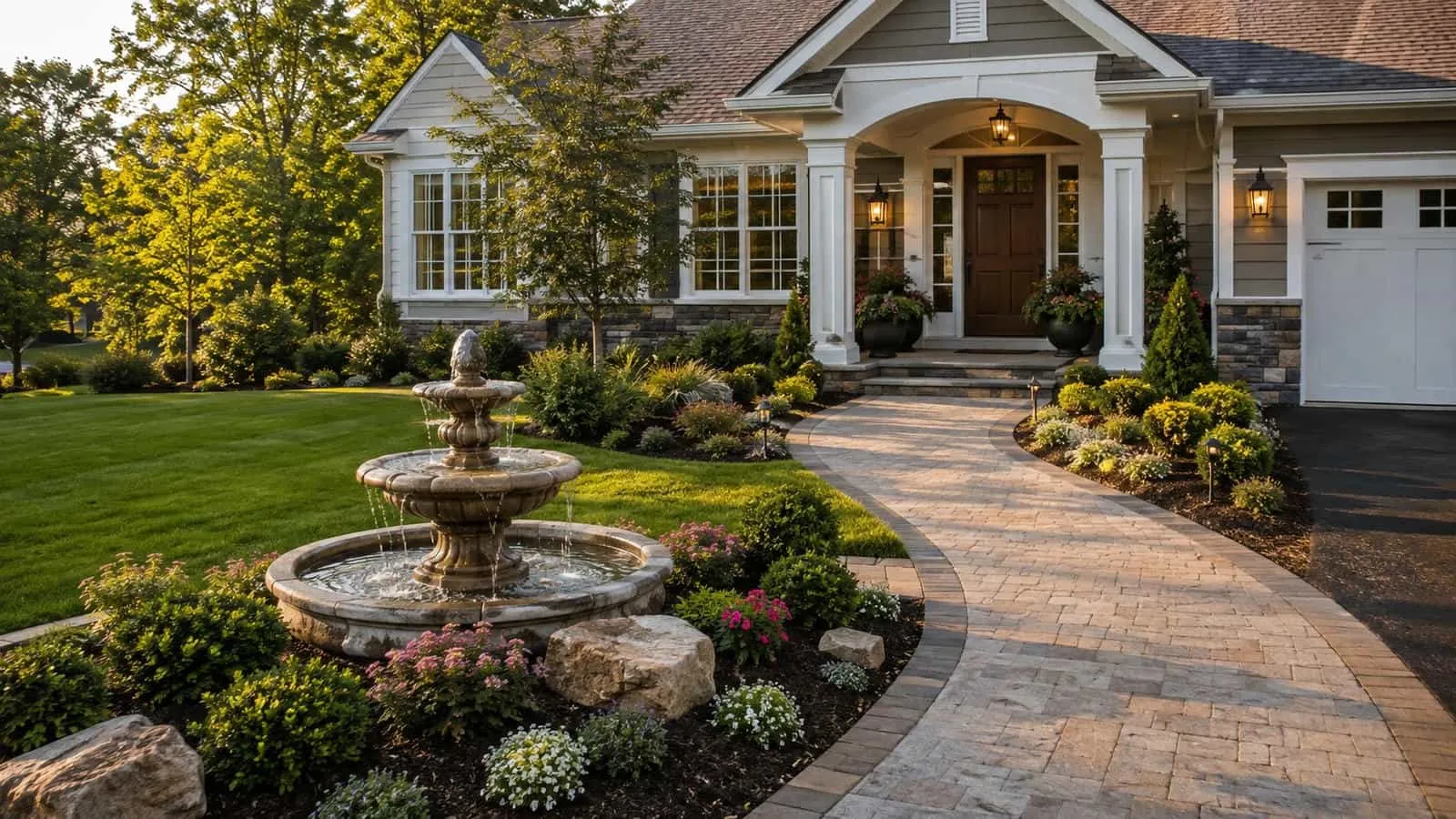
💦🏡 A front yard fountain is experienced differently from a backyard water feature because it becomes part of the home's public face and daily arrival experience. It may be viewed from the street, sidewalk, driveway, front walkway, porch, windows and neighbouring properties before anyone stands beside it. The strongest design balances fountain type, size, architecture, sightlines, splash, sound, plants, hardscape, power access and four season appearance. Use this guide to compare front yard water fountains for small and large homes, entrance gardens, walkways, circular drives, formal landscapes, natural planting and modern residential design.
📌 Front Yard Water Fountain Ideas for Curb Appeal, Entrances, Walkways and Landscaping
Explore front yard water fountain ideas for welcoming entrances, stronger curb appeal and practical residential landscaping. Compare fountain types, home scale, placement, plants, hardscape, sound, lighting and buying decisions for small front yards, entrance gardens, walkways and other public-facing areas of the home. Select an image below to explore that front yard fountain topic.


🏆 Best Front Yard Water Fountains for Curb Appeal, Entrances and Residential Landscaping
A front yard water fountain has a different job than a fountain hidden inside a backyard retreat. It becomes part of the home's first impression and may be seen from the street, sidewalk, driveway, front walkway, porch and interior windows. The fountain therefore needs enough visual presence to register from normal viewing distances without becoming so large that it competes with the house. A compact urn or bubbling fountain may be enough for a narrow entrance garden, while a wider lawn or formal approach may support a tiered fountain, pedestal design or larger architectural feature.
Placement is just as important as fountain style. A beautiful fountain can become frustrating when it narrows the walking route, sends water onto porch steps, interferes with driveway movement or disappears behind mature shrubs. The strongest front yard fountain ideas consider how people actually approach the home, where deliveries arrive, how lawn and snow equipment move through the property and where water can splash safely. The fountain should strengthen the entrance view while leaving the front door, house numbers, pathways and important sightlines easy to see.
Landscaping should frame the fountain instead of burying it. Low shrubs, ornamental grasses, perennials, evergreens, decorative gravel, river rock and pavers can connect moving water with the surrounding front garden, but mature plant size and service access need to be considered from the beginning. Because a front yard fountain remains visible from the street even when it is not operating, the design should also consider lighting, power access, seasonal appearance and how the fountain looks during winter shutdown.
If you are still comparing fountain styles before narrowing the choice to a front yard setting, explore our complete best water fountains guide for a broader comparison of fountain types, placements, power options, water movement and homeowner needs.
Compare urn, bubbling, tiered, pedestal and architectural fountains sized for front entrances, garden beds and visible approach areas.
Choose a fountain that creates a welcoming focal point while keeping walkways, sightlines and everyday access comfortable.
🛒 Compare Front Yard Water Fountains for Entrances on Amazon
🏡 What Makes a Front Yard Water Fountain Work Well?
- Match the Fountain to the Home: Choose a fountain with enough height and visual weight to suit the house, lawn and viewing distance without overwhelming the architecture.
- Protect the Arrival Route: Keep the front door, walkway, porch steps, driveway and delivery path open while allowing enough room around the fountain for comfortable movement.
- Control Splash near Hard Surfaces: Position water movement so wind and pump flow do not regularly wet sidewalks, steps, driveways or other surfaces people use every day.
- Use Landscaping as a Frame: Combine low planting, stone and hardscape around the fountain while preserving open sightlines and enough space for plants to reach mature size.
- Think Beyond the Street View: Check how the fountain looks from the driveway, walkway, porch and important interior windows instead of judging it from only one position.
- Plan for Sound and Power: Decide whether the fountain should create gentle entrance sound or help soften street noise, then plan electric or solar power without leaving distracting cords or panels in prominent views.
- Keep Maintenance Practical: Leave enough access for refilling, cleaning, pump service and seasonal shutdown without having to remove plants or decorative stone every time the fountain needs attention.
There is no single fountain form that is best for every property. Traditional homes may work beautifully with tiered or pedestal fountains, Mediterranean inspired landscapes often pair naturally with urn fountains, contemporary homes can support simple geometric designs, and naturalistic front gardens may favor bubbling rock or pondless features. The goal is not to choose the most dramatic fountain. It is to choose the water feature whose scale, movement, sound and character make the entire front landscape feel more intentional.
👀 Garden Delights Front Yard Viewing Test: Before choosing the final fountain location, stand at the street or sidewalk, driveway, beginning of the front walkway and front door. The fountain should strengthen the view from each important position without hiding the entrance, crowding the approach or appearing disconnected from the house.
Section Summary Snapshot: The best front yard water fountain should complement the house, improve curb appeal and remain practical during everyday use. Match fountain form and scale with the architecture, entrance, lawn and viewing distance. Protect walkways and driveways from splash, preserve important sightlines, frame the fountain with restrained landscaping and keep power, lighting, maintenance access and seasonal appearance in the plan from the beginning.
🔎 Front Yard Water Fountain Scenario Engine: Match the Right Fountain to Your Home, Entrance and Landscape
The best front yard water fountain depends on home size, architecture, entrance layout, viewing distance, available landscape space, desired water sound, splash control, power access and maintenance needs. Use these seven residential scenarios to compare fountain forms, scale, placement and practical tradeoffs before choosing a water feature for your front entrance or landscape.
Start with the property rather than the fountain style you like most. A compact urn can look balanced beside a small entrance but disappear across a large lawn, while a broad tiered fountain can create a strong focal point on a wide property but overwhelm a modest home. These scenarios help match the fountain to real front yard conditions.
Open the scenario that best matches your property. Compare fountain type, visual scale, placement, water sound, landscaping and everyday access, then use the caution at the end of each scenario to avoid the most common design mistake.
🏡 Best Front Yard Water Fountain for a Small Suburban Home
Best choice: Compact urn fountain, bubbling fountain or small pedestal fountain with controlled water movement
A small front yard needs enough water movement to create curb appeal without making the lawn, garden bed or entrance feel crowded. Compact urn fountains, bubbling bowls and modest pedestal fountains usually provide a better visual fit than wide basins or tall multi tier designs. Urn fountains are especially useful near entrances because their upright vessel shape creates visible height without requiring a broad footprint, while bubbling or overflowing water can add movement without overwhelming the walkway. For a deeper look at choosing the right vessel size, water movement, material, pump, reservoir and placement, explore our front entrance urn fountain ideas. Keep surrounding planting low so the fountain remains visible from the sidewalk and driveway.
- 📏 Scale: Choose a compact fountain with restrained height, basin width and visual weight.
- 📍 Placement: Use a front garden bed, walkway bend or porch approach with enough open space around the feature.
- 🚶 Access: Protect the front door, house numbers and comfortable walking clearance.
⚠️ Watch For: A fountain that looks attractive close up can still appear oversized when viewed against a modest house from the street.
🚪 Front Entrance Water Fountain for a Narrow Walkway or Entry Garden
Best choice: Wall fountain, slim urn fountain or compact vertical fountain with low splash
Narrow front entrances benefit from vertical fountain forms that create movement without using valuable walking space. A wall fountain or slender urn can fit beside an entry path while leaving more room for visitors, packages and daily movement. Keep water drops short and controlled so spray does not reach steps, paving or the door threshold.
- ⛲ Form: Choose a wall fountain, narrow urn or slim architectural fountain.
- 💧 Splash: Use controlled flow and dependable basin return near paved surfaces.
- 📦 Clearance: Preserve space for visitors, deliveries, strollers and mobility access.
⚠️ Watch For: Mature plants, wet pavement and decorative containers can slowly reduce an already narrow walking route.
🏛️ Front Yard Fountain for a Traditional or Symmetrical Home
Best choice: Tiered fountain, pedestal fountain or classic basin fountain that supports the architecture
Traditional homes often work well with fountains that reinforce architectural balance. Tiered, pedestal and classical basin fountains can complement centered walkways, formal planting beds and balanced window arrangements. The fountain does not have to sit exactly on the centerline if an offset garage, entrance or driveway changes the visual weight of the property.
- 🏠 Architecture: Traditional, Colonial and formal farmhouse homes often suit classic fountain forms.
- ⚖️ Balance: Compare the entrance axis, windows and planting beds before choosing centered or offset placement.
- 🌿 Landscaping: Use structured shrubs, restrained perennials or low hedges to frame the fountain.
⚠️ Watch For: Forcing perfect symmetry onto an asymmetrical house can make the front landscape feel less balanced rather than more formal.
🏙️ Modern Front Yard Water Fountain for Contemporary Architecture
Best choice: Geometric fountain, modern urn, architectural wall fountain or simple bubbling basin
Modern front yards usually look strongest with clean fountain shapes, controlled water movement and a limited material palette. Geometric basins, tall vessels and simple wall features can connect naturally with contemporary architecture. Open space, broad pavers, decorative gravel and repeated ornamental grasses often make the fountain feel more intentional than dense decorative planting.
- ◼️ Form: Use simple geometric shapes, tall vessels or restrained bubbling features.
- 🌊 Water Movement: Favor controlled bubbling, sheet flow or clean vertical movement.
- 💡 Night View: Use subtle lighting that reinforces fountain shape without creating glare from the street.
⚠️ Watch For: Too many materials, ornate statuary or dense planting can weaken the clean relationship between a modern fountain and contemporary architecture.
🚗 Front Yard Water Fountain for a Large Lawn or Circular Driveway
Best choice: Medium or large tiered fountain, broad pedestal fountain or architectural statement fountain
Wide front yards and circular driveways can support stronger fountain scale because the feature is often viewed from farther away and from several directions. A larger tiered fountain or broad basin can anchor an open landscape where a compact fountain would disappear. The house, setback and surrounding planting should still determine the final visual size.
- 👁️ Viewing Distance: Choose enough height and basin width for the fountain to register from the street and driveway.
- 🚘 Vehicle Access: Protect turning radius, backing visibility, delivery routes and snow clearing space.
- 🌳 Landscape Balance: Use broad planting beds or open lawn so the fountain feels connected rather than isolated.
⚠️ Watch For: A large property does not automatically need the largest fountain available. Scale still has to relate to the house and viewing distance.
☀️ Solar Front Yard Water Fountain Where Electrical Power Is Difficult
Best choice: Compact solar fountain with dependable sunlight and a discreet solar panel location
Solar fountains can simplify installation when an outdoor outlet is distant or electrical work would disturb finished landscaping. Compact bubbling fountains, birdbath fountains and urn fountains usually work better with solar pumps than large water features that need strong continuous flow. Check both sun exposure and the street view before deciding where the panel will sit.
- ☀️ Sun Exposure: Check shade from the house, porch roof, trees and mature shrubs.
- 👀 Panel Appearance: Keep the solar panel functional without making it the most visible object near the entrance.
- 🌙 Operation: Decide whether daytime use is enough or whether evening operation requires another power option.
⚠️ Watch For: Choosing the fountain first and trying to hide the solar panel later can reduce sunlight, water flow and curb appeal.
🧽 Lower Maintenance Front Yard Fountain for Easier Seasonal Care
Best choice: Simple bubbling fountain, compact urn or controlled basin fountain with easy pump access
A lower maintenance front yard fountain should use simple water movement and remain easy to reach for refilling, cleaning and seasonal shutdown. Bubbling fountains and straightforward urn designs often have fewer exposed levels than elaborate tiered fountains. Keep the feature away from heavy leaf drop, lawn clippings and road debris when possible.
- 🍂 Debris Exposure: Avoid locations directly beneath messy trees or beside areas that collect blowing leaves.
- 🔧 Service Access: Keep the pump, refill area and electrical connections easy to reach.
- ❄️ Seasonal Planning: Allow space for draining, pump removal and snow clearance in cold climates.
⚠️ Watch For: Easy care does not mean maintenance free. Water level, debris, pump condition and seasonal shutdown still require attention.
✅ How to Choose Between Front Yard Water Fountain Scenarios
Start with the property conditions that are hardest to change. Available space, house architecture, viewing distance, walkway and driveway clearance, sunlight and maintenance access should guide the decision before decorative style. Then choose the fountain form, water sound and landscaping that fit those limits.
- 📏 Match Fountain Scale to the Property: Compact entrances need restrained fountain size, while wider lawns and longer setbacks can support stronger visual presence.
- 🏠 Match Fountain Character to the Home: Let architecture, entrance layout and surrounding landscape guide whether the fountain should feel classic, natural or modern.
- 🚶 Protect Everyday Use: Keep walkways, driveway movement, deliveries, lawn equipment, snow clearing and maintenance access practical after installation.
The strongest front yard water fountain is not automatically the largest or most decorative option. It is the fountain that looks connected to the home, works from important viewing angles and remains comfortable to live with as plants mature, weather changes and maintenance becomes part of normal ownership.
✅ Scenario Engine Recommendation: If two scenarios describe your property, combine their practical requirements. A small modern front yard, for example, may need the compact footprint of the small yard scenario together with the clean fountain form and restrained landscaping of the contemporary home scenario.
⛲ Types of Front Yard Water Fountains for Entrances, Gardens, Walkways and Curb Appeal
The best types of front yard water fountains include tiered fountains, urn fountains, bubbling fountains, wall fountains, birdbath fountains, cascading and pondless water features, solar fountains and modern architectural designs. The right choice depends on home architecture, front yard size, viewing distance, entrance layout, water movement, splash control, landscaping and how much visual presence the fountain needs from the street.
Choosing a front yard fountain type is less about finding the most dramatic water feature and more about choosing a form that belongs with the property. Fountain height, basin width, water movement and visual weight should relate to the house, lawn, walkway and normal viewing distance. A fountain that looks balanced beside a cottage entrance may disappear across a broad lawn, while a large tiered design can overpower a modest suburban home.
Front yards also create practical limits that may not be obvious in product photographs. Water can reach sidewalks and steps, broad basins can narrow an entrance route, mature shrubs can hide low fountains and visible solar equipment can weaken curb appeal. Compare each fountain type by scale, architecture, sound, splash, placement, power and maintenance before deciding which form best fits the property.
Compare tiered, urn, bubbling, wall, birdbath, pondless, solar and architectural fountains for different front yard layouts and home styles.
Find a fountain type that adds welcoming curb appeal without creating excess splash, crowding or maintenance problems.
🛒 Explore Front Yard Fountain Types on Amazon
⚖️ Compare Front Yard Water Fountain Types for Curb Appeal, Sound, Scale and Placement
Choosing the best front yard water fountain starts with matching fountain form, water movement, residential scale and placement to the home and entrance. Tiered, urn, bubbling, wall, birdbath, pondless, solar and modern architectural fountains create different levels of visual presence, splash, sound and curb appeal. Compare how each fountain type behaves near walkways, garden beds, driveways and front doors so the finished water feature creates a welcoming focal point without becoming difficult to maintain.
| ⛲ Fountain Type | 🏡 Best Front Yard Placement | 👀 Scale and Visual Presence | 💦 Water Movement and Sound | Best Choice and Main Planning Consideration |
|---|---|---|---|---|
| Tiered Fountain | Works well in formal entrance gardens, open front lawns and circular driveway centers where the fountain can be viewed from several directions. | Creates medium to strong visual mass because basin width, fountain height and multiple tiers make it easy to see from the street. | Layered cascading water creates a noticeable falling water sound that can add movement and help soften moderate street noise near an entrance. | Ideal for homeowners seeking a traditional front yard focal point with strong curb appeal, but the fountain should be scaled carefully to avoid overpowering a modest home or spreading splash onto pavement. |
| Urn Fountain | Fits naturally in front entrance garden beds, beside walkways and within Mediterranean, cottage or transitional residential landscapes. | Provides compact to medium vertical presence without requiring the broad footprint of a large basin or multi tier fountain. | Gentle bubbling or overflowing water creates a calm, steady sound and a smooth reflective surface around the urn. | Often chosen by homeowners who want an elegant front entrance water fountain without using much ground space, although smaller urns may need stronger planting or hardscape contrast to remain visible across a deep lawn. |
| Bubbling Fountain | Works well in small front yards, quiet entry gardens, naturalistic planting beds and locations close to a porch or front walkway. | Usually has low to medium visual presence, making it easier to integrate into compact residential landscaping without dominating the entrance. | Soft bubbling water produces gentle sound, limited splash and subtle surface movement that works especially well near close listening areas. | Perfect for homeowners seeking a peaceful low splash front yard fountain, but the feature needs enough stone, plant or background contrast to remain noticeable from the sidewalk or street. |
| Wall Fountain | Best suited to narrow front entrances, courtyards, porch approaches and blank exterior walls where ground space is limited. | Creates medium vertical presence while keeping most of the fountain footprint close to the wall and outside active walking areas. | Controlled trickling water or a narrow sheet flow creates a steady sound that can feel calm without producing the broad splash of an open basin. | Commonly chosen for compact entrances where homeowners want moving water without sacrificing walkway space, but wall condition, drainage, splash distance and service access should be checked before installation. |
| Birdbath Fountain | Fits cottage front gardens, wildlife friendly landscapes, pollinator planting areas and smaller residential yards with softer landscape character. | Creates low to medium visual presence and usually feels lighter than a large architectural or tiered fountain. | Gentle bubbling or low spray creates soft water movement while also making the basin more active and visually inviting. | Ideal for homeowners who want a front yard fountain with wildlife appeal and a relaxed garden feeling, although its smaller scale may provide too little architectural presence against a broad or two story facade. |
| Cascading or Pondless Feature | Works especially well on sloped front yards, naturalistic entrance landscapes, larger planting beds and areas where stone can become part of the design. | Visual presence is highly flexible because stream length, stone size, water drop and surrounding landscape can be adjusted to the property. | Layered water movement can range from a gentle trickle to a stronger waterfall sound that provides noticeable acoustic masking near streets or driveways. | Often chosen by homeowners seeking a natural front yard water feature rather than a traditional fountain, but drainage, reservoir access, splash control, grading and hidden pump service need careful planning. |
| Solar Fountain | Best for sunny front gardens, open entrance beds and locations where routing permanent electrical power would be difficult or visually disruptive. | Usually compact to medium in scale, although the fountain and solar panel should be considered together when judging the street view. | Water movement is generally gentle to moderate and may change as sunlight, shade or battery capacity affects pump performance. | Frequently selected by homeowners wanting flexible front yard fountain placement without permanent wiring, but direct sunlight, panel visibility and dependable water flow should be evaluated before choosing the final location. |
| Modern Architectural Fountain | Pairs well with contemporary homes, minimalist entrance gardens, geometric walkways and front yards built around clean hardscape lines. | Creates medium to strong visual presence through simple geometry, smooth surfaces and deliberate contrast with surrounding planting. | Controlled bubbling, narrow spillways or sheet flow produce clean water movement that reinforces the restrained character of modern landscape design. | Best for homeowners seeking a polished contemporary front yard focal point, but keeping materials, lighting and nearby decoration simple helps preserve visual rhythm instead of making the entrance feel busy. |
| The best front yard water fountain is not determined by style alone. Match fountain type with home scale, entrance placement, viewing distance, water sound, splash control, landscape character and maintenance access so the feature creates welcoming curb appeal while remaining practical from the street, walkway, driveway and front door. | ||||
👀 Front Yard Fountain Type Test: Judge each fountain from the sidewalk, driveway and front door rather than only from beside the basin. The best fountain type should remain visible at normal viewing distance, complement the architecture and landscaping, and still leave the house as the main visual anchor.

🏡 Front Yard Water Fountain Types by Home Style, Yard Size and Landscape
The fountain types below solve different front yard needs. Compare each option by home architecture, available space, entrance layout, viewing distance, water movement, splash, landscaping and maintenance so you can narrow the choices before focusing on material or decorative finish.
🏛️ Tiered Front Yard Water Fountains for Formal Curb Appeal
🏛️ Tiered Front Yard Water Fountains for Traditional Homes, Lawns and Circular Drives
Tiered front yard water fountains provide strong visual presence through height, repeated bowls and falling water. They work especially well with traditional architecture, formal entrances, broad lawns and circular driveways where the fountain can be viewed from a distance without crowding the house or entrance.
Problem A tiered fountain can overpower a modest home or appear undersized when viewed across a large lawn.
Why it happens Tiered fountains carry more visual mass than compact fountain forms, so height, basin width, house scale and viewing distance strongly affect proportion.
Solution Compare total fountain size with the home and setback while leaving enough open space for the full tiered shape, splash zone and surrounding landscape to remain visible.
Compact two tier fountains can complement smaller traditional homes and cottage entrances, while larger balanced tiered fountains may suit wider properties and formal approaches. Keep shrubs and vehicles from visually crowding the lower basin, and confirm that falling water stays clear of front walks, steps and driveway traffic.
- 📏 Match Scale to Viewing Distance: Use enough height for the fountain to register from the street without allowing it to dominate the house.
- 🏠 Support Formal Architecture: Traditional, Colonial and symmetrical homes often provide a natural backdrop for tiered fountain forms.
- 💦 Allow a Safe Splash Zone: Keep falling water far enough from walkways, vehicles and steps for wind driven spray.
👀 Tiered Fountain Tip: Mark the proposed fountain height and basin width before installation, then view the outline from the street and front door. This makes scale problems easier to notice before the fountain becomes a permanent focal point.
🏺 Urn Front Yard Water Fountains for Entry Gardens and Walkways
🏺 Urn Front Yard Water Fountains for Entrances, Walkways and Compact Garden Beds
Urn front yard water fountains create vertical interest without requiring the broad footprint of a large basin. They fit especially well beside entrance walkways, porch approaches and front garden beds where gentle bubbling or spilling water can provide a clear focal point while preserving walking and planting space.
Urn fountains can complement traditional, cottage, Mediterranean and transitional homes depending on their shape and finish. Their smaller footprint makes them useful near an entrance, but they need enough background contrast to remain visible. Low plants near the base and taller shrubs behind the fountain can frame the vessel without hiding it as the landscape matures.
- 🚪 Use Urns near the Main Approach: A walkway bend, porch approach or defined entry garden gives the vertical form stronger purpose.
- 💧 Choose Controlled Water Movement: Gentle bubbling and spilling water usually create less splash near front walks and steps.
- 🎨 Match Finish to the Home: Stone, cast stone and ceramic finishes can support traditional, Mediterranean or more contemporary entrance styles.
🏺 Urn Fountain Tip: Avoid placing a compact urn alone in the middle of a broad lawn. A walkway, garden bed, wall or porch backdrop gives the fountain stronger visual context.
💦 Bubbling Front Yard Water Fountains for Gentle Water Movement
💦 Bubbling Front Yard Water Fountains for Small Yards, Natural Landscaping and Quiet Curb Appeal
Bubbling front yard water fountains create gentle movement, softer sound and lower splash than taller cascading designs. Bubbling rocks, bowls and low basin fountains work especially well in small front yards and natural entrance gardens where moving water should add interest without becoming the dominant architectural feature.
Because bubbling fountains often sit lower in the landscape, location and background contrast are important. Position them near a walkway, porch or garden bed where the water can be viewed at closer range. Pale gravel, river rock or restrained planting can help a low fountain remain visible from the driveway and sidewalk.
- 🌊 Keep Water Movement Gentle: Bubbling flow provides visible water with less splash than a tall drop or layered cascade.
- 🪨 Create Useful Contrast: Stone, gravel and low planting can define the fountain and keep it from disappearing into the garden.
- 🔧 Protect Pump Access: Leave enough open space for cleaning and service after nearby plants reach mature size.
💦 Bubbling Fountain Tip: If the fountain will mainly be enjoyed from the front walk or porch, closer placement can provide more visual impact than increasing fountain height.
🧱 Wall Front Yard Water Fountains for Narrow Entrances
🧱 Wall Front Yard Water Fountains for Compact Entrances, Courtyards and Architectural Backdrops
Wall front yard water fountains use vertical space to create visible water movement without occupying the centre of a walkway or garden bed. They work well beside narrow entrances, entry courtyards and blank exterior walls where a broad freestanding fountain would reduce usable space.
Wall fountains can create strong entrance character, but the wall becomes part of the water system. Surface material, splash, drainage, basin position and service access all matter. Keep the fountain outside the normal door swing and delivery route, and make sure water returns cleanly to the basin rather than repeatedly reaching the wall or pavement.
- 🚪 Protect Entrance Clearance: Keep the fountain outside door swings, steps and the main walking route.
- 💧 Control Wall and Pavement Splash: Choose a basin and water pattern that contain normal spray and runoff.
- 🏠 Use the Wall as Part of the Design: Match fountain geometry and finish with the architecture so the feature still looks intentional when the pump is off.
🧱 Wall Fountain Tip: View the fountain as a permanent architectural feature, not just moving water. It remains visible during winter shutdown and other periods when the pump is not operating.
🐦 Birdbath Front Yard Fountains for Wildlife Friendly Gardens
🐦 Birdbath Front Yard Water Fountains for Cottage Gardens, Wildlife and Gentle Water Movement
Birdbath front yard fountains combine gentle water movement with wildlife interest and relaxed garden character. They work especially well in cottage gardens, pollinator friendly landscapes and smaller front yards where birds, planting and close range viewing are more important than strong architectural presence from the street.
Place a birdbath fountain where the basin can be seen from a front window, walkway or garden viewing area rather than isolated in a broad lawn. Nearby shrubs or small trees can provide bird cover, but planting should not hide the basin or make routine cleaning difficult.
Homeowners who want to combine moving water with bird activity can explore our complete birdbath water fountain guide for deeper guidance on basin design, wildlife use, water movement, placement, landscaping, cleaning and four season planning.
- 🐦 Provide Accessible Water: Choose a basin that offers practical drinking and bathing areas for visiting birds.
- 🌿 Keep Nearby Shelter within Reach: Shrubs and small trees can provide cover without crowding the fountain.
- 🧽 Make Cleaning Easy: Wildlife use makes regular water changes and basin cleaning especially important.
🐦 Birdbath Fountain Tip: Let this type create a smaller garden moment rather than forcing it to become the main front yard focal point.
🌊 Cascading and Pondless Front Yard Water Features for Stronger Water Movement
🌊 Cascading and Pondless Front Yard Water Features for Slopes, Natural Entrances and Stronger Water Sound
Cascading and pondless front yard water features create stronger movement and sound than simple bubbling fountains. Small waterfalls, disappearing streams and pondless entrance features work especially well on slopes and in naturalistic landscapes where stone, gravel and planting can integrate moving water without creating an exposed pond.
Pondless systems add another layer below the visible waterfall or stream because the pump, plumbing, collection area and water reservoir are concealed within the landscape. For a complete explanation of those systems, explore our complete pondless water fountain guide .
Problem A front yard cascade can become too loud, wet or visually dominant when it is placed too close to a sidewalk, front door or narrow entrance.
Why it happens Greater water drop and stronger pump flow increase sound, splash and visible movement, while pondless systems also require hidden reservoir and service access.
Solution Use restrained waterfall height, controlled flow and enough landscape space for the water to return naturally while keeping pumps and reservoir access practical.
Existing grade can help a short stone cascade look more believable than a waterfall built on an oversized artificial mound. Use natural stone, gravel and low planting to guide the eye along the water path while keeping wet areas away from the main walking route.
- ⛰️ Use Natural Grade when Possible: Existing slope can create convincing water movement without forcing unnecessary height.
- 🎧 Control Water Drop and Sound: Several modest drops often create a more comfortable entrance sound than one tall fall.
- 🔧 Preserve Hidden Service Access: Conceal pumps and reservoirs without making maintenance difficult.
🌊 Pondless Front Yard Tip: Let the shape of the property guide the water path. A shorter cascade that follows the landscape often looks more natural and remains easier to service.
☀️ Solar Front Yard Water Fountains for Sunny Gardens and Flexible Placement
☀️ Solar Front Yard Water Fountains for Entry Gardens, Small Fountains and Flexible Power
Solar front yard water fountains provide flexible placement where electrical power is difficult or visually disruptive. Compact urn fountains, bubbling bowls and birdbath fountains often work well with solar pumps when the front garden receives dependable sunlight and the panel can be positioned without weakening curb appeal.
Check sunlight before choosing the final fountain location. House shadows, porch roofs, trees and mature shrubs can change solar exposure through the day. The panel should also be viewed from the street and front door so it does not become more noticeable than the fountain itself.
- ☀️ Confirm Useful Sun Exposure: Observe the panel location through several parts of the day before installation.
- 💦 Match Flow to Available Power: Gentle bubbling and moderate circulation generally suit compact solar fountains better than demanding cascades.
- 👀 Keep the Panel Visually Discreet: Balance solar performance with an attractive street and entrance view.
☀️ Solar Fountain Tip: Plan the fountain and solar panel together. Choosing the fountain location first and solving power afterward can create weak water movement or an awkward panel position.
◼️ Modern Front Yard Water Fountains for Contemporary Homes
◼️ Modern Front Yard Water Fountains for Contemporary Architecture and Minimalist Landscaping
Modern front yard water fountains use simple geometry, controlled water movement and restrained materials to complement contemporary architecture. Rectangular basins, smooth vessels, architectural spillways and clean bubbling forms work especially well with large pavers, gravel, structural grasses and open space.
Modern fountain design depends as much on what is left out as what is added. Limit the number of materials and plant varieties, repeat shapes already found in the house and leave enough negative space for the fountain geometry to remain clear from the street and entrance.
- ◼️ Choose Simple Geometry: Rectangular, cylindrical and clean vertical forms generally suit contemporary architecture better than ornate fountain shapes.
- 🪨 Limit the Material Palette: Repeat paving, gravel and finishes already used around the house.
- 🌾 Use Structural Planting: Ornamental grasses and restrained evergreens can support the fountain without creating visual clutter.
◼️ Modern Fountain Tip: Leave generous open space around the water feature. Negative space helps simple fountain geometry appear more intentional and architectural.
🏡 Choose Front Yard Fountain Form Before Decorative Finish
Start by deciding whether the front yard needs height, a compact footprint, vertical wall placement, gentle bubbling or stronger water movement. Once the correct fountain form is clear, material and finish become easier decisions. An attractive finish cannot correct a fountain that is too large, too small or poorly suited to the entrance.
Fountain categories can overlap. An urn fountain may also use solar power, a wall fountain may create cascading water and a bubbling rock may use a hidden pondless reservoir. Think of fountain type as a combination of visible form, water movement, power and how the feature interacts with the property rather than as a rigid category.
Homeowners who want to compare fountain construction, forms and operating styles beyond front yard applications can explore the complete guide to different water fountain types . This section stays focused on the decision that matters in a front yard: whether the fountain form strengthens the entrance, architecture, landscape and curb appeal of the home.
Compare tiered, urn, wall, bubbling, cascading and other outdoor fountain styles for different front yard layouts and home designs.
Choose a fountain form that creates welcoming curb appeal while fitting your entrance, landscape and available space.
🛒 Compare Front Yard Fountain Types on Amazon
Section Summary Snapshot: Front yard water fountain types should be chosen by property scale, architecture, entrance layout, viewing distance, water movement and practical access. Tiered fountains create stronger formal presence, urn and wall fountains fit tighter entrances, bubbling and birdbath fountains provide gentler garden character, cascading and pondless features add stronger movement, while solar and modern fountains answer specific power and architectural needs.
📐 Front Yard Water Fountain Size and Scale for Homes, Lawns, Entrances and Curb Appeal
Fountain size is not only about measuring height. Two fountains with the same height can feel completely different if one has a broad basin and heavy stone tiers while the other has a narrow urn shape. Visual mass, width, water movement and surrounding open space all influence how large the fountain appears. A tall narrow fountain can fit a compact entrance better than a shorter fountain with a very broad basin.
The strongest front yard fountain scale also changes with viewing distance. A small bubbling bowl may look attractive from five or ten feet away but disappear when seen across a wide lawn from the street. A larger tiered fountain may look balanced from the road but become overwhelming if placed directly beside a narrow porch or front walkway. Always judge fountain size from the places where people will actually see it.
Compare compact, narrow, medium and larger fountain designs for different home proportions, lawn widths and entrance viewing distances.
Choose a fountain size that feels welcoming from the street without overwhelming the walkway, porch or surrounding landscape.
🛒 Compare Front Yard Fountain Sizes on Amazon
⚖️ Compare Front Yard Water Fountain Size by Home Scale, Viewing Distance and Welcoming Placement
Choosing the right front yard water fountain size means comparing house scale, lot width, setback, viewing distance, basin footprint and surrounding landscape before deciding how much visual presence the feature needs. A compact urn or bubbling fountain can create a calm entrance near a walkway, while a larger tiered or architectural fountain may suit a broad lawn, two story facade or circular driveway where the water feature must remain visible from farther away. The goal is balanced curb appeal, comfortable placement and enough open space for water movement, planting and maintenance without making the fountain feel lost or oversized.
| 🏡 Front Yard Setting | 👀 Viewing Distance and Scale | 📐 Recommended Fountain Presence | ⛲ Fountain Forms That Fit | Best Size Choice and Planning Guidance |
|---|---|---|---|---|
| Compact home with narrow entrance | Close viewing from the sidewalk, porch or short front walkway makes even a small fountain visually noticeable. | Use a restrained small fountain with a narrow footprint and enough negative space to keep the entrance open. | Urn fountain, wall fountain or compact bubbling bowl | Ideal for homeowners looking for a small front entrance fountain that adds gentle movement without narrowing the walkway or making a modest facade feel crowded. |
| Small suburban front yard | Close to moderate viewing distance usually allows a compact water feature to remain visible from both the house and street. | Choose small to medium visual mass with enough height or contrast to register without becoming the dominant feature. | Compact tiered fountain, urn fountain or bubbling fountain | Often chosen by homeowners who want noticeable front yard curb appeal while keeping lawn space, garden beds and visitor movement comfortable around the entrance. |
| Average suburban home and lawn | Moderate viewing distance from the street and driveway requires more height, basin width or surrounding contrast than a close entry garden. | A medium scale fountain usually provides enough visual presence to connect the house, lawn and entrance without overpowering them. | Tiered fountain, pedestal fountain, urn fountain or architectural fountain | Perfect for homeowners seeking a balanced residential front yard fountain that is visible from the street while still feeling proportional to a typical one or two story home. |
| Wide two story home | Moderate to long viewing distance and a taller facade increase the amount of visual mass needed for the fountain to feel connected to the architecture. | Use medium to strong presence through additional height, a broader basin or a more substantial fountain form. | Tiered fountain, broad pedestal fountain or larger urn fountain | Commonly suited to homeowners comparing larger front yard fountains that can hold their visual weight against a wide two story facade without looking undersized from the street. |
| Large open front lawn | Long viewing distances reduce the apparent size of the fountain and make small features easier to lose within open lawn. | Choose strong visual presence with enough height, width and landscape support to create a clear focal point from distant approach views. | Larger tiered fountain, broad basin fountain or statement water feature | Best for homeowners who want a prominent front lawn fountain, but surrounding planting, stone or hardscape should connect the feature to the property so it does not appear isolated. |
| Circular driveway | Multiple viewing distances and changing vehicle angles mean the fountain must read clearly from several directions without creating a traffic obstacle. | Medium to strong presence works well when the feature has enough scale to anchor the drive while preserving turning and passenger clearance. | Tiered fountain, pedestal fountain or architectural fountain | Ideal for homeowners planning a circular driveway fountain where curb appeal matters from several approach angles, provided basin width and surrounding landscaping stay outside vehicle movement zones. |
| Enclosed front garden | Close viewing and surrounding walls or planting make fountains feel larger than they would in an open lawn. | Use small to medium scale with controlled water movement and enough breathing room between the fountain, walls and pathway. | Wall fountain, urn fountain, bubbling fountain or compact cascading feature | Frequently chosen for intimate front gardens where homeowners want a peaceful water feature close to the entrance without overwhelming the confined space or creating excessive splash. |
| The right front yard fountain size depends more on visual proportion and viewing distance than on a single height rule. Match fountain height, basin width and overall visual mass with the home, lawn, entrance and surrounding landscape so the water feature remains visible from important approach views while preserving walkway clearance, open space and welcoming curb appeal. | ||||
👀 Garden Delights Scale Test: Mark the proposed fountain footprint on the ground and estimate the finished height with a stake, pole or temporary marker. Then view the location from the sidewalk, driveway, front walkway, porch and an important front window. This reveals scale problems much more clearly than judging a fountain from product photographs alone.

📏 Fountain Height, Basin Width and Visual Mass Matter Together
Fountain height receives most of the attention, but width can matter just as much in a front yard. A broad pedestal basin can occupy a large amount of visual and physical space even when the fountain is not especially tall. Wide basins also need more clearance from walkways, driveways and planting because falling water and wind can increase the splash area.
Visual mass describes how substantial the entire fountain feels. Thick stone, multiple tiers, large bowls and dark finishes can make a fountain appear heavier, while slim urns, narrow wall fountains and simple vertical forms can feel lighter. This is why a homeowner should not choose a front yard fountain from height alone.
Problem A fountain looks perfectly sized in a showroom or close photograph but appears too small or too large after installation.
Why it happens Product photographs rarely show the fountain beside the actual house, lawn, entrance, mature plants and real viewing distance that determine scale.
Solution Compare the complete fountain footprint, height and visual mass with the home and landscape before buying, then judge the planned location from every major approach to the property.
🏠 Match Front Yard Fountain Scale to the House
- 🏡 Small Single Story Homes Use restrained fountain forms that support the entrance without rising so high or spreading so wide that they compete with windows, porch features or the front door.
- 🏠 Two Story Homes Taller facades can usually support more fountain height and visual weight, especially when the water feature is viewed from a moderate distance across the lawn or driveway.
- 🚪 Enclosed Entrance Gardens Reduce scale when walls, steps, planters and foundation planting already create a visually full space. A compact urn or wall fountain may have enough presence without adding a large basin.
- 🌳 Wide Open Front Lawns Increase visual presence when the fountain must be seen across a longer setback, but support the feature with planting, stone or a defined garden bed so it does not appear stranded in open grass.
- 🪟 Consider Window Relationships Avoid placing a tall fountain where it blocks an important window or interrupts the architectural pattern of the front facade.
🌿 Plan Fountain Scale Around Mature Front Yard Landscaping
Plants change fountain scale over time. A small shrub that sits below the basin during installation may reach several feet high after a few growing seasons. If surrounding landscaping eventually hides the fountain, the feature can appear smaller from the street and become harder to clean or service.
Think about mature plant height before choosing the final fountain position. Lower groundcovers, compact perennials and decorative gravel can keep the base visible, while taller shrubs and ornamental grasses can form a backdrop. This creates depth without allowing the fountain to disappear into the front garden.
🌿 Front Yard Scale Tip: When two fountain sizes both seem possible, compare them against the house rather than choosing the larger one automatically. The best fountain often has enough presence to be noticed from the street while still allowing the front door, windows, walkway and landscaping to remain visually important.
Compare compact, medium and larger fountain designs for two story homes, enclosed entrances, wide lawns and mature landscaping.
Choose balanced fountain proportions that stay visible without overpowering windows, walkways, planting or the home itself.
🛒 Explore Properly Scaled Front Yard Fountains on Amazon
Section Summary Snapshot: Choose front yard fountain size by comparing the whole property rather than following one fixed height rule. House scale, lawn width, viewing distance, fountain height, basin width, visual mass, surrounding planting and entrance space all affect proportion. A successful fountain remains visible from important viewpoints without overwhelming the home, crowding walkways or disappearing as the landscape matures.
📍 Front Yard Water Fountain Placement for Entrances, Walkways, Gardens and Curb Appeal
The best front yard water fountain placement keeps the feature visible from the street, driveway and front entrance while protecting walking space, door access, drainage and landscaping. Strong locations include garden beds, entrance sightlines, walkway turns, porch approaches, blank walls and circular driveway focal points when the fountain has enough open space and does not interfere with everyday movement.
Front yard fountain placement is different from backyard placement because the feature is experienced while people are moving toward the house. Visitors may first see the fountain from the street, then from the driveway, walkway, porch and front door. A location that looks balanced from one viewpoint can feel awkward from another if the fountain blocks the entrance, disappears behind planting or sits too close to pavement.
The strongest placement creates a clear relationship between the fountain, house and landscape. The water feature might mark the entrance, anchor a front garden bed, finish a sightline, soften a blank exterior wall or add movement beside a pathway. It should feel intentionally connected to the property rather than look as though an unused patch of lawn was simply filled with a fountain.
🧭 Best Front Yard Water Fountain Placement for Entrances, Walkways and Welcoming Curb Appeal
Front yard water fountain placement should balance visibility, walking clearance, water movement, sound and the way the feature relates to the house, driveway, walkway and entrance. A centered fountain can create formal architectural balance, while an offset garden fountain may feel more natural beside a curved path or asymmetrical home. Compare each location by sightline, splash exposure, service access, mature planting and everyday movement so the fountain creates a peaceful arrival without blocking the front door or making the landscape harder to use.
| 📍 Placement Area | 🏡 Best Residential Setting | 👀 Visual and Entrance Role | 💦 Water, Sound and Access | Best Placement Choice and Planning Guidance |
|---|---|---|---|---|
| Centered Entrance Axis | Formal homes, symmetrical facades and straight entrance approaches where the front door already establishes a strong centerline. | Creates a powerful architectural focal point and reinforces symmetry when the fountain remains proportional to the house and open space around it. | Water movement can be seen and heard from several approach angles, but enough clearance is needed around paths, steps and the basin. | Ideal for homeowners seeking a formal front yard fountain placement that creates elegant curb appeal, but centering should be avoided when the entrance or architecture is noticeably asymmetrical. |
| Offset Entrance Garden | Asymmetrical homes, side entrances, curved walkways and planting beds that carry more visual weight on one side of the facade. | Balances the entrance without blocking the front door and can visually connect a porch, window group, driveway or larger landscape bed. | Controlled water movement can remain close enough for a gentle entrance sound while leaving the main visitor route open. | Often chosen by homeowners who want a front entrance fountain that feels natural rather than formally centered, provided the feature has enough scale and landscape support to look intentional. |
| Beside Front Walkway | Small and medium front yards where visitors pass close to the fountain while approaching the house. | Creates strong close range visibility and makes moving water part of the daily arrival experience without requiring a large lawn focal point. | Gentle bubbling or controlled cascading sound works well here, but splash, decorative stone and mature plants must stay outside usable walkway clearance. | Perfect for homeowners looking for a water fountain beside a front walkway, as long as normal wind does not carry spray onto concrete, pavers, porch steps or mobility routes. |
| Front Garden Bed | Landscaped entrances, cottage gardens, foundation beds and front yards where plants, stone and water are intended to work as one composition. | Provides flexible visual strength because plant height, stone texture and background contrast can make a small or medium fountain feel more substantial. | Planting can soften fountain sound and frame moving water, but roots, leaf debris and mature growth should not block the basin or pump access. | Frequently used where homeowners want front yard landscaping with a fountain, but plant spacing should be based on mature size so the water feature remains visible and easy to maintain. |
| Porch Approach | Welcoming residential entrances where the fountain can be experienced shortly before visitors reach the front door. | Creates a strong emotional arrival because moving water, reflections and gentle sound become noticeable at close range. | Soft water flow can create a calm acoustic layer near the porch, but the fountain must stay clear of doors, steps, delivery routes and seating. | Ideal for homeowners seeking a peaceful front entrance water fountain that can soften street noise and create a welcoming feeling without interfering with normal porch activity. |
| Blank Exterior Wall | Narrow front yards, enclosed entry courts and homes with unused wall space where a freestanding basin would consume too much ground area. | Uses vertical space efficiently and can turn a plain wall into a defined architectural feature without crowding the entrance landscape. | Controlled trickling or sheet flow can produce steady sound while keeping the water source close to the wall and outside main walking routes. | Often chosen by homeowners comparing wall fountains for compact front entrances, but wall material, drainage, splash staining and maintenance access should be evaluated before installation. |
| End of a Sightline | Long entrance paths, straight walkways, formal garden approaches and deeper front yards where the eye naturally travels toward a distant focal point. | Creates strong visual direction by giving the walkway or landscape axis a clear destination that remains visible during the approach. | Water sound becomes more noticeable as visitors move closer, while open sightlines help the fountain maintain visual impact from farther away. | Best for homeowners who want a front yard fountain to anchor a long approach, provided trees, shrubs and ornamental grasses will not block the view as the landscape matures. |
| Circular Drive Center | Large front yards, broad setbacks and formal residential approaches with enough open center space for a substantial landscape feature. | Creates very strong visual presence and can become a recognizable arrival landmark from multiple vehicle and pedestrian viewing angles. | Layered water movement can be visible and audible across a larger area, but the fountain footprint must preserve turning radius, passenger clearance and snow removal space. | Commonly chosen by homeowners seeking a statement fountain for a circular driveway, but vehicle movement, winter snow storage, road salt and service access should be planned before the basin size is finalized. |
| The best place for a front yard water fountain is the location that creates a clear focal point without weakening entrance visibility, walkway safety or everyday access. Compare street views, front door sightlines, splash direction, fountain sound, mature landscaping, power access and seasonal conditions so the final placement feels balanced, welcoming and practical from every important approach. | ||||
👀 Garden Delights Placement Walk: Walk the same route a visitor would take. Start at the sidewalk or driveway, move toward the entrance and stop at the front door. The fountain should become more interesting as you approach without blocking the house, walkway, steps, house numbers or natural direction of travel.
Compare outdoor fountains suited to walkways, entrance gardens, sightlines and open front yard focal points with practical splash control.
Choose a fountain that creates welcoming curb appeal while preserving clear views, comfortable access and visual breathing room.
🛒 Explore Front Yard Placement Fountains on Amazon
👁️ Use Sightlines and Negative Space Around Front Yard Water Fountains
A front yard fountain needs enough open space around it to be understood as a complete feature. This visual breathing room is often called negative space. The surrounding landscape does not need to be empty, but the fountain's form, basin, water movement and relationship with the house should remain easy to recognize from important viewing areas.
Dense foundation shrubs, tall ornamental grasses and mature perennials can slowly close that space. A fountain that looks balanced during installation may become almost hidden several growing seasons later. Keep lower planting near the basin and place taller shrubs behind or beside the feature so vegetation frames the moving water instead of swallowing it.
Problem The fountain looks attractive from beside the garden bed but almost disappears from the street or front entrance.
Why it happens The fountain may sit behind tall plants, lack background contrast or be positioned outside the strongest sightline toward the house.
Solution Recheck the feature from the street, driveway, walkway and front windows, then adjust planting height, background contrast or fountain position so the water remains easy to see.
🚶 Protect Walking Routes, Doors, Driveways, Drainage and Service Access
- 🚪 Keep the Front Entrance Visible: Preserve a clear view of the front door, porch steps and natural approach so the fountain welcomes visitors rather than becoming an obstacle.
- 🚶 Preserve Comfortable Walking Clearance: Leave enough usable pathway width for visitors, children, strollers and mobility equipment without forcing anyone toward the fountain basin.
- 📦 Protect Everyday Delivery Access: Packages, groceries and other everyday items still need a practical route from the driveway or sidewalk to the front door.
- 💦 Check the Fountain Splash Zone: Wind and changing pump flow can carry water farther than expected, creating wet pavement, staining or slippery areas beside a walkway.
- 🌧️ Check Drainage and Ground Slope: Keep fountain overflow, splash and rainfall runoff moving away from the house foundation, walkway and low areas where standing water could collect.
- 🚗 Protect Vehicle Movement near Driveways: Fountain basins, decorative stone and surrounding planting should remain outside normal turning, backing and passenger access areas.
- 🔧 Leave Practical Fountain Service Access: Pumps, tubing, electrical connections and water controls should remain reachable without removing large plants or dismantling surrounding hardscape.

🏘️ Plan Front Yard Fountain Placement near Property Lines and Neighbouring Homes
Fountain placement near a property line deserves extra planning because water, sound and lighting can affect more than the immediate garden bed. Keep splash, overspray, nighttime illumination and routine maintenance activity comfortably inside the property while preserving access along fences, shared approaches and side boundaries. A fountain should strengthen the homeowner's entrance without creating unnecessary water or sound issues for neighbouring yards.
For broader location planning beyond the front yard, including sunlight, shade, prevailing wind, sound reach, drainage, maintenance access and seasonal conditions across gardens, patios and other outdoor spaces, explore our complete outdoor water fountain placement planning guide . It expands the placement decision while this section stays focused on curb appeal, residential entrances, street views, walkways, driveways and the daily approach to the home.
🏡 Front Yard Fountain Placement by Property Layout and Viewing Angle
Some front yard fountain placement decisions depend on the shape of the property rather than one ideal location. Compare centered and offset entrances, garden beds, exterior walls and interior window views to find a position that creates strong visual balance while preserving walking clearance, landscape function and long term maintenance access.
🏠 Centered or Offset Front Yard Fountain Placement
🏠 Centered Versus Offset Front Yard Fountain Placement
Centered fountain placement works best when the front door, walkway and architecture already create a clear central axis. Offset placement works better when the entrance, garage, windows or pathways are asymmetrical and the fountain needs to balance the property rather than sit directly in the middle.
A centered front yard fountain can look elegant in front of a formal home with matching windows, a straight entry path and balanced foundation planting. In this setting, the fountain reinforces an existing architectural pattern instead of inventing symmetry that the house does not have.
Offset placement can be stronger when a garage dominates one side of the facade, the front door sits away from the center or the walkway curves toward the entrance. In these properties, visual weight and balance matter more than mathematical symmetry.
📐 Balance Tip: Look at the entire facade before choosing the center. The visual center of a home may not be the same as the physical center of the lot, driveway or lawn.
🌿 Garden Bed and Wall Fountain Placement
🌿 Front Garden Bed and Exterior Wall Fountain Placement
Front garden beds and exterior walls can provide strong fountain backdrops because they connect moving water with planting, architecture and hardscape. Keep enough open space around the fountain for street visibility, splash control and service access while allowing nearby plants to soften the feature without hiding it.
A fountain in a front garden bed works best when plant height is layered around the water feature. Low groundcovers, compact perennials and restrained seasonal flowers can soften the base, while shrubs farther behind provide contrast and depth. Avoid placing dense roots, mulch or decorative stone directly over pump access or other areas that need routine cleaning.
Wall fountains need a suitable exterior surface, stable mounting conditions and controlled water return. They can be especially useful beside narrow entrances where a freestanding basin would consume too much walking or planting space, but splash should remain away from vulnerable siding, doors, windows and nearby paving.
🌿 Garden Placement Tip: Plan for the mature landscape rather than only the installation day. The strongest fountain placement should still look balanced after nearby shrubs, grasses and perennials reach full size.
🪟 Place Front Yard Fountains for Interior Views
🪟 Front Yard Fountain Placement for Views from Inside the Home
A front yard fountain can be positioned so it is enjoyed from inside the home as well as from the street and entrance. Front windows, entry windows and nearby sitting rooms create important viewing angles that can influence fountain location, height, background contrast and surrounding planting.
Before installation, look through the windows facing the proposed fountain area. A low feature hidden below the window line may provide little indoor visual value, while a tall fountain positioned directly in front of an important view can block more of the front landscape than expected.
Interior views also matter during cold weather when the fountain may be drained or shut down. Fountain material, surrounding stone, plant structure and overall shape should still create an attractive landscape composition when water is not moving.
🪟 Window View Tip: Check the proposed fountain location while seated as well as standing inside the home. The strongest viewing angle can change dramatically with eye level and window height.
📍 Front Yard Placement Tip: The best fountain location is rarely chosen by asking only where the feature fits physically. Ask where it improves the view, strengthens the entrance, protects drainage and movement, and remains practical for landscaping, maintenance and seasonal use. When those needs agree, the fountain usually feels as though it naturally belongs with the property.
Compare residential fountains with balanced height, open sightlines and attractive forms for front gardens, porches and interior viewing angles.
Choose a fountain that adds peaceful curb appeal while remaining beautiful from both inside and outside the home.
🛒 Shop Welcoming Front Yard Fountains on Amazon
Section Summary Snapshot: Front yard fountain placement should strengthen the entrance, protect everyday movement and remain attractive from the street, driveway, walkway, porch and interior windows. Garden beds, sightlines, walls and circular drives can all work when there is open space, controlled splash, safe drainage, walking clearance and room for mature planting. The strongest placement feels connected to the home while preserving practical access and neighbouring property comfort.
🚪 Front Entrance Water Fountain Design for Welcoming Curb Appeal and Arrival
A front entrance water fountain should strengthen the path toward the front door without blocking steps, house numbers, porch access or normal walking space. The best entrance fountain designs create a welcoming focal point from the driveway and walkway while keeping water splash controlled, landscaping balanced and the front door visually clear throughout the approach.

Front entrance fountain design is about more than placing water near the door. The entrance is a sequence of views and movements. A visitor may first notice the fountain while pulling into the driveway, then see it again while stepping from the vehicle, walking toward the house and finally standing on the porch. Each viewpoint changes how the fountain relates to the home.
The strongest entrance designs allow the fountain to support that sequence without becoming an obstacle. Water movement can guide attention toward the entrance, soften hard paving and add gentle sound, but the front door should remain easy to recognize. House numbers, steps, railings, planters, lighting and porch furniture should also remain visible and practical throughout everyday use.
Compare urn, tiered, wall and compact entrance fountains designed for walkways, porches, driveways and residential arrival areas.
Choose a fountain that creates a welcoming first impression while keeping the front door, path and steps visually clear.
🛒 Explore Front Entrance Water Fountains on Amazon
👣 Plan the Front Entrance Fountain Around the Arrival Sequence
| 👀 Viewing Point | ⛲ Fountain Role | 🏡 What Should Stay Visible | ⚠️ Main Design Risk |
|---|---|---|---|
| Street View | Create an inviting first impression | House form and entrance | Fountain overwhelms the facade |
| Driveway Arrival | Help guide attention toward the entrance | Front door and walking route | Fountain competes with vehicle movement |
| Walkway Approach | Add water movement and sound | Steps, pathway and door | Splash reaches pavement |
| Front Porch | Create a calm close range focal point | Door swing, seating and planters | Feature crowds the porch approach |
| Inside Entry Window | Extend the fountain view indoors | Landscape and daylight | Fountain blocks a useful exterior view |
🚪 Garden Delights Entrance Test: Stand at the sidewalk, driveway, beginning of the walkway and front door. At every point, you should be able to understand where the entrance is without the fountain hiding the door, house numbers, steps or natural walking route.
🏠 Keep the Front Door as the Main Destination
A front entrance fountain can become an architectural focal point, but it should not make visitors wonder where to walk. The front door should remain the clear destination and natural wayfinding point of the entrance landscape. This is especially important on homes with side facing doors, deep porches or entrances partly hidden by columns, planters or foundation planting.
Position the fountain so it supports the direction of travel. A compact urn beside a curved path can visually guide people inward. A wall fountain near the porch can mark the entrance without narrowing the walkway. A freestanding fountain directly in front of the door may work in a broad formal entry court, but it can feel obstructive in a typical residential entrance.
Problem The fountain becomes the strongest object in the entrance and makes the doorway difficult to notice.
Why it happens Large basins, tall water displays, dense planting and poor sightlines can pull visual attention away from the actual destination.
Solution Reduce fountain scale, move the feature slightly to one side or open the surrounding planting so the water feature supports the entrance rather than competing with it.
🌿 Coordinate Front Entrance Fountains with Steps, Planters, Lighting and Everyday Access
- 🚪 Keep the Door Swing Completely Clear: Fountain basins, decorative stone and nearby planting should never interfere with normal entry, exit or movement across the porch.
- 🔢 Protect House Number Visibility: Visitors, delivery drivers and emergency services should be able to read the address from the normal approach to the home.
- 🪜 Leave Generous Space Around Steps: Falling water and overspray should remain away from stair treads and landing areas where wet surfaces could become slippery.
- 🪴 Use Planters to Support the Fountain: Repeating similar shapes, materials or restrained planting can create visual balance without making the entrance feel crowded.
- 💡 Coordinate Fountain and Entrance Lighting: Gentle illumination should reveal moving water while working with porch lights and path lighting without creating harsh glare toward the street or front windows.
- 🌧️ Check Roof Runoff and Downspouts: Keep the fountain away from concentrated gutter discharge, roof valleys and heavy porch drip lines that can add dirty water, debris or extra splash to the basin.
- 🔔 Protect Entry Visibility and Security Features: Keep fountains and tall planting from blocking doorbells, cameras, porch lighting or the clear line of sight between the walkway and front door.
- 🪑 Protect Porch Furniture and Seating Areas: Fountain spray, sound and maintenance access should remain comfortable for anyone sitting or gathering near the entrance.
🏡 Front Entrance Fountain Design by Home Style, Entrance Size and Layout
Front entrance fountain ideas should respond to the architecture and amount of usable entry space. Formal homes may support centered designs and stronger symmetry, while compact porch approaches often need slender urns, wall fountains or bubbling vessels that add visible water movement without reducing door, step or walkway clearance.
🏛️ Symmetrical Front Entrance Fountain Designs
🏛️ Symmetrical Front Entrance Fountain Design for Formal Homes
Symmetrical entrance fountain design works best when the home already has a strong central door, balanced windows, straight walkway or formal planting. The fountain can reinforce that existing structure when it remains proportional to the house and leaves the main entrance easy to approach.
A centered fountain can create a formal arrival when there is enough space between the street and front door. Paired planters, matching shrubs and balanced lighting can strengthen the composition without requiring every object to be identical.
Do not force symmetry onto a house with an offset garage, corner entrance or curved path. In those situations, a slightly offset front entrance fountain often creates better visual balance than placing the feature at the mathematical center of the lawn or property.
🏛️ Formal Entrance Tip: Use the front door and major architectural lines as the reference point rather than measuring only from the property boundaries.
🏡 Small Front Entrance Fountain Designs
🏡 Small Front Entrance Water Fountains for Compact Porch Approaches
Small front entrances usually work best with fountains that add vertical interest without taking over walking space. Compact urns, wall fountains and bubbling vessels can create gentle water movement and welcoming curb appeal while preserving clear access to the porch, steps and front door.
In a compact entrance, every object carries more visual weight. A fountain does not need to be large to feel important when it sits close to the walkway or front door. Keeping the basin narrow and the water flow controlled prevents the feature from making the entrance feel crowded.
Vertical fountain forms can be especially useful where the porch approach is narrow. A wall fountain or tall slender urn may provide enough height to remain noticeable while using less ground space than a broad pedestal basin or tiered fountain.
Wall mounted water features can take this space saving approach further by using an exterior surface instead of occupying valuable entrance floor space. For a deeper comparison of wall styles, basin designs, water flow, mounting, placement and maintenance, explore our complete wall water fountain guide .
🏡 Small Entrance Tip: Choose height before width when floor space is limited. A slender fountain can provide stronger presence without reducing the usable walking area.
🌊 Front Entrance Design Tip: Judge the fountain while walking toward the house rather than from one fixed position. A successful entrance fountain should reveal itself gradually, remain proportional to the architecture and make the final approach to the front door feel clearer, calmer and more welcoming.
Compare compact urn, wall and bubbling fountains designed for narrow walkways, small porches and limited front entrance space.
Choose a slim fountain that adds peaceful water movement without crowding the path, steps or doorway.
🛒 Shop Small Front Entrance Fountains on Amazon
Section Summary Snapshot: Front entrance water fountain design should improve the complete arrival experience from the street and driveway to the walkway and front door. Keep door visibility, house numbers, steps, security features and walking space clear while using fountain scale, gentle water movement, planting and lighting to create welcoming curb appeal. The strongest entrance fountain feels connected to the home without becoming an obstacle or competing with the doorway.
🚶 Front Yard Water Fountains Beside Walkways and Driveways for Safe, Welcoming Entrances
Front yard water fountains beside walkways and driveways should improve curb appeal without interfering with people, vehicles or everyday access. Keep fountain splash away from pavement, preserve comfortable walking and driving clearance, protect entrance sightlines and plan for drainage, mature plant growth, winter ice, snow removal, road salt, lighting, power and service access before choosing the final location.

A fountain beside a front walkway is experienced at close range. People hear the water more clearly, notice the basin or stone texture and may pass within only a few feet of the feature. That closeness can make even a compact urn fountain, bubbling bowl or low spill fountain feel important, so a walkway fountain rarely needs the height or water flow required for a broad front lawn.
Walkways and driveways also create practical limits that do not exist in an open garden bed. Water blown across concrete can create slippery surfaces, plants can grow into travel areas and loose gravel or mulch can shift onto pavement. Near a driveway, front yard fountain placement must also account for turning room, passenger access, snow storage, road grime and the clear sightlines people need when entering or leaving the property.
🚶 Front Yard Walkway Fountain Planning for Clearance, Splash, Landscaping and Everyday Access
A front yard water fountain beside a walkway should improve the pedestrian approach without narrowing the path or creating wet pavement. Compare walking clearance, splash control, drainage, mature plant growth, lighting, sound and everyday access before deciding how close the fountain should sit to concrete, pavers, front steps or the main entrance route.
📏 Walking Clearance Around Front Yard Walkway Fountains
📏 Keep Comfortable Walking Space Around Front Yard Water Fountains
Start with the usable walking route before choosing the fountain footprint. Leave enough clear space for people carrying groceries or packages, children, strollers, wheelchairs and garden carts while keeping fountain basins, rocks, electrical cords and mature plants outside the normal path toward the front door.
Curved walkways create especially useful fountain placement opportunities because the water feature can sit near the outside of a bend and become visible before people reach it. This can make the fountain feel connected to the entrance without pushing the basin into the main travel line.
On straight paths, a fountain usually feels more comfortable when it sits slightly to one side rather than directly beside the narrowest part of the pavement. Remember that the effective fountain footprint includes more than the basin. Splash space, surrounding stone, planting and the distance people naturally keep from moving water all use part of the available area.
Problem A fountain looks perfectly placed in the front garden bed but makes the walkway feel narrow once people begin using the entrance.
Why it happens Fountain width is often measured without including splash space, surrounding stone, mature plant growth and the room people naturally keep between themselves and moving water.
Solution Mark the complete fountain area before installation, including the basin, surrounding landscape materials and expected mature planting, then walk through the space several times from both directions.
🚶 Walkway Clearance Tip: Test the route while carrying something bulky. If groceries, a package, stroller or garden cart makes the path feel tight, the fountain zone probably needs more breathing room.
💦 Fountain Splash, Drainage and Pavement Safety
💦 Control Front Yard Fountain Splash Near Concrete, Pavers and Front Steps
Low splash front yard fountains are usually easier to manage beside walkways because bubbling water, low spills and controlled returns keep droplets closer to the basin. Taller jets and stronger cascades need more setback from concrete, pavers and steps, especially in exposed front yards where wind can carry overspray toward walking surfaces.
💧 Walkway Splash Test: Run the fountain at its planned flow and watch the pavement during calm weather and light wind. Check where droplets land beyond the basin. If water regularly reaches the walkway, reduce the flow, increase the distance or change the water drop before treating the location as finished.
Gentle bubbling fountains, urns and low spill designs are often easier to manage beside a walkway because the water return stays close to the basin. Taller jets and larger cascading drops can throw fine droplets farther, especially when the front yard is exposed to regular wind.
Splash matters even more in colder climates. Water reaching concrete, stone or front steps can freeze during cool weather and create a slippery area near the entrance. Repeated moisture can also leave mineral marks, dark staining or algae on shaded surfaces.
Watch where runoff travels after rainfall, refilling or normal fountain splash. Water should not drain across the main walkway, collect beside steps or flow toward driveway depressions where standing water can create staining, algae or winter ice. The surrounding grade should move excess water away from the house foundation and primary walking route.
🌧️ Drainage Tip: Do not judge fountain drainage only on a dry day. Picture heavy rain, a slightly overfilled basin and wind driven splash happening at the same time.
🌿 Landscaping Around Front Yard Walkway Fountains
🌿 Landscape Around Front Yard Walkway Fountains Without Hiding the Path
Landscaping around a front yard walkway fountain should frame the moving water while preserving visible pavement, splash clearance and maintenance access. Keep lower plants near the path, place taller shrubs and ornamental grasses behind the fountain and use stone or edging to separate planting areas from the walking surface.
- 🌱 Keep Plants Low Along the Pavement: Low groundcovers, compact perennials and restrained flowers help the full walkway width remain visible and reduce foliage brushing against visitors.
- 🌾 Build a Taller Backdrop Behind the Fountain: Ornamental grasses, compact shrubs and evergreens can add depth while keeping the water feature visible from the sidewalk and entrance.
- 🪨 Separate the Fountain from the Walking Surface: Gravel, river rock, pavers or landscape edging can define the fountain zone and help prevent mulch or loose material from spreading onto the path.
- 🧹 Preserve Pump and Basin Access: Cleaning and service become frustrating when the only route to the fountain requires stepping through flowers or reaching over mature shrubs.
- 💡 Light the Walkway Before the Fountain: Path edges, front steps and changes in elevation should remain easy to see before decorative lighting draws attention toward the water.
🌿 Mature Landscape Tip: Leave more open space than the new planting seems to need. Perennials spread, shrubs widen and ornamental grasses can lean into the walkway after only a few growing seasons.
🏡 Everyday Use, Approach Sound and Long Term Walkway Planning
🏡 Test Front Yard Walkway Fountain Placement for Everyday Home Use
The best front yard walkway fountain should still work during ordinary household activity. Test the location with deliveries, groceries, children, lawn equipment, snow clearing and mature planting in mind so the water feature remains attractive without making the front entrance harder to use.
Picture someone carrying several grocery bags, a delivery driver approaching with a large package, children moving along the path and a lawn mower or garden cart passing nearby. These normal activities reveal placement problems that decorative photographs often hide.
Sound should also be judged while approaching the house. A bubbling fountain that seems pleasantly audible from beside the basin may disappear halfway down the path, while strong cascading water can become surprisingly loud when a visitor reaches the porch.
Long term plant growth matters too. Perennials may lean over paving, shrubs may widen and roots can shift edging or surrounding stone. Extra breathing room around the fountain helps keep the entrance comfortable several years after installation.
🚶 Approach Sound Tip: Walk toward the fountain from the sidewalk instead of standing beside it while adjusting water flow. Choose a sound level that supports the arrival experience without becoming harsh at the front door.
🚗 Front Yard Driveway Fountain Planning for Vehicle Clearance, Sightlines, Snow and Curb Appeal
Front yard water fountains near residential driveways and circular drives need stronger planning for turning space, backing visibility, passenger movement, snow storage, road salt, power routing and multiple viewing angles. The fountain should strengthen the arrival view from the street and driveway without making normal vehicle use more difficult.
🚘 Front Yard Fountain Placement Beside a Straight Driveway
🚘 Front Yard Water Fountain Placement Beside Residential Driveways
A fountain beside a straight front driveway usually works best as an offset landscape feature rather than an object placed directly against active pavement. Keep the basin, edging and planting outside normal vehicle movement while maintaining enough visual presence to connect the driveway, front garden and entrance.
A driveway fountain is viewed differently from a walkway fountain. It may first be seen from the street, then through a windshield and later while people move between a parked vehicle and the front entrance. This means the fountain needs enough presence to register from several angles without blocking views or crowding the parking zone.
Moving the fountain slightly deeper into a landscaped bed often works better than pushing it directly against the pavement edge. This provides space for low shrubs, ornamental grasses, river rock or edging while reducing exposure to tire spray, dust and winter grime.
🚗 Straight Driveway Tip: Judge the fountain from inside a parked vehicle as well as from the street. A location that looks balanced from the lawn may feel too close once a car is actually using the driveway.
⛲ Front Yard Water Fountains in Circular Driveways
⛲ Front Yard Water Fountains for Circular Driveways and Arrival Focal Points
Circular driveway fountains can become strong front yard focal points because they are viewed from several directions during arrival and departure. Use enough open space around the fountain for turning, snow storage, landscaping and clear sightlines so the central feature strengthens curb appeal without making the driving circle feel cramped.
A circular drive can support a stronger fountain presence than a narrow residential driveway because the feature may be viewed from the street, both sides of the driving loop and the front entrance. Tiered fountains, pedestal forms and architectural basins can work well when their scale fits the house and the available turning radius.
Avoid choosing fountain size only from the empty center island. The surrounding pavement is active space. Vehicles still need comfortable turning room, passengers need places to step out and snow may need to be stored somewhere during winter.
⛲ Circular Driveway Tip: Check the fountain from every part of the loop. A central feature should look intentional from multiple angles rather than having one attractive side and several awkward views.
🚙 Vehicle Clearance, Passenger Access and Backing Sightlines
🚙 Protect Vehicle Clearance and Sightlines Around Front Yard Driveway Fountains
Driveway fountain placement should protect turning space, backing visibility, passenger door clearance and the view toward sidewalks, streets and the front entrance. Fountain height, basin width, stone borders and mature shrubs should stay outside the areas drivers and passengers naturally use.
- 🚙 Protect Normal Turning Space: Keep fountain basins, edging and planting outside the path vehicles normally follow when entering, backing or turning.
- 👀 Preserve Backing Sightlines: Fountain height and nearby shrubs should not create blind areas toward the sidewalk, street or front entrance.
- 🚪 Leave Passenger Door Clearance: Keep fountain stone, planting and basin edges far enough from parking areas that doors can open normally and passengers can step out comfortably.
- 📦 Allow for Visitors and Deliveries: Larger vehicles and drivers unfamiliar with the property may need more room than the homeowner uses during a normal day.
- 🌿 Plan for Mature Plant Width: Shrubs that look safely away from the driveway during installation can grow into sightlines or passenger areas later.
🚙 Vehicle Use Tip: Test the fountain zone while the driveway is actually being used. A plan drawn on an empty driveway can underestimate how much space people and vehicles need.
❄️ Snow, Road Salt, Fountain Power and Nighttime Driveway Views
❄️ Plan Driveway Fountain Placement for Snow, Road Salt, Power and Night Visibility
Front yard fountains near driveways need protection from snow storage, road salt, dirty runoff and unsafe power routing. Winter conditions and nighttime headlight views should be considered before installation because the fountain remains part of the front landscape even when water is turned off.
- ❄️ Leave Room for Snow Removal and Storage: Plowed snow, dirty ice and heavy piles should not be pushed against the fountain, pump area or electrical connections.
- 🧂 Reduce Exposure to Road Salt and Tire Spray: Fountain finishes and nearby planting close to active pavement can receive more salt, grit and dirty winter runoff than features deeper inside a garden bed.
- 🔌 Plan Power Before Paving Becomes an Obstacle: Electrical cords should never cross a driveway or active walking route, and permanent wiring may require suitable protected installation.
- 🚘 Check Headlight Views at Night: Approaching headlights can illuminate wet stone, reflective water and nearby landscape lighting. The fountain should remain attractive without creating distracting glare.
- 💡 Keep Functional Lighting Clear: Driveway and walkway visibility should remain more important than decorative fountain lighting near active vehicle areas.
A fountain close to the driveway also collects more everyday grime. Tire spray, blowing dust and road residue can reach the basin and surrounding stone, increasing cleaning needs. A small setback from the pavement often preserves the visual connection while making the fountain easier to maintain.
❄️ Winter Driveway Tip: Decide where snow will go before choosing the fountain location. A beautiful summer placement can become a winter maintenance problem if the same area is needed for plowed snow.
🚗 Garden Delights Driveway Test: Place temporary markers around the proposed fountain footprint, then drive into and out of the property normally. Check turning room, backing visibility, passenger access and the view toward the house. Repeat the test while imagining mature plants and winter snow occupying additional space.
🏡 Make the Fountain Relationship with Walkways and Driveways Intentional
The goal is not to keep every front yard water fountain far from pavement. A fountain beside a walkway should strengthen the pedestrian approach, while a fountain near a driveway should improve the arrival view without interfering with vehicles. The strongest layouts keep the street, driveway, front path, landscaping and entrance visually connected while protecting the practical routes people use every day.
Compare compact, bubbling and controlled-flow fountains suited to driveways, entrance paths and other active front yard circulation areas.
Choose a fountain that adds welcoming curb appeal without creating splash, glare or everyday access problems.
🛒 Browse Low Splash Front Yard Fountains on Amazon
Section Summary Snapshot: Front yard water fountains beside walkways and driveways should improve the arrival experience while keeping people and vehicles moving comfortably. Control splash near pavement, preserve walking and turning clearance, protect driveway sightlines and plan for mature planting, drainage, lighting, passenger access, snow, road salt, power and service access. Well planned fountains can guide visitors toward the front door or strengthen a circular driveway without creating everyday obstacles.
🏠 Match Front Yard Water Fountains with House Architecture, Materials and Visual Balance
A front yard water fountain should feel connected to the architecture of the home rather than added as a separate decoration. Match fountain form, visual weight, materials and water movement with the home's level of formality, exterior finishes, entrance layout and surrounding landscaping. Traditional, Craftsman, farmhouse, Mediterranean, modern, cottage and Japanese inspired homes can all support different fountain relationships.

House architecture does not determine one exact fountain style, but it provides useful design clues. Window patterns, rooflines, porch columns, exterior stone, brick, stucco, siding and entry symmetry all affect how a fountain feels against the facade. A water feature usually looks more intentional when at least one part of its shape, material, visual weight or level of formality relates to something already present on the home.
The goal is connection rather than perfect matching. A fountain does not need to use the exact stone found on the porch or repeat every architectural detail. Instead, look for broader relationships such as clean geometry with contemporary architecture, balanced fountain forms with formal homes, natural texture with Craftsman landscaping or warmer vessel shapes beside Mediterranean inspired entrances.
Fountain color and finish should also sit comfortably beside the home's exterior palette. Warm stone, weathered bronze, pale concrete, dark metal and glazed ceramic can create very different effects against brick, stucco, siding or natural stone. The finish should support the house rather than becoming an unrelated color or texture in the front landscape.
🏡 Garden Delights Architecture Test: Stand far enough from the house to see the fountain, entrance and main facade together. The fountain should support the home's character without becoming the only feature you notice. If the water feature looks as though it belongs to a completely different property, reconsider its form, finish, scale or surrounding landscaping.
📐 Compare Fountain Scale, Facade Proportion and Background Contrast
Compare fountain height and basin width with the visible facade, porch height, window scale and amount of open front yard space. A fountain that feels impressive in a showroom may visually shrink a modest house, while a very small feature can disappear against a wide two story facade or long setback.
Background contrast also affects how clearly the fountain reads from the street. Pale stone can disappear against light stucco, while a dark fountain may feel visually heavy against shaded brick or dark siding. Use material tone, planting and open space to create enough contrast for the fountain to remain visible without overpowering the architecture.
🏡 Front Yard Fountain Ideas by Home Architecture, Materials and Landscape Style
Different home styles create different opportunities for front yard fountain design. Compare the architectural relationships below by fountain shape, material, water movement, visual weight and planting character rather than treating them as rigid decorating rules. The strongest choice usually repeats one or two cues from the house while allowing the fountain to remain a distinct landscape focal point.
Fountain material also changes how the water feature relates to the house, landscape and local climate over time. Stone, cast stone, concrete, ceramic, resin, fiberglass and metal each create different combinations of visual weight, weather resistance, maintenance and architectural character. Compare those differences in our complete water fountain materials guide before choosing a finish for a permanent front yard location.
🏛️ Traditional and Colonial Front Yard Water Fountains
🏛️ Traditional and Colonial Front Yard Fountains for Formal Architectural Balance
Traditional and Colonial homes often work well with tiered fountains, pedestal fountains and restrained basin designs because their balanced shapes can echo central entrances, repeated windows and formal foundation planting. Fountain scale should reinforce the architecture without becoming more visually important than the house.
Traditional homes often have clear horizontal and vertical relationships across the facade. A central doorway, balanced windows, porch columns or symmetrical planting can give a fountain a strong architectural framework. Tiered or pedestal forms can support this structure when the fountain has enough open space around it and remains proportional to the home.
Restraint is still important. A modest traditional house may look better with a compact two tier fountain than a large multi tier display. Matching formal architecture does not mean choosing the most decorative fountain available. The strongest design preserves the front door and house as the primary architectural anchors.
Homeowners considering this stronger formal water feature can explore our complete tiered water fountain guide for a deeper look at tier arrangements, basin proportions, water movement, sound, scale, placement and landscaping around tiered fountain designs.
- 📐 Use Existing Symmetry: Let central doors, straight paths and balanced windows guide fountain alignment instead of forcing a new centerline.
- 🪨 Choose Appropriate Visual Weight: Cast stone, concrete and restrained stone finishes often complement substantial traditional architecture.
- 🎨 Coordinate the Fountain Finish: Warm limestone tones, pale cast stone or weathered finishes can work well when they relate naturally to porch masonry, brick or exterior trim.
- 🌿 Keep Planting Structured: Low hedging, evergreens and balanced foundation planting can frame the fountain without competing with it.
🏛️ Traditional Fountain Tip: Judge the fountain against the complete facade. A formal fountain should reinforce architectural order without making the house feel smaller or overly decorated.
🌿 Craftsman and Farmhouse Front Yard Fountain Ideas
🌿 Craftsman and Farmhouse Front Yard Fountains with Natural Stone and Relaxed Character
Craftsman and farmhouse homes often pair well with bubbling rock fountains, simple urns and low stone basins that reflect natural texture without looking overly formal. Stone, timber, brick, porch details and relaxed foundation planting can provide useful cues for fountain material, scale and landscape character.
These homes often feel strongest when the fountain looks connected to materials already visible on the property. Stone from porch columns, retaining walls or walkway edging can guide the fountain finish, while brick, timber and warmer exterior colors can support natural or weathered fountain surfaces.
The match does not need to be exact. Similar texture, visual warmth and level of formality are usually enough. A simple bubbling stone beside ornamental grasses may feel more appropriate than an ornate classical fountain even if both fountains are attractive on their own.
Problem A beautiful front yard fountain looks expensive and attractive by itself but feels unrelated after it is installed beside the house.
Why it happens The fountain was chosen by decorative style alone without considering house architecture, visible building materials, entrance proportions or surrounding landscape character.
Solution Create at least one clear relationship between the fountain and home through shape, material, visual weight, color family or level of formality, then use landscaping to connect the two.
🪨 Craftsman and Farmhouse Tip: Repeat texture rather than trying to match materials perfectly. Natural stone, gravel and relaxed planting can visually connect a fountain with porch masonry and other existing landscape elements.
🌞 Mediterranean, Spanish and Tuscan Front Yard Water Fountains
🌞 Mediterranean, Spanish and Tuscan Front Yard Fountains for Warm Architectural Character
Mediterranean, Spanish and Tuscan style homes can support urn fountains, wall fountains and restrained tiered designs that complement stucco, masonry, arches, tile and warm exterior finishes. These fountains often work best when their stone or ceramic character feels connected to the entrance without adding too many competing decorative elements.
These architectural styles can carry stronger fountain character because the house itself often includes textured walls, arches, courtyards, ironwork or warm paving. A large urn, architectural wall fountain or simple tiered fountain can fit naturally when its finish relates to the home's masonry and entrance palette.
The main risk is visual overload. Decorative paving, colorful pottery, detailed ironwork, flowering plants and an ornate fountain can all compete for attention. Allow the water feature to become one part of the composition rather than making every element around the entrance equally decorative.
- 🏺 Use Vessel Forms Carefully: Urns and simple ceramic inspired fountains can reinforce warm Mediterranean entrance character.
- 🧱 Relate Fountain Finish to Masonry: Stucco, stone, tile and warm paving can guide the fountain's material and color family.
- 🌺 Control Decorative Competition: Let plants, pottery and ironwork support the water feature instead of surrounding it with too many equally strong accents.
🌞 Mediterranean Fountain Tip: Rich architecture does not require a highly ornate fountain. A simpler urn or wall fountain can provide stronger balance when the entrance already contains tile, arches, ironwork and colorful planting.
◼️ Modern and Contemporary Front Yard Fountain Designs
◼️ Modern and Contemporary Front Yard Water Fountains with Clean Architectural Lines
Modern and contemporary homes usually work best with simple geometric fountains, rectangular basins, smooth vertical walls, restrained urns and controlled bubbling features. Clean shapes, limited materials and open negative space can reinforce contemporary architecture without adding unnecessary ornament near the entrance.
Modern fountain design often depends on repeating geometry already present in the house. Horizontal rooflines, large windows, rectangular paving and simple facade materials can be supported by straight fountain edges, narrow spillways or uncluttered vertical forms.
Landscaping is especially important because it determines whether a modern fountain looks architectural or isolated. Repeated ornamental grasses, low shrubs, gravel, large pavers and simple planting masses can strengthen clean fountain geometry. Too many plant varieties, decorative statues or unrelated stone textures may weaken the overall design.
- ◼️ Repeat Simple Geometry: Use rectangular, cylindrical or clean vertical fountain forms that relate naturally to contemporary architecture.
- 🪨 Limit the Material Palette: Repeat paving, gravel, concrete, metal or stone already visible around the house rather than introducing several new finishes.
- 🌾 Use Structural Planting: Grasses, restrained evergreens and repeated plant masses can support the fountain without hiding its shape.
- ⬜ Preserve Negative Space: Open space around the fountain helps clean architectural lines remain visible from the street and entrance.
◼️ Modern Fountain Tip: If the house already has strong geometric lines, let the fountain reinforce them instead of introducing ornate details that compete with the architecture.
🌸 Cottage, Rustic and Japanese Inspired Front Yard Fountains
🌸 Cottage, Rustic and Japanese Inspired Front Yard Water Fountain Ideas
Cottage, rustic and Japanese inspired front yards often work well with softer fountain forms, natural stone, restrained water movement and landscape focused placement. Birdbath fountains, weathered urns, bubbling bowls and simple stone water features can feel integrated with planting rather than standing apart as formal architectural centerpieces.
Cottage and rustic front yards can support more informal fountain placement. A birdbath fountain, weathered urn or bubbling bowl may sit beside a curved garden path and be surrounded by perennials, low shrubs and natural edging. The fountain can feel discovered within the landscape rather than positioned as the main architectural feature.
Japanese inspired front yards generally benefit from greater restraint. Natural stone, gravel, carefully placed evergreens and simple water movement can create a strong relationship between water and landscape without relying on many decorative objects. The goal is visual balance, quiet movement and intentional placement rather than a highly ornate display.
- 🌸 Use Softer Garden Forms: Birdbath fountains, urns and bubbling bowls work naturally with cottage and informal planting.
- 🪨 Emphasize Natural Materials: Stone, gravel and weathered finishes can help the fountain blend with rustic or Japanese inspired landscapes.
- 🌲 Keep Japanese Inspired Design Restrained: Evergreens, carefully spaced stone and simple water movement usually create more impact than adding many ornaments.
- 💧 Let Water Support the Landscape: Gentle bubbling or quiet flow can reinforce a calm garden character without becoming the busiest feature in the front yard.
🌿 Natural Style Fountain Tip: Avoid making an informal fountain look accidentally placed. Use surrounding plants, stone, gravel or pathway relationships to give the water feature a clear reason for being where it is.

🎨 Connect Fountain Form, Material and Visual Weight with the Home
The strongest architectural match usually comes from repeating one or two relationships rather than copying the house literally. Fountain geometry can echo window and roof lines, stone texture can relate to porch masonry, warm urn finishes can support Mediterranean materials and natural bubbling forms can soften Craftsman or rustic landscapes. The connection should be noticeable without looking forced.
🏠 Front Yard Architecture Tip: Photograph the house from the street before choosing the fountain. Compare the proposed fountain's shape, height, basin width, material, color and visual weight with the facade instead of judging it only from a product photograph. The best water feature should make the complete property feel more intentional.
Compare natural stone, urn, tiered, wall and modern fountains that complement different home materials, proportions and landscape designs.
Choose a fountain that creates harmonious curb appeal while connecting naturally with your home's architecture and entrance.
🛒 Explore Architectural Front Yard Fountains on Amazon
Section Summary Snapshot: Match front yard water fountains with house architecture by comparing fountain form, scale, facade proportion, visual weight, materials, finish, water movement and surrounding landscaping. Traditional homes can support balanced tiered and pedestal forms, Craftsman and farmhouse properties often benefit from natural textures, Mediterranean homes can carry warm urn and wall fountains, modern architecture works well with clean geometry, while cottage, rustic and Japanese inspired landscapes usually benefit from softer or more restrained water features.
🌿 Front Yard Fountain Landscaping Ideas with Plants, Stone, Hardscape and Garden Styles
Front yard fountain landscaping should frame the water feature without hiding it, crowding the basin or blocking maintenance access. Low shrubs, perennials, ornamental grasses, evergreens, groundcovers, decorative gravel, river rock, pavers and edging can connect a fountain with the entrance while mature plant size, splash, drainage and service access determine how well the landscape works over time.
Landscaping changes how a front yard water fountain is seen. A fountain standing alone in lawn can feel disconnected, while the same feature framed with low plants, stone and defined edging can become part of a complete entrance garden. The goal is not to fill every open space. The fountain still needs enough breathing room for its shape, basin and water movement to remain visible.
Front yard planting also changes over time. A small shrub beside the basin may become several feet wider, ornamental grasses can lean toward the water and perennials may spread across edging or walkway space. Planning for mature plant size protects curb appeal, keeps the fountain visible and leaves room to reach the pump, basin and plumbing when maintenance is needed.
🌱 Choose Plants That Frame a Front Yard Water Fountain
Plants should guide the eye toward the fountain rather than compete with it. Low groundcovers, compact perennials and smaller flowering plants work well near the basin because they soften the base without covering the water. Medium shrubs and ornamental grasses can sit farther back where they add contrast and separate the fountain from the lawn, house or deeper garden.
Think of the planting in layers. Low plants form the foreground, medium plants create the middle layer and taller shrubs or evergreens can form the background. This keeps the fountain visible from the street and walkway while giving the landscape enough depth to feel established rather than flat.
Evergreen shrubs are especially useful where four season curb appeal matters. When flowers and herbaceous perennials disappear late in the season, evergreen structure can continue to define the fountain area. Seasonal flowers can then be used as accents instead of becoming the only landscape structure around the water feature.
🌿 Garden Delights Mature Plant Test: Check the expected mature width and height of every plant near the fountain. Leave enough open space so shrubs and grasses can grow naturally without covering the basin, blocking the water view or making pump access difficult several years after planting.
Compare bubbling, urn, stone and compact garden fountains that pair naturally with shrubs, perennials, grasses and layered entrance planting.
Choose a fountain that creates peaceful curb appeal while staying visible, accessible and balanced as surrounding plants mature.
🛒 Explore Front Yard Garden Fountains on Amazon
🌱 Protect Soil, Root Zones and Plant Health Around Front Yard Fountains
Fountain landscaping should also account for what happens below the surface. Large woody roots can make future excavation difficult, while constantly wet soil near splash zones may not suit plants that prefer drier conditions. Keep large shrubs and aggressive root systems far enough from buried tubing, electrical routes and fountain foundations that routine service remains practical.
Match plants to the actual moisture and sun conditions around the fountain. A shaded wall fountain may create a cooler, damper planting zone, while a fountain in an open sunny front yard may expose nearby plants to heat, reflected light and faster drying. The most attractive planting plan still needs to suit the site.
🪨 Use River Rock, Gravel, Pavers and Edging Around Front Yard Fountains
Hardscape helps define the fountain area and can make maintenance easier. Decorative gravel or river rock around the basin creates a clean transition between moving water and planting while reducing exposed soil in splash areas. Stone edging can separate the fountain bed from lawn, and pavers can provide a stable service route without turning the entire feature into a paved courtyard.
Material choice should relate to the fountain and surrounding landscape. Smooth gravel and large format pavers can reinforce contemporary front yards. Weathered stone and river rock often work naturally around bubbling fountains and informal gardens. Warm masonry tones can strengthen Mediterranean inspired entrances when they relate to nearby steps, walls or paving.
Watch how loose materials behave near moving water. Fine mulch can wash or blow toward the basin, while lightweight gravel may shift after heavy rain or repeated foot traffic. A defined edge and slightly wider stone zone around the fountain can keep soil, mulch and plant debris farther from the water.
🌿 Compare Front Yard Fountain Landscaping with Plants, Stone, Hardscape and Welcoming Curb Appeal
Front yard fountain landscaping works best when the water feature, mature planting, hardscape and home style feel connected instead of competing for attention. Tiered, urn, bubbling, wall, birdbath and modern fountains each pair differently with shrubs, ornamental grasses, perennials, evergreens, river rock, gravel and pavers. Compare each combination by fountain visibility, texture contrast, splash space, drainage and maintenance access so the finished entrance feels balanced, peaceful and intentional from the street, walkway and front door.
The same relationship between moving water, planting and hardscape extends beyond the front entrance into broader landscape design. For more ideas on integrating fountains with garden beds, pathways, plants, stone and outdoor focal points, explore our complete garden water fountain guide .
| ⛲ Fountain Form | 🌿 Planting and Mature Growth | 🪨 Hardscape and Texture | Landscape and Home Style | Best Landscaping Choice and Planning Guidance |
|---|---|---|---|---|
| Tiered Fountain | Low evergreen shrubs, structured perennials and restrained flowering plants can frame the basin while keeping layered water visible from the entrance and street. | Cut stone edging, formal pavers or a defined gravel border can reinforce the fountain's symmetry and create a clean transition into surrounding garden beds. | Works especially well with traditional homes, formal entrances, Colonial inspired landscapes and symmetrical front yard designs. | Ideal for homeowners seeking an elegant front yard fountain landscape, but plants should stay low around the lower basin so mature growth does not hide the fountain or restrict maintenance access. |
| Urn Fountain | Ornamental grasses, compact shrubs and seasonal flowering accents can soften the upright form while preserving clear views of gentle overflowing water. | Warm pavers, decorative gravel and natural stone create texture contrast around the urn without requiring a large planting bed or broad basin. | Pairs naturally with Mediterranean entrances, cottage gardens, transitional homes and smaller front entry landscapes. | Often chosen by homeowners who want a graceful front entrance fountain with layered planting, but tall grasses should be positioned behind or beside the urn rather than allowed to overwhelm its compact shape. |
| Bubbling Fountain | Evergreens, low groundcovers and naturalistic planting help a bubbling fountain blend into the garden while keeping soft water movement open to view. | River rock, irregular stone and gravel beds can connect the basin with the surrounding landscape and make the water feature feel naturally established. | Well suited to Craftsman homes, natural front gardens, woodland inspired landscapes and relaxed residential entrances. | Perfect for homeowners seeking a calm front yard water feature with natural character, but enough open stone and plant contrast is needed so the bubbling water does not disappear behind mature foliage. |
| Wall Fountain | Restrained shrubs, compact evergreens and container plants can soften the wall area without blocking plumbing, controls or access to the fountain basin. | Broad pavers, decorative gravel or a narrow stone apron can manage splash while visually connecting the fountain with the walkway or courtyard floor. | Works well in narrow entrance gardens, enclosed courtyards, urban front yards and homes with a strong blank exterior wall. | Frequently selected by homeowners who want moving water in a compact entrance, but planting and hardscape should preserve wall access, drainage and enough open space for pump service. |
| Birdbath Fountain | Perennials, low groundcovers and wildlife friendly plants can create a softer garden setting while leaving open flight and viewing space around the basin. | Natural stone, mulch or fine gravel can help the birdbath feel integrated with an informal garden without making the feature visually heavy. | Fits cottage gardens, pollinator friendly landscapes, informal front yards and wildlife focused entrance gardens. | Best for homeowners who want a front yard fountain with gentle water movement and wildlife appeal, but dense shrubs should not crowd the basin or reduce visibility for birds and people. |
| Modern Fountain | Repeated ornamental grasses, clipped shrubs and simple planting masses reinforce clean geometry while keeping the landscape visually controlled. | Large format pavers, smooth gravel and restrained stone surfaces create strong texture contrast and support a simple architectural composition. | Best suited to modern homes, contemporary entrances, minimalist front gardens and landscapes built around clean lines and negative space. | Commonly chosen by homeowners seeking a polished modern front yard fountain, but limiting plant varieties, colors and decorative materials helps preserve visual rhythm instead of making the entrance feel busy. |
| Strong front yard fountain landscaping connects the water feature with mature plants, stone, pavers and the architecture of the home while preserving visibility, splash control, drainage and service access. Choose planting by mature size and use hardscape to frame rather than bury the fountain so the entrance keeps a welcoming, balanced appearance through changing seasons. | ||||
📐 Protect Fountain Visibility, Splash Space and Maintenance Access
Plants closest to moving water need more than visual spacing. Leaves that constantly touch the basin can drop debris into the water, and flowers exposed to repeated spray may develop damaged blooms or foliage. Wind can carry fine droplets beyond the fountain, so plants that prefer dry conditions should not sit directly inside the normal splash zone.
Service access deserves equal attention. A fountain pump eventually needs inspection or cleaning. Water may need to be drained, tubing adjusted or the basin scrubbed. Leave at least one practical route into the fountain area instead of surrounding the feature with dense shrubs, thorny plants or tightly packed decorative stone.
Drainage should also remain visible in the plan. Water from splash, rain or basin refilling should move away from the house foundation and main walkway rather than collect inside a heavily planted bed. Plants can soften the fountain area, but they should not hide a drainage problem.
Problem A newly landscaped front yard fountain looks lush and complete but becomes difficult to see and service after several growing seasons.
Why it happens Plant spacing was based on nursery size rather than mature growth, and every open area around the fountain was filled immediately.
Solution Design for mature plant size, preserve open viewing and splash space around the water, and keep at least one practical maintenance route into the fountain area.

🌸 Front Yard Fountain Landscaping Ideas by Garden Style, Planting and Hardscape
Landscape style changes how the same front yard fountain can feel. A tiered fountain surrounded by clipped shrubs and defined stone edging creates a formal entrance, while an urn framed by loose perennials feels softer and more relaxed. Use the examples below to compare fountain form, plant character, open space and hardscape without turning every style into a separate design rule.
🏛️ Formal and Modern Front Yard Fountain Styles
🏛️ Formal and Modern Front Yard Fountain Landscaping
Formal and modern front yard fountain landscapes both rely on strong structure, but they create it differently. Formal gardens use symmetry, defined edges and balanced planting, while modern gardens use clean geometry, repeated plant masses, open space and a limited material palette.
Formal front yards often benefit from tiered or pedestal fountains paired with repeated shrubs, defined edging, broad walkways and balanced planting masses. The landscape should support the fountain without hiding its lower basin or softening every architectural line.
Modern landscapes use similar control with simpler forms. Geometric fountains, smooth bubbling vessels and wall fountains pair well with ornamental grasses, low evergreen masses, decorative gravel and large pavers. Repetition usually creates a stronger result than filling the garden with many unrelated plant varieties.
📐 Structured Landscape Tip: Use fewer plant forms and repeat them. Strong repetition often makes both formal and modern fountain gardens look more intentional.
🌼 Cottage and Pollinator Friendly Fountain Gardens
🌼 Cottage and Pollinator Friendly Front Yard Fountain Ideas
Cottage and pollinator friendly front yard fountain gardens can use flowering perennials, groundcovers and relaxed planting while keeping the immediate basin area open. The fountain should remain visible and serviceable even when the broader garden becomes colorful and full.
Cottage gardens allow a fountain to feel more relaxed within the planting. Birdbath fountains, urns and bubbling bowls can sit among flowering perennials, compact shrubs and groundcovers while remaining visible from the entrance path.
Pollinator friendly planting can use seasonal flowers and long blooming perennials throughout the broader bed while keeping dense growth slightly farther from the basin. This reduces plant debris in the water and gives birds, insects and homeowners a clearer view of the fountain.
🌼 Pollinator Garden Tip: Keep the fountain edge simpler than the outer planting. A slightly more open basin zone makes maintenance easier and prevents the water feature from disappearing inside dense flowers.
🌞 Mediterranean Front Yard Fountain Landscaping
🌞 Mediterranean Front Yard Fountain and Entrance Garden Ideas
Mediterranean inspired front yard fountains often work well with urns, wall fountains, warm stone, gravel, ceramic containers and restrained planting. Repeating warm colors and textures can connect the fountain with stucco, masonry, steps and courtyard style entrances.
Warm gravel, stone edging and a few strong plant forms often create enough texture around the fountain. The goal is to support the water feature with material and planting character rather than crowding the entrance with too many decorative objects.
Avoid combining a highly decorative fountain with many competing pots, statues, elaborate paving patterns and dense flowers in the same view. A strong urn fountain, a few carefully placed plants and warm hardscape can often create greater visual impact.
🌞 Mediterranean Landscape Tip: Repeat two or three warm materials or colors instead of adding a different decorative finish to every part of the entrance garden.
🌿 Natural and Japanese Inspired Fountain Landscapes
🌿 Natural and Japanese Inspired Front Yard Fountain Landscaping
Natural and Japanese inspired front yard fountain landscapes often rely on stone, gravel, evergreens, restrained planting and gentle water movement. Open space matters as much as plants, allowing the fountain to feel calm and connected to the garden rather than surrounded by decoration.
Naturalistic fountains work well with bubbling rock, low stone basins and gentle water movement surrounded by river rock, groundcovers, ornamental grasses and evergreen structure. The goal is to make the fountain feel integrated without allowing the landscape to become visually uncontrolled.
Homeowners who prefer this lower, more natural water feature can explore our complete bubbling rock fountain guide for a deeper look at natural stone choices, hidden reservoirs, pumps, water flow, sound, placement and landscaping around bubbling rock fountains.
Japanese inspired entrance gardens generally benefit from even greater restraint. Natural stone, gravel, carefully spaced evergreens and simple plant forms can create calm visual balance around the water. Every open area does not need to be planted.
Homeowners who want to take this restrained landscape approach further can explore our complete Japanese water fountain guide for deeper ideas on fountain forms, natural materials, placement, garden balance, water movement and Japanese inspired outdoor design.
🌿 Natural Landscape Tip: Leave deliberate open space around stone and water. Empty space can help the fountain and planting feel calmer, clearer and more intentional.
🏡 Small Urban Front Garden Fountain Ideas
🏡 Small Urban Front Yard Fountain Landscaping
Small urban front yard fountain landscaping works best with compact water features, low planting and a limited number of materials. Wall fountains, narrow urns and small bubbling features can add movement without taking over walkway, entrance or planting space.
Small front gardens need stronger editing because the fountain, walkway, entrance and planting are all viewed within a compact area. Vertical fountain forms can provide visual presence while preserving ground space for safe access.
Use fewer plant varieties and repeat them around the feature. Low groundcovers, compact shrubs and one or two ornamental grasses can provide softness without filling every corner or narrowing the walkway.
🏡 Small Front Garden Tip: Leave one visible open edge around the fountain. That breathing room helps a compact water feature feel intentional instead of squeezed into the landscape.
🌸 Landscape Style Tip: Choose the overall front garden feeling before selecting every individual plant. Formal, modern, cottage, Mediterranean and natural landscapes use different combinations, but all successful fountain gardens preserve visibility, splash clearance, drainage, mature plant space and practical access to the water feature.
Compare wall, narrow urn and bubbling fountains designed for compact entrances, small garden beds and limited walkway space.
Choose a space-saving fountain that adds peaceful movement while preserving planting room, visibility and comfortable access.
🛒 Explore Compact Front Yard Fountains on Amazon
Section Summary Snapshot: Front yard fountain landscaping should frame moving water with plants, stone and hardscape while protecting visibility, drainage, splash space and service access. Low shrubs, perennials, ornamental grasses, evergreens, groundcovers, river rock, gravel, pavers and edging can support formal, modern, cottage, Mediterranean, natural or small urban garden styles. Plan for mature plant growth and leave enough open space so the fountain remains a clear and welcoming front yard focal point.
🏡 Small Front Yard Water Fountains for Compact Entrances, Narrow Gardens and Curb Appeal
Small front yard water fountains work best when they add movement, sound and curb appeal without crowding the entrance, walkway or planting beds. Compact urn fountains, wall fountains, bubbling bowls, narrow vertical designs and small solar fountains can fit townhouses, shallow front setbacks, small lawns and tight garden spaces when scale, splash, visibility and maintenance access are planned carefully.

A small front yard does not need a large fountain to feel complete. Because viewing distance is usually short, even a compact water feature can have strong visual presence. A bubbling urn beside the front walkway, a wall fountain against a blank exterior wall or a small basin inside a narrow garden bed can become an attractive focal point without taking over the property.
The real challenge is controlling visual clutter. Small front gardens already contain doors, steps, railings, house numbers, planters, walkways, foundation plants and sometimes utility equipment. A successful small front yard fountain should simplify the scene rather than add another bulky object. Clear walking space, low splash, open sightlines and restrained landscaping matter more when every foot of space has a job.
⛲ Best Fountain Types for Small Front Yards
| ⛲ Fountain Type | 📐 Space Needed | 👀 Visual Presence | 🏡 Best Small Yard Use | ⚠️ Main Concern |
|---|---|---|---|---|
| Compact Urn Fountain | Small | Medium | Entrance beds and walkway corners | Needs enough contrast to remain visible |
| Wall Fountain | Very small ground area | Medium vertical presence | Narrow entrances and small porches | Requires a suitable wall and controlled splash |
| Bubbling Bowl | Small | Low to medium | Tiny lawns and compact garden beds | Can disappear behind mature plants |
| Small Pedestal Fountain | Small to medium | Medium | Traditional compact entrances | Wide basin can reduce walking space |
| Compact Solar Fountain | Small | Low to medium | Sunny front gardens without easy power | Visible solar panel can affect curb appeal |
🏡 Garden Delights Small Yard Rule: Choose the fountain by the space it must share, not by how impressive it looks alone. In a compact front yard, the walkway, front door, planting, service access and open space are all part of the fountain footprint.
📐 Small Front Yard Fountain Planning for Space, Placement and Everyday Access
Small front yard fountain ideas work best when fountain footprint, height, placement, landscaping and entrance access are planned together. Compare the compact space decisions below to use vertical forms, open sightlines and simple planting without crowding narrow walkways, small porches, townhouse entrances or limited front garden beds.
📐 Vertical and Narrow Fountain Designs for Small Front Yards
📐 Vertical and Narrow Front Yard Water Fountains for Tight Spaces
Narrow vertical fountains can create strong visual presence in a small front yard without using the ground space required by a broad basin. Wall fountains, slim urns and tall bubbling vessels work especially well beside compact porches, townhouse entrances and narrow foundation beds when their height remains proportional to the house.
When ground space is limited, height can often provide more impact than width. A narrow fountain can fit beside a walkway or entrance while leaving more usable space for people, planting and maintenance. This is especially helpful where the front garden is only a shallow strip between the sidewalk and house.
Townhouses and homes with shallow front setbacks often benefit from wall fountains or narrow urns because these designs create visible water movement without taking over the short route between the sidewalk and front door. A compact vertical form can also use a blank wall that would otherwise add little visual interest.
Height still needs to remain proportional to the home. A tall fountain placed directly beside a low window, small porch roof or short entry wall can feel crowded. The goal is to gain presence without making the front entrance feel boxed in.
📏 Small Yard Footprint Test: Mark the complete fountain footprint on the ground, including the basin, surrounding stone and expected planting. Then walk from the sidewalk to the front door. If the fountain makes the entrance feel narrower before it is even installed, choose a slimmer form.
📍 Small Fountain Placement for Depth and Open Space
📍 Small Front Yard Fountain Placement for Depth, Balance and Open Space
Small front yard fountain placement works best when the water feature gives an existing space a clear purpose. Use short walkway ends, blank walls, corners, narrow planting pockets and porch approaches rather than placing a compact fountain in the middle of a tiny lawn simply because the space is open.
A small fountain can create more depth when it sits slightly beyond the first layer of planting or becomes visible as the walkway turns toward the front door. This makes the yard feel more layered without filling the center of the property with another object.
Corners can also work well when the fountain remains visible from the entrance and street. An offset fountain may create better visual balance than forcing a small water feature onto the centerline of the house, especially where the front door, garage or walkway is already asymmetrical.
Problem A small fountain makes an already compact front yard feel crowded.
Why it happens The fountain, planting, decorative stone and nearby containers were added as separate features without considering how much visual and physical space they use together.
Solution Reduce the number of surrounding elements, choose a narrower fountain and preserve visible open space around the water so the entrance feels larger, calmer and easier to understand.
👀 Small Yard Depth Tip: View the fountain from the sidewalk as well as the front door. A slightly offset feature can create stronger depth and interest than placing everything in one straight line.
🌿 Simple Landscaping Around Small Front Yard Fountains
🌿 Small Front Yard Fountain Landscaping Without Visual Clutter
Landscaping around a small front yard fountain should stay simple enough to preserve the water feature, walkway and entrance as separate visible elements. Low groundcovers, compact perennials, limited ornamental grasses and narrow stone borders can soften the fountain without making the garden feel crowded.
- 🌱 Keep Plants Low Near the Fountain: Groundcovers and compact perennials soften the basin while keeping moving water visible from the walkway and street.
- 🌾 Use Taller Plants as Background: Place ornamental grasses and compact shrubs behind the water feature where they can add texture without swallowing a small fountain.
- 🪨 Use a Narrow Hardscape Edge: Gravel, river rock or a restrained stone border can define the fountain area without creating an oversized landscape island.
- 🪴 Limit Extra Decorative Objects: Too many containers, statues, lanterns or ornaments can make a compact entrance feel busy even when each item is attractive on its own.
- 🚶 Protect the Full Walking Route: Keep planting, edging and fountain materials outside the usable walkway and preserve clear views of the front door, steps and house numbers.
🌿 Small Landscape Tip: In a tight space, repeated plants usually work better than many different varieties. A simpler planting palette can make the fountain and entrance feel larger and more organized.
🚪 Everyday Entrance, Utility and Fountain Maintenance Access
🚪 Plan Small Front Yard Fountains Around Everyday Entrance and Maintenance Use
Small front yards leave less room for access mistakes. Fountain placement should preserve the route to the front door, utility equipment, lawn or side yard while keeping the pump, basin and water controls easy to reach for normal cleaning and seasonal care.
Picture the front yard on an ordinary busy day. A delivery driver may carry a large package to the door, someone may push a stroller along the walkway and lawn equipment or garbage bins may need to move through the same limited area. The fountain should not turn those normal movements into obstacles.
Compact front yards may also contain hose connections, utility meters, irrigation boxes, electrical equipment or side access routes. Keep those areas reachable so the fountain and surrounding planting do not make routine home maintenance unnecessarily difficult.
In colder climates, snow storage also needs planning. A small front garden may have only one practical place for shoveled or plowed snow, so avoid locating the fountain where winter piles could cover the basin, damage tubing or block service access.
Think about fountain maintenance before filling every open space. The pump, basin and water controls should remain reachable without stepping into flower beds, removing heavy containers or dismantling decorative stone.
🔧 Compact Fountain Access Tip: Leave one clear service side around the fountain even if the other sides are planted. A small hidden access route can make cleaning, draining and pump service much easier.
👀 Make a Small Front Yard Feel Larger Around the Fountain
The best small front yard fountain does not simply fit inside the available measurements. It also preserves visual space. Open pavement, visible lawn, low planting and a clear view toward the front door help the eye move through the property, while oversized basins, dense shrubs and too many decorative objects can make the same yard feel smaller.
🏡 Small Front Yard Design Tip: One well placed fountain usually creates more impact than several decorative features competing for attention. Let the water provide movement and gentle sound, then use simple planting, open space and restrained hardscape to support it.
Compare narrow urn, wall, bubbling bowl and small solar fountains designed for tight entrances, shallow setbacks and limited garden space.
Choose a compact fountain that adds calming movement without crowding walkways, utilities, planting or maintenance access.
🛒 Browse Compact Front Yard Fountains on Amazon
Section Summary Snapshot: Small front yard water fountains should add movement, sound and curb appeal without creating visual clutter or reducing entrance access. Compact urns, wall fountains, bubbling bowls, narrow vertical designs and small solar fountains can work well in townhouses, shallow setbacks, tiny lawns, narrow beds and compact porch approaches. Use vertical space carefully, preserve open sightlines, simplify landscaping and protect walking, utility and maintenance access so the fountain makes the front yard feel more complete rather than more crowded.
🎧 Front Yard Fountain Sound for Street Noise, Entrances and Residential Comfort
Front yard fountain sound should be noticeable enough to create a calm arrival and soften nearby street noise without becoming too loud for the porch, front door or neighbouring properties. Water drop, pump flow, basin shape, fountain type, hearing distance, wind and nearby walls all change how bubbling, trickling and cascading water sounds across a residential front yard.
Fountain sound in a front yard has a different purpose from sound in a private backyard retreat. People may hear it while walking toward the front door, sitting on the porch, opening a window or passing along the sidewalk. The sound should support the entrance without taking over conversations or carrying farther than intended.
Street conditions also matter. Homes near traffic, school routes or active sidewalks may benefit from stronger moving water, while a quiet residential street may only need a gentle bubbling sound. The goal is usually not to erase outside noise. It is to add a more pleasant layer of natural sound that makes the entrance feel calmer and less dominated by traffic, voices or neighbourhood activity.
💦 Water Drop, Pump Flow and Basin Design Control Front Yard Fountain Sound
Water sound usually becomes stronger as water falls farther and strikes a harder surface. A shallow bubbling fountain produces a soft close range sound because the water moves only a short distance. A tiered fountain with several drops creates a fuller cascade because each level adds another point where moving water meets the basin below.
Pump flow changes the effect as well. Increasing flow can make a fountain sound fuller and more continuous, but stronger flow can also increase splash, evaporation and wind drift. Near front walkways and steps, the most useful setting is often the strongest flow that still keeps water inside the intended splash area.
Basin shape and water depth also influence the character of the sound. A narrow stream striking shallow stone can produce a sharper splash, while water falling into a deeper basin often sounds rounder and less harsh. Fountain sound therefore depends on the complete water path, not only the pump size.
🎧 Garden Delights Sound Walk: Adjust the fountain while standing where people will actually hear it. Check the sound from the sidewalk, driveway, porch and front door. A fountain that sounds perfect beside the basin may be too quiet farther away or surprisingly loud when heard close to the entrance.
🚗 Use Front Yard Fountain Sound to Soften Street and Traffic Noise
A front yard fountain can make traffic noise feel less noticeable by adding a steady natural sound closer to the listener. Bubbling water, repeated small drops and layered cascades can reduce the contrast between quiet moments and passing cars, voices or road activity near the entrance.
This is better understood as sound masking rather than complete noise blocking. The fountain does not remove traffic. Instead, it adds a more pleasant sound in the same listening area so unwanted background noise feels less dominant.
Stronger fountain sound is usually most useful near the place where people actually spend time. A loud fountain positioned far across the lawn may have little effect on porch comfort, while a moderate fountain closer to the entrance may provide better acoustic comfort without requiring excessive pump flow.
| 🌊 Water Movement | 🎵 Sound Character | 🏡 Best Front Yard Use | 👂 Hearing Distance | ⚠️ Main Concern |
|---|---|---|---|---|
| Gentle Bubbling | Soft and steady | Quiet entrances and small front yards | Close range | May disappear beside traffic |
| Urn Overflow | Smooth trickling water | Walkways and porch approaches | Close to moderate | Needs controlled flow near pavement |
| Small Cascade | Layered and noticeable | Homes with moderate street noise | Moderate | Can sound strong near the front door |
| Tiered Fountain | Repeated falling water | Open front lawns and formal entrances | Moderate to longer range | Higher flow can increase splash |
| Wall Fountain | Focused falling water | Porches, courtyard entrances and enclosed areas | Close to moderate | Nearby walls may make sound seem louder |
🔊 Front Yard Fountain Acoustic Comfort Around Walls, Porches and Residential Streets
Fountain sound changes after installation because the surrounding property affects how people hear it. Walls, masonry, paving, porch ceilings, planting, open lawn and distance can all change perceived volume. The situations below help match water sound to the actual entrance rather than judging the fountain only beside the basin.
🧱 Walls, Stone and Hardscape Can Change Fountain Sound
🧱 How Walls, Stone and Hardscape Affect Front Yard Fountain Sound
Hard walls, porch surfaces, stone facades and enclosed entrances can reflect fountain sound toward the listener, making the same water feature seem louder than it would in an open lawn. Test sound in the actual location because masonry and paving can change the acoustic character of bubbling, trickling and falling water.
Fountain sound does not travel through every front yard in the same way. A masonry wall, covered porch or enclosed entry can reflect water sound back toward the entrance. A wall fountain or cascade may therefore sound stronger beside stone or stucco than a similar fountain positioned in an open garden bed.
Hard paving can make an entrance feel more acoustically active because water, footsteps and nearby traffic are heard around reflective surfaces. Shrubs, layered planting and open lawn generally create a softer setting because they do not reflect sound in quite the same way.
Problem A fountain chosen for relaxing water sound becomes distracting after it is installed near the porch.
Why it happens The fountain sits close to a hard wall, has a larger water drop than expected or operates at a stronger pump flow than the entrance needs.
Solution Reduce pump flow, shorten the water drop where possible or move the fountain farther from porch seating and reflective surfaces.
🧱 Reflective Surface Tip: Test a fountain beside the actual wall or porch before assuming its showroom sound will remain the same outdoors.
🪑 Porch Seating, Front Door Conversation and Water Sound
🪑 Balance Front Yard Fountain Sound with Porch Seating and Conversation
Fountain sound near a porch or front door should create atmosphere without competing with normal conversation. Gentle bubbling and light trickling are usually easier to live with at close range, while stronger cascades often work better farther from seating where their sound softens before reaching the entrance.
A front entrance still needs to function as a social space. Visitors may stop at the door, homeowners may sit on the porch and conversations may happen only a few feet from the fountain. Water should add character without forcing people to raise their voices.
Seating distance changes what feels comfortable. A soft bubbling fountain may be nearly perfect beside a porch chair, while a tiered cascade that sounds pleasant from the sidewalk may become too strong when the listener sits only a few feet away.
Open windows matter too. If a bedroom, home office or living room window faces the fountain, check how the water sounds indoors. Pleasant outdoor sound can feel much more noticeable when the window is open during quiet parts of the day.
🪑 Conversation Test: Have a normal conversation near the front door or porch while the fountain is running. If either person naturally begins speaking louder, reduce the flow or increase the distance.
🏘️ Fountain Sound for Quiet Streets and Busy Roads
🏘️ Match Front Yard Fountain Sound to Quiet Streets and Busy Roads
Quiet residential streets usually need less fountain sound than homes beside regular traffic, school routes or active sidewalks. Choose water movement by the background noise around the property so the fountain remains noticeable without becoming unnecessarily loud.
On a quiet street, gentle bubbling, a soft urn overflow or a small trickle may provide enough sound to make the front entrance feel calm. Strong cascading water may draw more attention than the setting needs, particularly in the evening when neighbourhood background noise drops.
Homes near busier roads may benefit from repeated small drops, moderate cascades or a tiered fountain positioned closer to the porch or entrance. The aim is not maximum volume. It is to create a consistent water sound in the area where traffic would otherwise dominate the listening experience.
Also consider neighbouring homes. Front yards are more exposed than private back gardens, so water sound that seems comfortable from your porch may carry toward another entrance, window or property line. Lower evening flow can be useful when the fountain has an adjustable pump.
🌙 Neighbourhood Sound Tip: Listen to the fountain during both daytime traffic and a quieter evening. The right setting at noon may feel much stronger after the street becomes quiet.

👂 Choose Fountain Sound for the Listening Zone
The best front yard fountain sound is determined by where people hear it most often. A fountain intended to improve porch comfort should be adjusted from the porch, while one meant to create a welcoming walkway should be judged while approaching from the sidewalk. Water drop, pump flow and placement should serve the listening area rather than simply make the fountain itself sound impressive.
🌊 Front Yard Sound Tip: Choose the sound for the place where people will hear it most often, not for the fountain itself. The best front yard fountain sound creates a peaceful arrival, softens unwanted background noise and still allows comfortable conversation near the entrance.
Compare bubbling, tiered and cascading fountains that create different sound levels for porches, walkways, entrances and street-facing landscapes.
Choose gentle or stronger water movement to create a peaceful arrival while softening unwanted background noise.
🛒 Compare Relaxing Front Yard Fountains on Amazon
Section Summary Snapshot: Front yard fountain sound depends on water drop, pump flow, basin design, fountain type, distance and surrounding surfaces. Gentle bubbling suits quiet entrances and close porch seating, while tiered or cascading water can provide stronger sound near traffic and active streets. Test the fountain from the walkway, porch, front door and nearby windows so the water creates acoustic comfort without becoming too loud for conversations, neighbours or the entrance itself.
☀️ Solar and Electric Power for Front Yard Water Fountains
Solar and electric front yard water fountains can both work well, but the best power source depends on sunlight, fountain size, pump demand, nighttime use and how visible the power equipment will be from the street. Solar fountains offer flexible placement, while electric fountains provide more consistent water flow and reliable operation in shaded front gardens or after sunset.

Power is easy to overlook when choosing a front yard fountain because the fountain itself gets most of the attention. In a visible entrance landscape, however, the power source affects both performance and curb appeal. A solar panel placed in the middle of an otherwise polished garden bed may be more noticeable from the street than expected, while an electric cord routed across a walkway is both unattractive and impractical.
Plan power at the same time as fountain placement. Consider where sunlight falls throughout the day, where outdoor outlets are located, whether the fountain should run after sunset and how the pump, cable or solar panel will look from the sidewalk, driveway and front door.
⚡ Compare Solar and Electric Front Yard Water Fountains for Reliable Flow, Placement and Nighttime Curb Appeal
Choosing between solar and electric power for a front yard water fountain depends on sunlight exposure, pump reliability, desired water movement, nighttime operation and how visible the equipment will be from the street and entrance. Direct solar offers flexible placement, battery assisted solar can extend operation beyond peak sun, and electric fountains provide the most consistent flow when a suitable outdoor outlet and protected cable route are available. The best power choice should support steady fountain performance while keeping the front garden calm, attractive and easy to maintain.
| ⚡ Power Choice | ☀️ Site and Placement Needs | 💦 Water Flow and Reliability | 🌙 Evening Operation | Best Power Choice and Planning Guidance |
|---|---|---|---|---|
| Direct Solar | Works best in open front gardens with reliable direct sunlight and a solar panel position that remains clear of rooflines, trees and mature plant shade. | Pump flow changes with available sunlight, so bubbling or gentle spill patterns may become weaker during clouds, shade or lower sun angles. | Most direct solar fountains stop or slow significantly after sunlight fades unless the system includes separate energy storage. | Ideal for homeowners looking for a simple solar front yard fountain without permanent wiring, but the panel should receive strong sun while remaining visually discreet from the street, walkway and front door. |
| Battery Assisted Solar | Needs enough daytime sunlight to charge the battery while allowing the solar panel to be positioned where it does not dominate the entrance landscape. | Water flow is usually more stable than direct solar because stored energy can help maintain pump operation when sunlight becomes weaker or briefly interrupted. | Evening operation may be possible when the battery has received enough daytime charge, although run time varies with system capacity, pump demand and weather conditions. | Often chosen by homeowners who want solar fountain flexibility with steadier water movement and some after sunset use, while still avoiding the need to route an electrical cable across the front yard. |
| Electric | Requires suitable outdoor electrical access and a protected cable route that avoids walkways, driveways, steps and other active entrance areas. | Provides the most consistent pump flow for bubbling, cascading or stronger fountain designs because performance does not depend on changing sunlight. | Reliable nighttime operation makes electric power better suited to fountains that use evening lighting or are intended to run on a predictable schedule. | Best for homeowners seeking dependable front yard fountain performance and nighttime curb appeal, provided wiring remains hidden, protected and easy to reach for maintenance without creating a safety or visual problem. |
| Solar and electric front yard water fountains can both create attractive curb appeal, but the best choice depends on sunlight, desired pump flow, nighttime use and equipment visibility. Direct solar offers the simplest flexible placement, battery assisted solar improves operating consistency, and electric power provides the most reliable water movement when a safe outdoor electrical route is available. | ||||
⚡ Front Yard Fountain Power Planning for Sunlight, Wiring and Night Use
Front yard fountain power should support the way the water feature will actually be used. Compare solar exposure, panel visibility, pump demand, outdoor electrical access, service needs and evening operation before deciding between direct solar, battery assisted solar or electric power. When pump capacity also needs to match fountain height, water movement and circulation requirements, use our front yard fountain pump sizing guide to compare GPH, head height, delivered flow, tubing resistance and adjustable pump performance.
☀️ Solar Front Yard Water Fountains for Flexible Placement
☀️ Solar Front Yard Water Fountains for Sunny Gardens and Flexible Placement
Solar front yard water fountains are useful where running electrical power would be difficult or where a smaller fountain needs modest pump flow. They work best in sunny garden beds, open entrance areas and front lawns where the panel can receive dependable direct sunlight through the main part of the day.
Sun exposure should be checked before installation rather than guessed. A location that receives full sun in the morning may be shaded later by the house, porch roof, neighbouring structures or mature trees.
Seasonal changes matter too. A panel that receives long summer sun may get much less useful light when the sun angle drops or when nearby plants and trees create longer shadows later in the year.
Front yard placement is only one part of choosing a solar powered water feature. Homeowners who want to compare solar panels, pump performance, sunlight requirements, battery options, water flow and other outdoor applications can explore our complete solar water fountain guide .
Battery assisted solar fountains can offer more flexibility because stored energy may help maintain water movement when sunlight weakens. Performance still depends on the system, battery capacity and how consistently the panel can recharge.
☀️ Front Yard Solar Test: Check the proposed fountain and panel location during the morning, midday and afternoon. Make sure trees, rooflines and the house do not create long periods of shade where the solar panel needs direct sunlight to maintain useful pump performance.
👀 Hide Solar Fountain Panels Without Blocking Sunlight
👀 Place Solar Fountain Panels for Sunlight and Front Yard Curb Appeal
Solar fountain panels should receive strong sunlight without becoming the main object people notice from the street. Use low planting, ornamental grasses, stone edging or a nearby sunny garden pocket to soften the panel visually while keeping its surface open to direct light.
Panel placement matters more in a front yard because the equipment may be visible from the sidewalk, driveway and entrance. A panel positioned directly in front of an urn fountain or beside a formal walkway can weaken the design even when the water feature itself looks excellent.
Look for a nearby sunny location where the panel can sit lower in the landscape. Low shrubs, restrained ornamental grasses or hardscape can soften the view, but growing plants should not eventually shade the panel.
Problem A solar fountain works well but the panel becomes one of the first things people notice from the street.
Why it happens The panel location was chosen only for sunlight without considering front yard sightlines, landscaping or curb appeal.
Solution Move the panel to a nearby sunny position where low planting or hardscape reduces its visual impact without blocking direct sunlight.
🔌 Electric Front Yard Fountains for Reliable Water Flow
🔌 Electric Front Yard Water Fountains for Reliable Pump Performance
Electric front yard fountains are usually better when steady water flow, stronger pump performance or dependable evening operation is important. They can also be a better choice in shaded front gardens where solar exposure changes throughout the day.
Electric power gives the pump a more predictable supply than direct solar, which can be useful for tiered fountains, stronger cascades or water features that need consistent flow for their visual effect.
The main challenge is getting electricity to the fountain safely and neatly. Existing outdoor access near a porch or house wall can simplify installation, while a fountain farther into the lawn may need a more involved power route.
Cords should never cross walkways, front steps or driveways where people or vehicles can contact them. Power planning should protect normal entrance use as well as the appearance of the landscape.
🔌 Electric Fountain Tip: A reliable power source is most useful when the route to the fountain is just as practical. Consider the outlet, cable path and pump location before choosing the final fountain position.
🔧 Fountain Cables, Outdoor Outlets and Pump Access
🔧 Plan Front Yard Fountain Cables, Outdoor Outlets and Service Access
Front yard fountain cords, connections and controls should stay outside normal walking and driving areas while remaining reachable for service. A clean installation keeps power equipment visually quiet without burying it behind dense landscaping or making the pump difficult to access.
Electrical connections, pump cords and controls should remain accessible for routine cleaning, winter shutdown or pump replacement. Low landscaping can help screen equipment, but service access should remain simple.
Permanent electrical work may require suitable outdoor rated equipment and professional installation. This becomes more important when power needs to travel a long distance, pass near water or reach a fountain beyond a driveway or substantial paved area.
🔧 Service Access Tip: Do not hide electrical equipment so completely that reaching the pump or connection requires removing plants, stone or decorative features.
🌙 Choose Fountain Power for Day and Night Use
🌙 Choose Front Yard Fountain Power Based on Daytime and Evening Use
A solar fountain may be enough when the water feature is mainly enjoyed during daylight, while electric or battery assisted systems can be more useful when evening curb appeal, porch use or dependable nighttime operation matters.
Think about when the fountain will actually be seen and heard. A daylight garden feature does not necessarily need constant nighttime operation, while a fountain near the front entrance may become part of the evening arrival experience.
Moving water illuminated after sunset can remain an attractive focal point, but that effect depends on dependable pump operation as well as landscape lighting. Power planning therefore connects directly with nighttime fountain design.
Evening use can also influence operating choices. A quieter nighttime setting may be preferable near bedrooms, neighbouring homes or a porch where stronger water flow would feel unnecessary after street activity drops.
🌙 Night Use Tip: Decide whether the fountain needs to run after dark before choosing the power system. That one decision can quickly narrow the choice between direct solar, battery assisted solar and electric operation.
🏡 Choose Fountain Placement and Power Route Together
Fountain location and power source should be planned as one decision. Moving a front yard fountain several feet closer to dependable sunlight or existing outdoor electrical access can simplify installation, reduce visible equipment and make future pump service easier without changing the overall landscape design.
🔌 Front Yard Power Tip: Choose the fountain location and power route together. The best system provides reliable water movement while keeping solar panels, cords, controls and electrical equipment from weakening the entrance or curb appeal.
Compare solar, battery assisted and electric fountains for daylight gardens, evening entrances and dependable residential water movement.
Choose the power system that keeps your fountain attractive, reliable and easy to service without cluttering the landscape.
🛒 Compare Front Yard Fountain Power Options on Amazon
Section Summary Snapshot: Solar and electric front yard water fountains offer different advantages. Direct solar provides flexible placement when sunlight is reliable, battery assisted solar can extend operation when charging conditions are good, and electric power delivers steadier pump flow and dependable nighttime use. Consider shade, seasonal sun, solar panel visibility, outdoor outlets, hidden cabling, service access and evening operation before choosing the power source.
💡 Front Yard Fountain Lighting for Nighttime Curb Appeal and Welcoming Entrances
Front yard fountain lighting should make moving water visible after dark without creating glare or competing with the front door, walkway and security lighting. Warm uplighting, underwater LED lights and carefully aimed landscape fixtures can improve nighttime curb appeal when the fountain remains visible from the street, driveway and entrance while paths and steps stay safely illuminated.
A front yard fountain changes after sunset. During the day, sunlight reveals fountain shape, water movement and surrounding plants. At night, lighting decides what remains visible. A carefully illuminated basin can become a graceful focal point near the entrance, while poor lighting can flatten the water, create harsh glare or make the fountain look disconnected from the rest of the property.
The fountain also needs to fit into the lighting already around the home. Front door fixtures, path lights, porch lights, landscape lighting and security lights may all compete for attention. Fountain lighting works best when it adds another gentle layer rather than trying to overpower everything nearby.
🌙 Design Front Yard Fountain Lighting for the Night View
Start by deciding where the fountain should be visible after dark. A fountain beside the front entrance may need to look attractive from the driveway and walkway, while one farther into the lawn may need enough illumination to remain recognizable from the street.
Lighting should reveal the shape of the water feature rather than simply shine on its front surface. Moving water becomes more interesting when light catches falling droplets, ripples and reflections. Stone texture, basin edges and nearby planting can also receive a small amount of light so the fountain remains connected to the surrounding landscape.
Check the fountain while the surrounding surfaces are wet as well as dry. Wet stone, glossy pavers and moving water can reflect light much more strongly after rain or normal fountain splash, creating glare that may not appear during the first lighting test.
🌙 Garden Delights Night Viewing Test: Look at the fountain from the street, driveway, walkway and front door after sunset. The water should be easy to notice, but the front entrance and walking route should still be clearer and more important than the decorative fountain lighting.
✨ Front Yard Fountain Lighting Options for Water, Paths, Glare and Nighttime Safety
Front yard fountain lighting works best when each light has a clear job. Use accent lighting to reveal fountain shape and moving water, practical lighting to keep walkways and steps visible, and restrained brightness to protect street views, neighbouring homes and interior windows. The options below cover the main ways to build a balanced nighttime entrance.
🔦 Uplighting Front Yard Water Fountains
🔦 Front Yard Fountain Uplighting for Shape, Height and Water Movement
Fountain uplighting works best when a low fixture is aimed toward the water feature rather than toward viewers. A controlled beam can reveal fountain height, stone texture and falling water while keeping the light source less noticeable from the walkway and street.
Position the light low enough to reveal the fountain form but not so close that only one small section becomes bright. Tiered fountains, pedestal forms and taller urns often benefit from light that travels upward across several levels.
Aim the fixture carefully. A strong beam directed toward the street, front windows or porch can create uncomfortable glare. Small changes in angle often improve the result more than simply using a brighter light.
🔦 Uplighting Tip: Hide the fixture within gravel, low planting or a garden bed when possible, but keep it reachable for cleaning and adjustment.
💦 Underwater LED Fountain Lighting
💦 Underwater LED Lights for Front Yard Fountain Reflections and Moving Water
Underwater LED fountain lights can make moving water glow from inside the basin and create reflections across falling water, ripples and wet stone. They work especially well in tiered fountains, broad basins and features where water passes directly through the illuminated area.
Underwater lighting creates a different effect from uplighting because the light begins inside the water rather than outside the fountain. This can make small ripples, falling streams and basin texture easier to see after dark.
More light is not always better. One or two well positioned underwater fixtures can produce stronger visual depth than several bright lights. Excessive brightness can make the basin look harsh and remove the softer residential atmosphere most front entrances need.
💦 Underwater Lighting Tip: Aim the light through moving water rather than directly toward the viewer. The water itself should become the visible effect.
🚶 Path and Entrance Lighting Around Fountains
🚶 Coordinate Front Yard Fountain Lighting with Walkways, Steps and Entrances
Path lighting should remain the practical priority around a front yard fountain. Walkway edges, steps, changes in elevation and the front door should stay easy to see before decorative lighting is used to emphasize moving water.
A useful approach is to keep path lights low and consistent, then use one stronger accent near the fountain. This creates a visual destination without making the walking route difficult to read.
Fountain lighting should not create dark gaps between bright areas. Visitors should be able to follow the entire route from the sidewalk or driveway to the front door without losing sight of steps, edges or changes in grade.
🚶 Entrance Lighting Tip: Look at the front yard as a sequence. The walkway should lead the eye toward the entrance, while the fountain adds interest beside that route rather than replacing it.
✨ Warm Lighting for Relaxing Curb Appeal
✨ Warm Front Yard Fountain Lighting for Inviting Nighttime Curb Appeal
Warm fountain lighting can create a softer residential appearance around stone, brick, planting and flowing water. A consistent light tone helps the fountain feel connected to porch fixtures and entrance lighting instead of becoming a separate bright display.
Warm illumination often works especially well with natural stone, masonry, ornamental grasses and front entrance planting because it brings out texture without making the water feel cold or overly commercial.
Whatever light tone is chosen, consistency matters. A fountain illuminated very differently from the rest of the front entrance can attract attention for the wrong reason.
✨ Warm Lighting Tip: Compare the fountain light with the porch and front door fixtures after dark. Similar visual warmth can make the entire entrance feel more unified.
👀 Control Glare from the Street, Driveway and Front Windows
👀 Control Front Yard Fountain Lighting Glare and Water Reflections
Front yard fountain lighting should remain comfortable from the street, driveway, porch and inside the home. Aim fixtures toward water, stone and planting rather than outward toward viewers, and check wet surfaces because reflections can create glare even when the light source itself is hidden.
Glare matters more in a front yard because fountain lighting may be visible from neighbouring properties, passing vehicles and interior windows. A fixture that looks subtle from the garden bed may feel much brighter when viewed directly from the driveway.
Smooth water, wet stone, glazed surfaces and windows can reflect light toward unexpected directions. Check the fountain from several viewpoints after installation and again when surrounding surfaces are wet.
Problem The fountain looks beautiful from one side but produces a bright distracting glare from the driveway or street.
Why it happens A light is aimed too directly at viewers or reflects from the basin, wet stone, window glass or moving water.
Solution Lower the light angle, reposition the fixture or reduce brightness until the water remains visible without creating an uncomfortable bright spot.
🏠 Coordinate Fountain Lighting with Security Lights
🏠 Balance Front Yard Fountain Lighting with Porch and Security Lights
Security lighting and fountain lighting have different jobs. Security fixtures illuminate entrances, driveways and activity areas, while fountain lights reveal moving water and create atmosphere. The strongest front yard design keeps safety lighting dominant without washing out the fountain.
If a bright security light covers the entire front yard, subtle fountain lighting may disappear whenever that fixture activates. Focused fountain lighting can help the water remain visible without increasing overall brightness across the property.
The entrance should still feel safe and easy to navigate. Fountain lighting should never create darker walking areas, hide porch steps or pull attention away from the front door.
🏠 Security Lighting Tip: Test the fountain while porch and security lights are operating. The water should remain visible, but the entrance should still be the clearest and safest part of the scene.
🌤️ Keep Fountain Light Fixtures Attractive During the Day
🌤️ Plan Front Yard Fountain Light Fixtures for Daytime Curb Appeal
Fountain lighting equipment should look discreet during daylight as well as after dark. Fixtures, cables and mounting hardware should blend into planting, stone or hardscape without blocking maintenance access or becoming obvious features beside the entrance.
Front yard lighting is different from lighting hidden deep inside a backyard garden because fixtures may be visible from the sidewalk throughout the day. A large spotlight sitting in open mulch can weaken curb appeal even if it creates excellent fountain lighting at night.
Low planting, gravel, river rock and stone edging can help visually soften fixtures while keeping the lens clear and the equipment reachable for adjustment, cleaning or replacement.
🌤️ Daytime Fixture Tip: Check the lighting installation from the street during daylight. If the fixture is more noticeable than the fountain, the placement probably needs refinement.

🏡 Keep the Front Door, Walkway and Fountain in the Right Nighttime Order
Nighttime curb appeal depends on visual hierarchy. The walkway should remain easy to follow, the front door should be the main destination and the fountain should act as an attractive secondary focal point. When each element has a clear role, the entrance feels polished instead of overly bright or visually confusing.
💡 Front Yard Lighting Tip: Light the entrance for safety first, then illuminate the fountain for atmosphere. When the walkway, front door and water feature each have a clear purpose after dark, the entire front yard usually feels more welcoming and complete.
Compare underwater LED, uplighting and accent lighting options for fountains, walkways, entrances and surrounding front yard landscaping.
Create a welcoming nighttime focal point while keeping the front door, pathway and moving water comfortably visible.
🛒 Explore Front Yard Fountain Lighting on Amazon
Section Summary Snapshot: Front yard fountain lighting can strengthen nighttime curb appeal when it reveals moving water without producing glare or competing with the entrance. Warm uplighting, underwater LED lights, coordinated path lighting and carefully aimed accent fixtures can highlight fountain shape, reflections and landscaping. Keep the front door and walking route visually clear, check street and window views, control wet surface reflections and keep fixtures discreet during the day.
❄️ Front Yard Fountain Climate and Seasonal Planning for Year Round Curb Appeal
Front yard fountain seasonal planning should account for freezing temperatures, snow, road salt, wind, falling leaves, summer heat and evaporation before the fountain is installed. A well planned front yard water fountain should remain practical through changing weather and still look attractive from the street, driveway and entrance when the water is turned off for winter.

A front yard fountain stays visible through every season, even when it is not operating. That makes climate planning more important than it may seem during a warm weather installation. Snow may pile beside the driveway, leaves can collect in the basin, wind can carry water toward pavement and summer sun can increase evaporation. Each condition changes how the fountain functions and how the entrance looks.
Seasonal planning is also about appearance. A fountain surrounded by summer flowers may look bare once those plants disappear, while evergreen shrubs, ornamental grasses, stone and well placed hardscape can continue to frame the feature. The goal is a front yard water feature that still feels intentional when the pump is off and the landscape is between growing seasons.
🌦️ Compare Front Yard Water Fountain Seasonal Conditions for Winter Protection, Summer Performance and Year Round Curb Appeal
Front yard water fountains face different seasonal stresses because they remain exposed to freezing temperatures, snow storage, road salt, summer heat, wind, evaporation and falling debris near the public side of the home. Good seasonal planning considers how water, pumps, tubing, pavement, landscaping and hardscape behave throughout the year so the fountain remains practical to maintain, visually balanced when shut down and protected from avoidable weather related damage.
| 🌦️ Season or Condition | 💧 Fountain and Water Effect | 🏡 Front Yard Exposure | 🔧 Best Planning Response | Seasonal Planning Guidance |
|---|---|---|---|---|
| Winter Freeze | Standing water can freeze inside bowls, tubing, pump chambers and narrow plumbing areas, increasing the risk of cracking or damaged components. | Cold exposed front yards may keep the fountain visible even when it is drained, so shutdown access and off season appearance both matter. | Plan dependable drainage, easy pump access and enough service space to winterize the fountain before sustained freezing temperatures arrive. | Essential for homeowners in freezing climates who want a front yard fountain that can be shut down safely without making winter maintenance difficult or leaving the entrance looking unfinished. |
| Snow and Road Salt | Snow piles, grit, deicing residue and dirty meltwater can reach the basin, stonework or pump area and leave debris behind as conditions warm. | Fountains near driveways, streets and snow storage areas receive more exposure to plowed snow, road salt and winter runoff than protected garden locations. | Provide enough setback from vehicle surfaces, plan realistic snow storage and use surrounding landscaping or hardscape to reduce direct runoff toward the feature. | Especially important for homeowners placing a fountain near a driveway or street where winter snow removal must remain practical without burying the basin or directing salty runoff into the water feature. |
| Summer Heat and Wind | Hot weather increases evaporation while wind can push spray beyond the basin and lower the water level more quickly during extended dry periods. | Open lawns, exposed corners and sunny entrance areas can experience greater water loss and more wind driven splash onto paths, walls or nearby planting. | Use adjustable flow, monitor water levels and position the fountain where normal wind patterns do not repeatedly carry spray onto important walking or building surfaces. | Ideal planning for homeowners who want reliable summer fountain performance without frequent refilling, wet pavement or unnecessary pump stress during hot and windy weather. |
| Autumn Leaves and Debris | Leaves, seeds and plant fragments can collect in the basin, restrict pump intakes and make otherwise clear moving water look untidy. | Front yard fountains beneath deciduous trees or beside dense seasonal planting may receive heavy debris during autumn even when the rest of the entrance remains clean. | Consider nearby tree canopy, preserve easy basin access and plan regular debris removal before leaves accumulate around pump openings or water returns. | Useful for homeowners comparing fountain locations near trees or mature gardens where easier cleaning and open pump access can reduce seasonal maintenance work. |
| Seasonal Shutdown | Once the pump stops, moving water, reflections and sound disappear, leaving the fountain form and surrounding landscape to carry the visual design. | A front yard fountain remains visible from the street, driveway and front entrance even when it is dry, unlike many backyard features that become less noticeable in winter. | Choose a fountain shape that looks intentional without water and use evergreen structure, ornamental grasses, stone or hardscape to maintain visual balance through the off season. | Best for homeowners who want year round curb appeal and understand that a front yard water fountain should still contribute to the entrance landscape when the water is turned off. |
| Front yard fountain seasonal planning should be based on the hardest conditions the property experiences, not only on how the feature looks during summer. Account for freezing, snow storage, road salt, wind, evaporation, leaf debris and winter shutdown before installation so the fountain remains accessible, durable and visually intentional throughout the year. | ||||
🌦️ Front Yard Fountain Planning for Winter, Summer, Wind and Seasonal Debris
A front yard fountain experiences more than one set of conditions during the year. Use the seasonal planning sections below to compare freezing weather, snow storage, road salt, summer heat, wind, leaf debris and off season appearance before deciding where and how the fountain will be installed.
❄️ Freezing Temperatures, Snow and Winter Shutdown
❄️ Plan Front Yard Water Fountains for Freezing Temperatures and Snow
Front yard fountains in cold climates need a practical winter shutdown plan. Exposed bowls, tubing and pump areas should remain easy to reach before freezing weather arrives, and the fountain should stay outside normal snow storage zones used for front walkways and driveways.
Freezing weather changes both fountain operation and access. Water left in exposed bowls, tubing or pump areas may freeze, so seasonal care should be considered before installation rather than after snow arrives. The exact shutdown process depends on the fountain design and materials, but access should never become difficult once winter begins.
Freeze and thaw cycles can also place repeated stress on exposed fountain surfaces and joints. Keeping standing water out of vulnerable areas and following the care requirements for the specific fountain material can reduce unnecessary winter damage.
Winter shutdown is only one part of long term fountain care. For deeper guidance on basin cleaning, pump care, water levels, algae, mineral buildup, hard water, seasonal maintenance and winter protection, explore our complete water fountain maintenance guide .
Snow clearing matters just as much. A fountain near a walkway or driveway should not occupy the space normally used for shoveled or plowed snow. Heavy piles can block pump access, press against decorative components and make spring cleanup harder.
❄️ Garden Delights Winter Space Test: Picture where snow normally goes after the driveway and front walkway are cleared. Keep the fountain, pump access and electrical connections outside that snow storage area so winter maintenance does not conflict with the water feature.
🧂 Road Salt, Dirty Snow and Winter Runoff
🧂 Protect Front Yard Fountains from Road Salt, Dirty Snow and Winter Runoff
Front yard fountains near streets and driveways can receive road salt, tire spray, grit and dirty melting snow. A modest setback from active pavement, combined with low planting or stone edging, can reduce exposure while keeping the fountain visible from the street and entrance.
Winter traffic carries more than snow. Tires, plows and passing vehicles can move salt, dirt and grit toward a fountain positioned close to the road or driveway edge. That residue may collect on stone, fountain surfaces and surrounding plants over time.
Moving the fountain slightly deeper into a garden bed can reduce direct exposure without weakening curb appeal. Low shrubs, river rock or a defined stone border can also create separation between the water feature and active pavement.
Watch where melting snow and driveway runoff travel in spring. The fountain should not sit in a low area where salty water, grit or dirty meltwater naturally collects.
🧂 Winter Runoff Tip: Check the site during spring melt. A location that looks dry in summer may become a natural path for salty driveway runoff once snow begins to thaw.
☀️ Summer Heat, Wind and Fountain Evaporation
☀️ Manage Front Yard Fountain Wind, Summer Heat and Evaporation
Hot sun and exposed wind can increase water loss from a front yard fountain. Taller jets, broad cascades and shallow basins are more affected because evaporation rises and wind can carry fine spray beyond the basin onto nearby pavement or planting.
Strong summer sun can heat shallow fountain water and increase evaporation, while exposed front yards may experience more wind than sheltered backyard spaces. Taller jets and wide water drops are especially affected because wind can carry droplets beyond the intended splash zone.
Check the water level more often during hot weather and watch where spray travels during normal afternoon winds. Lowering pump flow can often reduce water loss while keeping the fountain visually active.
Also watch nearby pavement. Constant wind driven splash can leave walkways damp, increase mineral residue and make the fountain use more water than expected.
Problem A front yard fountain loses water quickly and nearby pavement stays damp during warm windy weather.
Why it happens High water flow, exposed placement, strong sunlight and wind increase evaporation and move droplets beyond the basin.
Solution Lower the pump flow, shorten the water drop where possible and watch the fountain during typical wind conditions before changing the surrounding landscape.
🌬️ Wind Exposure Tip: Observe the fountain during the time of day when wind is usually strongest. Morning testing alone may not show where afternoon spray will travel.
🍂 Fallen Leaves, Seeds and Seasonal Debris
🍂 Keep Fallen Leaves and Seasonal Debris Away from Fountain Water
Mature trees can add shade and landscape structure, but leaves, seeds and small debris can collect quickly in a front yard fountain. Heavy seasonal debris may restrict pump intake, reduce water flow and make the basin look neglected from the street.
Fountain placement several feet away from the heaviest leaf drop can reduce autumn cleanup without removing the feature from the landscape. This is especially useful beneath large deciduous trees or near shrubs that release seeds and small plant material.
During periods of heavy leaf fall, more frequent debris removal may be needed. Removing floating material before it settles into the basin or reaches the pump intake helps preserve both water movement and curb appeal.
Autumn maintenance is easier when the basin edge and pump area remain reachable. Dense fall planting or decorative objects should not make routine debris removal harder than necessary.
🍂 Leaf Debris Tip: Look up as well as around the fountain before choosing its location. The canopy above the basin can matter just as much as the planting beside it.
🏡 Front Yard Fountain Appearance During Seasonal Shutdown
🏡 Plan How the Front Yard Fountain Looks When the Water Is Turned Off
A front yard fountain remains part of the entrance even when the pump is off. Fountain shape, stone texture, evergreen planting, ornamental grasses and clean edging can help the feature stay attractive during winter or seasonal shutdown when there is no flowing water, sound or reflection.
One of the most overlooked front yard fountain decisions is how the feature looks without moving water. In winter or during seasonal shutdown, the fountain still sits in full view of the street, driveway and front entrance.
A design that depends entirely on water movement for visual interest may look empty once the pump stops. Strong fountain form, material texture and surrounding landscape structure become more important during the off season.
Evergreen shrubs, ornamental grasses, natural stone, gravel and clean edging can continue to frame the fountain when seasonal flowers are gone. The goal is for the feature to remain part of the front yard composition rather than looking abandoned until spring.
🌲 Four Season Curb Appeal Tip: Photograph or imagine the fountain without flowing water, flowers or summer foliage. If the entrance still looks balanced, the water feature is more likely to remain attractive throughout the year.
🔧 Keep Seasonal Fountain Access Practical All Year
Seasonal fountain care becomes much easier when the pump, basin, power connection and surrounding service area remain reachable in every season. Avoid placing the fountain where snow piles, dense plants, wet soil or decorative stone make draining, cleaning or winter shutdown difficult when the weather changes.
🌦️ Seasonal Planning Tip: Judge the fountain during the hardest season for the property, not only during the best one. A location that works during summer should also make sense during snow clearing, spring runoff, autumn leaf fall and periods of strong wind.
Compare weather resistant outdoor fountains suited to seasonal shutdown, changing temperatures, wind, leaf debris and exposed front yard locations.
Choose a durable fountain that maintains attractive curb appeal through summer use, autumn cleanup and winter downtime.
🛒 Explore Weather Resistant Front Yard Fountains on Amazon
Section Summary Snapshot: Front yard fountain climate planning should consider freezing temperatures, snow clearing, road salt, winter runoff, falling leaves, wind, summer heat and evaporation. Leave practical seasonal access, protect the fountain from dirty snow and pavement runoff, control wind driven splash and plan how the feature will look when shut down. Strong four season landscaping helps the fountain remain part of the front yard curb appeal even when it is not operating.
⚠️ Common Front Yard Water Fountain Mistakes That Hurt Curb Appeal and Everyday Use
Common front yard fountain mistakes include choosing the wrong scale, blocking entrance views, placing water too close to walkways, ignoring splash and drainage, hiding the fountain behind plants, overlooking power or winter access and choosing sound, lighting or decorative features that do not fit the property. Good planning should protect curb appeal, safe access, visibility, maintenance and four season use.

A front yard water fountain can look attractive by itself and still be wrong for the property. Unlike a fountain hidden in a private backyard garden, a front yard feature is judged beside the house, walkway, driveway, front door and surrounding landscaping. Mistakes are therefore easier to notice and often affect more than appearance.
The most expensive problems usually come from decisions that seemed minor before installation. A basin sits several inches too close to the path. A shrub grows across the pump access. The fountain disappears from the street. Snow has nowhere to go in winter. Looking for these problems before installation can save far more work than correcting them later.
| ⚠️ Planning Area | 🏡 What Can Go Wrong | ✅ Best Check Before Installation |
|---|---|---|
| Scale | Fountain overwhelms the house or disappears from view | Compare height, basin width and visual mass from the street |
| Entrance Visibility | Front door, steps or house numbers become harder to see | Check sightlines from street, driveway and visitor parking |
| Splash and Drainage | Walkways stay wet or runoff moves toward the house | Test normal flow during light wind and check grade |
| Landscaping | Mature plants hide the fountain or service area | Plan with mature plant width and height |
| Power and Access | Cords, panels or pump service become awkward | Plan power route and maintenance access with placement |
| Sound and Style | Water becomes too loud or the fountain looks unrelated | Test sound at the porch and compare fountain character with the home |
| Winter and Seasonal Use | Snow, shutdown or off season appearance creates problems | Check snow storage, winter access and dry fountain appearance |
⚠️ Front Yard Fountain Mistakes to Check Before Installation
Most front yard water fountain problems can be prevented by checking scale, entrance visibility, splash, drainage, landscaping, power, maintenance access, sound, architecture and seasonal use before installation. Open the mistake categories below to compare the warning signs and the practical design choice that helps avoid each problem.
📐 Mistake 1: Choosing the Wrong Fountain Size
📐 Choosing a Front Yard Fountain That Is Too Large or Too Small
Front yard fountain size should relate to the house, lot width, setback and viewing distance. An oversized tiered fountain can overpower a modest home, while a small bubbling feature may disappear across a deep lawn or wide front garden.
Judge visual mass as well as height. Basin width, number of tiers, stone thickness and surrounding planting all affect how large the fountain feels in relation to the house.
View the proposed location from the street, driveway and front walkway before choosing the final size. A fountain that looks balanced from ten feet away may feel completely different from the public approach to the property.
📐 Scale Check: Compare the complete fountain outline with the front facade, not just the empty garden bed where the water feature will sit.
🚪 Mistake 2: Blocking the Entrance or Important Sightlines
🚪 Blocking the Front Door, House Numbers, Walkway or Entrance Views
A front yard fountain should strengthen the arrival experience rather than hide it. Tall fountain forms, broad basins and dense planting can block views of the front door, porch steps, house numbers or walkway connection from the street and driveway.
Walk toward the house from several directions before installation. The fountain can become a focal point, but visitors should still understand immediately where the entrance is and how to reach it.
Also check the fountain from visitor parking areas and from inside a vehicle. A feature that looks open from the lawn may hide more of the entrance when viewed from a lower angle.
👀 Front Entrance Visibility Test: Stand at the street, driveway entrance and normal visitor parking area. Make sure the fountain does not hide the front door, house numbers, steps, walkway connection or important sightlines.
💦 Mistake 3: Ignoring Splash, Wind and Drainage
💦 Ignoring Front Yard Fountain Splash, Wind, Drainage and Wet Pavement
Front yard fountain splash should stay away from walkways, porch steps, driveway edges and the house foundation. Wind can push water beyond the normal basin, while poor grading or overflow can leave pavement wet and create winter ice or drainage problems.
A fountain that keeps water inside the basin during calm weather may still throw fine droplets onto nearby pavement when wind changes direction.
Test normal pump flow during typical wind conditions and check where overflow moves after refilling or heavy rain. Water should drain away from important walking areas and the house rather than collect beside them.
💦 Splash Test: Watch the fountain during a normal breezy afternoon, not only on a calm installation day. Wind driven splash is one of the easiest front yard problems to underestimate.
🌿 Mistake 4: Burying the Fountain in Landscaping
🌿 Burying the Front Yard Fountain Behind Mature Plants
Plants should frame moving water rather than hide it. Small nursery shrubs, perennials and ornamental grasses can grow wide enough to cover a basin, block street views and make fountain maintenance difficult after only a few growing seasons.
Plan around mature plant size instead of planting day appearance. Keep lower plants near important viewing angles and place taller shrubs or ornamental grasses where they form a backdrop rather than a screen.
Problem The fountain looked balanced when installed but now disappears behind mature shrubs and flowers.
Why it happens Plant spacing was based on nursery size instead of mature width and height.
Solution Leave open viewing and service space around the fountain and choose plant spacing according to mature growth.
🔌 Mistake 5: Ignoring Power, Solar Panels and Maintenance Access
🔌 Planning Front Yard Fountain Placement Without Power and Service Access
Fountain placement, pump power, solar panel position and maintenance access should be planned together. A beautiful location can become impractical when electrical access is difficult, cords cross active routes, solar equipment dominates the street view or the pump becomes hard to reach.
Electric fountains need a clean and protected power route. Visible cabling across planting beds or cords crossing a walkway, step or driveway can weaken both safety and curb appeal.
Solar fountains create a different challenge. The panel may receive excellent sunlight but look awkward beside the basin or formal entrance. Check panel visibility from the street while making sure plants will not shade it later.
Pump access matters just as much. Hide plumbing, cords and controls from normal viewing angles, but keep at least one practical route to the basin, pump and electrical connections for cleaning, draining and future repairs.
🔧 Power and Access Check: Before final placement, identify the exact power route, solar panel position and service side of the fountain. If any of those require crossing an active walkway or dismantling landscaping, reconsider the location.
🎧 Mistake 6: Making Fountain Sound or Lighting Too Strong
🎧 Choosing Front Yard Fountain Sound or Lighting That Overpowers the Entrance
Front yard fountain sound and lighting should add atmosphere without overpowering the porch, front door, walkway or neighbouring properties. Strong cascading water, reflective hard surfaces and bright accent lights can all feel more intense near a residential entrance than expected.
Water sound that seems pleasant beside the basin may become tiring near porch seating or the front door. Hard walls and covered entrances can reflect cascading sound and make the fountain seem louder.
Lighting can create a similar problem after dark. Bright uplights, underwater LEDs or reflected light from wet stone may compete with the front door or create glare toward the street and windows.
Test the fountain from the places people actually use: porch seating, walkway, driveway, front door and nearby windows. The goal is a calm arrival, not maximum sound or brightness.
🌙 Comfort Check: Run the fountain after dark and have a normal conversation near the entrance. If the water or lighting draws more attention than the front door, reduce the flow, brightness or intensity.
🏠 Mistake 7: Choosing a Fountain That Does Not Fit the Property
🏠 Choosing Front Yard Fountain Style, Symmetry and Landscaping That Feel Unrelated
A front yard fountain does not need to copy the house, but its form, material, visual weight, alignment and surrounding landscape should feel connected to the property. Poor style choices, forced symmetry or an isolated fountain can make an attractive water feature feel out of place.
A heavily ornate classical fountain may look disconnected beside a simple contemporary home, while a sharp geometric fountain may fight the softer character of a cottage entrance.
Centering the fountain is not automatically correct either. Formal symmetrical homes may support a strong centerline, while corner entrances, curved paths, offset garages and uneven facades may look better with an intentionally offset feature.
The fountain also needs a visual connection to the landscape. A feature placed alone in open lawn can feel isolated even when the size is correct. A simple garden bed, repeated plants, stone edging or related hardscape may be enough to make the fountain feel intentional.
⚖️ Visual Balance Check: Look for one or two clear relationships between the fountain and property through material, shape, scale, alignment or landscaping rather than forcing perfect matching or symmetry.
❄️ Mistake 8: Forgetting Winter and Four Season Appearance
❄️ Forgetting Front Yard Fountain Snow Removal, Shutdown and Winter Curb Appeal
A front yard fountain remains visible after winter shutdown. Keep it outside normal snow storage areas, preserve pump and electrical access, and choose a fountain form and surrounding landscape that still look intentional when the water is drained and the pump is off.
Snow piles can block pump access, bury electrical connections and press against decorative fountain surfaces. Road salt, dirty snow and melting runoff can also affect fountains positioned too close to active pavement.
Think about appearance as well as maintenance. Evergreen planting, ornamental grasses, clean stone and a fountain with an attractive dry shape can help preserve four season curb appeal when there is no moving water.
❄️ Winter Check: Picture the entire front entrance with the fountain turned off and snow on the ground. If the water feature still feels like part of the landscape and does not interfere with snow clearing, the placement is much more likely to work year round.
✅ Most Front Yard Fountain Mistakes Begin Before Installation
The same pattern appears behind many front yard fountain problems: the feature is chosen first and the surrounding property is considered second. Scale, entrance routes, power, mature planting, winter conditions, sound and maintenance access should all be tested while the fountain location can still be changed easily.
✅ Garden Delights Final Mistake Check: Before installation, evaluate the fountain with the pump off as well as on. Check its scale, street view, entrance visibility, walking clearance, splash area, power route, maintenance access, mature planting, winter conditions and nighttime appearance. A fountain that works under all of those conditions is far less likely to become a frustrating feature later.
Compare practical outdoor fountains with manageable scale, controlled splash, accessible pumps and straightforward installation for residential front yard use.
Choose a fountain that delivers welcoming curb appeal without creating avoidable maintenance, access or placement problems.
🛒 Browse Low Maintenance Front Yard Fountains on Amazon
Section Summary Snapshot: Common front yard water fountain mistakes include poor scale, blocked entrance views, oversplash, weak drainage, crowded planting, awkward power routes, difficult pump access, excessive sound, mismatched style, forced symmetry and weak seasonal planning. Evaluate the fountain from the street, walkway, driveway and front door before installation so it improves curb appeal while remaining safe, practical and easy to maintain.
✅ Front Yard Water Fountain Planning Checklist for Placement, Size, Installation and Curb Appeal
A front yard water fountain planning checklist should confirm size, placement, street visibility, walking clearance, splash control, drainage, power, sound, landscaping, pump access and seasonal conditions before purchase or installation. The strongest plan also considers mature plants, nighttime views and how the fountain will look when the water is turned off.
A fountain can be attractive and still be wrong for the space. Before buying or installing a front yard water fountain, evaluate the entire setting as one system. The house, entrance, garden bed, walkway, driveway, power source, moving water and surrounding plants all affect whether the finished feature feels natural and remains practical.
It helps to make these decisions before choosing a specific fountain. Once a homeowner becomes attached to a particular tiered fountain, urn or bubbling design, it is easy to start forcing the property to fit the fountain. A better approach is to define what the front yard needs first, then choose the water feature that fits those conditions. Homeowners comparing the entrance with patios, gardens, backyards, courtyards or other exterior spaces can use our guide to outdoor water fountains for whole property planning to compare fountain types, size, water movement, sound, power, materials, installation, weather exposure and long term ownership across the complete residential landscape.
📍 Front Yard Fountain Placement and Visibility Checklist
Use these front yard fountain placement checks to confirm clear sightlines, calm water movement and a welcoming entrance before choosing the final location.
- 👀 Check Street Visibility: View the front yard fountain from the street, sidewalk and driveway so moving water remains visible without hiding the home. A clear view creates stronger curb appeal and a calmer arrival.
- 🚪 Protect Entrance Views: Walk the normal visitor route and confirm the fountain does not hide the front door, steps or house numbers. Clear placement keeps the entrance welcoming and easy to understand.
- 🪟 Check Indoor Views: Look toward the fountain from important front windows to see how water movement fits the everyday home view. A pleasant indoor sightline adds quiet value beyond street appeal.
- 🌿 Create Background Contrast: Use planting, stone or architecture behind the fountain so gentle water movement remains easy to see. Good contrast keeps the feature visually calm instead of disappearing into the landscape.
- 📐 Measure Full Footprint: Include the basin, splash zone, decorative stone, mature plants and service clearance when measuring a front yard fountain location. Complete spacing prevents a polished entrance from feeling crowded later.
These placement checks help the fountain remain visible, balanced and comfortable from the street, entrance and everyday living areas before installation begins.
📸 Garden Delights Photo Test: Photograph the proposed fountain area from the street, driveway and front door before buying anything. A flat image often makes poor scale, blocked sightlines and awkward empty space easier to notice than standing inside the yard.
📐 Front Yard Fountain Size, Style and Water Movement Checklist
| ✅ Planning Question | 🏡 What to Evaluate | ⚠️ Warning Sign |
|---|---|---|
| Does the fountain match the house scale? | House height, frontage, setback and viewing distance | Fountain dominates the home or disappears from the street |
| Does the style suit the property? | Materials, shapes, visual weight and formality | Fountain looks like an unrelated decoration |
| Is there enough open space? | Basin width, negative space and mature planting | Entrance begins to feel crowded |
| Will the fountain remain visible? | Street view, plant height and background contrast | Mature shrubs will hide the moving water |
| Does the water movement fit the site? | Water drop, pump flow, splash and wind exposure | Water regularly reaches pavement |
💦 Check Fountain Splash, Power, Sound and Everyday Access
Next, test how the fountain will behave during normal home use. Water movement, pump power, entrance traffic and sound should work together without creating wet pavement, exposed cords or uncomfortable noise near the front door.
- 💧 Check Splash Range: Test the front yard fountain at normal pump flow and allow extra space where afternoon wind moves spray. Controlled water movement keeps nearby pavement dry and comfortable.
- 🔌 Confirm Power Access: Choose electric or solar power before fixing the fountain placement so cords and panels remain outside normal walking routes. Clean power planning protects safety and a polished entrance view.
- 🎧 Listen from Porch: Hear the fountain from the front door and porch rather than only beside the basin. Gentle sound should create a peaceful arrival without competing with normal conversation.
- 🚶 Protect Walking Clearance: Preserve enough walkway space for visitors, packages, strollers and mobility needs after stone and plants reach their full size. Comfortable movement keeps the entrance calm and practical.
- 🚗 Test Driveway Movement: Check turning, backing and passenger space where the fountain sits near an active driveway. Clear vehicle placement prevents attractive landscaping from becoming an everyday obstacle.
These operating checks confirm that the fountain can deliver steady water movement and a welcoming sound while preserving safe access, practical power and normal front yard use.
Compare tiered, wall, bubbling, solar and other outdoor fountain styles after checking available space, power access, splash control and desired water movement.
Choose a fountain that supports a welcoming entrance, practical placement and lasting residential curb appeal. 🏡💦
🛒 Compare Front Yard Fountain Styles on Amazon
✅ Final Front Yard Fountain Checks for Landscaping, Seasons and Real Life Use
Before purchasing the fountain, use the final checks below to picture mature landscaping, seasonal weather and everyday entrance use several years after installation.
🌿 Landscaping, Mature Plants and Fountain Maintenance
🌿 Plan Front Yard Fountain Landscaping and Maintenance Before Planting
Front yard fountain landscaping should be planned at mature size so shrubs, grasses and perennials frame moving water without blocking the basin, pump or service route. Leave at least one practical path to the fountain before planting is complete.
Small shrubs placed tightly around the basin may look balanced during the first season but can block the fountain, reduce open space and make pump access difficult after several years of growth.
Keep the pump, basin, tubing, power connection and controls reachable without stepping through flowers or dismantling decorative stone. The service route can be visually subtle while remaining easy to use.
Use these three checks before planting around the fountain.
- 🌱 Plan Mature Growth: Mark where shrubs, ornamental grasses and perennials will spread around the front yard fountain. Proper spacing keeps moving water open and visually calm as the landscape matures.
- 🔧 Keep Service Access: Leave a clear route to the pump, basin and electrical connections after surrounding plants reach full size. Easy access makes routine fountain maintenance less disruptive.
- 👀 Protect Water Views: Preserve open space around the basin so landscaping frames flowing water instead of covering it. Clear sightlines keep the front entrance attractive from the street and walkway.
Planning plant growth and fountain access together creates a more peaceful front garden while preventing the water feature from becoming hidden or difficult to service.
❄️ Winter, Summer and Four Season Fountain Conditions
❄️ Check Winter, Summer and Four Season Front Yard Fountain Conditions
A front yard fountain location should remain practical through snow, road salt, summer heat, wind, evaporation and autumn leaves. Seasonal conditions should be checked before installation rather than after the weather changes.
In cold climates, determine where snow will be shoveled or pushed and whether the pump area can still be reached during seasonal shutdown. Near a driveway, also consider road salt, dirty snow and winter runoff.
Summer creates different concerns. Direct sun can increase evaporation, while wind can carry fine spray beyond the basin. Fallen leaves and seed debris may become the main maintenance issue during autumn.
A useful front yard fountain plan includes the months when the fountain is not running. The basin, stonework and surrounding landscape remain part of the curb appeal after winter shutdown, so the dry fountain should still look intentional from the street.
🚶 Complete One Final Front Yard Fountain Planning Walk
🚶 Complete One Final Front Yard Fountain Planning Walk Before Buying
Before buying a front yard fountain, walk the complete visitor route from the street to the front door and judge the proposed feature from each viewpoint. Repeat the test after dark when fountain or landscape lighting will be part of the design.
Begin at the street, enter through the driveway or sidewalk, approach the front door and then look back toward the fountain from the porch. Notice scale, entrance visibility, walkway clearance and how naturally the water feature fits the property.
Imagine the fountain operating during wind, sitting dry during winter and surrounded by mature plants several years from now. Also picture the pump needing service and visitors arriving with packages or using the walkway after dark.
If the entrance remains open, the fountain still looks correctly scaled, sound stays comfortable and maintenance access remains simple, the location has passed the most important real life planning tests.
✅ Final Planning Rule: Do not ask only whether a front yard fountain looks beautiful today. Ask whether it will still work when visitors arrive, plants mature, wind moves the water, snow falls, the pump needs cleaning and the fountain is viewed from the street with the water turned off.
Section Summary Snapshot: A front yard water fountain planning checklist should confirm size, placement, architecture, street visibility, walking clearance, splash, drainage, power, sound, landscaping, maintenance and seasonal conditions before purchase or installation. Check the fountain from the street, driveway, front door and interior windows, then consider mature plants, nighttime use and winter shutdown. Careful planning creates stronger curb appeal while preventing costly placement and access problems later.
❓ Front Yard Water Fountain Questions and Answers
Front yard water fountain questions often focus on placement, size, curb appeal, landscaping, sound, solar power, winter care and maintenance. These answers cover the decisions homeowners are most likely to make before choosing a fountain for a front entrance, walkway, garden bed or lawn while helping avoid problems with scale, splash, visibility and everyday access.
The best front yard fountain placement keeps the water feature visible from important approach views while preserving a clear front door, walkway and driveway. Strong locations include entrance garden beds, walkway edges, porch approaches, the end of a sightline and circular driveway centers when enough space is available.
- 👀 Check the fountain from the street, driveway and front door before installation.
- 🚶 Preserve comfortable walking space between the fountain and entrance path.
- 🌿 Leave enough open landscape so mature plants do not hide the water feature.
A well planned front yard water fountain can improve curb appeal by adding movement, sound and a clear landscape focal point near the entrance. The strongest designs connect fountain size, material and shape with the architecture, walkway, foundation planting and overall scale of the property.
- 🏡 Match fountain scale with the visual size of the house and front yard.
- 🌿 Use landscaping to connect the fountain with the surrounding entrance garden.
- 💦 Keep water movement attractive while controlling unnecessary splash.
Small front yards usually work best with compact urn fountains, bubbling bowls, wall fountains and narrow vertical water features. The fountain should have enough visual presence to be noticed from the entrance without reducing walking space or making a compact front garden feel crowded.
- 📐 Measure the complete fountain footprint including the basin and surrounding landscape.
- 🏺 Consider narrow vertical fountain forms where ground space is limited.
- 🌱 Keep nearby plants low enough for moving water to remain visible.
A front yard fountain does not always need to be centered. Centerline placement can look elegant with a formal symmetrical home, but an offset fountain may create better visual balance when the entrance, driveway, windows or walkway are asymmetrical.
- ⚖️ Consider centered placement when the home has strong architectural symmetry.
- 🌿 Use offset placement beside curved paths or asymmetrical entrance gardens.
- 👀 Judge overall visual balance rather than measuring only from the front door.
A water fountain can work very well beside a front walkway when the basin, surrounding stone and mature landscaping remain outside the usable walking area. Water flow should also stay controlled so regular splash does not wet concrete, pavers, porch steps or other important walking surfaces.
- 🚶 Leave comfortable clearance for visitors, packages, strollers and mobility needs.
- 💦 Test the splash radius during the normal wind conditions around the house.
- ❄️ Keep repeated water spray away from pavement where freezing can create ice.
There is no single distance that works for every front yard fountain. Proper spacing depends on fountain height, basin width, water drop, splash, wind exposure, drainage, windows, wall materials and maintenance access. Leave enough separation so water does not regularly reach the house and the fountain still has visual breathing room.
- 💧 Watch where water travels during typical wind conditions.
- 🧱 Avoid repeated spray against windows, walls and front steps.
- 🔧 Preserve enough working space to clean the basin and reach the pump.
Solar water fountains can be a practical choice for sunny front yards where electrical access is difficult. They provide flexible fountain placement, but water flow depends on available sunlight and the solar panel should be positioned so it does not become an unwanted focal point within the front entrance landscape.
- ☀️ Check direct sunlight during the morning, midday and afternoon.
- 🌳 Watch for shade created by trees, rooflines and the house.
- 👀 Keep the solar panel visually discreet while preserving useful sunlight exposure.
Modern and contemporary homes often pair well with geometric fountains, simple wall fountains, smooth urns and restrained bubbling water features. Clean shapes, controlled water movement and simple landscaping can reinforce modern architecture without making the front entrance feel overly decorated.
- ⬜ Choose simple geometric shapes and clean fountain lines.
- 🌾 Use repeated ornamental grasses and restrained shrub planting.
- 🪨 Pair the fountain with gravel, concrete or broad modern pavers.
Landscape around a front yard fountain by keeping low plants near the basin and placing taller shrubs or ornamental grasses farther behind it. Groundcovers, perennials, decorative gravel, river rock, edging and pavers can frame the water while preserving visibility, splash space and maintenance access.
- 🌱 Use low groundcovers and compact perennials near important viewing angles.
- 🌾 Place taller plants behind the fountain to create background depth.
- 🔧 Keep one side open enough for cleaning, refilling and pump service.
A front yard fountain can make traffic and street noise less noticeable by adding a steady layer of bubbling or cascading water closer to the listener. It does not eliminate outside noise, but carefully placed fountain sound can create a calmer acoustic environment near the porch, walkway and front entrance.
- 🎧 Use gentle bubbling water for quiet streets and close listening areas.
- 💦 Choose layered cascading water when stronger sound masking is useful.
- 🪑 Adjust pump flow while listening from the porch rather than beside the basin.
In freezing climates, many front yard fountains need seasonal shutdown before sustained freezing temperatures arrive. Water should not remain where it can freeze inside bowls, tubing or pump areas. Winter planning should also account for snow clearing, road salt, dirty runoff and how the fountain looks from the street when it is dry.
- ❄️ Drain standing water before sustained freezing conditions arrive.
- 🔧 Follow the pump instructions for proper winter removal or protection.
- 🌲 Use four season landscaping so the dry fountain still feels intentional.
Simple bubbling fountains, compact urn fountains and uncomplicated basin designs are often easier to maintain because they have fewer water levels and easier pump access. Actual maintenance also depends on leaf exposure, water quality, basin depth, pump accessibility and how easily the fountain can be reached from the surrounding landscape.
- 🔧 Choose a fountain with easy access to the pump and basin.
- 🍂 Avoid heavy leaf drop when selecting the fountain location.
- 💧 Maintain a steady water level for smoother pump operation.
Compare top rated front yard fountains by size, style, power, sound, maintenance needs and overall residential placement.
Choose a fountain that brings welcoming curb appeal together with practical everyday ownership and long term landscape fit.
🛒 Compare Best Front Yard Water Fountains on Amazon
Front Yard Water Fountain Final Summary
The best front yard water fountain becomes part of the house, entrance and landscape rather than standing apart from them. Good planning balances fountain size, placement, architecture, sound, splash, solar or electric power, landscaping, maintenance and winter conditions. Choose the location and experience first, then select the fountain form that creates welcoming curb appeal while remaining practical from the street, walkway, driveway and front door.