
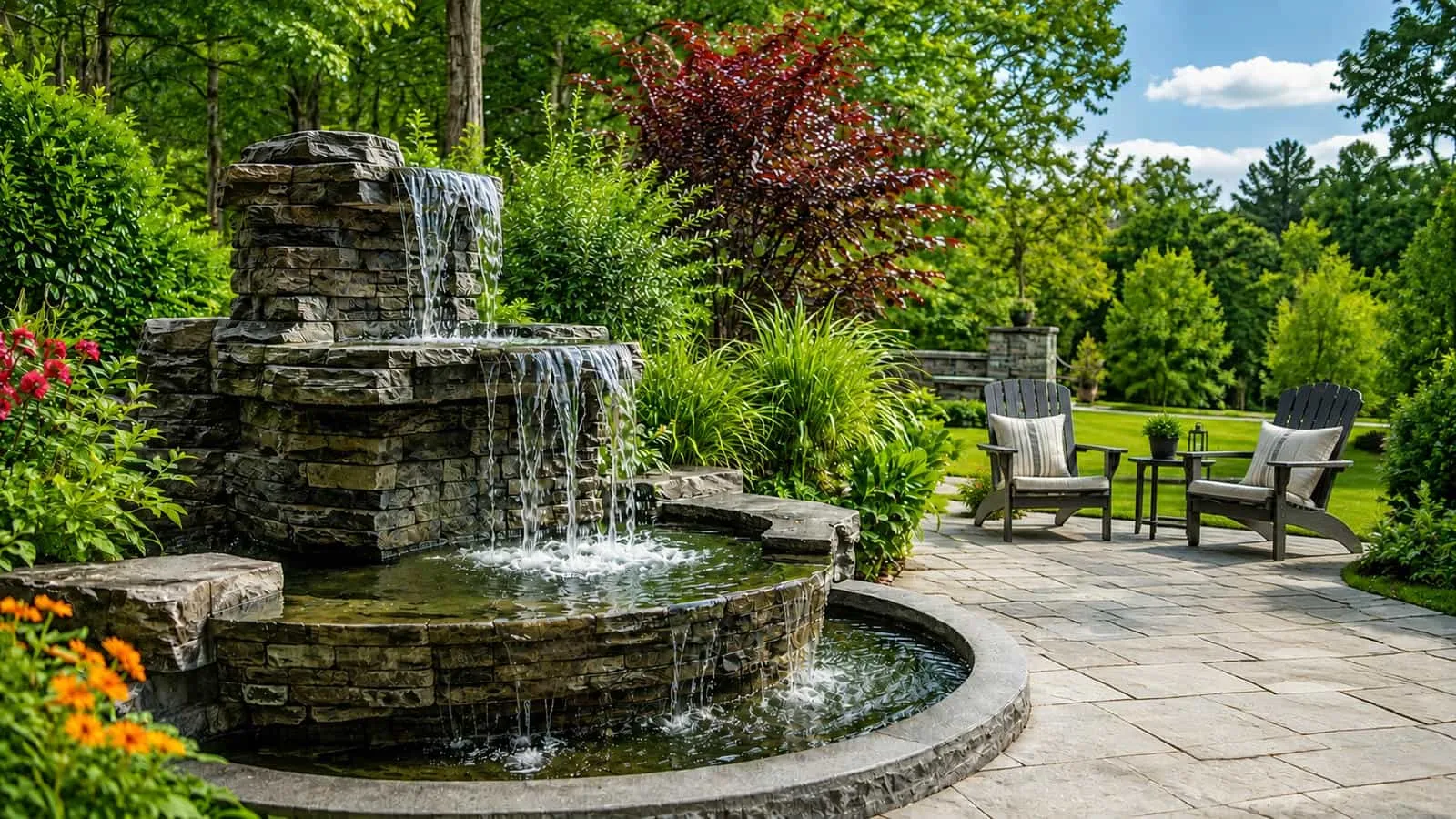
💧 What Is the Best Water Fountain Sound for Your Space?
The best water fountain sound is clearly audible from the place where people normally listen without becoming distracting, harsh or difficult to control. Gentle bubbling and short trickling water often work well near seating, while cascading and falling water create stronger sound for larger gardens and backyards. Flow rate, water drop height, landing surface, basin depth, listening distance and nearby walls all affect how a fountain actually sounds.

Choosing the best water fountain sound starts with deciding what the water should do for the space. A fountain beside patio chairs may only need a gentle bubbling or short cascading sound that can be heard during conversation. A fountain positioned farther across a backyard may need greater water movement, several drops or a stronger cascade so the sound remains noticeable from the house, deck or pergola. The goal is not simply to choose a quiet or loud fountain. The goal is to create the right amount of water sound at the normal listening distance.
Fountain sound begins with water movement. Bubbling water usually creates soft close range sound because the water rises and returns over a short distance. Trickling water creates finer acoustic detail as smaller streams move over stone, bowls or textured surfaces. Cascading fountains produce a fuller sound because water moves through one or more visible drops, while stronger falling water can create greater impact and carry farther through an outdoor space. These differences make water movement one of the most important choices when comparing different water fountain types and designs.
The same fountain can also sound different when its operating conditions change. Increasing adjustable pump flow can strengthen water movement and impact, while reducing flow may soften the fountain. A higher water drop generally creates a more noticeable impact than water sliding across a wet surface. Water landing on stone, gravel, another bowl or an open basin can each produce a different sound character. Basin depth and water level also matter because they change the way falling water meets the receiving area.
Listening distance changes the experience just as much as fountain design. A subtle bubbler that feels peaceful from a chair three feet away may almost disappear when heard from the opposite side of a large backyard. A multi level cascade that sounds balanced from fifteen or twenty feet away may feel overpowering beside a dining table. This is why fountain sound should be evaluated from the place where people will actually sit, walk, read, entertain or relax rather than only while standing directly beside the fountain.
Surrounding surfaces can further change how strong the fountain seems. Open lawns and planted gardens allow water sound to spread into a larger environment, while courtyard walls, fences, house walls and covered patios can reflect sound back toward the listener. Dense planting and soft landscape surfaces can make the experience feel different from a hard paved courtyard with masonry walls. For complete decisions involving overall location, drainage, power, sightlines and physical clearances, use our water fountain placement planning guide.
Compare bubbling, trickling and cascading fountains with adjustable flow for patios, gardens, backyards and comfortable listening distances.
Choose controllable water sound that feels peaceful near seating yet remains noticeable throughout your outdoor space.
🛒 Compare Adjustable Flow Water Fountains on Amazon
🎧 Sound Selection Tip: Judge a fountain from the normal listening position, not only while standing beside the basin. Sit where you normally read, dine or talk and imagine whether the water should remain a subtle background sound, a clearly noticeable garden feature or a stronger sound that competes with traffic and other environmental noise. Listening distance can turn the same fountain from gentle to dominant.
🎧 Water Fountain Sound for Different Listening Situations
Some fountain sound decisions depend less on whether the water is simply gentle or strong and more on the environment where it will be heard. Natural rock surfaces, enclosed courtyards, conversation areas and persistent background noise can all change which sound profile works best.
- 🪨 Natural Rock and Stream Sound: Water moving across irregular stone, gravel and multiple small landing surfaces can create a layered natural sound that works especially well in landscaped gardens, pondless water features and informal relaxation areas.
- 🧱 Wall and Courtyard Sound: Water near hard walls or enclosed surfaces may seem stronger because nearby structures can reflect sound toward the listening area. Start with controlled water movement and judge the fountain from the actual seating position.
- 🪑 Conversation Area Sound: Fountain water should remain clearly audible without forcing people to raise their voices. Gentle trickling, bubbling or a controlled short cascade usually provides a better balance around dining tables, patio chairs and conversation areas.
- 🚗 Background Noise Masking Sound: A consistent cascade or falling water feature can make traffic, pool equipment and other unwanted background sounds less noticeable. Use enough water presence to remain audible near the listener without treating the fountain as true soundproofing.
These listening situations add another layer to fountain sound selection. After choosing a general sound level, consider nearby surfaces, seating distance, background noise and how people actually use the space before making the final choice.
Section Summary Snapshot: The best water fountain sound depends on what people should hear from the normal listening area. Bubbling and trickling water usually create softer close range sound, while cascading and falling water can provide greater acoustic presence. Drop height, flow strength, landing surface, basin depth, water level, fountain placement, surrounding walls and listening distance all work together, so choose the complete sound behavior rather than judging the fountain by size or appearance alone.
🎧 Water Fountain Sound Spectrum: From Gentle Bubbling to Strong Falling Water
Water fountain sound usually becomes stronger as water movement, drop height and impact increase. Use this sound spectrum to compare gentle bubbling, trickling, short cascades, layered cascading water and stronger falling water with the listening distance and outdoor or indoor setting where each sound profile often works best.
Soft Bubbling Water
Soft, rounded and close-range water sound with very little falling impact.
- Best For: Bedrooms, desks, reading chairs and meditation spaces
- Listening Distance: Very close
- Water Movement: Gentle bubbling or shallow overflow
- Main Risk: Can disappear beneath normal background noise
Trickling Water Sound
Fine continuous water detail with limited impact and a calm acoustic character.
- Best For: Small patios, courtyards and quiet garden seating
- Listening Distance: Close
- Water Movement: Trickling, wet surfaces or short narrow streams
- Main Risk: Wind and traffic can overpower subtle sound
Short Cascading Water
Noticeable but controlled fountain sound that remains comfortable around everyday outdoor living.
- Best For: Patios, pergolas, outdoor dining and garden seating
- Listening Distance: Close to medium
- Water Movement: Short cascades or controlled falling water
- Main Risk: Too much flow can increase splash near seating
Layered Cascading Water
Fuller water sound created by several drops or impact points working together.
- Best For: Backyards, larger gardens and longer listening distances
- Listening Distance: Medium to farther
- Water Movement: Tiered cascades or multiple water drops
- Main Risk: Can become dominant when placed too close to seating
Strong Falling Water
Greater acoustic presence created by stronger controlled flow, useful drop height and pronounced water impact.
- Best For: Large yards, distant seating and background noise masking
- Listening Distance: Farther
- Water Movement: Falling water, pondless waterfalls or stronger cascades
- Main Risk: Excessive flow can cause splash, evaporation and conversation interference
🎚️ Important: This spectrum shows general sound character rather than fixed decibel levels. The same fountain can sound very different when pump flow, water drop height, basin depth, landing surface, surrounding walls, background noise and listening distance change. Use the spectrum to choose a sound direction, then judge the fountain from the place where people will actually listen.
🔎 Water Fountain Sound Scenario Engine for Real Homes, Patios, Gardens and Living Spaces
Water fountain sound changes with much more than fountain size or style. Listening distance, water drop height, flow strength, basin depth, landing surface, pump condition, nearby walls and existing background noise can all change how quiet, relaxing, noticeable or overpowering a fountain feels. Use the eight real world sound scenarios below to narrow the fountain sound profile that best fits your patio, garden, backyard, courtyard, meditation area or indoor living space before adjusting flow or choosing a new fountain.
Open each scenario to compare fountain sound by real listening conditions. These situations focus on conversation comfort, traffic noise, quiet relaxation, meditation, long listening distances, acoustic reflection, pump noise and changing water levels so you can understand why a fountain sounds the way it does and what adjustments may improve it.
🪑 Small Patio Where Conversation Matters
Best sound direction: Gentle bubbling, short trickling water or a restrained low cascade
A water fountain beside patio seating should create enough sound to feel present without forcing people to speak louder. Compact bubbling fountains, urn fountains, low basin designs and controlled wall fountains can work especially well because their water usually travels a short distance before returning to the basin.
Listening distance is critical in a small patio. A cascade that sounds pleasantly moderate from ten or fifteen feet away may feel much stronger when chairs sit only a few feet from the water. Shorter water drops, lower adjustable flow and controlled landing surfaces help keep the sound softer while also reducing splash near cushions, dining furniture and doors.
Choose this sound direction when you want relaxing water close to seating but still want conversation, dining and everyday patio use to feel comfortable.
- 🎧 Gentle water sound supports conversation
- 💧 Short water drops reduce impact intensity
- 🎚 Adjustable flow makes sound easier to fine tune
- 💦 Controlled water movement helps limit splash
- 🪑 Close listening distance means even moderate sound can feel strong
Micro Recommendations: Sit in the normal chair before making a final sound judgment. If the fountain dominates conversation, reduce adjustable flow first and listen again before changing fountain location or replacing the feature.
⚠️ Common Mistake: Choosing a dramatic multi level cascade because it sounds impressive in a showroom, then placing it only a few feet from a dining or conversation area.
🚗 Backyard Beside Traffic or Other Persistent Background Noise
Best sound direction: Consistent moderate to strong cascading or falling water
A backyard exposed to traffic, road noise, nearby mechanical equipment or other steady background sound usually needs more acoustic presence than a quiet garden. A tiny bubbler may be peaceful when standing beside it but can disappear completely once traffic and outdoor activity enter the soundscape.
Cascading fountains, tiered designs and pondless waterfalls can create broader and more continuous water sound because they combine water flow with one or more impact points. The goal is not to make the fountain louder than every unwanted sound. The goal is to introduce a more pleasant water sound close enough to the listening area that distracting background noise becomes less dominant.
Choose this sound direction when the fountain needs to remain clearly audible around a deck, pergola or backyard seating area where traffic or mechanical noise is already present.
- 🌊 Several water drops create a fuller acoustic texture
- 🎧 Consistent sound can make background noise less noticeable
- 📍 Fountain location relative to the listener matters greatly
- 🎚 Adjustable flow helps balance masking sound with comfort
- 💦 Stronger flow must still stay within the basin splash zone
Micro Recommendations: Position the fountain where its water sound reaches the seating area clearly instead of assuming the feature needs to sit directly beside the road or noise source.
⚠️ Common Mistake: Expecting a small bubbling fountain to eliminate road noise. Water fountains can help mask or soften the perception of unwanted sound, but they do not physically soundproof a yard.
📚 Quiet Garden Reading Corner With Close Listening Distance
Best sound direction: Soft bubbling, gentle trickling or shallow flowing water
A reading corner usually benefits from water sound that remains continuous but does not demand attention. Small bubbling rock fountains, Japanese inspired basins, low urn fountains and restrained wall fountains can create fine acoustic detail that becomes noticeable when the listener sits nearby. When the fountain will become part of planting, pathways and quiet seating, compare garden water fountains for relaxing spaces that balance gentle sound with the surrounding landscape.
In a naturally quiet environment, very little water movement may be needed. Short drops and lower flow can produce enough sound to create a calm background layer without turning the fountain into the dominant feature. Pump noise becomes more important here because hum, vibration or rattling can be easier to notice when there is little traffic or environmental noise to cover it.
Choose this sound direction when the fountain should support reading, quiet reflection or relaxed garden seating without becoming a strong acoustic focal point.
- 📖 Soft continuous sound supports quiet activity
- 💧 Short drops create restrained water impact
- 🎚 Lower flow can preserve subtle sound character
- ⚙️ Pump vibration becomes more noticeable in quiet settings
- 🪑 Close seating allows very gentle fountains to remain audible
Micro Recommendations: Listen for both the water and the pump. If mechanical hum is more noticeable than the moving water, check water level, pump position and vibration before increasing flow.
⚠️ Common Mistake: Increasing fountain flow simply because the sound feels subtle while standing several feet away, even though the normal reading chair sits close enough to hear the water clearly.
🧘 Meditation Garden Where Sound Should Stay Calm and Predictable
Best sound direction: Gentle continuous bubbling, trickling or controlled natural water movement
Meditation gardens usually benefit from water sound that feels steady, balanced and easy to ignore once attention settles. Japanese water fountains for meditation gardens, low stone basins, bubbling rocks and restrained stream style features can create soft to moderate sound through short drops and controlled natural water movement without the sudden impact associated with tall cascades or forceful jets.
Natural landing surfaces can also change the character of the sound. Water moving over stone, gravel or textured rock may create many small acoustic details instead of one sharp splash. Consistent pump flow and stable water level help prevent unexpected changes that can interrupt the calm quality of the fountain.
Choose this sound direction when the water should create a calm soundscape for meditation, breathing exercises, yoga or quiet garden reflection.
- 🧘 Predictable water movement supports a calmer soundscape
- 🪨 Natural surfaces create softer layered detail
- 💧 Low to moderate flow avoids aggressive impact
- 🎚 Stable water output reduces distracting sound changes
- 🌿 Planting and softer landscape surfaces support the overall setting
Micro Recommendations: Choose the fountain from the normal meditation position. A gentle fountain placed fairly close may create a better experience than a much louder fountain positioned farther away.
⚠️ Common Mistake: Assuming meditation requires the quietest possible fountain. Water that is too subtle may disappear beneath wind, distant traffic or normal outdoor sounds.
🏡 Large Backyard Where the Fountain Cannot Be Heard From the House
Best sound direction: Stronger cascading water, multiple drops or greater controlled water impact
A fountain positioned across a large lawn may look impressive but create very little useful sound at the deck, house or covered seating area. Listening distance reduces the apparent strength of the fountain, especially when wind, birds, conversation, lawn equipment and neighborhood activity are part of the outdoor environment.
A larger tiered fountain, architectural cascade or pondless waterfall can create stronger sound through greater water volume, more drop height or several impact points. Increasing pump flow may also help when the fountain is designed for adjustable output, but excessive flow can cause splash, water loss or poor basin control.
Choose this sound direction when the fountain needs to remain audible from a distant patio, window, pergola or deck instead of only while standing beside the basin.
- 📏 Longer listening distance requires more acoustic presence
- 🌊 Multiple cascades can create layered sound
- 🎚 Flow adjustment may increase useful water impact
- 💦 Basin size must still control stronger water movement
- 👂 Evaluate sound from the real listening area, not from beside the fountain
Micro Recommendations: Before replacing a fountain that seems too quiet, check whether adjustable flow can be increased safely and whether the main listening area could be moved slightly closer.
⚠️ Common Mistake: Assuming a physically large fountain will automatically sound strong enough across a large backyard even when its water drops are short and flow remains restrained.
🧱 Courtyard Fountain That Sounds Much Louder Than Expected
Best sound direction: Lower flow, shorter effective drops and controlled water movement
Courtyards, enclosed patios and narrow outdoor rooms can make a fountain feel stronger because nearby walls and hard surfaces may reflect water sound back toward the listener. The same cascade that feels moderate in an open garden may sound much more dominant when surrounded by masonry walls, pavers, stucco or covered structures.
Reducing adjustable pump flow is often the easiest first step. Shorter exposed drops, higher receiving water levels where appropriate and smoother landing surfaces can also soften impact. Increasing the distance between the fountain and the primary seating area may improve comfort without requiring any change to the fountain itself.
Choose this adjustment direction when fountain sound feels unexpectedly strong because the space is enclosed, reflective or very close to the listening area.
- 🧱 Hard walls can reflect sound toward seating
- 🎚 Lower flow may soften water impact
- 💧 Shorter drops usually reduce acoustic intensity
- 🪑 Greater seating distance may restore balance
- 🌿 Plants and softer surfaces can change the feel of the soundscape
Micro Recommendations: Adjust one variable at a time. Reduce flow first, listen from the seat, then consider water level, landing surface or distance so you know which change actually improves the sound.
⚠️ Common Mistake: Replacing a fountain because it seems too loud without first recognizing that the surrounding walls and short listening distance are amplifying the experience.
⚙️ Fountain Pump Sounds Louder Than the Moving Water
Best adjustment direction: Restore proper water level, reduce vibration and check the pump intake
A fountain should normally be experienced primarily through moving water rather than mechanical hum. When the pump becomes the loudest part of the feature, low water, trapped air, debris, vibration against the basin or restricted flow may be changing the operating sound.
Begin with the water level because evaporation can expose or partially uncover a submersible pump and allow it to draw air. Check that the pump sits securely and is not rattling against stone, resin, ceramic or metal surfaces. Leaves, algae, mineral buildup and debris around the intake can also reduce normal water movement while making the pump work harder.
Choose this troubleshooting direction when humming, rattling, buzzing or gurgling is more noticeable than the bubbling, trickling or cascading water.
- 💧 Low water can change pump sound quickly
- ⚙️ Pump contact with the basin may transmit vibration
- 🌿 Debris can restrict the intake and reduce water flow
- 💨 Air entering the pump may cause gurgling or irregular sound
- 🧼 Cleaning may restore both flow and quieter operation
Micro Recommendations: Restore the recommended water level and inspect the pump before increasing flow. If water movement improves and mechanical sound decreases, the problem may have been operating conditions rather than the fountain design.
⚠️ Common Mistake: Assuming every loud fountain needs a quieter pump when low water, debris or vibration may be causing the unwanted sound.
💦 Fountain Sound Changes After Several Hot or Windy Days
Best adjustment direction: Check water level, flow restriction and the receiving basin before changing pump settings
Fountain sound can change gradually as water evaporates, especially during warm, sunny or windy weather. A lower basin level changes how falling water meets the receiving surface and can expose more of the pump. The result may be sharper splashing, louder impact, gurgling, reduced flow or increased mechanical noise.
Leaves, pollen and other debris can also collect around the pump intake or narrow water channels, reducing flow and changing the sound pattern. Mineral buildup can slowly alter spillways and outlets as well. A fountain that sounded smooth when first filled may therefore become quieter, harsher or less even several days later even though no mechanical adjustment was made.
Choose this troubleshooting direction when fountain sound changes over time rather than immediately after installation or adjustment.
- ☀️ Evaporation can lower water level during hot weather
- 🌬 Wind can increase both water loss and splash
- 🌿 Debris can restrict pump and spillway flow
- 🪨 Mineral buildup may change water paths over time
- 🎧 Changing water depth can alter both splash and impact sound
Micro Recommendations: Compare the current water level with the normal operating level first. Refill as recommended, remove visible debris and listen again before changing pump output.
⚠️ Common Mistake: Adjusting pump flow every time the fountain sounds different without checking whether evaporation, debris or water level caused the change.
🧭 How to Use the Water Fountain Sound Scenario Engine
These scenarios help identify the sound problem or listening goal before you change the fountain. Small patios usually need controlled conversation friendly water sound, noisy backyards may benefit from stronger consistent cascades, reading and meditation areas often work better with gentler close range sound, large yards need enough acoustic presence for longer listening distances, enclosed courtyards may strengthen reflected water sound, and changing water levels or pump conditions can create unwanted mechanical noise. Start with the real listening situation, then adjust water movement, flow, drop height, placement or maintenance only where the scenario points to a likely cause.
🔊 How Water Fountain Sound Works: Flow, Drop Height, Water Impact and Listening Distance
Water fountain sound is created by moving water, the distance it falls, the amount of water flowing and what the water strikes when it lands. Short bubbling movement usually produces softer sound, while greater drop height and stronger flow can create more noticeable impact. Basin depth, landing surfaces, multiple water drops, pump output and listening distance all change how a fountain sounds in a real space.

Water fountain sound starts when pump driven water leaves an outlet, bubbler, nozzle, spillway or upper basin and begins moving through the fountain. As the water travels, its speed, volume and direction affect what happens next. Water that rises only slightly and rolls back across a surface usually creates a softer sound than water that falls through open air before striking another basin, stone ledge or body of water.
The strongest sound is often created at the point of impact. Falling water transfers energy when it meets the receiving surface, and that contact creates much of the bubbling, splashing, trickling or cascading sound people hear. A short drop into deeper water can sound different from the same amount of water landing on shallow stone. Water striking gravel, textured rock or another fountain bowl can create several smaller sounds instead of one stronger splash.
Flow rate changes this relationship because more moving water can create a broader or stronger impact when the fountain is designed to handle it. Lower adjustable flow can make some fountains sound softer and more restrained, while higher usable flow can make cascades, spillways and falling streams more noticeable. Flow should still remain within the fountain's intended operating range because excessive water movement can increase splash, water loss and uneven basin return.
Water fountain sound is also shaped by geometry. Tier spacing, spillway width, outlet size, basin depth and the number of separate water drops all influence the final acoustic character. A single short stream may create one clear impact sound, while several tiered drops can produce a layered fountain sound because water is landing at several different points. A broad sheet of water may create smoother continuous sound, while smaller streams can produce finer individual splashes.
The listener is part of the system too. A fountain does not have one useful sound level for every location. What feels strong while standing beside the basin may become gentle several feet away, and a quiet bubbler may nearly disappear across a broad backyard. Walls, fences, patios, pergolas and courtyards can further change the way the sound is perceived, which is why fountain sound should always be evaluated from the place where people actually sit or spend time.
💧 Water Fountain Sound Factors: What Makes Water Quieter, Stronger or More Noticeable?
Fountain sound is created by several physical variables working together rather than one single feature. Use this comparison to understand how water drop height, flow strength, landing surface, basin depth, multiple cascades and listener distance can change the sound of bubbling, trickling, cascading and falling water.
| 🎧 Sound Factor | 💧 What Changes | 🔊 Typical Sound Effect | 🏡 Homeowner Guidance |
|---|---|---|---|
| Water Drop Height | Water travels farther through open air before reaching the basin or landing surface. | Greater drop height can create a more noticeable impact and stronger falling water sound. | Use shorter drops near close seating when softer water sound and better splash control are priorities. |
| Flow Strength | More or less water moves through the outlet, spillway or cascade. | Higher usable flow can create fuller water movement, while lower flow often produces gentler sound. | Adjust pump flow gradually and stop before stronger water begins escaping the intended receiving area. |
| Landing in Deep Water | Falling water enters a deeper receiving basin instead of immediately striking a hard surface. | The sound may feel rounder and more water based, depending on drop height and flow. | Listen after the basin reaches its normal operating level because water depth changes the impact point. |
| Landing in Shallow Water | Water reaches a receiving area with less depth between the surface and basin floor. | Impact can sound sharper or more splash focused, especially with stronger falling water. | Maintain the intended water level so evaporation does not accidentally change the sound character. |
| Stone or Textured Surface | Water contacts rock, gravel, stone or another irregular surface before returning to the reservoir. | Several small impacts can create layered trickling and natural stream like sound. | Useful for garden fountains and pondless features where a natural acoustic character is preferred. |
| Wide Spillway | Water spreads across a broader edge before falling. | Can create a wider, smoother and more continuous sound compared with a narrow individual stream. | Consider both spillway width and delivered flow because a wide spillway needs enough water to remain visually and acoustically consistent. |
| Multiple Water Drops | Water travels through several bowls, ledges or levels before returning to the main basin. | Creates layered sound because several impacts happen at different heights and locations. | Useful when a richer fountain sound is wanted, but evaluate the combined sound near seating. |
| Short Bubbling Movement | Water rises only slightly before returning over or around the fountain surface. | Usually produces softer close range bubbling with limited falling water impact. | Often works well near reading chairs, small patios, meditation spaces and quiet garden areas. |
| Listening Distance | The listener moves closer to or farther from the fountain. | The perceived strength of the fountain changes even though the fountain itself has not been adjusted. | Judge sound from the actual patio chair, deck, window or garden seat rather than only beside the fountain. |
| Nearby Walls and Hard Surfaces | Fountain sound interacts with walls, fences, paving, courtyard surfaces and covered structures. | The sound may feel more noticeable or reflective than the same fountain in an open landscape. | Use lower flow or greater seating distance if an enclosed space makes the fountain feel stronger than expected. |
| 🎧 Water fountain sound comes from the complete relationship between moving water, drop height, flow strength, impact surface, basin depth, fountain geometry, surrounding surfaces and listening distance. Fountain size alone cannot predict whether the final sound will feel quiet, relaxing, moderate or strong. | |||
💡 Pro Tip: Change only one sound variable at a time when tuning a fountain. Start with the normal water level, then listen from the usual seating area. If needed, adjust pump flow gradually and listen again. Changing flow, water depth, landing surfaces and seating distance all at once makes it difficult to know which adjustment actually improved the fountain sound.

🌊 Why Water Drop Height, Flow and Impact Matter More Than Fountain Size
A common mistake is assuming that a physically larger fountain will automatically create louder water sound. Fountain dimensions influence visual scale, but sound depends more directly on how the water moves through that structure. A broad fountain with shallow bubbling water can remain relatively gentle, while a much smaller fountain with a concentrated stream falling several inches into a hard receiving surface can sound surprisingly strong.
- 📉 Short Water Drop: Water has less open falling distance before reaching the basin, which often creates softer impact and can reduce splash near seating.
- 📈 Taller Water Drop: Water travels farther before impact and can create a clearer, stronger falling water sound when enough flow is present.
- 💦 Higher Usable Flow: More moving water can increase acoustic presence, but only when the basin, spillway and pump system are designed to handle the additional volume.
- 💧 Lower Flow: Reduced water output can soften bubbling and cascading sound, although reducing flow too far may make the fountain uneven or barely audible.
- 🪨 Hard Landing Surface: Stone, ceramic, metal or shallow hard surfaces can create a more defined impact than water sliding gently down an already wet surface.
- 🌊 Water Landing in Water: Basin depth, water level and drop height work together to determine whether the sound feels like a soft splash, deeper bubbling impact or stronger falling water.
- ⛲ Multiple Fountain Levels: Tiered fountains and multi stage cascades can create richer sound because several individual water impacts combine into one layered acoustic experience.
- 👂 Listener Position: The useful sound is the sound heard from the seat, walkway, patio or room where people spend time, not the sound measured by standing directly over the fountain.
Section Summary Snapshot: Water fountain sound is created when moving water travels and meets another surface or body of water. Drop height, flow strength, basin depth, spillway width, landing material, multiple water drops and listener distance all change the result. A larger fountain is not automatically louder, and a smaller fountain is not automatically quiet. The best way to predict fountain sound is to understand how the water moves, where it lands and where the listener will normally be.
🌊 Water Fountain Sounds From Bubbling, Trickling, Cascading and Falling Water
Water movement is one of the biggest reasons fountains sound different. Bubbling water usually creates soft close range sound, trickling water adds fine detail, cascading water creates richer layered sound and falling water produces stronger impact. Sheet flow, jets, sprays and water moving over rock create different acoustic profiles because the water travels, spreads and lands in different ways.

Water movement gives a fountain its basic acoustic personality before placement, surrounding walls or background noise are considered. Water that barely rises from a bubbler sounds different from a narrow trickle moving across stone, and both sound different from a stream falling several inches into a receiving basin.
The key relationship is how far the water travels, how much water is moving and what happens when it lands. Bubbling usually involves little open falling distance. Trickling divides water into smaller paths. Cascading creates repeated drops and impacts. Falling water usually has more exposed travel before landing, while rock streams create many irregular contacts instead of one dominant splash.
Choose water movement according to the listening goal rather than visual drama alone. A soft bubbler may be ideal beside a reading chair, while several moderate cascades can remain audible across a larger garden. Stronger movement can also increase splash and evaporation, and fine jets or sprays can become more sensitive to wind.
🎧 Water Fountain Sound Types From Quiet Bubbling to Strong Cascading Water
Bubbling, trickling, cascading and falling water create recognizable sound profiles because each movement changes drop distance, water speed, impact and the number of contact points. These differences help determine which fountain sound works best near seating, across a backyard or in a quiet indoor space.
💧 Bubbling Water Fountain Sound for Quiet Patios, Reading Areas and Meditation Spaces
💧 Bubbling Water Fountain Sound for Soft, Gentle and Close Range Listening
Bubbling water usually creates one of the gentlest fountain sounds because water rises only a short distance before returning across the surface or basin. Bubbling fountains work especially well near patio seating, reading chairs, small gardens and meditation spaces where the water should remain audible without becoming a strong background sound.
A bubbler pushes water upward through an outlet where it rolls, spills or breaks gently across stone, a bowl or another fountain surface. Because there is little open falling distance, the sound is normally softer and more rounded than a tall cascade. Rough rock can add detail by dividing the water into many small paths.
Flow still matters. A very low bubbler may disappear beyond a few feet, while stronger output can create more audible movement. The useful limit is reached when added flow begins producing unnecessary splash rather than better sound.
- 🤫 Quiet Character: Short water movement generally keeps impact soft.
- 🪑 Close Listening: Bubbling works well when seating is only a few feet away.
- 🪨 Textured Surfaces: Rough stone can add many small water contacts without creating a strong fall.
🌿 Trickling Water Fountain Sound for Gentle Background Water and Garden Ambiance
🌿 Trickling Water Fountain Sound for Fine Detail, Relaxation and Close Listening
Trickling fountain sound comes from small streams moving over stone, bowls, walls or textured surfaces with limited drop height. It creates finer acoustic detail than simple bubbling but usually remains softer than cascading water. Trickling works especially well in quiet gardens, courtyards, patios and indoor spaces where listeners remain fairly close.
Trickling water usually travels through narrow outlets, shallow channels or across a wet surface rather than falling in one large stream. Small taps, drips and continuous water movement blend into a delicate background layer that can suit reading areas and meditation spaces.
The tradeoff is listening distance. Fine trickling sound can disappear beneath wind, conversation, traffic or air conditioning more quickly than a cascade. A subtle trickle that is pleasant from four or five feet away may become nearly inaudible from across a large backyard.
- 🌿 Fine Sound Detail: Smaller streams create delicate water sounds instead of one dominant impact.
- 📏 Shorter Listening Distance: Subtle trickling is usually best when the listener remains relatively close.
- 🌬 Background Noise Matters: Wind and traffic can overpower quiet trickling water.
🌊 Cascading Water Fountain Sound for Richer, Layered and More Noticeable Water
🌊 Cascading Fountain Sound for Patios, Gardens, Backyards and Layered Water Movement
Cascading fountains create richer sound because water falls from one bowl, ledge, spillway or rock surface to another. Several drops combine into a layered acoustic profile that usually carries farther than gentle bubbling or trickling. Cascading water works well where the fountain should remain clearly noticeable from a moderate listening distance.
Cascading sound develops through repeated impacts. In a tiered fountain, the water may leave an upper bowl, land in a second level and then fall again before reaching the main basin. Each landing point adds another layer, which is why several moderate drops can sound fuller than one shallow overflow.
Drop height, flow and receiving water depth determine whether a cascade feels gentle or energetic. More flow can strengthen the sound, but the number and spacing of the drops are equally important. A fountain does not need maximum pump output to create a rich acoustic presence.
Cascading water is especially useful in medium and larger outdoor spaces where subtle bubbling may disappear. Near close dining or conversation areas, however, strong multi level water can feel excessive and may also create a larger splash zone.
- 🌊 Layered Sound: Several water impacts create a fuller acoustic profile.
- 📏 Better Projection: Cascades can remain noticeable at greater listening distances.
- 💦 Splash Awareness: Greater drop and flow can enlarge the wet area around the basin.
⛲ Falling Water, Sheet Flow, Jets, Spray and Rock Stream Fountain Sounds
⛲ Falling, Sheet, Jet and Rock Water Fountain Sounds for Stronger and Natural Sound Profiles
Falling water generally produces stronger fountain sound as exposed drop and impact increase. Broad sheet flow creates a smoother continuous sound, while jets and sprays produce more directional movement. Water moving across rocks, gravel and stream beds creates many small irregular impacts that combine into a natural layered sound.
Falling water travels through open air before reaching the receiving basin, so enough flow combined with a greater drop can create clear impact and stronger sound projection. This works well when a fountain needs greater presence across a backyard, but it can become too aggressive close to quiet seating.
Sheet flow spreads water across a wider spillway instead of concentrating it into one stream. When the flow remains even, the fountain can produce a broad, smooth and continuous sound. Wall fountains and contemporary architectural features often use this movement.
Jets and sprays project water through individual nozzles. Jets create defined landing points and more directional impact, while fine spray produces lighter droplets. Both are more exposed to outdoor wind, which can shift the water path and increase splash or water loss.
Rock and stream movement is more irregular. Water changes direction as it moves around gravel, ledges and uneven stone, creating many small splashes, trickles and short drops. The result can resemble a creek or small waterfall rather than the repeating sound of a manufactured bowl fountain.
- 💦 Falling Water: Stronger impact and greater acoustic projection.
- 🌊 Sheet Flow: Smooth, broad and continuous water sound.
- ⛲ Jets and Spray: More directional movement with greater wind sensitivity.
- 🪨 Rock and Stream Flow: Many irregular impacts create natural layered sound.
📊 Bubbling vs Trickling vs Cascading vs Falling Water Fountain Sound
Use this comparison to match water movement with the desired fountain sound, listening distance, setting and splash tolerance before choosing a specific fountain design.
| 💧 Water Movement | 🎧 Sound Character | 📏 Listening Range | 🏡 Best Uses | ⚠️ Main Consideration |
|---|---|---|---|---|
| Soft Bubbling | Gentle, rounded and close range | Close | Patio seating, reading corners, meditation areas | Can disappear in noisy environments |
| Fine Trickling | Delicate, detailed and continuous | Close to moderate | Courtyards, wall fountains, quiet gardens and indoor spaces | Wind and background noise can overpower it |
| Short Cascade | Moderate, balanced and noticeable | Close to medium | Patios, pergolas and garden seating | Higher flow can increase splash |
| Multi Level Cascade | Layered, fuller and acoustically rich | Medium to longer | Tiered fountains, larger patios and backyards | Combined drops may feel strong close to seating |
| Strong Falling Water | Clear impact with greater presence | Medium to longer | Large backyards and stronger sound goals | Splash, evaporation and conversation interference |
| Broad Sheet Flow | Smooth, wide and continuous | Close to medium | Wall fountains and contemporary patios | Needs even spillway flow |
| Jets and Spray | Directional with defined landing points | Varies | Formal fountains and decorative focal points | Wind can redirect the water |
| Rock and Stream Flow | Natural, irregular and layered | Varies with feature size | Natural gardens and pondless landscapes | Sound depends heavily on individual drops and surfaces |
| 🌊 Bubbling and trickling usually create softer close range sound, while cascading and falling water provide stronger acoustic presence. Sheet flow creates broad continuous sound, jets create directional impacts and rock streams produce irregular natural layers. Match the movement to listener distance, background noise, splash tolerance and how the space is used. | ||||
Best choice Choose bubbling or gentle trickling when the fountain sits close to seating and the goal is soft background water sound.
Common mistake Choosing a tall cascade or strong falling stream for visual drama without considering how powerful the impact may sound from nearby chairs, windows or dining areas.
Consider another option Choose layered cascading, rock stream movement or stronger falling water when the fountain needs to remain audible across a larger landscape or around normal environmental noise.
Ideal homeowner Someone who wants to select a fountain according to how its moving water actually sounds rather than judging only its size, material or decorative appearance.
🎧 Water Movement Sound Tip: Listen for the character of the water rather than asking only whether a fountain is loud or quiet. Bubbling, trickling, cascading, falling, sheet flow, jets and rock streams each begin with a different acoustic personality. Pump adjustment can change intensity, but it cannot completely change the basic behavior of the water movement.
Section Summary Snapshot: Water movement gives every fountain its basic sound character. Bubbling is usually soft and close range, trickling creates fine detail, cascading adds richer layered impacts and falling water creates greater acoustic presence. Sheet flow sounds broad and continuous, jets and sprays are more directional, and rock streams create natural irregular layers. Choose the movement according to listening distance, background noise, splash comfort and how the space is actually used.
🏗️ How Fountain Design Changes Water Sound: Drop Height, Basin Depth, Spillways and Landing Surfaces
Fountain design changes water sound by controlling how far water falls, how many times it lands, how widely the flow spreads and what surface receives it. Drop height, tier spacing, basin depth, basin width, spillway design, outlet size, water volume and landing material can make similar fountains sound gentle, smooth, layered or much stronger.

Fountain geometry determines the path water follows from the outlet back to the reservoir. Two fountains can use similar pumps yet sound different because one moves water through short rounded overflows while another uses several exposed drops. The design controls drop distance, number of impacts, water spread and the way each landing point behaves.
Drop height and tier spacing shape the falling side of the sound, while basin depth and width shape the receiving side. Spillways and outlets determine whether water leaves as one concentrated stream, several smaller streams or a broad sheet. Landing surfaces then add the final acoustic detail by allowing water to strike open water, smooth stone, textured rock, gravel, ceramic or metal.
These physical relationships are more useful than fountain dimensions alone. A tall fountain with short water drops can remain relatively gentle, while a smaller fountain with a concentrated stream falling onto a hard surface may sound considerably stronger.
📏 Water Drop Height and Tier Spacing for Quiet, Moderate and Strong Fountain Sound
Drop height and tier spacing determine how far water travels before impact and how many separate impacts combine into the final sound. They are among the most useful fountain design clues when comparing softer close range sound with stronger or more layered water.
📏 How Water Drop Height Changes Fountain Sound
📏 Short vs Tall Water Drops and Their Effect on Fountain Sound
Short water drops usually create softer fountain sound because water travels less distance before landing. Taller exposed drops can create stronger impact and greater acoustic presence when enough flow is available. Multiple drops can also combine into layered sound, so tier spacing matters as much as the overall height of the fountain.
Short drops work well near patios, dining tables and reading areas because the water may simply roll over a lip or move from one bowl into a nearby basin. The smaller impact often creates smoother sound with less splash.
Taller drops become more noticeable because water travels farther through open air before landing. Several tiered drops add repeated impacts, creating a fuller sound that can remain audible from greater listening distances.
- 📉 Short Drop: Softer impact for close range fountain sound.
- 📈 Taller Drop: Stronger impact and greater acoustic presence.
- ⛲ Multiple Drops: Several landing points create layered sound.
- 💦 Splash Relationship: Greater drop height can expand the wet zone.
📏 Drop Height Tip: Look at the distance between each outlet and receiving surface rather than relying on overall fountain height. That measurement provides a much better clue to likely sound strength.
💧 How Basin Depth, Water Level and Basin Width Change Fountain Sound
💧 Fountain Basin Depth and Water Level for Softer or Sharper Water Impact
Basin depth and water level change the way falling water is received. Deeper water can create a fuller water based landing sound, while shallow water may allow the basin floor or hard surface to influence the impact more strongly. Basin width also affects how well a fountain contains broad or stronger water movement.
When water lands in a deeper receiving basin, most of the impact occurs against water. In a shallow basin, the hard floor or nearby surface may contribute more to the resulting splash and sound. This can make a fountain feel sharper or more defined even when the water drop has not changed.
Water level matters because evaporation changes the receiving depth. A fountain that sounds smooth when properly filled may become splashier, more hollow or mechanically noisier as the basin drops. Wide basins also provide more room for broad cascades, while narrow basins can concentrate the landing zone.
- 🌊 Deeper Water: Creates a fuller water based receiving sound.
- 💦 Shallow Water: Can make hard surface influence more noticeable.
- 🚰 Water Level: Changes both landing behavior and pump conditions.
- 📐 Wide Basin: Gives stronger or broader flow more receiving space.
💧 Basin Sound Tip: Judge fountain sound at its normal operating water level. A partly empty basin can give a misleading impression of both water impact and pump noise.
🌊 Spillway Width, Water Outlets and Fountain Water Volume
🌊 How Spillway Width and Outlet Size Shape Fountain Water Sound
Spillway width and outlet size determine whether water leaves the fountain as one narrow stream, several smaller flows or a broad sheet. Narrow outlets create concentrated landing points, while wide spillways spread water across a broader edge. Stable sound depends on matching water volume with the outlet or spillway design.
Narrow outlets focus water into a defined stream and can create a surprisingly noticeable landing point even with moderate flow. Several small outlets divide the water into multiple streams, creating finer layered sound instead of one dominant impact.
Wide spillways create a broader curtain or sheet of water when flow is distributed evenly. This can produce smoother continuous sound across wall fountains and architectural features. If the pump supplies too little water, the sheet may break into uneven streams. Excessive volume can create splash without producing a better acoustic result.
- 💧 Narrow Outlet: Concentrates water into one defined stream.
- 🌊 Wide Spillway: Spreads water into a broader continuous sound.
- ⛲ Multiple Outlets: Create several smaller impacts and added detail.
- 🎚 Water Volume: Must match the outlet and receiving basin.
🪨 How Stone, Gravel, Water and Hard Landing Surfaces Change Fountain Sound
🪨 Fountain Landing Surfaces for Natural, Smooth and Strong Water Sound
Fountain landing surfaces change sound by breaking, spreading or concentrating moving water. Water landing in open water sounds different from water striking smooth stone, textured rock, gravel, ceramic or metal. Rough surfaces create many small water paths, while smoother hard surfaces often produce clearer and more predictable impact points.
Natural stone and gravel create complex acoustic texture because uneven surfaces divide one stream into many smaller trickles and splashes. That irregular movement can resemble a creek or small waterfall and works especially well in bubbling rock and pondless fountain designs.
Smooth stone, ceramic and metal produce more defined water paths. Water may slide continuously across a wet surface or strike one clear landing point. Open water creates yet another result because receiving depth and stream strength influence whether the impact feels soft, hollow, rounded or energetic.
- 🪨 Textured Rock: Breaks water into several paths for natural layered sound.
- 🌊 Open Water: Changes sound with receiving depth and stream strength.
- 🏺 Smooth Stone or Ceramic: Creates clearer, more predictable water paths.
- 🌿 Gravel and Pebbles: Produce many small trickles and irregular contacts.
📊 Fountain Design Features and Their Effect on Water Sound
Use this comparison to identify how fountain geometry is likely to influence quiet, moderate, layered or stronger water sound before choosing a specific design.
| 🏗️ Design Feature | 💧 Water Behavior | 🎧 Likely Sound Effect | 🏡 Best Planning Use |
|---|---|---|---|
| Short Water Drop | Water travels a short distance before landing. | Softer impact and gentler close range sound. | Patios, reading areas and conversation seating. |
| Tall Water Drop | Water travels farther through open air. | Stronger impact and greater acoustic presence. | Larger gardens and distant listening areas. |
| Multiple Tiers | Water lands several times. | Layered and fuller fountain sound. | Tiered fountains and larger outdoor spaces. |
| Deep Receiving Basin | Water lands into deeper water. | Fuller water based impact. | Stronger water movement with controlled landing. |
| Shallow Basin | Water lands closer to the basin floor. | Sharper or more defined impact. | Small fountains with restrained flow. |
| Wide Spillway | Water spreads across a broad edge. | Smoother, wider and continuous sound. | Wall fountains and architectural features. |
| Narrow Outlet | Water concentrates into one stream. | Focused and defined landing sound. | Urns, basins and decorative fountains. |
| Textured Rock | Water divides around uneven surfaces. | Natural layered trickling and splashing. | Bubbling rocks and pondless landscapes. |
| Smooth Wall Surface | Water remains attached to a wet surface. | Softer continuous flow until final impact. | Wall fountains and enclosed patios. |
| Several Small Outlets | Water divides into individual streams. | Fine layered detail instead of one impact. | Sculptural and architectural fountains. |
| 🏗️ Fountain sound is strongly shaped by geometry. Drop height controls impact strength, tier spacing creates layers, basin depth changes the receiving sound, spillways control water spread and landing surfaces determine how the flow breaks apart. These design relationships are usually more useful for predicting sound than overall fountain size alone. | |||
Best choice Use short drops, controlled water movement and suitable receiving surfaces when the fountain will sit near seating and gentle sound is the priority.
Common mistake Choosing a fountain by overall dimensions without checking the actual water drop, tier spacing, spillway width, basin depth or landing surface.
Consider another option Choose multiple tiers, greater controlled drop height or textured rock when you want richer layered sound or stronger acoustic presence.
Ideal homeowner Someone who wants to predict fountain sound from physical design features rather than relying only on product descriptions such as quiet, soothing or relaxing.
🎧 Fountain Design Sound Tip: Trace the complete water path before choosing a fountain. Count the meaningful drops, estimate their height, notice whether water lands in open water or on a hard surface and look at the width of each outlet or spillway. Those details usually reveal more about the likely fountain sound than the overall height or width of the product.
Section Summary Snapshot: Fountain design controls how moving water becomes sound. Drop height changes impact strength, tier spacing creates layered sound, basin depth and width shape the receiving area, spillways and outlets control how water spreads, and landing surfaces add natural or defined acoustic detail. The best design matches these physical features with listening distance, desired sound strength and practical splash control.
⛲ Water Fountain Sound by Fountain Type: Tiered, Wall, Bubbling Rock, Urn, Pondless and More
Different fountain types create different sound profiles because they move water in different ways. Tiered fountains create layered cascades, wall fountains often produce smooth trickling or sheet flow, bubbling rocks create softer natural sound and pondless waterfalls can produce stronger landscape cascades. Fountain type provides a useful acoustic starting point, but flow rate, drop height, basin design, landing surface and listening distance determine the final sound.

Fountain type influences sound because the physical design controls how far water falls, how many impacts occur and what surfaces receive the water. A tiered fountain may create several bowl-to-bowl drops, while a wall fountain can keep water connected to a vertical surface. A bubbling rock uses texture instead of height, and a pondless waterfall may combine stream flow, stone and several elevation changes.
Type does not provide an exact volume rating. Two fountains in the same category can sound very different when drop height, pump flow, outlet size, basin depth or receiving surfaces change. Use fountain type to identify the likely sound family, then evaluate the individual water path and the distance between the fountain and listener.
Compare tiered, wall, bubbling rock, pondless and other fountain types with distinct water movement and sound characteristics.
Choose a fountain style that creates the peaceful, balanced sound experience that best fits your space.
🛒 Shop Water Fountain Types by Sound on Amazon
⛲ Tiered and Wall Fountain Sound for Cascading, Layered and Smooth Water Movement
⛲ Tiered Water Fountain Sound
⛲ Tiered Fountain Sound for Layered Cascades and Stronger Water Presence
Tiered fountains usually create layered water sound because water falls from one bowl or level to another several times before reaching the main basin. Short tier spacing can create moderate continuous sound, while taller useful drops and stronger controlled flow produce a fuller cascade that can remain noticeable from farther away.
Several individual impacts blend together, giving tiered fountains a richer acoustic character than many single-outlet designs. The actual number of water drops matters more than the number of decorative tiers. Wider spacing strengthens individual impacts, while lower adjustable flow can soften a fountain that feels too active near seating.
⛲ Tiered Fountain Sound Tip: Count the meaningful water drops and judge them from the normal seating distance. Several short cascades can create layered sound without the sharp impact of one tall fall.
🧱 Wall Water Fountain Sound
🧱 Wall Fountain Sound for Smooth Sheet Flow, Trickling Water and Courtyard Acoustics
Wall fountain sound depends on whether water slides down the surface, spreads into sheet flow, breaks into narrow streams or falls freely into a basin. Water that stays connected to stone, slate or metal often sounds smoother, while exposed spouts create stronger impact. Nearby courtyard walls and paving can also make the sound seem more noticeable.
Wall fountains are especially sensitive to their surroundings. A gentle sheet of water may remain restrained in an open patio but seem stronger in a small courtyard where hard surfaces reflect sound toward the listener. Adjustable flow is useful when seating is close.
🪨 Bubbling Rock and Urn Fountain Sound for Gentle, Natural and Moderate Water Movement
🪨 Bubbling Rock Fountain Sound
🪨 Bubbling Rock Fountain Sound for Soft Natural Water and Close Range Relaxation
Bubbling rock fountains usually create gentle natural sound because water rises through stone and flows across textured surfaces instead of falling through a large open distance. Grooves, rough edges and uneven rock divide the flow into small trickles and splashes that work well near garden seating, pathways and meditation areas.
Bubbling rocks create acoustic texture through surface contact rather than tall water drops. Stronger flow can produce moderate sound as water spills over several sides, but these fountains usually remain softer than multi-tier cascades or larger landscape waterfalls.
🏺 Urn Water Fountain Sound
🏺 Urn Fountain Sound for Bubbling Tops, Overflowing Water and Patio Ambiance
Urn fountains commonly create gentle to moderate sound as water bubbles from the top and flows down curved sides toward a basin or concealed reservoir. Lower flow creates subtle trickling, while stronger overflow can divide into several streams and create a fuller sound around patios, entrances and garden beds.
The receiving area changes the final sound. Water landing in a visible basin can create more impact than water disappearing through decorative gravel into a hidden reservoir. Adjustable flow makes urn fountains especially flexible near outdoor seating because the same vessel can produce soft bubbling, gentle surface flow or a fuller overflow as water movement changes. For a deeper look at how vessel shape, water path, pump flow, reservoir design and placement work together, explore our urn fountain sound and water flow guide.
🌿 Pondless, Birdbath and Japanese Fountain Sound for Natural, Gentle and Meditation Spaces
🌊 Pondless Waterfall and Stream Sound
🌊 Pondless Waterfall Sound for Layered Cascades, Streams and Stronger Backyard Water Sound
Pondless waterfalls can create some of the richest residential water sounds because water moves across rocks, stream channels and multiple elevation changes before entering a concealed reservoir. Sound can range from gentle stream movement to strong cascading water depending on waterfall width, individual drops and pump flow.
Instead of one repeating impact, pondless features combine many sound sources. Water may trickle around gravel, cross shallow stone, fall over a ledge and continue through a stream. This creates a natural layered soundscape that can remain noticeable across larger gardens and backyards.
🐦 Birdbath Fountain Sound
🐦 Birdbath Fountain Sound for Gentle Bubbling, Spray and Wildlife Gardens
Birdbath fountains usually create gentle close range sound because shallow basins and smaller pumps support bubbling, light spray or short water movement. A bubbler creates soft splashing, while a spray head adds more directional sound. Water level changes can quickly alter the sound because the receiving basin is shallow.
In wildlife gardens, sound should remain secondary to practical shallow water and safe landing edges. Birdbath fountain sound is usually best appreciated near a garden path, window or seating area rather than across a large backyard.
🎋 Japanese Water Fountain Sound
🎋 Japanese Fountain Sound for Meditation, Gentle Flow and Restrained Water Movement
Japanese inspired fountains often use restrained water movement, short spouts, stone basins and close listening distances to create gentle meditation oriented sound. Tsukubai inspired basins, bamboo spouts and simple rock channels emphasize controlled water movement rather than maximum volume.
The acoustic effect comes from the relationship between a narrow stream, short water drop and natural landing surface. These features can add clear water detail to a quiet garden without becoming the dominant sound source.
🏡 Tabletop, Solar and Architectural Fountain Sound for Indoor and Outdoor Spaces
🏠 Tabletop Water Fountain Sound
🏠 Tabletop Fountain Sound for Bedrooms, Offices, Desks and Close Indoor Listening
Tabletop fountains usually produce quiet close range sound because their pumps, basins and water drops are small. Bubbling or trickling can be clearly audible from a desk, bedside table or reading chair, while pump hum becomes more noticeable indoors because there is less environmental noise to mask mechanical sound.
Tabletop water fountains for quiet indoor sound rarely need strong acoustic projection because listeners may remain only a few feet away for long periods. Correct water level, quiet pump operation, restrained bubbling or trickling and controlled splash are more important than creating enough water sound to carry across a larger room.
☀️ Solar Water Fountain Sound
☀️ Solar Fountain Sound With Changing Sunlight, Pump Flow and Water Movement
Solar fountain sound can change as available power changes. Direct solar pumps may create stronger movement in bright sun and softer bubbling or intermittent flow when clouds, shade or changing sun angles reduce output. Battery supported systems can provide more consistent sound when their stored energy and pump design allow it.
This variability makes solar fountain sound less predictable than a steady plug-in pump. When consistent acoustic presence matters, consider how sunlight reaches the panel during the hours when the fountain will normally be heard.
🏛️ Architectural and Large Fountain Sound
🏛️ Architectural Fountain Sound for Broad Spillways, Strong Cascades and Larger Spaces
Architectural fountains can produce moderate to strong sound because they often use broad spillways, larger basins, multiple streams, sheets of water or formal jets. Their acoustic presence can suit courtyards, front entrances and larger outdoor spaces where a subtle bubbler would become difficult to hear.
Bigger does not automatically mean louder. The strongest influences are still water drop, flow, impact and the number of active streams. Large designs should provide enough sound for the intended listening area without creating excessive splash or overpowering nearby entrances and seating.
📊 Water Fountain Type Sound Comparison for Quiet, Moderate and Strong Water Sound
Use this comparison to identify the general acoustic personality of each fountain type before judging the individual flow setting, water drop, basin design and listening distance.
| ⛲ Fountain Type | 🌊 Typical Water Movement | 🎧 General Sound Profile | 🏡 Best Sound Setting |
|---|---|---|---|
| Tiered Fountain | Several bowl-to-bowl cascades | Moderate to strong layered sound | Patios, gardens and larger outdoor spaces |
| Wall Fountain | Sliding water, sheet flow or short falls | Gentle to moderate continuous sound | Courtyards, patios and vertical spaces |
| Bubbling Rock | Low bubbling across textured stone | Soft to moderate natural sound | Garden seating, paths and meditation spaces |
| Urn Fountain | Top bubbling with curved overflow | Gentle to moderate trickling sound | Patios, entrances and garden beds |
| Pondless Waterfall | Streams, rocks and multiple cascades | Moderate to strong natural layered sound | Backyards and larger landscape settings |
| Birdbath Fountain | Bubbling, light spray or short movement | Soft close range sound | Wildlife gardens and small yards |
| Japanese Fountain | Narrow spout, stone basin or restrained flow | Gentle meditation oriented sound | Zen gardens and quiet seating areas |
| Tabletop Fountain | Small bubbling and trickling movement | Quiet close range indoor sound | Bedrooms, offices and desks |
| Solar Fountain | Movement varies with pump and available power | Soft to moderate and sometimes variable | Sunny gardens, patios and birdbaths |
| Architectural Fountain | Broad spillways, jets or multiple streams | Moderate to strong acoustic presence | Large patios, courtyards and entrances |
| 🎧 Fountain type predicts a general sound family, not an exact volume. Tiered and pondless fountains often create richer layered water sound, bubbling rocks and Japanese fountains generally stay gentler, wall fountains range from smooth sheet flow to stronger falls, and tabletop fountains favor close indoor listening. Judge the final sound by the actual water path, flow, drop height, receiving surface and listener distance. | |||
Best choice Choose a fountain type whose natural water movement already matches the quiet, gentle, moderate or strong sound you want.
Common mistake Assuming every fountain within the same category sounds alike even though drop height, flow, basin design and landing surfaces can differ greatly.
Consider another option Move toward tiered or pondless designs for greater sound presence, or toward bubbling rock, wall, Japanese or tabletop styles when restrained close range sound matters more.
Ideal homeowner Someone who wants fountain style, water movement and acoustic character to work together rather than choosing a water feature by appearance alone.
🎧 Fountain Type Sound Tip: Use fountain type to narrow the acoustic family, then inspect the actual water path. A tiered fountain suggests layered cascades and a bubbling rock suggests gentler flow, but drop height, pump setting, basin depth, landing surface and listening distance determine whether the finished fountain sounds quiet, moderate or strong.
Section Summary Snapshot: Fountain type shapes acoustic personality because each design moves water differently. Tiered fountains create layered cascades, wall fountains use sliding or falling water, bubbling rocks create natural close range sound, urns combine bubbling with overflow and pondless waterfalls produce richer landscape sound. Birdbath, Japanese, tabletop, solar and architectural fountains add different sound behavior, while flow, drop height, basin design, surroundings and listening distance determine the final experience.
🤫 How to Choose a Quiet Water Fountain for Soft, Gentle and Relaxing Water Sound
A quiet water fountain usually uses gentle bubbling, fine trickling, smooth sheet flow or short water drops to create soft sound without strong impact. Quiet fountains work especially well near patio seating, reading areas, bedrooms, offices and meditation spaces where the water should remain clearly audible without dominating conversation, concentration or relaxation.

Quiet water fountains are built around low impact water movement rather than maximum volume or dramatic falling water. Gentle bubbling, narrow trickles and water that remains attached to stone, ceramic, metal or another wet surface usually create a softer acoustic character because there is less exposed falling distance. Bubbling rock fountains for gentle water sound are a natural example because water moves across textured stone through short trickles and small surface impacts instead of relying on a tall exposed cascade.
Quiet does not mean silent. A useful quiet fountain still needs enough acoustic presence to remain noticeable from the chair, desk, bed or garden bench where it will normally be heard. If the water disappears beneath conversation, wind, air conditioning or normal household activity, the fountain may be too subtle for that listening position.
💧 Best Water Movement for a Quiet Fountain: Bubbling, Trickling and Gentle Sheet Flow
The quietest fountain sounds usually come from water that stays close to the fountain surface. Bubbling water, small trickles and smooth sheet flow create less impact than tall cascades or concentrated falling streams, making them easier to live with around close seating and calm indoor spaces.
💧 Bubbling vs Falling Water for Quiet Fountain Sound
💧 Bubbling vs Falling Water for Soft and Quiet Water Fountain Sound
Bubbling water is usually better for quiet fountain sound because it rises and returns over a short distance. Falling water creates stronger impact as the exposed drop increases. For patios, bedrooms, offices, reading areas and meditation spaces, gentle bubbling or restrained trickling is usually easier to balance with nearby activities.
Bubblers keep most movement close to the basin, rock or fountain surface. Their sound is often rounded and concentrated near the feature. Trickling water adds finer detail as small streams move through grooves, across stone or down a wet wall.
Falling water has a different acoustic character because it travels through open air before landing. Even a small stream can become surprisingly noticeable when it drops onto stone or shallow water. This is why fountain size alone does not predict whether a feature will sound quiet.
- 💧 Bubbling Water: Soft, rounded and well suited to close listening.
- 🌿 Gentle Trickling: Fine detail for reading, patios and meditation spaces.
- 🌊 Smooth Sheet Flow: Continuous sound when water remains attached to a surface.
- 💦 Tall Falling Water: Stronger impact and usually less suitable beside quiet seating.
🎚 Quiet Fountain Design Features: Short Drops, Broad Wet Surfaces and Controlled Flow
🎚 Short Water Drops and Broad Wet Surfaces for Gentle Fountain Sound
Quiet fountains usually combine short water drops with broad wet surfaces and controlled water movement. Water that slides, spills gently or enters a nearby basin creates less impact than a stream falling through open air. Adjustable flow is useful, but the fountain's basic geometry should already support the softer sound you want.
Short drop height is one of the clearest quiet-fountain characteristics. A small spill from one surface into a nearby basin usually creates softer sound than a tall exposed fall. Wall fountains, urns and some stone fountains also keep water in contact with wet surfaces, producing smoother continuous sound.
Pump adjustment can fine tune the result, but it should not be the main reason a fountain is considered quiet. The later sound adjustment section explains how to make an existing fountain quieter or louder. Here, the better buying decision is to choose a water path that naturally starts in the gentle range.
🪑 Quiet Water Fountains Near Patio Seating, Dining Areas and Reading Chairs
🪑 Quiet Patio Fountain Sound for Conversation, Reading and Outdoor Dining
Quiet fountains near seating should remain clearly audible without competing with speech. Bubbling rocks, low urns, restrained wall fountains and short cascades can work well because their sound stays relatively controlled at close range. The normal listening distance often matters more than the physical size of the fountain.
Patio fountains may be heard from only a few feet away for an hour or more at a time. When comparing patio water fountains for conversation areas, look for controlled bubbling, trickling or short cascading water that remains comfortable beside chairs and dining tables. A cascade that sounds appealing during a brief demonstration can become tiring when the water impact is too strong or repetitive during longer periods of patio use.
Reading chairs and meditation areas usually benefit from softer continuous water rather than sharp individual splashes. Outdoor dining also needs enough acoustic space for conversation. A quiet fountain should support the setting rather than become the main event.
🏠 Quiet Indoor Water Fountains for Bedrooms, Offices and Meditation Rooms
🏠 Quiet Indoor Fountain Sound With Gentle Water Movement and Low Mechanical Noise
Quiet indoor fountains need gentle water movement and very little mechanical noise because there is less outdoor activity to hide pump hum or vibration. Tabletop fountains, restrained wall fountains and small bubbling designs often work best when the water drop remains short and the fountain is positioned close enough to be heard at low intensity.
A pump sound that disappears outdoors may be obvious beside a desk or bed. This makes quiet indoor fountains different from outdoor features. The listener hears both the water and the mechanical system more clearly, so the intended water sound should remain stronger than any background hum.
Bedrooms and offices usually do not need strong projection. A small fountain several feet from the listener may provide enough trickling or bubbling sound without creating the repetitive impact that a larger cascade could produce in a quiet room.
👂 Can a Water Fountain Be Too Quiet?
👂 When a Quiet Water Fountain Becomes Too Soft to Hear
A water fountain can be too quiet when its bubbling or trickling disappears beneath normal conversation, wind, air conditioning, traffic or household activity. Quiet sound is useful only when it remains audible from the intended listening area. A fountain that cannot be heard from that position is visually attractive but acoustically ineffective.
This problem often appears when a very subtle fountain is placed too far from the listener. A small bubbler across a broad lawn may look appealing but contribute almost nothing to the patio soundscape. The same fountain could feel perfectly balanced beside a nearby bench.
Test quiet fountains during the time of day when the space is normally used. Morning conditions can be much quieter than afternoon traffic, family activity, wind or outdoor equipment. The correct sound level is the one that remains present under normal conditions without becoming dominant when the surroundings become quiet again.
👂 Too Quiet Tip: Judge the fountain from the real listening position, not while standing over the basin. If you must concentrate to hear the water during normal use, the fountain may be too quiet for that particular distance or environment.
📊 Quiet Water Fountain Features for Patios, Indoor Rooms and Relaxing Garden Spaces
| 🤫 Quiet Fountain Feature | 🎧 Sound Character | 🏡 Best Setting | ⚠️ Main Consideration |
|---|---|---|---|
| Gentle Bubbling | Soft, rounded close range sound | Reading chairs, patios and meditation areas | May disappear in noisy environments |
| Fine Trickling | Delicate continuous detail | Quiet gardens, courtyards and indoor rooms | Works best fairly close to the listener |
| Short Water Drop | Lower impact and gentler sound | Conversation and dining areas | Provides less long distance projection |
| Broad Wet Surface | Smooth sliding water sound | Wall fountains and modern patios | Uneven water paths can change the sound |
| Close Listening Distance | Keeps subtle water clearly audible | Desks, bedside areas and patio chairs | Strong water can become overpowering |
| 🤫 Quiet water fountains work best when gentle water movement, short drops and listening distance support one another. The goal is not silent water. The best quiet fountain produces soft, steady sound that remains clearly present without dominating conversation, reading, work, sleep or relaxation. | |||
Best choice Gentle bubbling, fine trickling or smooth sheet flow works best when the fountain sits close to seating, reading areas, bedrooms or meditation spaces.
Common mistake Choosing the weakest possible water sound and discovering that normal environmental noise makes the fountain difficult to hear.
Consider another option Choose a fountain with slightly more natural water presence when the listening distance is longer or the surrounding environment is consistently noisy.
Ideal homeowner Someone who wants soft relaxing water sound that supports conversation, reading, meditation or indoor comfort without becoming the dominant sound in the space.
🤫 Quiet Fountain Sound Tip: Listen from the normal chair, desk, bed or garden bench with everyday background noise present. The right quiet fountain should be easy to notice without demanding attention. If it disappears completely, it is too subtle for the space. If it competes with conversation or concentration, the acoustic character is too strong for that listening distance.
Compare bubbling, trickling and low-flow fountains designed for gentle sound near seating, bedrooms, offices and meditation spaces.
Create a peaceful water feature that stays clearly audible without overpowering conversation, reading or quiet relaxation.
🛒 Compare Quiet Water Fountains for Relaxing Sound on Amazon
Section Summary Snapshot: Quiet water fountains usually rely on gentle bubbling, fine trickling, short drops and smooth water movement across wet surfaces. They work best near patio seating, reading areas, bedrooms, offices and meditation spaces where close listening makes subtle water easy to hear. A fountain can also become too quiet, so the goal is soft sound that remains clearly present in the real listening environment.
🔊 How to Choose a Louder Water Fountain With Stronger Water Sound
A louder water fountain usually combines greater water drop height, stronger controlled flow, multiple cascades or more noticeable water impact. Tiered fountains, pondless waterfalls and larger cascading designs can create stronger outdoor water sound for backyards and longer listening distances. The goal is useful acoustic presence without excessive splash, water loss or sound that overwhelms nearby conversation.

Louder fountains create stronger acoustic presence by moving water in ways that produce more noticeable impact. Greater water drop height, several landing points and higher usable flow can all increase fountain sound. Tiered water fountains with cascading water can create especially rich acoustic presence because several bowl-to-bowl drops produce repeated water impacts, while a small bubbler may disappear across the same backyard listening distance.
Stronger sound is most useful when the listener sits farther from the fountain or when normal outdoor noise competes with subtle water movement. When comparing outdoor water fountains for stronger sound, look for controlled cascades, useful water drop and enough flow to remain audible from the normal seating area. The pump should not simply be turned to maximum because the best outdoor fountain sound creates enough acoustic presence without becoming harsh, splashy or difficult to control.
🌊 What Makes a Water Fountain Louder and Creates Stronger Water Sound?
🌊 Water Drop Height, Flow Rate and Strong Fountain Sound
A fountain becomes louder when water creates greater or more frequent impact. Taller controlled water drops, higher usable flow and several cascades can strengthen the sound. A concentrated stream striking a receiving basin may also sound stronger than water sliding over a wet surface, even when both fountains are similar in size.
Drop height is especially important because water traveling through open air creates a clearer landing event. Increasing adjustable flow can strengthen that impact when the fountain is designed for the additional water. Several moderate drops can also create richer sound without requiring one dramatic waterfall.
- 📏 Greater Drop Height: Creates a more noticeable landing impact.
- 🎚 Higher Usable Flow: Adds water volume and strength within the fountain's design limits.
- 🌊 Several Water Drops: Layer multiple impacts into fuller sound.
- 🪨 Defined Landing Surfaces: Stone, water and textured surfaces can strengthen or layer the impact sound.
⛲ Strong Cascading Fountain Sound for Gardens and Backyards
Tiered fountains and pondless waterfalls are useful when stronger water sound is wanted because they create several individual impacts. Instead of relying on one stream, the fountain produces a sequence of cascades that combine into a broader acoustic profile.
This can work especially well in medium and larger yards where the fountain sits beyond the immediate seating area. If you want to compare those layered designs more closely, see our pondless waterfall guide for landscape cascades.
📍 Louder Fountain Sound and Longer Listening Distance
A fountain does not need to sound loud while standing beside it. What matters is whether the water remains useful from the normal listening position. Strong cascading water may feel balanced from fifteen or twenty feet away but unnecessarily dominant from a chair only three feet from the basin.
This is why louder outdoor fountains often work best when there is enough space between the main water impact and the listener. The sound can spread through the garden while still allowing conversation around patios and outdoor dining areas.
💦 How to Get Strong Fountain Sound Without Excessive Splash
Strong fountain sound should come from controlled water movement, not excessive pump output. Increase adjustable flow only within the fountain's intended range, keep falling water centered over the receiving basin and make sure the basin is wide enough for the drop. Excessive flow can increase splash, evaporation, wet walkways and water loss.
Louder is not automatically better. Once the fountain is clearly audible from the listening area, additional flow may create more problems than useful sound. The best setting balances acoustic presence with basin control, comfortable conversation and practical water use.
| 🔊 Sound Feature | 🎧 Likely Effect | ⚠️ Main Consideration |
|---|---|---|
| Taller Water Drop | Stronger impact and greater sound presence | Can increase splash |
| Higher Controlled Flow | Fuller water movement and stronger cascade | Stay within basin and pump limits |
| Multiple Cascades | Layered sound that carries farther | May feel strong near close seating |
| Greater Listening Distance | Makes stronger water more comfortable | Too much distance can reduce useful sound |
🔊 Strong Fountain Sound Tip: Increase acoustic presence only until the fountain is clearly audible from the place where you normally sit. If additional flow mainly creates splash instead of better sound, the fountain has reached its useful operating limit for that setting.
Compare tiered and cascading fountains with multiple drops and adjustable flow for stronger backyard sound and longer listening distances.
Create fuller, uplifting water sound that carries farther while keeping splash and conversation comfort under control.
🛒 Explore Strong Cascading Water Fountains on Amazon
Section Summary Snapshot: Louder water fountains usually rely on greater drop height, stronger controlled flow, multiple cascades and more noticeable water impact. Tiered fountains and pondless waterfalls can create enough sound for larger gardens and longer listening distances. Strong sound should remain balanced with seating distance, conversation and splash control because increasing water flow beyond the useful range can create water loss without improving the listening experience.
🚗 Using Water Fountain Sound to Mask Traffic, Neighbor and Background Noise
Water fountains can help mask traffic, neighbor conversations, air conditioners and other background noise by adding a more pleasant and consistent water sound near the listening area. Cascading water, multiple drops and controlled falling water usually provide stronger masking than a quiet bubbler. A fountain does not soundproof a yard, so placement, listening distance, water movement and sound strength all matter.

Water fountain noise masking works by adding a desirable sound to the same environment where unwanted noise is already being heard. Instead of trying to physically stop a passing vehicle, air conditioner or distant conversation, the fountain gives the listener another sound to focus on. Consistent water movement can make the overall soundscape feel more comfortable even when the original noise is still present.
Stronger cascading water is usually more useful for noise masking than very quiet bubbling because it creates greater acoustic presence. Multiple drops, a broad spillway or controlled falling water can produce continuous sound that remains noticeable around a patio or backyard. The fountain should still match the listening area because excessive volume can replace one distraction with another.
Placement is equally important. A fountain positioned where its sound reaches the seating area clearly may be more effective than one placed directly beside the road, fence or mechanical equipment. Noise masking is experienced by the listener, so the relationship between the unwanted noise, fountain and seating area matters.
| 🔊 Background Noise | 🌊 Useful Fountain Sound | 📍 Main Planning Goal | ⚠️ Important Limit |
|---|---|---|---|
| Road or Traffic Noise | Moderate to strong continuous cascade | Keep water clearly audible from the seating area | The fountain will not physically block vehicle noise |
| Neighbor Conversations | Layered trickling or cascading water | Create a comfortable foreground sound around the patio | Avoid turning the fountain so high that conversation becomes difficult |
| Air Conditioner | Steady moderate water sound | Reduce the prominence of repetitive mechanical hum | Do not place water where equipment airflow or service access is affected |
| Pool Equipment | Broad cascade or multi drop fountain | Add more pleasant sound near lounging areas | Strong water sound still needs splash control |
| General Urban Background | Continuous moderate fountain sound | Create a more intentional patio or courtyard soundscape | Changing background noise may require adjustable flow |
🚗 Water Fountains for Traffic and Road Noise Around Backyards and Patios
🚗 Can a Water Fountain Help Mask Traffic Noise?
A water fountain can help make traffic noise less noticeable by adding consistent cascading or falling water near the listening area. Moderate to strong water sound usually works better than a subtle bubbler when road noise is persistent. The fountain masks perception rather than physically blocking traffic, so sound level, location and listener distance determine how useful it feels.
For a patio beside a busy road, the fountain should create enough continuous sound to remain present between passing vehicles. Multi tier cascades and pondless waterfalls are useful because several water impacts combine into a broader acoustic layer instead of producing one occasional splash.
Do not assume the fountain belongs directly against the road or back fence. A fountain closer to the seating area can sometimes create a stronger foreground water sound at the listener while using less overall volume.
🏡 Fountain Sound for Neighbor Conversations and Backyard Activity
Neighbor voices, children playing and everyday backyard activity are different from steady road noise because they change in level and timing. A moderate continuous fountain can provide a stable background layer that makes those occasional sounds less prominent around your own patio.
The objective should remain comfort, not acoustic competition. If the fountain has to be so loud that your own family raises their voices, the water sound is no longer well balanced for the space.
⚙️ Fountain Sound for Air Conditioner, Pool Equipment and Mechanical Noise
Air conditioners, pool pumps, heat pumps and other outdoor mechanical equipment often create steady humming, droning or cycling background noise. A water fountain with continuous trickling, cascading or controlled falling water can add a more natural acoustic layer near the listening area, making repetitive mechanical sound feel less dominant.
Moderate cascading water usually provides more useful masking presence than a very quiet bubbler when mechanical noise is persistent. Several short water drops, steady flow and consistent impact can create enough acoustic detail for patios, outdoor dining areas and backyard seating without requiring excessive fountain volume.
Position the fountain so its water sound reaches the listener clearly rather than placing it only beside the equipment. A fountain closer to the seating area can often provide better mechanical noise masking with less flow and splash. The goal is to shift attention toward pleasant water sound while keeping conversation comfortable and normal equipment access unobstructed.
🎧 Why Fountain Noise Masking Is Different From Sound Blocking
Noise masking and sound blocking are different. A fountain adds water sound that can make unwanted noise less noticeable, while a solid barrier attempts to reduce the amount of sound reaching the listener. Water fountains should therefore be treated as soundscape tools rather than as true soundproofing for a backyard or patio.
This distinction prevents unrealistic expectations. A fountain cannot stop a truck from passing or prevent a neighbor's voice from traveling across a property line. What it can do is change what dominates the listener's attention by adding bubbling, cascading or falling water to the same space.
For stronger masking, choose enough water presence to remain audible but stop increasing flow once additional volume mainly creates splash or disrupts conversation. The best result is usually a balanced soundscape rather than the loudest possible fountain.
Best choice Use a consistent moderate cascade or layered falling water when traffic, mechanical equipment or neighborhood activity competes with the outdoor relaxation area.
Common mistake Choosing a tiny quiet bubbler for a noisy backyard and expecting the fountain to overpower road traffic from across the property.
Consider another option Combine appropriate fountain sound with fences, walls, vegetation or other landscape features when unwanted noise is strong enough that acoustic masking alone is not sufficient.
Ideal homeowner Someone who wants a patio, courtyard or backyard to feel more peaceful by replacing some of the listener's attention to unwanted noise with a controlled and more pleasant water sound.
🎧 Noise Masking Tip: Evaluate the fountain while the unwanted noise is actually present. A cascade that seems strong in a quiet backyard may become subtle during rush hour or when an air conditioner starts. Judge the balance from the real patio chair, not from directly beside the fountain.
Compare cascading and tiered fountains with steady water movement for patios, courtyards and backyards affected by traffic or mechanical noise.
Create a more peaceful outdoor soundscape without overpowering conversation or adding unnecessary splash.
🛒 Compare Cascading Fountains for Noise Masking on Amazon
Section Summary Snapshot: Water fountain sound can help mask traffic, neighbor and mechanical background noise by introducing a more desirable sound near the listener. Cascading water, multiple drops and controlled falling water generally provide more masking presence than a quiet bubbler. The goal is not soundproofing or maximum volume. Effective noise masking balances water movement, fountain placement, listening distance, background sound and conversation comfort.
📍 Water Fountain Placement for Better Sound: Seating Distance, Walls, Patios and Backyards
The best water fountain placement for sound depends on where people normally listen, how strong the water movement is and what surrounds the fountain. Gentle bubbling often needs to sit closer to seating, while stronger cascading water can work farther away. Walls, fences, courtyards, pergolas and hard patio surfaces can also make fountain sound feel stronger through reflection.

Water fountain placement changes how strongly the sound reaches the listener even when pump flow and fountain design stay exactly the same. A soft bubbling fountain placed close to a garden chair can be clearly noticeable, while the same fountain positioned across a large lawn may contribute very little sound to the seating area.
Strong cascading water works differently. Several falling streams or larger water drops can project farther, so placing the fountain directly beside a dining table may create more sound than the space needs. The most useful location is where the water remains clearly audible without dominating conversation, reading or relaxation.
Surrounding surfaces also change perceived fountain sound. Open lawns give sound more room to disperse, while walls, fences, paving and enclosed courtyards can reflect some of the fountain sound back toward the listener. This is why identical fountains may feel quiet in one backyard and noticeably stronger in another.
| 📍 Fountain Location | 🎧 Sound Effect | 💧 Best Water Movement | ⚠️ Main Consideration |
|---|---|---|---|
| Close to Patio Seating | Water feels more immediate and noticeable | Bubbling, trickling or restrained cascade | Strong falling water may interfere with conversation |
| Across a Backyard | Sound becomes less prominent with distance | Layered cascade or stronger falling water | A quiet bubbler may become difficult to hear |
| Against a Wall | Sound may feel more reflective or concentrated | Gentle to moderate flow | Test from seating before increasing pump output |
| Inside a Courtyard | Hard surfaces can make water sound more noticeable | Controlled bubbling, sheet flow or short cascade | Strong water may become overpowering |
| Near a Garden Path | Creates a short close range listening experience | Bubbling, trickling or natural rock flow | Sound may disappear once the listener moves away |
| Near a Pergola | Can create an audible background layer around seating | Moderate controlled cascade | Covered surfaces may change perceived sound strength |
🪑 How Far Should a Water Fountain Be From Patio Seating for Comfortable Sound?
🪑 Fountain Listening Distance for Quiet, Moderate and Strong Water Sound
There is no single ideal fountain distance from seating because sound strength varies by fountain design. Gentle bubbling usually needs a closer listening position, while cascading or falling water can remain audible from farther away. Place the fountain where its sound is clear from the normal chair without forcing conversation to compete with the water.
Listening distance should be matched with water movement. A compact bubbler several feet from a reading chair can create subtle background sound. A multi tier cascade may need considerably more separation because several water impacts combine into a stronger acoustic presence.
Test from the real seat whenever possible. Standing beside the fountain tells you how the water sounds at close range, but it does not tell you how the feature will feel during a meal, conversation or an hour of relaxing outdoors.
🏡 Fountain Placement Beside a Patio vs Across a Backyard
Patio fountains usually need controlled water sound because listeners remain relatively close to the feature. Bubbling fountains, wall fountains and short cascades can provide clear acoustic detail without overwhelming conversation, dining or quiet relaxation. Splash control also becomes more important because chairs, cushions, doors and walking surfaces may sit only a few feet from the basin.
A fountain positioned across a backyard needs greater acoustic projection. Layered tiered water, stronger controlled cascades or pondless waterfalls can remain audible across longer listening distances, while subtle bubbling or trickling may disappear beneath wind, birds, conversation and normal neighborhood activity.
Match fountain placement to both water movement and listening distance. Keep gentle bubbling and trickling fountains close enough to patio or garden seating that their softer sound remains noticeable, while stronger cascading fountains can sit farther away and still provide useful backyard water sound. Evaluate the fountain from the actual chair, deck, pergola or outdoor living area so the sound feels balanced without creating excessive splash or conversation interference.
🧱 Water Fountain Sound Near Walls, Fences and Enclosed Courtyards
Walls and enclosed hard surfaces can change the perceived strength of fountain sound. A cascade positioned against masonry may feel more noticeable than the same fountain surrounded by lawn and planting because the surrounding environment is different. Wall water fountains for patios and courtyards can work especially well where floor space is limited, but their sheet flow, trickling water and reflected sound should still be judged from the normal seating position.
Courtyards deserve particular care. When seating, paving and walls are all close together, start with restrained pump flow and listen before increasing it. A modest wall fountain or controlled sheet of water may create plenty of acoustic presence without a tall fall.
🌿 Fountain Sound Near Windows, Pergolas and Property Boundaries
Fountain placement should also consider where sound travels beyond the primary patio. A fountain near an open window may be pleasant during the day but more noticeable inside the house at night. Strong cascading water near a property boundary may also be heard differently by neighbors than by people sitting closer to the feature.
Pergolas and covered patios can create excellent listening areas because the fountain can sit just outside the structure while water sound reaches the chairs. The key is balancing fountain strength with the actual distance rather than automatically placing the water feature directly beside the seating.
Best choice Match fountain location to water movement so gentle bubbling stays close enough to hear and stronger cascades have enough distance to feel comfortable.
Common mistake Placing every fountain as close to seating as possible without considering drop height, flow strength or reflected sound from nearby walls.
Consider another option Move a strong fountain farther from the listener or move a subtle fountain closer before changing pump flow or replacing the fountain.
Ideal homeowner Someone who wants fountain sound to reach patios, garden chairs or backyard living areas clearly without creating excessive noise, splash or conversation interference.
📍 Fountain Sound Placement Tip: Choose the listening position first and the fountain location second. Sit where you normally relax, dine or read, then judge whether the water should sound subtle, clearly present or strong from that exact point. This prevents a visually attractive fountain location from becoming an acoustically poor one.
Section Summary Snapshot: Water fountain placement for sound depends on listening distance, water movement and the surrounding environment. Gentle bubbling often works closer to seating, while stronger cascades can sit farther away. Walls, courtyards, pergolas, fences and hard patio surfaces may change perceived sound through reflection. Position the fountain according to what people should hear from the real listening area, then use the full Placement Guide for foundation, power, drainage and physical installation decisions.
⚙️ How Pump Flow Changes Water Fountain Sound, Volume and Water Movement
Pump flow changes fountain sound by controlling how much water reaches the bubbler, spillway, cascade or outlet. Higher usable flow can create stronger water movement and louder impact, while lower flow usually softens the sound. Adjustable fountain flow is especially useful because it lets homeowners tune water volume without changing the entire fountain.

The pump supplies the water movement that ultimately becomes fountain sound. When usable flow increases, more water may move across a spillway, through a nozzle or over a tier. That can create a fuller cascade, stronger landing impact and greater acoustic presence. Reducing flow generally creates gentler movement and softer fountain sound.
Pump flow does not work alone. The same flow rate can sound different depending on drop height, outlet size, basin depth and landing surface. A narrow stream falling several inches may sound stronger than a broad sheet sliding down a wet wall even when both receive similar water volume.
| ⚙️ Pump Flow Condition | 🌊 Water Movement | 🎧 Likely Sound Effect | ⚠️ Main Concern |
|---|---|---|---|
| Lower Adjustable Flow | Gentler bubbling or smaller cascades | Softer close range fountain sound | Flow can become uneven if reduced too far |
| Moderate Flow | Stable bubbling, trickling or cascading | Balanced sound for many patios and gardens | Must still match listening distance |
| Higher Usable Flow | Fuller spillways and stronger water impacts | Greater fountain sound and projection | Can increase splash and water loss |
| Insufficient Delivered Flow | Thin, weak or incomplete water movement | Fountain may sound too quiet or uneven | Check restrictions and operating conditions |
🎚 Higher vs Lower Pump Flow and Fountain Sound Strength
🎚 Does Increasing Pump Flow Make a Water Fountain Louder?
Increasing adjustable pump flow can make a fountain louder when the additional water creates stronger movement and impact. Higher flow may fill spillways, strengthen cascades and increase falling water sound. The increase should remain within the fountain's intended operating range because excessive flow can cause splash, water loss and poor basin control.
Flow adjustment works best when changed gradually. Increase or decrease the control slightly, allow the water path to stabilize and then listen from the normal seating area. The useful setting is the one that creates the desired sound without sending unnecessary water outside the basin.
⚙️ Adjustable Pump Flow for Tuning Fountain Sound
Adjustable flow gives a fountain a useful acoustic range. Lower settings can make a patio fountain more comfortable during conversation, while a moderate increase may help the same fountain remain noticeable when the listener sits farther away.
Flow adjustment is often more practical than trying to change fountain geometry. It lets homeowners fine tune bubbling, trickling or cascading water while keeping the existing water path and fountain design.
📏 How Head Height Affects Delivered Fountain Flow and Sound
A pump may be rated for a particular maximum flow, but the amount of water reaching the outlet can decrease as the pump must lift water higher. If delivered flow becomes too weak at the actual fountain height, an intended cascade may turn into a thin trickle and produce less sound.
For this Sound Guide, the important lesson is simple: judge the water that actually reaches the fountain outlet, not only the pump's advertised maximum flow number. For complete sizing decisions involving GPH, vertical lift, total dynamic head and real delivered flow, use our fountain pump GPH and head height guide.
⚠️ When Fountain Pump Flow Is Too High or Too Low
Too little flow can make spillways uneven, bubbling weak and cascades difficult to hear. Too much flow can create aggressive impact, overspray, rapid evaporation and wet areas around the basin.
Do not overpower a fountain with excessive pump output just to create louder water sound. Strong fountain sound should come from a balanced relationship between flow, drop height, basin size and water movement.
⚙️ Pump Flow Sound Tip: Adjust fountain flow while listening from the real patio chair, garden seat or indoor position. The highest pump setting is rarely automatically the best. Stop increasing flow when the water is clearly audible and additional output begins creating more splash than useful sound.
Compare adjustable fountain pumps for balanced outlet flow, stronger cascades and quieter bubbling without excessive splash or water loss.
Fine tune fountain sound so water stays clear, controlled and comfortable from the normal listening area.
🛒 Compare Adjustable Fountain Pumps for Sound on Amazon
Section Summary Snapshot: Pump flow directly influences water fountain sound by changing how much water reaches the outlet, spillway or cascade. Lower flow generally softens water movement, while higher usable flow can strengthen impact and sound projection. Adjustable flow provides useful acoustic control, but delivered flow also depends on lift and fountain design. The best setting creates the desired water sound without weak movement, excessive splash or unnecessary water loss.
🔧 Pump Noise vs Water Sound: Humming, Rattling, Gurgling and Normal Fountain Noise
Normal fountain sound comes mainly from bubbling, trickling, cascading or falling water. Pump noise is different and may sound like humming, buzzing, rattling, vibration or gurgling. When mechanical noise becomes more noticeable than the water, check the basin water level, pump submersion, trapped air, debris, intake restriction and whether the pump is touching the fountain surface.

Normal fountain water sound has a recognizable relationship with visible water movement. Bubbling creates soft close range sound, trickling creates fine continuous detail and cascading or falling water creates stronger impact. When a separate mechanical hum, buzz or rattle continues underneath that water sound, the pump or its operating conditions may be contributing unwanted noise.
Pump noise can become especially noticeable in quiet patios, courtyards, bedrooms and reading areas where there is little background sound to hide it. The first goal is not to increase water flow to cover the motor. Identify whether the sound comes from the water, the pump itself or vibration being transferred into the basin.
| 🎧 Sound | 🔍 Likely Source | 💧 First Check |
|---|---|---|
| Bubbling or Cascading | Normal moving water | Confirm the sound matches the visible water movement |
| Steady Hum or Buzz | Pump motor, low water or restriction | Check water level and pump intake |
| Rattling or Vibration | Pump contacting the basin or loose component | Check pump position and contact points |
| Gurgling or Sputtering | Air entering the pump or uneven water supply | Check pump submersion and basin water level |
| Weak Water With Louder Motor | Debris or restricted pump intake | Inspect the intake for leaves, algae or buildup |
💧 How to Tell Normal Fountain Water Sound From Pump Noise
Watch and listen at the same time. If each bubbling, trickling or cascading sound changes with visible water movement, it is probably normal fountain sound. Mechanical noise often continues as a steadier hum, vibration or buzz beneath the changing water pattern.
⚙️ Why Is My Fountain Pump Humming or Vibrating?
Fountain pump humming or vibration can become noticeable when water is low, the intake is restricted or the pump touches the basin, reservoir or another hard surface. Pump contact can transfer vibration into stone, ceramic, resin or metal and make a relatively small motor sound much louder than expected.
Begin with the water level and pump position. A submersible pump should have the required water around it during operation. If it is resting directly against a basin wall, repositioning it so vibration is not being transmitted through the fountain may reduce mechanical sound.
🔊 Why Is My Fountain Rattling, Gurgling or Sputtering?
Rattling often points toward vibration or contact between the pump and another fountain component. Gurgling and sputtering are more often associated with air entering the water path, low water around the pump or irregular water delivery.
These sounds are different from normal splashing because they may appear suddenly even though the fountain design has not changed. Restore the proper water level and check that the pump sits securely before changing the flow setting.
💦 Low Water, Debris and Clogged Pump Intake Noise
Evaporation can gradually lower a fountain basin until the pump begins pulling air or operating with less water around it. Leaves, algae, grit and mineral buildup can also restrict the intake, reducing normal water flow while making mechanical noise more noticeable.
If the fountain suddenly sounds different, check water level and visible intake debris before assuming the pump has failed. Correcting the operating condition may restore both stronger water movement and quieter pump operation. For deeper cleaning, algae control, mineral buildup, basin care and ongoing pump upkeep, use our water fountain maintenance and pump care guide.
🔧 Pump Noise Tip: Turn your attention away from the visible cascade for a moment and listen for a steady mechanical sound underneath it. If humming, rattling or gurgling remains separate from the rhythm of the moving water, check water level, pump contact, trapped air and intake restriction before adjusting the fountain for more volume.
Compare submersible fountain pumps designed for steady flow, reduced vibration and reliable circulation in indoor and outdoor water features.
Restore calmer fountain sound by reducing mechanical noise while keeping bubbling, trickling and cascading water moving smoothly.
🛒 Browse Quiet Replacement Fountain Pumps on Amazon
Section Summary Snapshot: Normal water fountain sound follows bubbling, trickling, cascading or falling water, while pump noise often appears as humming, buzzing, vibration, rattling, gurgling or sputtering. Low water, trapped air, debris, restricted pump intakes and pump contact with the basin can make mechanical noise more noticeable. Identify the source first so unwanted pump sound is not mistaken for normal fountain acoustics.
🎚️ How to Make a Water Fountain Quieter or Louder by Adjusting Flow, Drop and Water Impact
To make a water fountain quieter, reduce adjustable pump flow, shorten exposed water drops, maintain the proper basin water level, reduce vibration and soften where the water lands. To make a fountain louder, increase usable flow within design limits, strengthen falling water, use multiple drops or improve listening distance. Always balance sound changes with splash, water loss and basin control.

Water fountain sound is often adjustable because several physical variables control what the listener hears. Pump flow changes how much water moves, water drop height changes impact strength, basin water level changes the receiving surface and fountain placement changes how strongly that sound reaches the listener.
The best approach is to change one variable at a time. If a fountain is too loud beside patio seating, lowering adjustable flow may solve the problem immediately. If a fountain is too quiet across a backyard, a moderate flow increase or stronger useful water drop may improve acoustic presence without changing the entire feature.
Sound adjustment should always remain within the fountain's normal operating limits. More water is not automatically better, and quieter does not mean reducing flow until the pump struggles or the intended water path disappears.
| 🎚️ Adjustment | 🤫 Quieter Direction | 🔊 Louder Direction | ⚠️ Watch For |
|---|---|---|---|
| Pump Flow | Reduce adjustable flow slightly | Increase usable flow within design limits | Weak flow or excessive splash |
| Water Drop | Reduce exposed falling distance | Use greater useful drop where design allows | Splash and water loss |
| Basin Water Level | Maintain proper receiving water depth | Do not lower water just to create impact | Pump exposure and air intake |
| Landing Surface | Let water enter deeper water or smoother surfaces | Use stronger defined impact where appropriate | Harsh repetitive splash |
| Listening Distance | Move seating farther from stronger water | Move listening position closer to subtle water | Comfort and practical layout |
🤫 How to Make a Water Fountain Quieter and Reduce Fountain Noise
🤫 Ways to Reduce Water Fountain Sound
Make a fountain quieter by lowering adjustable pump flow, reducing exposed water drop, keeping the pump properly submerged, maintaining the correct basin level, reducing vibration and changing where falling water lands. If the fountain is still too strong near seating, increasing listening distance can soften the experience without changing the fountain itself.
Start with adjustable flow because it is usually the easiest change to reverse. Reduce the setting gradually until the water becomes softer while still maintaining smooth bubbling, trickling or cascading movement.
Next, listen for mechanical noise. A vibrating pump, loose component or low water level can make a fountain seem louder even when the actual water sound is moderate. Correct those problems before reducing water movement further.
- 🎚️ Lower Pump Flow: Reduce water volume in small steps.
- 📏 Shorten the Drop: Less exposed falling distance usually reduces impact.
- 💧 Maintain Water Level: Proper depth can soften impact and protect pump operation.
- ⚙️ Reduce Vibration: Stabilize the pump and loose fountain components.
- 🪑 Increase Listening Distance: Strong water may feel more balanced several feet farther away.
🔊 How to Make a Water Fountain Louder and Increase Water Sound
🔊 Ways to Increase Fountain Sound
Make a fountain louder by increasing adjustable pump flow within the fountain's intended range, strengthening useful falling water, increasing water impact or using multiple drops. Moving the listener closer can also make subtle water easier to hear. Correct weak flow or clogged intake problems before assuming the fountain needs a stronger pump.
A moderate increase in flow can fill spillways more completely and create a stronger cascade. Multiple drops can add layered sound because the water produces several separate impacts rather than one small trickle.
Before increasing flow, make sure the existing water path is clean and unrestricted. A fountain that has become too quiet may simply have debris, low water or reduced pump output rather than an acoustic design problem.
💧 Adjust Water Drop, Basin Depth and Landing Surface
Where water lands can change fountain sound almost as much as pump flow. Water falling into deeper receiving water often produces a different, smoother impact than the same stream striking shallow stone or a hard exposed surface.
If the sound is harsh, reduce exposed drop or direct the stream toward a softer receiving point when the fountain design allows. If more acoustic presence is wanted, a clearly defined but controlled water impact can create stronger sound without simply turning the pump to maximum.
⚠️ Avoid Excessive Flow, Splash and Pump Mismatch
Do not install an oversized pump or push a fountain beyond its intended flow simply to make the water louder. Excessive output can create splash, rapid water loss, wet walkways, poor basin return and an unbalanced water pattern.
The correct goal is useful sound, not maximum sound. Once the fountain is clearly audible from the intended listening area, additional flow may create more maintenance problems than acoustic benefit.
Best choice Adjust pump flow, water drop and listening distance gradually until the fountain reaches the desired quiet, gentle, moderate or stronger sound level.
Common mistake Increasing pump output immediately when weak sound may actually come from low water, debris or restricted flow.
Consider another option Change where the water lands or where people sit when flow adjustment alone does not create the desired acoustic balance.
Ideal homeowner Someone who wants to fine tune an existing fountain rather than replace it simply because the water currently sounds too quiet or too loud.
🎚️ Fountain Sound Adjustment Tip: Make one change at a time and listen from the actual seating area after each adjustment. If you change pump flow, water level, drop height and fountain position together, you will not know which variable improved or worsened the sound.
Section Summary Snapshot: Making a water fountain quieter or louder usually starts with adjustable pump flow, water drop height, basin water level, landing surface, pump vibration and listening distance. Lower flow, shorter drops and stable pump operation can soften fountain sound, while stronger controlled flow, useful falling water and multiple impacts can increase acoustic presence. The best adjustment creates the desired sound without excessive splash, water loss or pump mismatch.
⚠️ Common Water Fountain Sound Mistakes With Flow, Placement, Pump Noise and Listening Distance
Common water fountain sound mistakes include choosing by appearance alone, assuming a larger fountain will automatically sound louder, placing strong cascading water too close to seating, using excessive pump flow, ignoring walls and wind, letting water levels fall too low and confusing pump noise with normal water sound. The best fountain sound should match the real listening area and intended use.

Most water fountain sound mistakes happen when homeowners judge the fountain by appearance instead of by how the water actually moves and sounds from the normal listening position. Fountain size, pump strength and visual drama do not automatically create the right acoustic result.
A quiet fountain can disappear across a large backyard, while a strong cascade can feel overwhelming beside a dining table. Walls, courtyards, wind, water level and pump vibration can also change the experience after the fountain is installed.
| ⚠️ Sound Mistake | 🎧 Why It Causes Problems | ✅ Better Approach |
|---|---|---|
| Choosing Only by Appearance | The visible design does not reveal exact water movement or sound strength. | Compare bubbling, trickling, cascading and falling water before choosing. |
| Assuming Bigger Means Louder | A large fountain with short drops may be quieter than a smaller strong cascade. | Judge drop height, flow and water impact instead of size alone. |
| Strong Cascade Too Close to Seating | Water sound can interfere with conversation and dining. | Reduce flow or increase listening distance. |
| Tiny Bubbler for Traffic Noise | Subtle water may disappear beneath road or neighborhood sound. | Use enough consistent water presence for useful masking. |
| Excessive Pump Flow | More flow can create splash, water loss and harsh impact. | Use only enough flow to reach the desired sound level. |
| Ignoring Low Water | Low water can change impact sound and increase pump hum or gurgling. | Maintain the fountain's proper operating water level. |
| Confusing Pump Noise With Water Sound | Humming, rattling and vibration can dominate the intended fountain sound. | Check pump contact, submersion, air and debris. |
| Ignoring Walls and Courtyards | Hard surfaces can make water sound more noticeable than expected. | Start with restrained flow and listen from the actual seat. |
| Ignoring Wind | Wind can redirect water, weaken perceived sound and increase splash. | Evaluate the fountain during normal outdoor conditions. |
| Ignoring Nighttime Sound | A fountain may seem much stronger when traffic and daytime activity become quiet. | Consider evening use, open windows and nearby neighbors. |
⚠️ Common Fountain Sound Mistake Tip: Never judge a fountain only while standing beside it. Listen from the real patio chair, garden bench, doorway or window where the sound will normally be experienced. The same water feature can feel quiet, balanced or overpowering depending on distance and surrounding surfaces.
Best choice Match water movement, pump flow and listening distance to the actual patio, garden or backyard sound goal.
Common mistake Trying to solve every sound problem by increasing or decreasing pump flow without checking placement, water level, impact surface or mechanical noise first.
Consider another option Reposition the listener, adjust the water drop or correct pump noise when flow adjustment alone does not solve the problem.
Ideal homeowner Someone who wants the fountain to sound intentional and comfortable instead of simply choosing the loudest, quietest or most visually dramatic water feature.
Section Summary Snapshot: Common water fountain sound mistakes include choosing by appearance, assuming larger fountains are louder, placing strong cascades too close to seating, using weak bubbling water for noisy yards, increasing pump flow too far, ignoring walls and wind, allowing low water and confusing pump noise with water sound. Better fountain acoustics come from balancing flow, drop height, water impact, listening distance and real environmental conditions.
✅ Final Water Fountain Sound Selection Framework for Choosing the Right Flow, Volume and Listening Experience
Choose the right water fountain sound by starting with where people will listen, then define the goal, desired sound strength and water movement. Compare bubbling, trickling, cascading or falling water, then evaluate drop height, pump flow, surrounding walls, background noise, splash and listening distance. The best fountain sound fits the real space rather than simply sounding impressive beside the basin.

A good fountain sound decision starts with the listener rather than the fountain. Decide where people will normally hear the water from a patio chair, garden bench, pergola, window, dining area or indoor room. Once you know the listening position and preferred water sound, compare the best water fountains for your space by location, sound, size and everyday use instead of choosing a fountain that sounds impressive only when standing directly beside it.
Next, decide what the water sound should accomplish. Relaxation, conversation background, meditation, decorative ambiance and noise masking all need different amounts of acoustic presence. From there, choose the water movement and intensity that best fits the goal.
🎧 10 Step Water Fountain Sound Decision Sequence
- Choose the listening position: Identify where the fountain needs to sound right during normal use.
- Define the main sound goal: Decide whether the priority is relaxation, conversation background, meditation, decorative ambiance or masking unwanted background noise.
- Select the desired sound intensity: Choose quiet, gentle, moderate or strong water sound before comparing fountain styles.
- Choose the water movement: Bubbling and trickling usually work at closer range, while cascading and falling water can create greater sound projection.
- Evaluate water drop height: Short drops generally create softer impact, while greater exposed falling distance can increase fountain sound.
- Check pump flow adjustment: Adjustable flow allows the water sound to be fine tuned without replacing the fountain.
- Consider walls and surrounding surfaces: Courtyard walls, fences, patios and other hard surfaces can change how noticeable fountain sound feels.
- Account for existing background noise: Traffic, mechanical equipment, wind and neighborhood activity can make subtle fountain sound harder to hear.
- Check splash and water control: Strong sound is not useful if it creates wet walkways, rapid water loss or uncomfortable splash.
- Test from the real listening area: Finalize the fountain sound only after hearing it from where people will actually spend time.
| 🏡 Situation | 🎧 Best Sound Direction | 🌊 Useful Water Movement | 🔍 Main Decision Factor |
|---|---|---|---|
| Small Patio Conversation | Gentle to moderate | Bubbling, trickling or short cascade | Conversation comfort |
| Large Backyard | Moderate to strong | Layered cascade or falling water | Longer listening distance |
| Meditation Garden | Quiet to gentle | Bubbling, stone trickle or restrained natural flow | Predictable continuous sound |
| Traffic Exposed Yard | Moderate to strong | Consistent cascading water | Useful noise masking presence |
| Enclosed Courtyard | Quiet to moderate | Sheet flow, bubbling or short cascade | Reflected sound from hard surfaces |
| Outdoor Dining | Gentle background sound | Trickling or controlled cascade | Speech and splash control |
| Indoor Bedroom or Office | Very quiet | Small bubbling or trickling fountain | Minimal pump noise |
✅ Final Fountain Sound Selection Tip: Do not choose a fountain by asking whether it is quiet or loud. Ask whether its bubbling, trickling, cascading or falling water creates the right amount of sound from the real listening position while maintaining comfortable flow, controlled splash and low mechanical noise.
Compare bubbling, trickling, cascading and adjustable-flow fountains for patios, backyards, meditation areas, courtyards and quiet indoor spaces.
Choose water sound that feels peaceful, comfortable and naturally matched to your real listening environment.
🛒 Compare Water Fountains by Sound on Amazon
Section Summary Snapshot: Choosing the right water fountain sound is a complete decision involving listening distance, sound goal, water movement, intensity, drop height, pump flow, surrounding surfaces, background noise and splash. Quiet bubbling may be ideal near seating, while cascading water can provide stronger backyard projection or noise masking. The final test is simple: listen from the real living area and choose the sound that feels balanced there.
❓ Water Fountain Sound FAQs
The most relaxing water fountain sound usually comes from gentle bubbling, soft trickling or a controlled short cascade. The best choice depends on listening distance, background noise and personal preference. A quiet bubbler can work beautifully near a reading chair, while a moderate cascade may feel more relaxing when the fountain sits farther across a garden.
- 💧 Soft Bubbling: Works well for close seating and quiet spaces.
- 🌿 Gentle Trickling: Creates fine continuous background water sound.
- ⛲ Controlled Cascading: Provides fuller relaxing sound at greater distance.
Fountains with greater water drop height, stronger usable flow and multiple cascades generally create louder water sound. Tiered fountains and pondless waterfalls can produce strong layered sound because water lands at several points. Fountain size alone does not determine volume, so compare water movement, drop distance and impact rather than assuming the largest fountain will be the loudest.
Make a water fountain louder by increasing adjustable pump flow within the fountain's intended operating range, strengthening useful falling water, using multiple drops or increasing water impact where the design allows. Also check for low water, debris or restricted flow if the fountain has become quieter than normal. Do not overpower the basin simply to create more sound.
- 🎚️ Increase Flow Gradually: More usable flow can strengthen a cascade.
- 🌊 Use Water Impact: Defined falling water creates greater acoustic presence.
- 📍 Check Listening Distance: Moving closer can make subtle water easier to hear.
Make a fountain quieter by reducing adjustable pump flow, shortening exposed water drops where practical, maintaining the proper basin water level and reducing pump vibration. Changing where water lands or increasing the distance between the fountain and seating can also soften perceived sound without replacing the fountain.
- 🤫 Reduce Flow: Lower water volume gradually while maintaining smooth circulation.
- 📏 Reduce Drop: Shorter falling distance can soften water impact.
- ⚙️ Check Vibration: Mechanical noise can make a fountain seem louder.
A loud fountain pump can be caused by low water, trapped air, debris around the intake, pump vibration or contact with the basin. Humming, buzzing, rattling and gurgling are mechanical sounds rather than normal bubbling or cascading water. Check water level, pump submersion, intake condition and contact points before assuming the pump needs replacement.
Adding water can make some fountains quieter when the basin level has fallen below its normal operating depth. A higher receiving water level may reduce exposed drop distance, soften impact and keep a submersible pump properly covered. Do not overfill the basin, because every fountain has an intended operating level and excessive water can change circulation or overflow behavior.
A larger fountain does not automatically make more sound. Fountain volume depends more directly on water movement, flow strength, drop height, landing surface, basin depth and the number of water impacts. A large fountain with short gentle flow can sound quieter than a smaller fountain with a strong exposed cascade.
There is no single ideal fountain distance from patio seating because bubbling, trickling and cascading fountains produce different sound strengths. Gentle water usually needs to sit closer to listeners, while stronger falling water can remain audible from farther away. Test the fountain from the actual chair and choose a distance where water is clear without interfering with conversation.
A water fountain can help mask traffic noise by introducing a more desirable and consistent water sound near the listening area. Cascading or falling water usually provides more acoustic presence than a subtle bubbler. A fountain does not physically block or soundproof against traffic, so effectiveness depends on fountain sound strength, placement, listener distance and the surrounding noise level.
Water fountain sound is created as moving water leaves an outlet, travels through the fountain and contacts another surface or body of water. Flow rate, drop height, basin depth, spillway shape, landing surface and multiple impacts all change the result. Surrounding walls, patios and listening distance then influence how strong that sound seems to the listener.
Pump flow affects fountain sound because it changes how much water reaches the bubbler, spillway, cascade or nozzle. Higher usable flow can strengthen water movement and impact, while lower adjustable flow can create softer sound. Flow should remain within the fountain's intended range because excessive output may create splash, rapid water loss and poor basin control.
A fountain can suddenly sound different when evaporation lowers the water level, debris restricts the pump intake, mineral buildup changes a spillway, air enters the pump or a component begins vibrating. Wind can also change water paths and splash outdoors. Check water level, visible debris, pump position and normal flow before changing pump settings.
- 💦 Low Water: Can increase splash, gurgling and pump noise.
- 🌿 Debris: Can reduce flow and change the water sound pattern.
- ⚙️ Vibration: Can create humming or rattling separate from the water.
Final Summary Snapshot: Water fountain sound comes from the complete relationship between water movement, drop height, flow strength, landing surface, basin depth, pump operation, surrounding surfaces and listening distance. Bubbling and trickling usually create softer close range sound, while cascading and falling water can provide stronger projection. The best fountain sound is not simply quiet or loud. It is the sound that remains comfortable, useful and clearly audible from the place where people actually listen.