
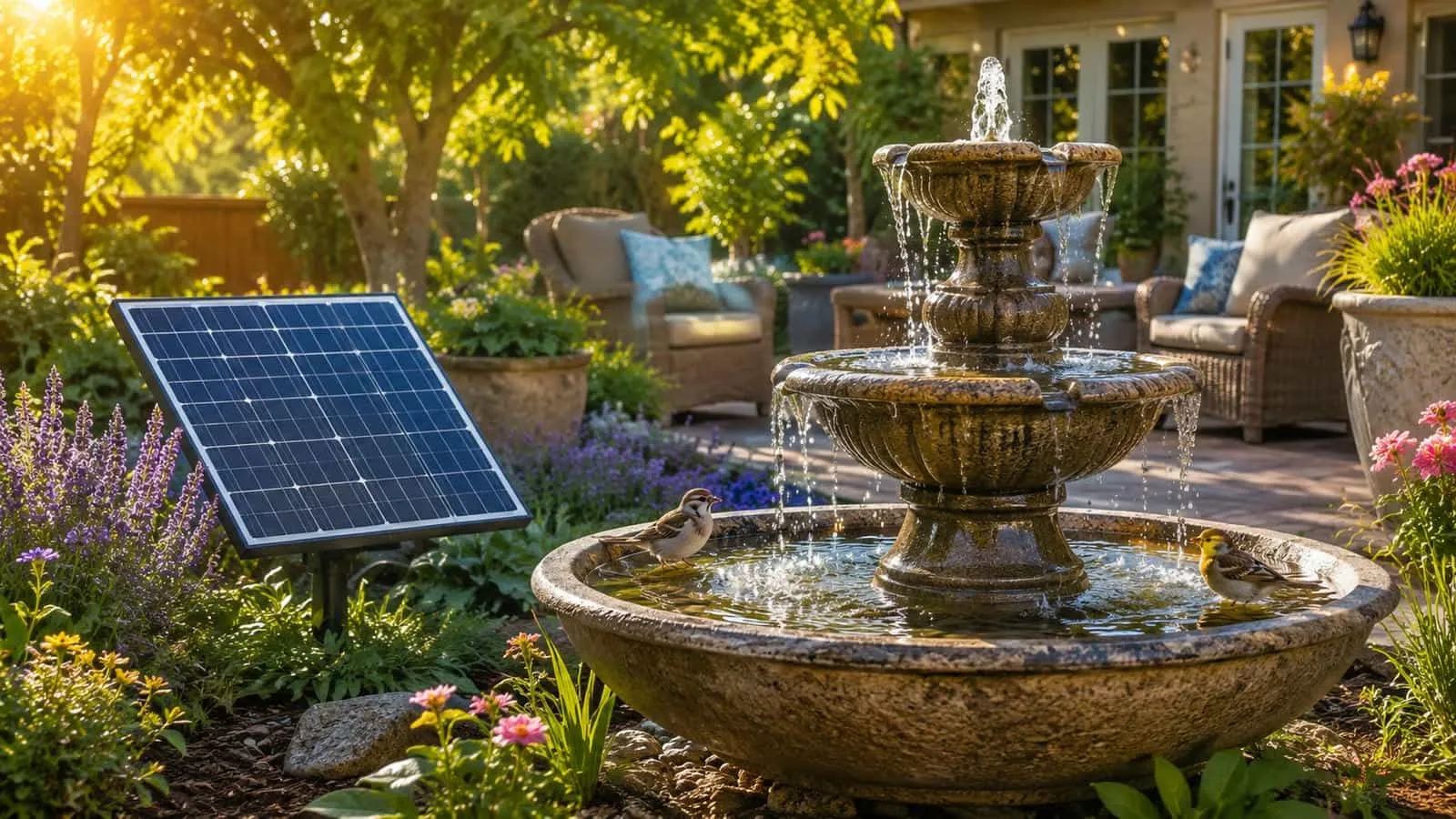
☀️⛲ A solar water fountain works best when sunlight, water movement, fountain style, sound and placement support one another. A small bubbling fountain beside a sunny patio creates a different experience from a battery powered tiered fountain in a courtyard, while a shallow solar bird bath near flowering plants can bring birds, bees and butterflies closer to everyday outdoor spaces. Use this guide to compare solar panels, pump systems, battery backup, fountain styles, sunlight needs, sound, wildlife value, materials, maintenance and real homeowner situations before choosing your fountain.
📌 Solar Water Fountain Ideas, Comparisons, Styles, Placement and Buying Advice
Explore the strongest solar water fountain images and decision guides from this complete article. Compare fountain styles, sunlight and battery systems, water sound, landscape scale, outdoor materials, common mistakes and buying priorities before choosing a dependable solar water feature for your garden, patio, bird bath or backyard retreat. Select any image below to explore that section of the guide.


☀️ Best Solar Water Fountains for Gardens, Patios, Wildlife and Peaceful Outdoor Living
A solar water fountain works best when the fountain, pump and solar panel are planned as one complete outdoor system. Available sunlight, moving shade, fountain size, water depth, nearby seating, prevailing wind and maintenance access all influence how the water feature looks, sounds and performs. The strongest designs remain attractive and dependable as plants grow and seasonal conditions change.
Solar powered water fountains bring moving water into gardens, patios, courtyards and wildlife areas without requiring a nearby electrical outlet. A compact bubbling fountain can create gentle sound beside a reading chair, while a solar bird bath may attract birds and pollinators. Larger tiered or cascading designs create stronger movement and a more visible landscape focal point. If you prefer a traditional multi level centerpiece, explore our tiered water fountain ideas for classic gardens, courtyards and landscape centerpieces to compare two tier, three tier and four tier designs, cascading water sound, materials, placement and long term outdoor care.
Choosing the right solar water fountain begins with understanding the sunlight available throughout the day. Direct solar models may flow strongly in bright sun, slow during clouds and stop in shade, while fountains with battery backup can provide steadier operation. Pump strength, panel placement, water sound, viewing distance, wildlife goals and fountain scale should all match the way the outdoor space will be used. For additional planning ideas, explore our complete water fountain placement guide.
Outdoor conditions naturally change over time. Summer plant growth can shade the panel, hot weather increases evaporation, autumn leaves may block the pump and freezing temperatures require winter protection. Choosing a solar fountain with an accessible pump, easy-to-clean panel, replaceable parts and realistic water flow creates a feature that remains easier to maintain and enjoyable through many seasons.
Compare solar bird baths, bubbling bowls, tiered fountains and cascading water features for gardens, patios, wildlife areas and backyard seating.
Choose the right panel, pump and battery system for reliable water movement, relaxing sound and easier outdoor placement.
🛒 Shop Peaceful Solar Water Fountains on Amazon
☀️ What Makes a Solar Water Fountain Work Well?
A successful solar water fountain works with the outdoor environment instead of against it. The best solar water fountains combine reliable sunlight, efficient pump performance, thoughtful placement and practical maintenance to create a peaceful focal point that complements gardens, patios, flower beds and wildlife spaces while delivering dependable water movement throughout the seasons.
Use these design principles to choose a solar water fountain that remains attractive, efficient and enjoyable as sunlight, surrounding plants and seasonal weather naturally change.
- ☀️ Maximize Available Sunlight: Position the solar panel where it receives the longest period of direct sunlight while allowing the fountain to remain exactly where it looks best. Reliable solar exposure helps maintain stronger water flow, steadier pump performance and more consistent operation throughout the day.
- 📏 Match the Fountain to the Space: Choose a solar fountain that fits the scale of the landscape and remains visible after nearby flowers, shrubs and ornamental grasses reach their mature size. If your primary goal is creating a comfortable seating area around decks, pergolas or outdoor furniture, explore our patio water fountain ideas for outdoor living spaces. Balanced proportions create a natural focal point without overwhelming smaller gardens or patios. If you're designing a larger property with lawns, pergolas, pools, outdoor kitchens and multiple entertaining zones, explore our complete backyard water fountain planning and design guide for ideas that connect the entire outdoor living space.
- 💧 Create Comfortable Water Movement: Select bubbling, cascading or gentle flowing water that matches nearby seating, reading areas, patios and garden paths. The right pump size and water pattern create relaxing sound while minimizing unnecessary splash and water loss.
- 🧽 Make Cleaning Easy: Leave clear access to the basin, solar panel and pump so routine cleaning, refilling and seasonal maintenance remain simple. Easy access helps the fountain perform more reliably while keeping the panel operating at peak efficiency.
- 🍂 Plan for Changing Weather: Consider summer heat, passing clouds, falling leaves, strong winds and winter freezing before selecting the fountain location. Planning for seasonal conditions helps protect the pump, battery, solar panel and fountain materials for years of dependable outdoor use.
When sunlight, solar panel placement, pump performance, fountain style and seasonal care work together, a solar water fountain becomes more than an attractive landscape feature. It creates relaxing outdoor ambience, encourages birds and pollinators, adds gentle movement to the garden and provides years of peaceful enjoyment with very little energy cost.

✅ Best For: Solar water fountains are ideal for sunny flower beds, wildlife gardens, patios, courtyards, bird baths, rock gardens, pond edges, pollinator gardens, backyard seating areas and other outdoor spaces where reliable sunlight can power peaceful water movement without requiring a nearby electrical outlet.
Best Solar Water Fountains Summary
The best solar water fountain is not simply the one with the tallest spray or largest solar panel. It is the fountain that receives dependable sunlight, matches the landscape, delivers comfortable water sound and remains easy to clean throughout the seasons. Begin by evaluating available sunlight, then compare fountain styles, battery options, pump performance and overall landscape compatibility.
Compare solar bird bath fountains, bubbling bowls, cascading fountains and battery backup models designed for reliable water movement, relaxing sound and energy efficient outdoor enjoyment.
Choose a solar water fountain that performs beautifully through changing sunlight, seasons and everyday backyard living.
🛒 Browse Premium Solar Water Fountains on Amazon
🔎 Solar Water Fountain Scenario Engine: Find the Best Solar Fountain for Your Sunlight, Garden and Outdoor Space
Every outdoor space has different sunlight patterns, shade conditions, water sound preferences, wildlife activity and maintenance needs. Use the scenarios below to compare solar water fountain styles, panel placement, battery options, pump performance and real-world outdoor situations so you can confidently choose the best solar fountain for your garden, patio and everyday enjoyment.
Open each scenario to discover which solar water fountain best fits your available sunlight, outdoor space, sound preference and everyday use. Guidance includes direct solar power, battery backup, panel placement, pump strength, water movement, wildlife access, seasonal exposure and realistic maintenance planning.
🌱 Small Sunny Flower Bed Beside a Quiet Garden Bench
Best choice: Compact solar bubbling bowl or low solar urn fountain
A compact solar fountain creates gentle water movement without overwhelming a small flower bed, narrow garden corner or close seating area. Its low profile works well among herbs, groundcovers and shorter perennials while producing soft sound that can be enjoyed from a nearby bench. A model with a separate solar panel provides greater placement flexibility when the fountain looks best in partial shade but stronger sunlight is available a short distance away.
Choose this when you want soft solar-powered water sound and a calming focal point within a compact planted space.
- 💧 Gentle bubbling sound suits close seating
- ☀️ Separate panels improve sunlight access
- 📏 Compact scale protects garden balance
- 🪑 Creates a peaceful reading or resting area
- 🛠 Self-contained designs simplify setup
Micro Recommendations: Place the fountain slightly beyond the bench and position the solar panel in reliable direct sunlight while leaving clear access for refilling, pump cleaning and panel maintenance.
⚠️ Common Mistake: Choosing a fountain with an oversized spray nozzle can create excessive splash, rapid water loss and stronger sound than a quiet seating area needs.
🌸 Cottage Garden with Flowers, Curved Borders and Changing Shade
Best choice: Solar ceramic urn, birdbath or weathered stone-look fountain
Cottage gardens usually look most natural with solar fountain forms that feel established rather than highly polished. A ceramic urn, traditional birdbath or weathered stone-look fountain can blend with roses, lavender, foxgloves, flowering shrubs and curved pathways. Solar urn fountains are especially flexible because the vessel can remain within the planted garden while a separate photovoltaic panel is positioned in stronger sunlight nearby. Gentle bubbling or controlled overflow also helps keep pump demand and splash manageable. For a deeper look at vessel styles, water movement, materials, pumps, reservoirs and placement, explore our solar urn fountain design and placement ideas.
Choose this when you want a romantic solar fountain softened by flowers, natural textures and seasonal colour.
- 🌺 Complements loose cottage garden planting
- 🪨 Aged finishes create established character
- 💦 Gentle flow supports a relaxed atmosphere
- 🐦 Birdbath forms encourage wildlife visits
- ☀️ Separate panels avoid flower-bed shade
Micro Recommendations: Position the panel where summer flowers will not block sunlight, and leave enough open space around the basin to protect pump access and simplify routine cleaning.
⚠️ Common Mistake: Placing the solar panel among fast-growing perennials can reduce pump performance by midsummer when flowers and foliage begin casting heavier shade.
🏛️ Formal Garden with Straight Paths and Symmetrical Beds
Best choice: Battery backup solar tiered or pedestal fountain
Formal landscapes benefit from a solar fountain that reinforces symmetry, central sightlines and structured planting. A tiered or pedestal fountain can anchor intersecting paths, clipped hedges, geometric beds or an open lawn viewed from the house. Because larger fountains require steadier pump output, a battery backup system or generously sized solar panel is usually better than a small direct solar pump that changes noticeably with passing clouds.
Choose this when you want a commanding solar centrepiece with balanced proportions and more dependable cascading water.
- 🏛 Reinforces formal landscape symmetry
- 📐 Supports straight paths and centred views
- 🔋 Battery power steadies water movement
- ⛲ Tiered flow creates stronger visual impact
- 🌳 Larger scale suits open garden spaces
Micro Recommendations: Compare the pump output and panel capacity with the fountain height, then position the panel discreetly without sacrificing the strong sunlight required for reliable operation.
⚠️ Common Mistake: Pairing a large tiered fountain with an undersized solar panel can produce weak, uneven cascades that reduce the formal impact of the design.
🐦 Wildlife Garden for Birds, Bees and Butterflies
Best choice: Shallow solar birdbath fountain or low bubbling basin
A wildlife-friendly solar fountain should provide clean moving water, shallow access and stable footing for visiting birds and pollinators. A solar birdbath or low bubbling basin can attract wildlife while adding natural sound near native plants and protective shrubs. Gentle bubbling is usually more suitable than forceful spray because it limits splash, preserves usable water depth and creates calmer drinking and bathing areas.
Choose this when you want renewable-powered moving water that supports wildlife without sacrificing garden beauty.
- 🐦 Shallow water supports safer bird access
- 💧 Movement helps wildlife locate the basin
- 🪨 Textured surfaces improve stable footing
- ☀️ Solar power avoids exposed extension cords
- 🧼 Regular cleaning protects water quality
Micro Recommendations: Use a low spray or bubbler attachment, keep the basin visible from several directions and clean the pump and water frequently during warm weather or heavy wildlife activity.
⚠️ Common Mistake: Using a tall spray nozzle in a shallow birdbath can empty the basin quickly, frighten smaller birds and expose the solar pump to damaging low water levels.
🪨 Sunny Rock Garden with Gravel and Drought-Tolerant Plants
Best choice: Solar bubbling rock or low natural stone-look fountain
Solar bubbling rock fountains integrate naturally with gravel beds, boulders, alpine plants, succulents and drought-conscious landscapes. Water appears to rise directly from the stone, creating restrained movement without the decorative formality of a tiered fountain. Open rock gardens often provide excellent sunlight for a solar panel, but reflective heat and rapid evaporation make water depth and pump protection especially important. For deeper planning beyond the solar power system, explore our bubbling rock fountain landscaping and installation guide for natural stone choices, hidden reservoirs, water flow, placement, sound and long term maintenance.
Choose this when you want solar-powered water movement that appears naturally built into the surrounding stone.
- 🪨 Blends naturally with gravel and stone
- ☀️ Open planting supports strong solar exposure
- 💦 Bubbling flow limits unnecessary splash
- 🌱 Complements drought-tolerant planting
- 📏 Low form protects open landscape views
Micro Recommendations: Create a stable level base, monitor water levels during hot weather and use larger edging stones to prevent gravel and soil from entering the reservoir or pump intake.
⚠️ Common Mistake: Assuming a sunny location requires little attention can lead to rapid evaporation, overheated water and a pump running dry during hot summer afternoons.
🚶 Garden Path with Solar Water Viewed While Walking
Best choice: Narrow solar urn, compact pedestal or low bowl fountain
A solar fountain beside a garden path should create interest without narrowing the route or placing panels, cables and basin edges where people walk. A slim urn, compact pedestal or low bowl can become a discovery point along a curved pathway or planted border. The fountain should face the main approach, while the solar panel and connecting cable remain outside normal foot traffic and garden maintenance routes.
Choose this when you want solar water movement to create a visual destination and changing sound experience along a garden walk.
- 🚶 Preserves comfortable walking clearance
- 👀 Creates a focal point along the path
- 🎧 Sound changes with movement and distance
- ☀️ Panel can sit beyond the path in sunlight
- 🔌 Keeps cables away from foot traffic
Micro Recommendations: Set the fountain beyond the path edge, secure the panel cable, direct splash away from paving and confirm that mature foliage will not shade the panel or conceal the basin.
⚠️ Common Mistake: Running an unsecured solar cable across a pathway creates a tripping hazard and increases the chance of damage from feet, lawn equipment or garden tools.
🌳 Large Landscaped Yard Viewed from the House
Best choice: Large battery backup solar urn or multi-tiered fountain
A solar fountain viewed from a window, deck or distant seating area needs enough height, contrast and water movement to remain visible across the landscape. A tall urn or tiered fountain can anchor broad lawns, deep flower beds and large shrub borders. Because stronger water movement requires more energy, these settings benefit from a larger solar panel, higher-capacity pump and battery backup that maintains visual flow during temporary cloud cover.
Choose this when you need a solar garden focal point with enough scale and movement to be appreciated from farther away.
- 🏡 Remains visible from windows and decks
- 📏 Larger scale suits broad landscapes
- 🔋 Battery backup supports steadier flow
- ⛲ Strong movement improves distant visibility
- ☀️ Larger panels support stronger pumps
Micro Recommendations: Test the location from important indoor and outdoor viewing areas, then confirm the solar panel receives enough direct sunlight to support the required pump output.
⚠️ Common Mistake: Choosing a visually large fountain with a low-powered solar pump can create weak water movement that is difficult to see or hear from the house.
🍂 Four-Season Garden in a Cold or Changing Climate
Best choice: Durable solar fountain with removable pump, panel and battery
Solar fountains exposed to intense sunlight, wind, falling leaves, frost and freeze-thaw cycles need materials and components selected for seasonal realism. Resin and fiberglass fountains are easier to move or store, while heavier cast stone designs may remain outdoors after complete draining and protection. Removable solar panels, pumps and battery units simplify winter storage and reduce the risk of cold-weather damage.
Choose this when winter preparation, component protection and manageable seasonal maintenance are central to the buying decision.
- ❄️ Removable parts simplify winter protection
- 🍂 Open access makes leaf removal easier
- ☀️ Seasonal sun angles affect charging
- 🌬 Wind changes splash and evaporation
- 🔋 Indoor battery storage may extend service life
Micro Recommendations: Drain the fountain before freezing weather, clean and dry the pump, disconnect the battery and store electrical components according to the manufacturer’s winter-care instructions.
⚠️ Common Mistake: Leaving water inside the pump, tubing or fountain basin during freezing weather can damage components and shorten the life of the entire solar fountain system.
📊 Solar Water Fountain Comparison by Sunlight, Power System, Water Flow and Outdoor Goal
| ☀️ Outdoor Goal | ⛲ Recommended Solar Fountain | 💧 Water Sound and Flow | Solar Placement and Performance | Buyer Guidance and Planning Insight |
|---|---|---|---|---|
| 🏛️ Elegant Garden Centrepiece | A battery backup tiered or pedestal solar fountain creates height, symmetry and stronger visual presence. | Layered cascading water produces brighter splash notes and broader sound across open landscaped areas. | Place the fountain on a central sightline and position a larger solar panel where it receives dependable direct sunlight. | Best for homeowners who want a formal solar fountain with steadier flow, stronger visibility and enough power for multiple tiers. |
| 🌸 Relaxed Cottage Garden Character | A solar ceramic urn, weathered stone-look basin or traditional solar birdbath blends naturally with informal planting. | Soft bubbling or gentle trickling adds movement without overpowering birds, breezes or surrounding garden sounds. | Place the fountain among curved borders while locating the panel beyond taller flowers where summer growth will not block sunlight. | Well suited to gardeners who want a romantic solar water feature that feels naturally integrated with flowers and aged materials. |
| 🐦 Wildlife Friendly Water Source | A shallow solar birdbath fountain with textured edges provides safer access for birds, bees and butterflies. | Low circulation or gentle bubbling creates visible movement while preserving usable water depth and limiting splash. | Position it in open view near protective planting, with the solar panel clear of branches and moving afternoon shade. | Ideal for buyers who want wildlife activity, renewable power and accessible moving water without running an outdoor electrical cord. |
| 📖 Peaceful Seating and Reading Area | A compact solar bubbling bowl or low urn fountain creates a quiet and intimate outdoor destination. | Rounded bubbling provides soothing close-range sound with limited spray and comfortable conversation levels. | Use a separate solar panel so the fountain can remain near shaded seating while the panel receives stronger sunlight nearby. | Frequently chosen by homeowners seeking gentle water sound for reading, morning coffee, reflection or quiet outdoor conversations. |
| 🪨 Natural Rock Garden Integration | A solar bubbling rock or low stone-look fountain adds movement without appearing formal or overly decorative. | Water rises across the textured surface and creates grounded bubbling with controlled splash and limited acoustic projection. | Open rock gardens usually provide strong solar exposure, but hot reflected surfaces increase evaporation and water temperature. | A practical choice for people who want a natural-looking solar fountain within gravel, alpine planting or drought-conscious landscaping. |
| 🏡 Compact Patio or Small Garden | A tabletop solar fountain, small urn or low bubbling basin adds movement without taking up valuable walking space. | A light trickle or compact bubbling pattern creates noticeable ambience without excessive volume in a confined area. | Choose a model with a movable panel and enough cable length to reach direct sun without crossing walkways or seating areas. | Ideal for buyers seeking a small solar water fountain with flexible placement, gentle sound and simple everyday maintenance. |
| Solar fountain summary: The best solar water fountain should match the available sunlight, desired water movement and purpose of the outdoor space. Battery backup tiered fountains provide steadier flow for formal landscapes, while solar birdbaths, bubbling bowls, urns and rock fountains suit wildlife gardens, cottage planting and quiet seating areas. Thoughtful panel placement, realistic pump sizing and easy maintenance access improve long-term performance. | ||||
Compare solar birdbaths, bubbling rocks, tiered fountains, compact urns and battery backup models for gardens, patios, wildlife areas and peaceful retreats.
Find a solar fountain with the right panel capacity, pump strength, water sound and outdoor scale for dependable everyday enjoyment.
🛒 Discover Top Rated Solar Water Fountains on Amazon
Advantages and Disadvantages of Solar Water Fountains
Solar water fountains can add moving water, relaxing sound, wildlife activity and visual interest without requiring a nearby electrical outlet. They also depend on sunlight, water depth, clean solar panels and regular pump care. Comparing the main benefits and practical limitations can help you decide whether a solar powered fountain fits your outdoor space, climate, maintenance comfort and expected operating schedule.
| Benefits of Solar Water Fountains | Limitations and Practical Tradeoffs |
|---|---|
|
|
| Solar Fountain Tip: Position the fountain where it can be enjoyed from a patio, bench or nearby window, but place the solar panel where it receives dependable direct sunlight. Leave enough access to refill the basin, clean the pump, wipe the panel and protect removable components during winter. | |
💡 Comparison Tip: Compare solar fountains by their complete power system, not only the fountain body. Panel wattage, pump output, battery capacity, cable length and replacement-part availability often determine whether the fountain performs reliably after installation. If you are still deciding whether solar is the right power source for your yard, use our solar vs electric water fountain guide to compare sunlight, shade, pump strength, battery backup, outlet access and evening operation.
Section Summary Snapshot: Comparing solar water fountains by sunlight, power system, water sound, outdoor use and maintenance reveals which design will perform most reliably. Battery backup fountains provide steadier operation, while direct solar birdbaths, bubbling bowls and rock fountains suit bright gardens and simpler water features. The strongest choice combines adequate panel capacity, realistic pump output, convenient cleaning access and seasonal protection. If you are also comparing traditional outdoor water features beyond solar models, explore our complete garden water fountains guide for additional fountain styles, landscape ideas and planning inspiration.
☀️ Solar Water Fountain Styles for Cottage, Formal, Wildlife, Shaded and Rock Gardens
🌷 Cottage Solar Water Fountains for Romantic Gardens and Informal Planting
🌷 Cottage Solar Water Fountains for Flowers, Gentle Bubbling and Relaxed Outdoor Charm
Cottage solar water fountains look most natural when softly weathered materials, quiet water movement and loose planting work together. Solar ceramic urns, birdbath fountains, stone-look bowls and compact bubbling basins create peaceful focal points among roses, lavender and flowering perennials without requiring a nearby electrical outlet.
Problem A solar fountain can disappear behind summer flowers, while nearby foliage may shade the panel and weaken the water flow.
Why it happens Cottage gardens contain layered plants that change rapidly in height and density, creating new shadows that may not exist during spring installation.
Solution Choose a fountain with a separate solar panel, keep lower flowers around the basin and position the panel beyond tall perennials where it can receive dependable direct sunlight.
🌷 Best Cottage Solar Water Fountain Ideas
Cottage solar fountains should feel comfortably settled into the landscape rather than newly placed on top of it. Aged stone-look finishes, softly coloured ceramic urns, traditional solar birdbaths and small bubbling bowls complement curved pathways, overflowing borders and romantic planting. Gentle water movement adds sound and reflected light without competing with birds, bees, rustling leaves or the informal character of the garden.
Place the fountain where it remains visible from a porch, pathway or nearby window, then position its photovoltaic panel where summer growth will not reduce charging. Lavender, catmint, creeping thyme and compact herbs can soften the basin edge, while taller roses, foxglove, salvia and hollyhocks should remain behind the fountain so the pump and water reservoir stay accessible.
- 🪨 Choose Softly Aged Fountain Finishes Weathered stone-look resin, glazed ceramic and softly textured finishes complement romantic planting while hiding minor water marks, pollen and outdoor wear more naturally than highly polished surfaces.
- 🌸 Keep Low Flowers Around the Basin Lavender, catmint, thyme and other compact plants can soften the fountain without covering the pump, blocking the water view or creating dense shade across the solar panel.
- ☀️ Move the Panel Beyond Tall Flowers Use a fountain with adequate cable length so the photovoltaic panel can sit in open sunlight even when the basin is surrounded by taller cottage garden plants.
- 🧹 Preserve a Clear Maintenance Side Leave one side open for refilling, cleaning the pump, wiping the panel and removing flower petals without stepping through densely planted garden beds.
🌷 Cottage Solar Fountain Tip: Position the fountain first for appearance and the separate solar panel second for performance. A remote panel lets the water feature remain among flowers while the power source receives stronger uninterrupted sunlight.
🏛️ Formal Solar Water Fountains for Symmetry, Structure and Reliable Cascading Flow
🏛️ Formal Solar Water Fountains for Balanced Sightlines, Stronger Pumps and Classical Garden Design
Formal solar water fountains require symmetry, dependable pump output and precise placement. Battery-supported tiered fountains, pedestal basins and classical solar designs work best when centred on straight pathways, aligned with doors or windows and paired with a solar panel large enough to maintain steady cascading water.
Problem A formal solar fountain can look weak or visually unbalanced when water flow changes constantly or the panel disrupts the symmetrical landscape.
Why it happens Tiered designs need more pump power, while formal gardens make off-centre placement, uneven foundations and visible equipment easier to notice.
Solution Choose a higher-capacity solar pump with battery backup, install the fountain on a level central axis and place the panel discreetly where it still receives strong direct sunlight.
🏛️ Best Formal Solar Water Fountain Ideas
Formal solar fountains should strengthen the geometry of the landscape while producing enough water movement to remain impressive from a distance. Tiered fountains, pedestal bowls and classical stone-look forms work well with clipped boxwood, structured hedges, geometric flower beds and straight garden paths. Battery backup is especially valuable because it helps maintain steadier flow when brief clouds pass over the panel.
Position the fountain at the end of a primary path, within a central courtyard or where important sightlines intersect. The foundation must remain level so water falls evenly from every side. A larger remote panel can be placed behind a hedge, beside an open bed or along a sunny property edge, provided it remains accessible and receives sufficient sunlight to recharge the battery and support the selected pump.
- 🏛️ Select Strong Architectural Forms Tiered fountains, pedestal bowls and classical stone-look designs reinforce formal symmetry and create enough height to remain visible along long garden sightlines.
- 🔋 Choose Battery-Supported Operation A rechargeable battery can smooth out temporary changes caused by passing clouds and help maintain more consistent cascading water during planned outdoor use.
- 📐 Centre the Fountain Precisely Align the fountain with straight paths, entrances, windows or the main garden axis so the water feature strengthens rather than weakens the structured layout.
- ☀️ Hide the Panel Without Shading It Position the photovoltaic panel discreetly behind low planting or along a sunny border, but never sacrifice direct solar exposure simply to keep it out of view.
🏛️ Formal Solar Fountain Tip: Check the pump rating before choosing a multi-tiered model. A fountain may look large enough for the garden but still produce disappointing cascades when the panel and pump are undersized for the total lift height.
🐦 Solar Wildlife Fountains for Birds, Bees, Butterflies and Backyard Habitats
🐦 Solar Water Fountains for Safe Bird Bathing, Pollinator Drinking and Natural Wildlife Activity
Wildlife solar water fountains provide visible moving water without exposed household electrical cords. Shallow solar birdbaths, low bubbling basins and gentle circulation pumps can support birds, bees and butterflies when the water remains clean, accessible and calm enough for safe drinking and bathing.
Problem Birds and pollinators may avoid a solar fountain that sprays too strongly, empties quickly or offers no secure landing surface.
Why it happens Small spray attachments can send water outside shallow basins, while slippery edges and fluctuating pump pressure make the fountain harder for wildlife to use.
Solution Use a low bubbler or gentle nozzle, add textured stones and maintain a shallow water level that gives wildlife stable access without exposing the pump.
🐦 Best Solar Wildlife Fountain Ideas
Solar birdbath fountains and shallow bubbling basins are among the most practical renewable-powered water features for wildlife gardens. Moving water reflects sunlight and creates small ripples that birds may notice from nearby branches. Bees and butterflies can drink from damp stones, shallow ledges and gently sloping edges, while the absence of an extension cord makes placement easier in open planting areas.
Keep the basin within sight of nearby shrubs or small trees so birds have a place to perch before approaching, but avoid placing it inside dense cover where predators could remain hidden. The solar panel should receive direct sunlight without creating an obstacle near the basin. Refresh the water often, remove algae and debris, and avoid additives that may be unsafe for birds, pollinators or pets.
- 🐦 Use a Shallow Solar Birdbath Broad shallow basins make drinking and bathing easier while reducing the risk created by deep water, steep sides or forceful vertical spray.
- 🪨 Add Textured Landing Stones Partially submerged stones and rough edges give birds, bees and butterflies stable places to stand while keeping them close to shallow moving water.
- 💧 Reduce Pump and Spray Intensity Choose a low bubbling attachment or adjustable pump setting that creates visible movement without rapidly emptying the basin.
- 🧼 Protect Wildlife Water Quality Replace stale water, brush away algae, clear the pump intake and avoid harsh chemicals whenever wildlife or pets can reach the fountain.
🐦 Solar Wildlife Fountain Tip: Keep several inches of open space around the solar panel. Flowering plants attract pollinators, but dense stems and leaves can shade the panel and cause the fountain to stop during the busiest wildlife hours.
🌿 Solar Water Fountains for Shaded Gardens, Woodland Paths and Covered Retreats
🌿 Solar Water Fountains for Partial Shade Using Remote Panels and Battery Backup
Solar fountains can work in shaded garden spaces when the water feature and power source are positioned separately. A remote photovoltaic panel can remain in direct sunlight while a bubbling bowl, ceramic urn or compact basin sits among hostas, ferns and woodland planting. Battery backup can provide steadier flow during temporary shade.
Problem A solar fountain placed directly beneath trees or beside a shaded patio may run slowly, stop frequently or fail to operate.
Why it happens Photovoltaic panels need adequate direct light, while tree canopies, roofs, fences and surrounding buildings reduce the energy available to the pump.
Solution Choose a solar fountain with a separate panel, sufficient cable length and optional battery storage so the panel can charge in sun while the fountain remains in the desired shaded setting.
🌿 Best Solar Fountain Ideas for Shaded Gardens
A shaded fountain can bring reflected light, cool water sound and gentle movement to woodland gardens where flowers may be limited. Pale stone-look finishes, glazed ceramic, stainless accents and light-coloured basins create useful contrast against hostas, ferns, heuchera and deep green foliage. The fountain itself does not need direct sunlight when a separate panel can be positioned in an open nearby area.
Before installation, measure the distance between the preferred fountain location and the nearest reliable sunlight. Confirm that the included cable reaches without crossing a path or becoming exposed to lawn equipment. A battery-supported model may help maintain water flow through shifting tree shadows, but even battery fountains require enough daily sunlight to recharge properly.
- ☀️ Use a Remote Solar Panel Place the fountain in partial shade while positioning its separate panel beyond the tree canopy, roofline or fence shadow where direct sunlight remains available.
- 🔋 Consider Battery Backup A rechargeable battery can support steadier operation during moving shade, but it must receive enough solar charging time to replace the energy being used.
- 🌿 Choose Reflective Fountain Materials Pale stone, glazed ceramic and metallic accents reflect available light and help the water feature remain visible among darker woodland foliage.
- 🍂 Prepare for Additional Debris Shaded fountains beneath trees often collect more leaves, pollen, seeds and organic matter, making accessible pump placement and regular cleaning especially important.
🌿 Shade Solar Fountain Tip: A battery does not replace sunlight. It stores collected energy, so the panel still needs a dependable sunny location and enough charging hours to support the fountain during shaded periods.
🪨 Solar Rock Garden Fountains for Gravel, Stone and Drought-Tolerant Landscapes
🪨 Solar Rock Garden Fountains for Natural Bubbling Water, Stone Texture and Sunny Landscapes
Solar rock fountains look most convincing when their colour, texture and water flow blend with the surrounding landscape. Bubbling boulders, carved stone-look bowls and low recirculating features work especially well in sunny gravel gardens where a photovoltaic panel can receive strong light and gentle water movement can resemble a natural spring.
Problem A solar rock fountain may look artificial or perform poorly when the stone finish, pump output or reservoir design does not match the setting.
Why it happens Strong vertical spray conflicts with natural rock garden character, while loose gravel, soil and intense reflected heat can affect water levels and pump performance.
Solution Choose a low bubbling stone form, match it to surrounding rock, protect the reservoir from loose material and monitor evaporation during hot sunny weather.
🪨 Best Solar Rock Garden Fountain Ideas
Solar bubbling rocks, stone-look basins and low recirculating fountains can bring water into dry landscapes without introducing a highly decorative object. Open gravel beds and alpine gardens often provide excellent direct sunlight, allowing the solar pump to operate strongly during the day. Slow bubbling water creates a grounded sound and wet stone texture that feels more realistic than a tall spray pattern.
Position the fountain along the natural grade of the garden and repeat nearby stone colours so the feature appears connected to the terrain. Slightly embedding the base in gravel can improve realism, but the pump access cover should remain reachable. Use edging or larger rocks to prevent loose gravel from entering the reservoir, and check the water level frequently during hot or windy conditions.
- 🪨 Match the Surrounding Rock Choose a bubbling rock or stone-look fountain with colours and textures that repeat nearby boulders, gravel and edging materials.
- ☀️ Use Open Solar Exposure Rock gardens often provide excellent sunlight, but the panel should remain slightly elevated so gravel, dust and irrigation runoff do not cover its surface.
- 💧 Keep Water Movement Low Gentle bubbling and wet stone surfaces create a spring-like appearance while limiting splash, water loss and visual competition with the surrounding landscape.
- 🧹 Protect the Hidden Reservoir Use stable edging and larger stones to keep gravel, soil and plant debris away from the pump intake and underground water chamber.
🪨 Solar Rock Fountain Tip: Bright rock gardens can become extremely hot. Check the basin more frequently during summer because reflected heat, direct sun and dry wind can lower the water level faster than expected.
🎋 Japanese Inspired Solar Water Fountains for Quiet and Balanced Gardens
🎋 Japanese Inspired Solar Fountains for Gentle Sound, Natural Simplicity and Reflective Outdoor Spaces
Japanese inspired solar water fountains emphasize restraint, balance and quiet water movement. Solar stone basins, bamboo-style spouts, bubbling rocks and low tsukubai-inspired forms can complement moss, gravel, stepping stones and carefully shaped evergreens when the panel is positioned discreetly and the pump remains gentle.
Problem A solar fountain may disturb a Zen garden when the spray is too active, the equipment is highly visible or too many decorative objects surround the water.
Why it happens Japanese inspired landscapes depend on negative space, natural materials, quiet proportions and controlled sensory detail rather than constant visual movement.
Solution Choose a low-flow stone or bamboo-style fountain, hide the solar cable carefully, position the panel outside the main view and leave open gravel or moss around the feature.
🎋 Best Japanese Inspired Solar Fountain Ideas
Solar stone basins, bamboo-style spouts and low bubbling rocks can create contemplative water sound without the permanent wiring of a conventional pump. A restrained direct solar fountain may naturally slow when clouds pass, while a battery-supported model offers more consistent flow for meditation or evening garden use. For a deeper look beyond solar power, explore our traditional Japanese fountain forms and features to compare bamboo water features, stone basins, tsukubai, gentle water movement and their role in Japanese inspired garden design. Both solar and conventional options should avoid tall spray and visually busy water patterns.
Place the fountain where it can be appreciated from a stepping-stone path, quiet bench or meditation area without becoming the only object in view. Moss, ferns, dwarf evergreens, smooth gravel and natural boulders can frame the water feature while preserving open space. Route the panel cable discreetly and position the photovoltaic panel where it receives direct light without dominating the carefully balanced scene.
- 🪨 Choose Restrained Natural Forms Stone basins, bamboo-style spouts and low bubbling rocks provide water movement without introducing unnecessary ornament or visual weight.
- 💧 Use Quiet Controlled Flow Gentle dripping, trickling or bubbling creates a meditative sound that works with birds, wind and rustling foliage instead of overpowering them.
- ☀️ Position the Panel Discreetly Place the solar panel beyond the primary viewing area while preserving direct sunlight and avoiding dense overhead branches.
- 🧘 Protect Open Visual Space Allow gravel, moss, stepping stones and empty ground to surround the fountain so the landscape remains calm, balanced and uncluttered.
🎋 Japanese Inspired Solar Fountain Tip: Hide the technology without limiting its performance. A carefully routed cable and well-positioned remote panel allow the fountain to feel natural while still receiving enough sunlight to operate reliably.
Section Summary Snapshot: Choosing the right solar water fountain style requires matching the fountain to both the landscape and the available solar energy. Cottage gardens benefit from remote panels among layered flowers, formal gardens need stronger pumps and battery support, wildlife fountains require shallow gentle water, shaded gardens depend on sunny panel placement, while rock and Japanese inspired spaces favour restrained flow and natural integration.
Compare solar birdbaths, tiered fountains, bubbling rocks, ceramic urns and battery backup designs for cottage, formal, wildlife, shaded and Japanese inspired gardens.
Choose a solar fountain that matches your sunlight, outdoor style, preferred water sound and everyday maintenance needs.
🛒 Explore Solar Water Fountain Styles on Amazon
⛲ Choosing the Best Solar Water Fountain Form for Your Sunlight, Outdoor Space and Lifestyle

Choosing a solar water fountain can feel confusing because fountains that look similar may use very different panels, pumps and battery systems. The better approach is to begin with the outdoor experience you want. A softly bubbling fountain beside a reading chair needs less pump power than a tiered centrepiece viewed across a large yard, while a solar birdbath has different water-depth and wildlife requirements.
Look beyond the shape of the fountain and consider how the complete solar system will operate. Direct sunlight, moving shade, panel wattage, pump lift, cable length, battery capacity, spray height, water loss and maintenance access all affect long-term satisfaction. Our complete guide to outdoor water fountain types and styles can help you compare fountain forms, while this section focuses on matching those forms to realistic solar performance.
Use the comparisons below to narrow your choices by real outdoor conditions instead of appearance alone. A solar powered water fountain is more likely to perform well when the fountain body, photovoltaic panel, pump strength and daily sunlight are selected as one connected system.
Compare solar tiered fountains, birdbaths, bubbling rocks, decorative urns and compact battery backup models for gardens, patios and peaceful backyard retreats.
Choose a solar fountain that matches your sunlight, preferred water sound, available space and everyday outdoor routine.
🛒 Compare Solar Water Fountains on Amazon
🌿 Choosing the Best Solar Water Fountain Form for Your Outdoor Space
Choosing the right solar fountain means matching the water feature to available sunlight, pump capacity, viewing distance and the way the outdoor space is used. The strongest options provide suitable water movement without demanding more solar energy than the panel and battery system can reliably produce.
| ☀️ Outdoor Priority | ⛲ Recommended Solar Fountain Form | 🎧 Why It Performs Well | 🏡 Best For Homeowners Who... |
|---|---|---|---|
| Create a statement feature visible across the landscape | Battery Backup Tiered Solar Fountain | A larger panel, stronger pump and rechargeable battery can support elevated cascades, brighter water movement and broader sound across open gardens, courtyards and formal landscaped areas. | Ideal for homeowners who want a prominent solar centrepiece and are prepared to provide dependable direct sunlight, sufficient panel capacity and regular water-level monitoring. |
| Blend flowing water into flowers and informal planting | Solar Urn Fountain | Rounded forms and gentle bubbling require less water lift than large tiered designs, helping the solar pump create steady movement while the fountain blends naturally with shrubs and flowering borders. | Often chosen by buyers who want a peaceful solar garden fountain that adds sound and movement without dominating cottage gardens, perennial beds or relaxed landscapes. |
| Attract birds, bees and butterflies | Solar Birdbath Fountain | Shallow circulating water creates visible ripples and light bubbling that can help wildlife notice the basin while using relatively modest pump power. | Best for people who want a solar powered bird bath fountain that supports wildlife without requiring a nearby outlet or permanent outdoor wiring. |
| Create a natural feature with restrained water movement | Solar Bubbling Rock Fountain | Low water lift, concealed reservoirs and subtle bubbling can produce grounded sound and natural texture without demanding the energy required by tall spray or multi-level cascades. | Frequently selected by homeowners who prefer solar water movement that blends into gravel gardens, natural stone, ornamental grasses and drought-conscious landscapes. |
| Add water to a compact patio or narrow garden | Compact Solar Wall or Tabletop Fountain | Vertical and small-footprint designs preserve usable space while directing water through short channels that can operate with lower pump output and controlled splash. | Commonly researched by people seeking small solar water fountain ideas for patios, balconies, courtyards, side yards and intimate seating areas. |
| Create stronger sound and water movement in a larger setting | High-Capacity Solar Cascade or Pond Fountain | A larger photovoltaic panel, higher-flow pump and battery storage can support wider water movement, greater acoustic reach and more visible circulation across ponds or broad landscapes. | Best for homeowners who want a substantial renewable-powered feature and understand that larger water displays require more panel capacity, stronger sunlight and increased maintenance. |
| ☀️ The best solar water fountain is rarely determined by appearance alone. Matching fountain form to daily sunlight, panel wattage, pump lift, battery support, water sound and maintenance expectations creates a feature that performs more reliably. When the solar power system and fountain design are properly balanced, the water feature feels like a natural part of the outdoor space instead of an underpowered decoration. | |||

Compare compact bubbling bowls, solar birdbaths, decorative urns, tiered fountains and larger battery backup designs for every landscape size.
Find a solar fountain with balanced proportions, suitable pump output and enough panel capacity for your outdoor space.
🛒 Find the Right Solar Fountain on Amazon
📏 Choosing the Right Solar Water Fountain by Outdoor Space and Power Needs
| 🌿 Outdoor Space | ⛲ Recommended Solar Fountain Forms | 🎯 Why They Work Best |
|---|---|---|
| 🏡 Small Gardens and Patios | Compact solar bowls, tabletop fountains, birdbath inserts, small urns and low bubbling fountains | These designs preserve walking and seating space while using shorter water lifts and lower pump output to create soft sound, visible movement and practical direct solar performance. |
| 🌸 Medium Gardens and Courtyards | Solar urn fountains, complete birdbath fountains, bubbling rocks and compact battery-supported tiered fountains | They provide enough height and water movement to create a defined focal point while remaining compatible with moderately sized panels, accessible reservoirs and common backyard sunlight conditions. |
| 🌳 Large Gardens and Open Landscapes | Larger tiered solar fountains, pond fountains, substantial bubbling rocks and high-capacity battery backup models | Larger forms offer stronger visual presence and wider sound coverage but require more direct sunlight, greater panel wattage, higher pump capacity and increased attention to water levels. |
| ☀️ Matching solar fountain size to both the landscape and the available energy creates better performance. Small fountains usually need less pump lift, while large cascades and pond systems require stronger panels, higher water flow and dependable battery support. Proper scale allows the fountain to remain visible without placing unrealistic demands on its solar power system. | ||
☀️ Choosing a Solar Water Fountain for Everyday Outdoor Living
| 🌿 Your Outdoor Lifestyle | ⛲ Solar Fountain Recommendation |
|---|---|
| ☕ Enjoy quiet mornings with coffee, reading or reflection | Choose a low bubbling solar bowl or urn positioned near seating. A direct solar model may suit daytime use, while a battery-supported fountain can provide steadier flow when morning light is filtered or inconsistent. |
| 🎉 Frequently entertain family and friends outdoors | Select a battery backup solar fountain with adjustable flow so the water sound remains pleasant during meals and conversation without stopping immediately when temporary cloud cover passes. |
| 🧹 Prefer simple maintenance and uncomplicated operation | Look for a self-contained solar fountain with a removable pump, easy-access basin, washable panel and limited tubing. Simple bubbling designs usually require less cleaning than multiple tiers or narrow water channels. |
| ❄️ Live where winters regularly fall below freezing | Choose a lightweight fountain with removable pump, panel and rechargeable battery components that can be drained, cleaned and stored before freezing temperatures arrive. |
| 🌱 Expect trees, shrubs and flower beds to grow larger | Use a separate solar panel and place it where mature growth will not reduce charging. Keep the fountain visible while preserving an open route for refilling, panel cleaning and pump maintenance. |
| ☀️ The best solar fountain should fit your daily routine as well as your landscape. Matching operating hours, battery expectations, sound level, cleaning requirements and future shade patterns creates a off-grid water feature that remains useful instead of becoming frustrating when outdoor conditions change. | |

🌿 Long-Term Solar Water Fountain Planning for Reliable Performance and Outdoor Enjoyment
A solar water fountain should continue working after the first sunny week of installation. Long-term planning means accounting for growing plants, shifting shadows, changing sun angles, battery wear, evaporation, airborne debris and winter weather. These details determine whether the fountain remains enjoyable or gradually becomes difficult to operate.
Use these practical planning principles to choose a solar fountain that remains efficient, accessible and visually balanced as the landscape and seasons change.
- 🌱 Predict Future Shade Watch how trees, shrubs and tall perennials affect sunlight during different seasons. Position the photovoltaic panel where mature growth will not block the strongest charging hours.
- ☀️ Match Energy Supply to Water Demand Compare panel wattage and pump output with the desired lift height, spray pattern and operating time. Stronger cascades require more solar energy than gentle bubbling.
- 🧹 Preserve Easy Component Access Leave enough open space to refill the basin, remove the pump, clean tubing, wipe the panel and replace a rechargeable battery without disturbing nearby planting.
- 🍂 Prepare for Seasonal Changes Consider pollen, leaves, wind, evaporation, shorter autumn days and freezing temperatures before choosing the final position. Seasonal realism reduces unexpected performance problems.
- 🔋 Plan for Replaceable Parts Choose a solar fountain with accessible pumps, batteries, nozzles and cables whenever possible. Replaceable components can extend the useful life of the fountain when one part eventually wears out.
Choosing a solar water fountain with long-term performance in mind creates a more dependable outdoor feature. When panel exposure, pump demand, battery care, seasonal maintenance and landscape growth are planned together, the fountain can continue providing relaxing sound and visible water movement for many seasons.
Section Summary Snapshot: Choosing the right solar water fountain requires more than selecting an attractive design. Fountain form, available sunlight, panel wattage, pump strength, battery support, outdoor space and maintenance expectations must work together. A balanced solar system provides more reliable water movement and remains easier to enjoy as sunlight patterns, plants and seasons change.
Compare durable solar urns, birdbath fountains, bubbling rocks, tiered designs and battery backup models with accessible pumps and practical outdoor construction.
Create a peaceful solar-powered off-grid outdoor fountain that remains balanced, serviceable and dependable through changing sunlight and seasons.
🛒 Shop Durable Solar Water Fountains on Amazon
🌼 Solar Water Fountain Plants, Flower Beds and Sunlight-Friendly Landscape Combinations

A solar water fountain rarely succeeds because of the fountain alone. Surrounding plants influence how much sunlight reaches the panel, how often debris enters the basin and whether the off-grid water feature remains visible as the landscape matures. Layering plants by height, bloom period, texture and maintenance needs creates a balanced setting while preserving reliable solar charging and clear access to the pump.
🌿 Best Plants Around Solar Water Fountains for Sunlight, Wildlife and Reliable Performance
Use this solar fountain planting guide to choose groundcovers, flowers, ornamental grasses and shrubs that frame the off-grid garden water feature without shading the panel, covering the pump or interfering with water circulation.
| 🌿 Solar Fountain Planting Area | 🌸 Best Plants to Use | ☀️ How the Plants Support the Fountain | 💧 Placement and Maintenance Tips |
|---|---|---|---|
| 🌱 Low Plants Near the Solar Fountain Basin | Creeping thyme, sedum, ajuga, moss, dwarf mondo grass and other compact groundcovers. | Low-growing plants soften the fountain base while preserving views of the water, limiting shade and keeping the basin visually connected to the flower bed. | Keep foliage below the basin edge and leave one side completely open for refilling, pump removal, cable inspection and seasonal cleaning. |
| 🌼 Flowers Beside a Solar Water Fountain | Lavender, catmint, salvia, heuchera, coneflowers, compact hostas and smaller ornamental grasses. | Medium-height flowers add colour, pollinator activity and movement without overpowering the fountain or creating excessive shade across a separate solar panel. | Allow enough space for mature stems and flowers so they do not lean into the basin, interfere with spray patterns or cover the pump access area. |
| 🌳 Background Plants Behind a Solar Fountain | Compact hydrangeas, boxwood, roses, evergreen shrubs and upright ornamental grasses. | Background plants frame the water feature and create contrast that helps stone-look, ceramic, metal or resin solar fountains remain visible from a distance. | Place taller plants north of the panel when possible so they frame the fountain without blocking the strongest southern sunlight during peak charging hours. |
| 🌷 Seasonal Flowers Around a Solar Fountain | Daffodils, tulips, compact annuals, chrysanthemums and other spring, summer and fall flowers. | Seasonal flowers add changing colour around the fountain while permanent shrubs, groundcovers and grasses maintain year-round structure. | Plant seasonal colour where it can be replaced without disturbing the solar cable, panel stake, fountain foundation or buried reservoir. |
| ☀️ Best Plants for Solar Fountains in Full Sun | Lavender, salvia, yarrow, catmint, coneflowers, sedum, compact roses and drought-tolerant grasses. | Sun-loving plants support colourful beds and pollinator activity while thriving in the same bright conditions needed for strong photovoltaic charging. | Preserve airflow and monitor the basin because full sun, warm surfaces and dry wind can increase evaporation, water temperature and algae growth. |
| 🌿 Best Plants When the Fountain Sits in Partial Shade | Hostas, ferns, heuchera, brunnera, astilbe and woodland groundcovers. | Shade-tolerant plants create cool texture around a fountain positioned away from direct sun while a remote solar panel charges in a brighter nearby location. | Keep the photovoltaic panel outside tree and roof shadows, and prevent woodland plants from covering the connecting cable or collecting debris around the pump. |
| 🐦 Best Plants for Solar Wildlife Fountains | Native flowers, berry-producing shrubs, small trees, pollinator plants and open evergreen cover. | Wildlife-supporting plants provide food, shelter and resting places for birds, bees and butterflies attracted to the fountain's shallow moving water. | Keep clear sightlines around the basin and place dense shelter several feet away so wildlife can approach safely while watching for predators. |
| 🦋 Pollinator Plants Around a Solar Fountain | Bee balm, native asters, coneflowers, salvia, catmint, yarrow and other nectar-rich flowers. | Long-blooming flowers combine nectar, reflected sunlight and moving water to create a more complete habitat for butterflies, bees and beneficial insects. | Keep flowers beside rather than directly over the basin so petals, pollen and visiting insects do not accumulate around the pump intake. |
| ☀️ The best plants around a solar water fountain combine low groundcovers near the basin, colourful flowers through the middle layer and taller framing plants behind the main view. Protect direct sunlight around the photovoltaic panel, preserve pump access and plan for mature plant height so the fountain remains visible, efficient and easy to maintain. | |||
🌱 Solar Landscape Design Tip: Plan every planting layer around its mature height and the path of the sun, not its size on installation day. A shrub that appears harmless in spring may shade the solar panel by midsummer, reducing charging, weakening the pump and shortening daily fountain operation.
Section Summary Snapshot: Choosing plants around a solar water fountain requires balancing landscape beauty with reliable solar performance. Low groundcovers preserve basin visibility, flowering perennials add colour and wildlife value, and taller shrubs create background structure. The strongest planting plan also protects panel sunlight, keeps debris away from the pump and maintains open access for cleaning, refilling and seasonal care.
Compare solar bird bath fountains, shallow bubbling basins and pollinator friendly water features designed for sunny flower beds and active wildlife gardens.
Create a welcoming solar-powered water source that attracts birds, supports pollinators and adds peaceful movement without requiring outdoor electrical wiring.
🛒 Explore Solar Bird Bath Fountains on Amazon
🪴 Solar Water Fountain Placement for Garden Paths, Benches and the Best Viewing Areas

Garden paths shape how a solar water fountain is discovered. A straight route creates an immediate focal point, while a curved pathway can reveal moving water gradually between flowers, ornamental grasses or shrubs before the complete fountain comes into view.
The fountain and solar panel do not always need to occupy the same visual space. A fountain can sit beyond a path turn or near a shaded bench while a remote photovoltaic panel remains in a brighter location with direct sunlight and enough cable length to operate the pump safely.
Seating distance should match the fountain's water movement. Solar bubbling bowls and compact urns produce softer close-range sound, while battery-supported tiered fountains and stronger pumps may need greater distance to keep splashing, glare and cascading sound comfortable.
Indoor views also increase everyday enjoyment. A solar powered water fountain aligned with a kitchen, dining room or living-room window can provide reflected light and visible movement even when no one is outside, especially when the panel remains outside the primary sightline. When the fountain is part of a street-facing entrance landscape, the design also needs to balance house scale, walkways, curb appeal, planting and solar panel visibility. Explore our solar fountain ideas for front yard landscaping for deeper planning around these front-of-home decisions.
Evaluate seasonal sunlight before choosing the final location. A position that performs well in spring may receive more shade after trees leaf out, while low winter sun, autumn debris and mature plant growth can affect charging, visibility and pump maintenance.
| 🌿 Solar Fountain Viewing Location | ⛲ Best Fountain and Panel Placement | 👀 Viewing and Water Sound Experience | ☀️ Solar Design Planning Tip |
|---|---|---|---|
| Curved Garden Path | Place the solar fountain beyond a gentle bend where planting reveals part of the basin first, then position the remote panel in open sunlight away from the walking route. | The sound may be heard before the fountain appears, creating gradual discovery and encouraging visitors to continue along the path. | Preserve comfortable path width, direct spray away from paving and secure the panel cable so it cannot create a tripping or maintenance hazard. |
| Garden Bench or Reading Corner | Position a solar bubbling bowl, compact urn or low cascade within comfortable listening distance while locating the panel beyond nearby shade. | Soft moving water supports reading, reflection, morning coffee and quiet conversation without dominating the seating area. | Test pump volume, afternoon glare, wind direction, panel exposure and splash distance before making the location permanent. |
| Frequently Used House Window | Align the fountain with a kitchen, dining room, living room or home-office view while placing the solar panel outside the central composition. | Visible water movement and changing reflections allow the fountain to enhance the landscape even when the garden is viewed from indoors. | Confirm that summer flowers, mature shrubs, winter branches and future tree growth will not hide the fountain or shade the panel. |
| Garden Path Intersection | Use a solar urn, birdbath or compact tiered fountain as a directional focal point where two paths meet, with the panel positioned beyond normal foot traffic. | A central water feature provides orientation, creates a visual pause and encourages visitors to explore different parts of the landscape. | Keep the basin, connecting cable, panel stake and maintenance area outside the clear walking zone used by people, carts and garden tools. |
| Garden Entrance or Gate | Place the fountain where it creates a welcoming first view without interfering with the gate, walkway or access route, then locate the panel in nearby open sunlight. | Bubbling or trickling water creates a calm transition into the garden and makes the entrance feel more inviting and memorable. | Leave room for gates, hoses, wheelbarrows and seasonal work while protecting the solar panel from accidental contact. |
| Patio or Outdoor Dining Area | Position the solar fountain near the outer edge of the patio where it can be heard without reducing furniture space or placing the panel among chairs. | Controlled water sound can soften distant traffic and create a more relaxing atmosphere during meals, conversation and everyday outdoor living. | Choose adjustable pump flow or battery backup for steadier performance and keep splash, cables and panel glare away from primary seating. |
| ☀️ The strongest solar water fountain viewing areas connect garden paths, benches, patios, entrances and house windows while preserving reliable panel exposure. A successful location provides comfortable water sound, clear sightlines, dry walking surfaces, protected cables and practical access to the basin, pump, battery and photovoltaic panel. | |||
👣 Test the Entire Outdoor Experience: Walk each pathway, sit in every important seating area and look through the windows used most often. Then check whether the proposed solar panel location receives direct sunlight without placing cables across paths or making the panel the dominant visual feature.
☀️ Recheck Sunlight as the Seasons Change: Observe morning and afternoon shadows, mature plant height and tree canopy growth. Preserve one clear viewing opening, one sunny panel location and one maintenance route so the fountain continues working and looking attractive throughout the year.
Section Summary Snapshot: Thoughtful solar water fountain placement connects paths, benches, patios and house windows with reliable renewable power. The best location combines relaxing sound and attractive views with direct panel sunlight, safe cable routing, controlled splash and easy pump access. Planning for mature plants and seasonal shade helps preserve both visual enjoyment and dependable operation.
Compare solar bubbling fountains, urns, birdbaths, wall designs and battery backup models for pathways, benches, patios and visible garden focal points.
Transform everyday outdoor routes and seating areas with renewable-powered water movement, relaxing sound and flexible panel placement.
🛒 Shop Solar Water Fountains on Amazon
🎧 Solar Water Fountain Sound, Changing Water Rhythm and Outdoor Acoustic Comfort
Solar water fountain sound is created by both the fountain design and the renewable energy available to its pump. A compact solar bubbler can produce a quiet rhythm beside a reading chair, while a battery-supported tiered fountain can spread brighter cascading sound across a larger patio or landscaped yard. Homeowners who want to encourage wildlife often prefer birdbath water fountains for backyard birds because gentle bubbling water adds relaxing sound while creating a safe bathing and drinking area for songbirds. The most enjoyable choice supports conversation, birdsong and relaxation instead of simply producing the greatest possible volume.
Water-drop height, pump flow and the receiving surface determine much of the acoustic character. A short stream entering a deeper basin normally creates rounded, low splash notes. Water striking a shallow stone ledge sounds sharper, while a broad sheet flowing over a spillway produces a fuller and more continuous sound. Even fountains using similar solar pumps can sound completely different because their water follows different paths.
Solar energy adds another layer of realism. A direct solar fountain may run strongly at midday, soften when light becomes filtered and stop beneath heavy cloud. A model with a rechargeable battery can maintain a steadier rhythm, but its operating time still depends on panel wattage, charging conditions, pump demand and stored energy.
Listening distance should match the fountain's acoustic reach. Gentle bubbling may be ideal beside a bench yet disappear from the opposite side of the yard. Layered cascades travel farther, although they can interfere with dining or conversation when installed too close to seating. Evaluate the fountain from where people will actually sit rather than judging its sound only while standing beside the basin.
🎧 Solar Water Fountain Sound Comparison for Patios, Gardens and Relaxing Outdoor Spaces
Solar fountain sound changes with water movement, photovoltaic output, pump capacity, battery support and fountain construction. Comparing solar bubbling, gentle trickling, layered cascades, tiered splashing and stronger waterfall flow helps homeowners choose a realistic sound for quiet seating, wildlife gardens, outdoor dining and background-noise reduction. Homeowners considering a larger disappearing-water design can also explore our pondless waterfall systems with recirculating water to compare concealed reservoirs, water return, pump requirements, placement and landscape integration.
| 💧 Solar Water Movement | 🎧 Acoustic Character | ☀️ Solar Performance Needs | 🌿 Best Outdoor Placement | 🏡 Best Homeowner Experience |
|---|---|---|---|---|
| Soft solar bubbling lifts a small amount of water above a bowl, urn opening or bubbling stone before it returns close to the pump. | Rounded, quiet water notes remain close to the basin and create a subtle rhythm without much long-distance acoustic projection. | Low water lift usually requires less pump output, making this one of the most dependable forms for compact direct solar fountains. | Best beside reading chairs, meditation corners, small patios, flower beds and garden benches where listeners remain close. | Ideal for homeowners seeking a quiet solar water fountain that supports relaxation and conversation without dominating the space. |
| Gentle solar trickling moves through a short channel, spout or narrow spillway to produce a continuous but restrained flow. | Soft flowing notes offer slightly greater reach than bubbling while blending naturally with leaves, wind and everyday garden sounds. | Moderate direct sunlight may support the flow, although a small rechargeable battery can make the rhythm more consistent during passing clouds. | Works well beside cottage gardens, courtyard walls, pathways, compact decks and sheltered outdoor seating. | Suits buyers who want calming solar fountain sound for everyday use without the stronger splash of a tiered design. |
| A solar cascading fountain sends water across several short ledges or bowls, creating overlapping drops and changing splash points. | Layered water notes create greater depth and acoustic richness while remaining comfortable at a moderate listening distance. | Cascading designs need more pump lift and benefit from a larger photovoltaic panel or battery backup for steadier water delivery. | Suitable for medium gardens, patio edges, island beds and central landscape focal points where sound can spread naturally. | Best for homeowners who want a decorative solar powered water fountain with noticeable but manageable sound. |
| Solar tiered splashing moves water between elevated bowls, creating several visible falls and brighter water impact. | Lively splash notes travel farther through open landscapes and create a stronger traditional fountain atmosphere. | A stronger solar pump, generous panel capacity and battery support are often needed to maintain water at the highest tier. | Appropriate for formal gardens, open courtyards, entrance landscapes and larger lawns with seating positioned farther away. | Ideal for buyers who want an elegant solar tiered fountain that becomes both a visual and acoustic centrepiece. |
| Solar waterfall or pond flow moves a broader volume of water across rock, a wide spillway or a larger recirculating system. | Full-spectrum water sound offers broad coverage and stronger low and high splash notes that can soften competing environmental noise. | This movement requires greater panel wattage, higher pump capacity, dependable charging and careful battery sizing. | Best for larger backyards, pond edges, pondless waterfall systems and outdoor living areas with adequate viewing distance. | Suits homeowners seeking an immersive renewable-powered water feature with meaningful sound projection and natural energy. |
| 🎧 The best solar fountain sound matches water movement to the size of the landscape, available sunlight and normal listening distance. Bubbling and trickling designs provide quiet close-range comfort with lower energy demand, while cascades, tiers and waterfall forms require stronger pumps and larger solar power systems to create broader acoustic coverage. | ||||
Compare solar bubbling fountains, gentle cascades, birdbath designs and battery backup models for peaceful patios, gardens and backyard seating areas.
Choose renewable-powered water movement that matches your preferred sound, available sunlight and everyday outdoor routine.
🛒 Explore Relaxing Solar Water Fountains on Amazon
☀️ How Sunlight and Battery Backup Change Solar Fountain Sound
A direct solar fountain responds immediately to the energy reaching its photovoltaic panel. Strong direct sunlight may create a taller spray, faster cascade and brighter acoustic rhythm. When a cloud passes, the flow may soften or pause. This changing water sound is normal for many direct solar models and does not automatically indicate a faulty pump.
Battery backup changes the listening experience by separating immediate pump output from every brief change in sunlight. Stored energy can help the fountain maintain a more consistent flow during temporary cloud, moving shade or late-afternoon use. However, a rechargeable battery cannot provide steady operation indefinitely when the panel has not collected enough energy.
Panel orientation, surface cleanliness and seasonal sun angle all affect charging. Dust, pollen, bird droppings or overhead leaves can reduce photovoltaic output and weaken the water rhythm. A fountain that becomes noticeably quieter may need panel cleaning or better solar exposure rather than a new pump.
Battery-supported operation is especially useful near seating areas where abrupt starts and stops may feel distracting. Direct solar operation can still be enjoyable in wildlife gardens and informal landscapes where changing water movement feels connected to the natural shifts in sun and weather.

🌿 How Plants, Walls and Landscape Surfaces Change Solar Fountain Sound
Layered foliage can absorb sharper splash notes and reduce how far higher-frequency water sounds travel. Ornamental grasses, broad leaves, flowering shrubs and evergreen planting can soften a solar fountain near seating, but they must not grow across the photovoltaic panel or reduce the direct sunlight needed by the pump.
Hard surfaces reflect sound. Stone walls, wood fences, brick, house siding and enclosed courtyards may make a compact solar fountain sound stronger than expected. Gravel, mulch, soil and open planting absorb more of the reflected sound, creating a softer atmosphere around pathways, benches and informal gardens.
Fountain material also changes tone. Water landing on metal can create brighter, sharper notes, while stone-look resin, natural rock and deep ceramic basins often produce warmer or more rounded sound. Hollow lightweight fountain bodies may amplify pump vibration unless the pump is isolated from the basin wall.
Wind influences the sound and the solar system at the same time. Moving air can carry water sound away from seating, redirect spray outside the basin and increase evaporation. Wind-blown leaves or dust may also cover the panel or enter the pump intake, gradually weakening both charging and water flow.
⚙️ How to Adjust Solar Water Fountain Sound and Pump Flow
Improving solar fountain sound often requires only a few practical adjustments. Pump setting, panel exposure, battery charge, water depth and splash location can all change the rhythm without replacing the entire fountain.
Use these adjustments to create steadier flow, reduce harsh splash and match the fountain's acoustic character to nearby patios, wildlife areas and quiet outdoor seating.
- ☀️ Improve Solar Panel Exposure Move the photovoltaic panel into stronger direct sunlight and angle it toward the clearest portion of the sky. Better charging can restore weak pump output and create fuller, steadier water sound.
- 🔋 Check Battery Charge and Settings Allow the rechargeable battery to receive adequate charging before expecting extended operation. Use timer or flow controls carefully because higher pump settings consume stored energy more quickly.
- 💧 Adjust the Solar Pump Flow Reduce an overly strong pump setting to soften splash or increase the setting when the panel and battery provide enough power. Make small changes and listen from the actual seating area.
- 📏 Maintain the Correct Water Level Keep the pump fully submerged and the basin near its intended operating level. Low water can cause louder splashing, air intake, sputtering and mechanical humming.
- 🪨 Change the Water Landing Surface Place smooth river stones or adjust the receiving ledge where water lands. A textured natural surface can break up harsh impact while preserving visible movement.
- ↕️ Shorten the Water Drop Lower an adjustable outlet or raise the receiving water level to reduce airborne splash and create a quieter solar fountain near dining or meditation areas.
- 🔧 Isolate Pump Vibration Keep the solar pump away from the basin wall and remove stones or tubing that rattle against hard surfaces. A small stable pad may reduce transmitted vibration when appropriate for the design.
- 🧼 Clean the Pump and Panel Remove algae, mineral buildup and debris from the pump intake, tubing, nozzle and solar panel. Restricted water flow and reduced photovoltaic output can create uneven or sputtering sound.
Fine-tuning solar fountain sound creates a more comfortable outdoor environment while helping the pump operate efficiently. The goal is not constant maximum flow, but a balanced rhythm that fits available sunlight, stored battery energy, fountain scale and the way the surrounding space is enjoyed.

🔊 Common Causes of Solar Fountain Humming, Rattling and Sputtering
Not every solar fountain sound is produced by healthy moving water. Mechanical humming, rapid pulsing, sputtering, rattling and hollow echoes may point to low water, trapped air, pump vibration, debris, weak solar output or an uneven fountain foundation.
A solar fountain that repeatedly starts and stops may be operating in inconsistent light. Check whether branches, clouds, nearby structures or the person standing over the panel are creating shade. With direct solar models, rapid pulsing can occur when the available energy sits near the minimum needed to start the pump.
Humming often develops when the pump touches the basin wall or attempts to operate in shallow water. Rattling can come from loose tubing, decorative stones, an unstable panel mount or fountain components that are not sitting level.
Sputtering may indicate a clogged intake, trapped air, a blocked nozzle or insufficient water depth. Remove the pump, clean the intake and tubing, refill the basin and restart the system in strong sunlight before assuming the pump or solar panel has failed.
An aging rechargeable battery may also create shorter operating periods or weaker flow. If the panel is clean, sunlight is strong and the pump moves freely, compare the battery's age and replacement instructions with the manufacturer's recommendations.
🚗 Can Solar Water Fountains Help Soften Traffic and Neighbourhood Noise?
A solar water fountain can add a more pleasant layer of sound around patios, balconies and backyard seating areas, helping distant traffic, air conditioners and neighbourhood activity feel less noticeable. This is sound blending rather than complete noise removal. The fountain introduces nearby water movement that gives the listener something more relaxing to focus on.
Small solar bubblers provide limited sound coverage and work best close to the listener. Layered solar cascades and tiered fountains can project farther, but they require greater pump output, panel wattage and battery capacity. Position the fountain between the seating area and the unwanted noise when practical, while keeping it close enough for the water to remain clearly audible.
A direct solar fountain may not provide dependable sound masking during heavy cloud or late evening because its flow follows available sunlight. A battery backup solar fountain is usually better when consistent operation during specific patio hours is important, provided the battery receives sufficient daily charging.
🎵 Solar Fountain Sound Tip: Choose the water sound and operating pattern before choosing the fountain appearance. A beautiful direct solar fountain may be perfect for natural daytime rhythm, while a battery backup model may better suit homeowners who want steadier sound during meals, reading or evening relaxation.
Section Summary Snapshot: Solar water fountain sound is shaped by pump output, panel exposure, battery charge, water-drop height, basin depth, landscape surfaces, wind and listening distance. Direct solar fountains may change rhythm with sunlight, while battery backup models provide steadier operation. Cleaning the panel and pump, maintaining water depth and controlling vibration can improve both acoustic comfort and long-term performance.
📏 Solar Water Fountain Size, Pump Capacity and Landscape Proportion
Choosing the right solar water fountain size involves more than selecting a height that looks attractive in a product image. Fountain scale must work with the solar pump, photovoltaic panel, water reservoir, surrounding plants and the distance from which the fountain will normally be viewed.
A tall fountain creates greater pump head height because water must be lifted farther before it can spill, spray or cascade. That increased lift normally requires a stronger pump and more solar energy. A compact bubbling bowl may operate well with a smaller panel, while a large solar tiered fountain may need a higher-output panel and rechargeable battery to maintain steady flow.
Visual size also changes as the landscape matures. A fountain that appears prominent in a newly planted bed may become hidden once ornamental grasses, hydrangeas or flowering perennials reach full height. Planning for mature plant growth helps the fountain remain visible without forcing it too close to a walkway or seating area.
Basin width influences both appearance and maintenance. A broader basin can feel stable in an open backyard and may reduce how quickly the pump becomes exposed during evaporation. However, a wide fountain also needs more level ground, greater water volume and additional clearance from paths, children, pets and nearby furniture.
Use these practical planning tips to match solar fountain size with pump performance, viewing distance and everyday outdoor use.
- 👀 Match Detail to Viewing Distance Choose a compact solar fountain with visible texture and gentle bubbling for close seating. Small design details are easier to appreciate from a nearby bench, patio chair or morning coffee area.
- ☀️ Match Height to Solar Power Check the pump head rating before choosing a tall fountain. Greater water-lift height requires more energy, so a larger panel or battery backup may be necessary for dependable cascading flow.
- 🌄 Strengthen Long Garden Views Use a wider urn, tiered fountain or prominent solar off-grid outdoor fountain where the fountain must remain noticeable from a house window, distant path or open lawn.
- 🌿 Plan Around Mature Plants Leave enough open space for shrubs, ornamental grasses and flowering perennials to grow without shading the solar panel or hiding the moving water.
- 🏡 Balance Large Outdoor Spaces Avoid placing a very small solar fountain in the middle of a broad lawn or deep landscape border. A stronger visual form creates a more natural focal point and prevents the feature from feeling lost.
- 🚶 Protect Paths and Patio Circulation Keep the basin, panel stake and connecting cable outside normal walking routes. Allow extra room around fountains used near dining areas, gates or narrow side yards.
- 💧 Allow for Splash and Evaporation Larger sprays and higher water drops can lose more water during wind and hot weather. Choose a basin deep enough to protect the pump between normal refilling routines.
- 🔋 Consider Battery Runtime Larger pumps consume stored energy faster. A battery backup can improve consistency, but operating time depends on battery capacity, charging conditions and the selected flow setting.
📏 Solar Water Fountain Size Comparison by Garden Space, Pump Strength and Viewing Distance
The best solar fountain size balances landscape proportion with realistic renewable-energy performance. Comparing space, water-lift height, panel capacity, basin width and mature planting helps homeowners choose a fountain that looks properly scaled while continuing to circulate water under normal outdoor conditions.
| 🌿 Outdoor Setting | 📏 Recommended Solar Fountain Scale | ☀️ Solar and Pump Requirements | 🏡 Why This Size Works |
|---|---|---|---|
| Small Balcony or Compact Patio | Small bubbling bowl, tabletop-style fountain or compact solar bird bath | Low pump head height and modest water flow can often operate with a smaller photovoltaic panel in dependable direct sunlight. | Compact scale preserves seating and walking space while adding visible movement and quiet close-range sound. |
| Narrow Side Garden | Slim urn fountain, vertical solar feature or wall-style design | Choose a pump matched to the vertical lift and position the panel where fences, walls and rooflines do not create prolonged shade. | A narrow footprint adds height and water movement without reducing access along the pathway. |
| Mixed Perennial Flower Bed | Medium solar urn or bubbling fountain with visible upper water movement | Moderate pump output and a separate panel allow the fountain to sit among plants while the panel remains in open sun. | Medium scale stays visible above mature flowers without overpowering the planting design or blocking maintenance access. |
| Patio Seating or Outdoor Dining Area | Compact to medium solar cascade with controlled splash | Battery backup can improve sound consistency during meals, although pump speed should remain low enough for comfortable conversation. | The fountain feels substantial enough to create ambience while remaining proportionate to furniture and nearby foot traffic. |
| Formal Central Garden Bed | Medium or large solar tiered fountain | Greater pump head height usually requires a larger solar panel, stronger pump and rechargeable battery for steadier multi-tier circulation. | A taller symmetrical feature supports long sightlines and gives the formal landscape a clear visual centre. |
| Large Shrub Border or Open Backyard | Large urn, broad cascade or pondless solar water feature | Higher water volume and stronger circulation require generous panel wattage, adequate battery capacity and a stable water reservoir. | Greater height and width balance mature shrubs, open lawn areas and longer viewing distances without appearing undersized. |
| Small Wildlife or Pollinator Garden | Low solar bird bath fountain or shallow bubbling basin | Gentle circulation requires limited pump lift and can provide ripples, aeration and accessible water without excessive spray. | The low profile supports songbirds, bees and butterflies while preserving open sightlines and protective planting nearby. |
| Garden Pond or Large Water Feature | Floating solar pond fountain or larger solar pump system | Pump capacity, spray height and panel wattage must match pond volume, desired aeration and the distance between the panel and pump. | A larger spray pattern remains visible across open water and can improve surface circulation without requiring nearby household power. |
| 📏 The correct solar water fountain size balances fountain height, basin width, pump head, panel output, battery capacity, viewing distance and mature landscape growth. Compact designs work well in close spaces, while larger tiered, cascading and pond fountains need stronger renewable-energy systems, broader foundations and longer sightlines to perform and look balanced. | |||
🧭 What to Measure Before Buying a Solar Water Fountain
Measure the available footprint, not just the open ground visible today. Include the basin width, splash radius, panel location, cable route and enough room to remove the pump for cleaning. A fountain that technically fits may still feel crowded once furniture, mature plants and normal walking routes are considered.
Check the distance from the fountain to the main viewing area. Small bubbling details may disappear from across a large yard, while a tall tiered fountain can feel overwhelming beside an intimate two-chair patio. Scale should support the way the outdoor space is actually experienced.
Review the manufacturer's maximum pump head and flow rate. These specifications help show whether the pump can lift water to the highest outlet while maintaining the intended cascade. A tall decorative shell paired with an underpowered solar pump may produce weak flow even in strong sunlight.
Consider long-term water care as well. Larger reservoirs usually need more water during cleaning but may protect the pump longer between refills. Small basins are easier to empty, yet heat, wind and wildlife use can lower the water level quickly during summer.
📐 Solar Fountain Scale Tip: Mark the proposed height and basin width with garden stakes, boxes or a temporary outline before buying. View the shape from windows, seating areas and pathways, then check where the panel and cable will sit. This simple test can reveal whether the fountain feels too small, too dominant or difficult to maintain.
Section Summary Snapshot: Choosing the right solar water fountain size requires balancing visual proportion with pump capacity and available solar energy. Fountain height, water-lift distance, basin width, battery demand, viewing distance and mature plant growth all influence performance. Thoughtful measurement helps the fountain remain visible, accessible, properly powered and naturally integrated into the landscape.
Compare compact solar bubblers, medium urn fountains, wildlife-friendly bird baths and larger tiered designs for different landscape sizes and viewing distances.
Choose a properly scaled solar fountain that balances panel output, pump strength, water movement and everyday outdoor enjoyment.
🛒 Compare Solar Water Fountain Sizes on Amazon
🪨 Solar Water Fountain Materials for Weather, Weight, Heat and Long-Term Performance
Solar fountain material affects appearance, weight, water sound, heat absorption, freeze resistance and how easily the fountain can be moved into better sunlight. It also influences how securely the pump, tubing, battery compartment and photovoltaic panel can be installed and maintained. If you would like a deeper comparison of resin, fiberglass, ceramic, concrete, cast stone, natural stone and metal, see our complete water fountain materials guide.
Lightweight polyresin and fiberglass solar fountains are easier to reposition when tree cover, seasonal sun angle or patio use changes. This flexibility is useful for homeowners who may move the fountain from morning sun to a brighter afternoon location or store the entire feature indoors before freezing weather.
Concrete, cast stone and natural stone provide greater stability in exposed gardens where wind might disturb a lightweight fountain or panel. Their substantial weight creates a permanent landscape focal point, but installation, levelling, cleaning and winter protection require more planning.
Material colour and surface texture also affect heat. Dark metal, resin and stone can become hot in direct summer sunlight, increasing water temperature and evaporation. Glazed ceramic and reflective metal may create strong highlights around moving water, while rough stone surfaces produce a more natural appearance and softer visual reflections.
🧱 Solar Water Fountain Material Comparison for Climate, Maintenance and Garden Style
Choosing the best solar fountain material means balancing visual style with realistic outdoor ownership. Weight, UV exposure, freezing temperatures, hard water, algae, pump access and seasonal storage all influence whether a material will remain practical and attractive over time.
| 🪨 Material | ☀️ Main Solar Fountain Strength | ⚠️ Main Limitation | 🏡 Best Outdoor Fit |
|---|---|---|---|
| Polyresin or Resin | Lightweight, affordable and available in many stone-look, tiered, urn and wildlife-friendly solar fountain designs. It is easy to move when sunlight changes. | Lightweight models may need anchoring in strong wind, and lower-quality finishes can fade, chalk or become brittle after long UV exposure. | Best for patios, small gardens, rental homes, seasonal displays and homeowners who want flexible placement or simple winter storage. |
| Concrete or Cast Stone | Provides excellent stability, architectural weight and a permanent appearance that suits larger solar tiered fountains and formal garden settings. | Difficult to move when panel exposure changes and vulnerable to freeze damage if water remains in cracks, channels or internal reservoirs. | Best for courtyards, formal gardens, central flower beds and permanent locations with dependable sunlight and a level foundation. |
| Natural Stone | Offers authentic texture, strong weathered character and natural integration with rock gardens, ponds and bubbling solar water features. | Heavy weight, higher cost and irregular surfaces can make pump access, tubing placement and cleaning more difficult. | Well suited to woodland gardens, bubbling rocks, naturalistic landscapes, pond edges and long-term installations. |
| Ceramic | Adds rich glaze, reflective colour and decorative personality to compact solar urn fountains, patio water features and courtyard displays. | Can crack during freeze-thaw cycles and may become slippery or show mineral deposits around the waterline. | Best for protected patios, cottage gardens, warm climates and homeowners prepared to drain and store the fountain before winter. |
| Copper | Creates warm metallic colour, changing patina and strong visual contrast in modern or artistic solar fountain designs. | Surface appearance changes over time, hard water can leave visible marks and metal may become hot in direct sunlight. | Best for contemporary patios, front entrances, architectural courtyards and homeowners who appreciate natural patina. |
| Stainless Steel | Provides clean lines, reflective water movement and corrosion resistance in modern solar wall fountains and sculptural outdoor features. | Water spots, fingerprints and mineral buildup can remain visible, while polished surfaces may create glare in strong afternoon sun. | Best for modern landscapes, urban patios, structured garden designs and minimalist outdoor living areas. |
| Fiberglass | Supports larger fountain shapes with much less weight than stone or concrete, allowing easier placement and seasonal movement. | Finish quality, UV resistance and long-term structural durability vary widely between manufacturers. | Useful for rooftops, decks, larger patios and spaces where a broad fountain form is desired without excessive foundation weight. |
| 🪨 The best solar water fountain material balances climate, weight, UV exposure, freeze protection, pump access and placement flexibility. Resin and fiberglass are easier to move, concrete and stone provide stability, ceramic adds colour, and metal creates strong modern character with different long-term weathering patterns. | |||
🌦️ How Solar Fountain Materials Behave in Real Outdoor Weather
Direct sunlight affects both the solar panel and the fountain body. While the photovoltaic panel needs strong light for dependable pump output, intense summer sun can heat dark materials, raise the water temperature and increase evaporation. A shallow dark basin may need more frequent refilling during a heat wave than a deeper light-coloured reservoir.
Wind creates different risks depending on material weight. A heavy cast stone fountain may remain stable, while a lightweight resin fountain or separate solar panel can shift during storms. Secure panel stakes, protect connecting cables and position lightweight fountains where fences or planting provide some shelter without creating excessive shade.
Rain usually does not harm an outdoor-rated solar fountain, but repeated moisture can expose weak seals, battery compartments or cable connections. Water should not collect around electrical connections, and every component should be installed according to the manufacturer's outdoor-use instructions.
Freezing weather creates one of the greatest long-term risks. Water expands when frozen and can crack ceramic, concrete, cast stone and natural stone. Even resin and fiberglass models should be drained because ice can damage pumps, tubing, nozzles and internal channels.
🎧 How Material Changes Solar Fountain Sound
Fountain material influences how solar-powered water movement is heard. Thick stone and concrete tend to create grounded, rounded splash notes, while ceramic basins can produce brighter tones. Metal surfaces may sound sharper and more reflective, especially in enclosed courtyards. Lightweight hollow bodies can amplify pump vibration if the pump touches an interior wall.
Use these practical material checks before choosing a solar fountain for long-term outdoor use.
- ☀️ Check UV Resistance Look for finishes designed for continuous outdoor exposure. Strong sunlight can fade colour, weaken coatings and make lower-quality plastic or resin brittle over time.
- 🌡️ Consider Surface Heat Dark stone, metal and resin can become hot in full sun. Heated water evaporates faster and may become less appealing to birds during the hottest part of the day.
- ❄️ Plan Winter Storage Early Choose a material you can realistically drain, cover, protect or move before freezing weather. A fountain that is too heavy to winterize may require a permanent outdoor protection plan.
- 💧 Expect Hard Water Marks Ceramic glaze, stainless steel, copper and dark resin can show calcium deposits around splash lines. Regular wiping is easier than removing thick mineral buildup later.
- 🧼 Check Pump Access Confirm that the pump, filter and tubing can be removed without dismantling the entire fountain. Decorative complexity should not make routine cleaning unnecessarily difficult.
- 🌬️ Match Weight to Exposure Lightweight fountains provide flexibility but may need extra support in windy gardens. Heavy fountains offer stability but are much harder to relocate when shade patterns change.
- 🐦 Choose Wildlife-Safe Surfaces Shallow textured edges provide better footing for birds and beneficial insects than steep, highly polished walls. Avoid damaged coatings or exposed materials that could contaminate the water.
🏡 Best Solar Fountain Material for Different Homeowner Needs
| 🧭 Homeowner Priority | 🪨 Best Material Choice | 💡 Practical Reason |
|---|---|---|
| Easy seasonal movement | Polyresin or fiberglass | Lower weight makes it easier to follow changing sunlight, rearrange patio furniture and store the fountain before winter. |
| Permanent formal focal point | Cast stone or concrete | Substantial weight and architectural texture create a stable centrepiece when the location has reliable sun and a strong foundation. |
| Natural wildlife garden | Natural stone or textured resin | Rough surfaces, shallow edges and natural colours blend well with planting and offer more secure footing for birds and insects. |
| Colourful patio feature | Glazed ceramic | Decorative colour and reflective glaze create a strong close-range focal point where the fountain can be protected and stored seasonally. |
| Modern low-maintenance style | Stainless steel or quality fiberglass | Clean lines suit contemporary landscapes, although visible water spots and panel glare should be considered during placement. |
| Warm changing character | Copper | The developing patina allows the fountain to age naturally and become more visually connected with the surrounding landscape. |
| 🏡 No single solar fountain material is best for every homeowner. Lightweight materials favour mobility and winter storage, while stone and concrete favour permanence. Ceramic and metal provide stronger decorative character but require more attention to climate, heat and visible water deposits. | ||
🪨 Material Selection Tip: Choose the fountain material and the solar system together. A beautiful heavy fountain can become frustrating if its panel sits in seasonal shade, while a lightweight model may be a better long-term choice when you need to follow the sun, clean frequently or store the fountain during winter.
This section provides a solar-focused overview of common fountain materials. For deeper comparisons involving structural weight, water sound, heat, UV exposure, freeze-thaw cycles, cleaning and long-term durability, visit the complete water fountain materials guide.
Section Summary Snapshot: Solar water fountain materials affect weight, weather resistance, heat, water sound, maintenance and placement flexibility. Polyresin and fiberglass are easier to move into better sunlight, while concrete and stone create stable permanent features. Ceramic and metal add distinctive style but require careful attention to freezing, mineral deposits, surface heat and seasonal care.
Compare polyresin, fiberglass, ceramic, cast stone, natural stone and metal solar fountains for weight, durability, maintenance and outdoor style.
Choose a material that supports reliable solar placement, realistic seasonal care and long-term enjoyment in your landscape.
🛒 Explore Solar Water Fountain Materials on Amazon
⚙️ Solar Water Fountain Power, Pump Access and Practical Maintenance

Solar fountain maintenance begins before the fountain is installed. The basin may look attractive between flowers and ornamental grasses, but long-term care becomes difficult when mature plants block the pump cover, solar cable, battery compartment or refill area. Leaving one side open creates a practical route for removing debris, checking water depth and lifting out the pump.
A solar powered water fountain does not need a household outlet, but it still needs thoughtful energy planning. The photovoltaic panel must receive enough direct sunlight to operate the pump or recharge the battery. Trees, pergolas, fences, rooflines and fast-growing plants can create shade that changes throughout the day and weakens water flow.
Water access matters just as much as sunlight. Solar fountains lose water through evaporation, splashing, wind and wildlife use. A nearby hose, watering can or rainwater source makes regular refilling easier during dry summer weather when a shallow basin can drop below the pump intake within a few days.
Maintenance needs also differ between direct solar and battery backup models. A direct solar fountain has fewer stored-energy components but may stop when clouds pass. A solar fountain with battery backup delivers steadier circulation, yet the rechargeable battery, controls and charging cycle add another part that must remain dry, clean and accessible.
Compare direct solar and battery backup fountains with accessible pumps, removable filters, durable panels and practical cleaning features.
Choose a solar water feature that provides dependable circulation without making routine care difficult.
🛒 Browse Easy-Maintenance Solar Water Fountains on Amazon
☀️ Solar Fountain Panel Position and Cable Planning
A solar panel should face the clearest available portion of the sky and remain free from moving shade during the main operating hours. Morning sun may power gentle bubbling early in the day, while afternoon shade can reduce or stop the fountain later. Observe the proposed location for a full day before fixing the panel permanently.
Remote solar panels provide more placement flexibility than panels built directly into the fountain. The fountain can remain near a shaded bench or flower bed while the photovoltaic panel sits several feet away in stronger sun. The connecting cable should follow a protected route that avoids walkways, lawn equipment, sharp edging, digging areas and standing water.
Do not bury an ordinary cable unless the manufacturer specifically approves underground installation. Where concealment is needed, route the cable behind planting, along a protected border or through an outdoor-rated conduit suitable for the installation. Leave enough slack for cleaning and seasonal repositioning without creating a loop that becomes a trip hazard.
☀️ Panel Planning Tip: Check solar exposure again after nearby trees and shrubs leaf out. A location that receives excellent early-spring sunlight may become heavily shaded by summer foliage, reducing pump speed and daily battery charging.
💧 Solar Fountain Pump Access and Water Circulation
The pump, intake screen, tubing and nozzle should remain reachable after the surrounding landscape matures. A removable access panel, open basin or discreet maintenance side makes it easier to clean the pump when water flow weakens. Poor access often causes homeowners to delay cleaning until the pump stops completely.
Solar fountain pumps are usually compact, but small size does not make them maintenance-free. Pollen, flower petals, pine needles, insects and algae can collect around the intake. As the screen becomes restricted, the pump may produce lower flow, uneven spray, mechanical humming or repeated starting and stopping.
Pump head height must also match the fountain design. A weak pump may circulate water adequately through a low bubbling bowl but struggle to lift water through a tall tiered fountain. Before replacing the pump, confirm that the panel is clean, sunlight is strong, the battery is charged and the tubing is free from blockage. When the solar system is working properly but pump capacity still needs to be evaluated, use our solar fountain pump lift and delivery guide to compare GPH, head height, tubing resistance and actual delivered flow at the fountain outlet.
🔋 Solar Fountain Battery Backup and Charging Care
A rechargeable battery helps a solar fountain continue operating during light cloud, afternoon shade or early evening. It does not create unlimited power. Battery runtime depends on panel wattage, hours of direct sunlight, pump speed, water-lift height, battery capacity and whether LED lighting is also being used.
New batteries may need one or more strong charging days before they reach normal performance. During cloudy periods, reduce pump flow or shorten operating time so the available energy is not depleted too quickly. Some control boxes include timer, flow and lighting settings that can be adjusted to protect battery life.
Keep battery compartments and control boxes protected according to the manufacturer's instructions. Outdoor-rated does not always mean suitable for sitting in standing water. Inspect seals, connectors and cable openings during cleaning, especially after strong rain or winter storage.
Battery performance naturally declines with age. If a clean panel receives strong sunlight and the pump runs normally in direct mode but stored operation has become very short, the rechargeable battery may be approaching replacement rather than the entire fountain system failing.
| ⚙️ Solar Fountain Task | 🌿 Why It Matters | 📅 Suggested Timing | ✅ Practical Homeowner Tip |
|---|---|---|---|
| Check the Water Level | Low water exposes the pump, interrupts circulation and may cause sputtering, overheating or unnecessary wear. | Check at least weekly and more often during heat, wind, heavy bird activity or strong afternoon sun. | Keep a hose or watering can nearby and mark the normal fill level inside the basin where it is easy to see. |
| Clean the Photovoltaic Panel | Pollen, dust, bird droppings and water spots reduce the light reaching the solar cells and can weaken pump output. | Inspect every one to two weeks and after dusty weather, storms or heavy spring pollen. | Wipe the panel gently using a soft damp cloth and avoid abrasive products that may scratch the surface. |
| Remove Leaves and Floating Debris | Leaves, petals, seeds and insects can cover the intake, stain the basin and feed algae growth. | Remove visible debris weekly and immediately after windstorms or seasonal leaf drop. | Avoid placing the basin directly beneath dense tree branches when another location with better sunlight is available. |
| Inspect the Pump and Intake Screen | A clean intake supports reliable water circulation, consistent fountain sound and longer pump life. | Check every few weeks or whenever the spray height, cascade or bubbling action becomes weaker. | Photograph the tubing and pump position before removal so the parts can be returned to the correct arrangement. |
| Clean the Basin and Water Channels | Cleaning controls algae, hard water deposits, pollen film and slippery buildup that can restrict water movement. | Complete a deeper cleaning every few weeks or whenever the water becomes cloudy or surfaces feel slippery. | Use cleaning methods appropriate for resin, ceramic, metal, concrete or natural stone rather than one harsh product for every material. |
| Inspect Panel Cables and Connectors | Loose plugs, pinched cables and damaged insulation can interrupt charging or cause the pump to stop unexpectedly. | Inspect during routine cleaning, after moving the panel and after landscape work near the cable route. | Keep connectors raised above standing water and away from pruning tools, mower paths and sharp garden edging. |
| Review Battery Performance | Shorter evening runtime or weak cloudy-day flow may indicate poor charging, high pump demand or an aging battery. | Review seasonally and whenever stored operation becomes noticeably shorter than normal. | Test the system after a full sunny charging day before deciding that the battery requires replacement. |
| Prepare the Fountain for Winter | Freezing water can damage the pump, battery, tubing, nozzles, basin and internal water channels. | Complete winter preparation before sustained freezing temperatures begin. | Drain the fountain, clean the components and store the pump, panel and battery as recommended by the manufacturer. |
| ⚙️ An easy-maintenance solar fountain combines dependable sunlight, accessible pump parts, protected cables, nearby water and limited overhead debris. Regular panel cleaning, water checks, intake care and battery monitoring help prevent weak flow, repeated stopping, algae buildup and avoidable component failure. | |||

🍂 Managing Leaves, Algae, Pollen and Solar Panel Buildup
Solar fountain cleaning protects water flow and energy collection at the same time. Debris in the basin can restrict the pump, while pollen and dust on the panel can reduce charging. A simple routine keeps the fountain looking clean, sounding natural and operating more consistently through changing outdoor conditions.
Use these practical maintenance steps to support the pump, panel, battery and surrounding garden.
- 🍁 Remove Floating Debris Early: Lift out leaves, flower petals, seeds and insects before they sink or collect around the solar pump intake. Early removal reduces staining, algae and circulation problems.
- ☀️ Keep the Solar Panel Clear: Wipe away pollen, dust, dried water spots and bird droppings so the photovoltaic cells receive stronger sunlight throughout the day.
- 💦 Protect the Water Level: Refill the basin before evaporation, wind or bird bathing exposes the pump. A steady water level supports smoother bubbling, trickling and cascading sound.
- 🧽 Clean Fountain Surfaces Safely: Remove algae and mineral buildup with methods suited to the fountain material. Harsh cleaners may damage coatings and should not be left in water used by birds or pets.
- ✂️ Trim Plants Before They Create Shade: Cut back grasses, groundcovers and shrubs that lean into the basin, cover the panel or block access to the pump compartment.
- 🌧️ Inspect the System After Storms: Check the panel angle, cable route, water level and pump intake after strong wind or heavy rain. Panels and lightweight fountain parts may shift even when no damage is immediately visible.
- 🧊 Watch for Early Freezing Conditions: Drain and protect the fountain before repeated overnight freezes. Small tubing and pump chambers can retain water even after the visible basin appears empty.
These solar fountain maintenance habits help preserve clean water, reliable pump movement and stronger renewable-energy performance. Whether the fountain sits beside a patio chair, within a pollinator garden or near a bird-watching window, consistent light care prevents many common problems before they become expensive repairs.
🪴 Plan a Hidden Solar Fountain Maintenance Route
Design the maintenance route at the same time as the fountain, panel and planting layout. Stepping stones, a narrow gravel strip or an open area behind the basin can provide discreet access to the pump, battery box and cable connections. Keep the route wide enough to carry a water container or remove the pump without stepping into the flower bed.
The solar panel also needs an access route. It may require cleaning, seasonal angle changes or relocation as shade patterns develop. Avoid surrounding the panel with thorny shrubs, dense groundcover or decorations that make simple maintenance uncomfortable.
🧽 Maintenance Tip: The easiest solar fountain to maintain is usually a simple model with an accessible pump, removable intake screen, broad basin, adjustable flow and reachable solar panel. A smaller fountain with hidden tubing, narrow channels or sealed compartments may require more work than a larger open design.
This section provides a solar-focused overview of renewable power, water circulation and routine care. For deeper cleaning schedules, algae control, mineral deposit removal, pump troubleshooting and winter protection, visit the complete water fountain maintenance guide.
Section Summary Snapshot: Easy solar water fountain maintenance begins with strong panel exposure, accessible pump parts, protected cables, nearby water and a clear service route. Regular refilling, panel cleaning, debris removal, battery checks and winter preparation help maintain steady flow. Planning these details before installation reduces pump strain, charging problems, algae growth and unnecessary long-term repairs.
Compare solar fountains with accessible pumps, removable filters, durable panels, battery backup and practical basin designs for simpler outdoor care.
Enjoy renewable-powered water movement with fewer cleaning, charging and circulation problems throughout the season.
🛒 Shop Easy-Maintenance Solar Water Fountains on Amazon
🍂 Solar Water Fountain Climate, Weather and Seasonal Performance

A solar water fountain rarely produces identical water movement throughout the entire year. Longer summer days may provide several hours of strong photovoltaic output, while shorter autumn days, lower sun angles and winter cloud cover can reduce charging. Direct solar models respond immediately to these changes, while battery backup fountains may continue operating temporarily using stored energy.
Seasonal plant growth can change solar performance as dramatically as the weather. Bare spring branches may leave the panel fully exposed, but summer foliage from trees, shrubs and ornamental grasses can create moving shade across the photovoltaic cells. Even partial panel shading may reduce pump speed, spray height or battery charging during the most important operating hours.
Temperature also changes how the water feature behaves. Hot weather increases evaporation, warms shallow basins and can encourage algae growth. Cool autumn nights reduce water temperature and daily charging time, while freezing conditions can damage pumps, batteries, tubing, nozzles and fountain materials if water remains trapped inside the system.
The most dependable seasonal setup combines an adjustable solar panel, accessible pump, protected cable route and realistic winter plan. Homeowners should also consider whether the fountain will remain a summer-only feature or whether the panel, pump and battery can be removed while the decorative basin stays outdoors.
Compare solar fountains with durable panels, accessible pumps, battery backup and weather-resistant materials for gardens, patios and wildlife areas.
Choose a system designed for changing sunlight, summer heat, autumn debris and practical winter storage.
🛒 Explore Weather-Resistant Solar Fountains on Amazon
🍂 Seasonal Solar Fountain Care for Reliable Charging and Year-Round Protection
Seasonal solar fountain care involves more than cleaning the basin at different times of year. Changes in sun angle, daylight length, temperature, plant shade and storm exposure affect photovoltaic charging, battery storage, pump circulation and water loss. Comparing each season helps homeowners understand why a fountain may perform strongly in June but operate differently during cloudy spring weather or shorter autumn days.
| 🍃 Season | ☀️ Sunlight and Landscape Conditions | ⚙️ Solar Fountain Priorities | ✅ Best Seasonal Guidance |
|---|---|---|---|
| Spring | Increasing daylight and bare tree branches may provide strong panel exposure, although frequent clouds, rain, pollen and rapidly growing plants can create inconsistent operating conditions. | The basin, pump, tubing, panel, connectors and rechargeable battery should be inspected after storage. Winter dirt, mineral residue and loose electrical connections may prevent a dependable restart. | Clean the solar panel and basin, reconnect the pump, confirm the foundation is level and allow the battery to charge fully before judging water-flow strength or evening runtime. |
| Summer | Long days and strong direct sunlight can provide excellent solar energy, but mature foliage may shade the panel. Heat, dry air and wind also increase evaporation and warm the water. | Water levels may fall quickly enough to expose the pump. Warm water and nutrient-rich debris can encourage algae, while strong charging may produce higher spray and greater splash loss. | Check water levels frequently, clean pollen from the panel, trim plants that create shade and reduce fountain flow when excessive spray carries water outside the basin. |
| Autumn | Shorter days, a lower sun angle and increased cloud cover reduce charging time. Falling leaves, seeds and drying plant material collect around the panel, basin and pump intake. | Battery runtime may become shorter even when the system is working normally. Organic debris can restrict circulation, block sunlight and stain the fountain if it remains in the water. | Remove leaves regularly, reposition the panel for clearer low-angle sunlight and begin winter preparation before overnight temperatures repeatedly approach freezing. |
| Winter | Short daylight hours, low sun angles, snow cover and freezing temperatures may prevent dependable outdoor operation in cold climates. | Water trapped inside pumps, tubing, nozzles, battery boxes and decorative channels can freeze and expand. Batteries may also lose capacity when stored improperly in extreme cold. | Drain the fountain completely and store the pump, battery, panel and control box according to manufacturer guidance. Protect the empty fountain body based on its material and local winter conditions. |
| 🍂 Seasonal solar fountain care protects photovoltaic charging, battery life, pump circulation, water quality and fountain materials. Spring inspection supports a reliable restart, summer care controls evaporation and algae, autumn cleaning protects the panel and intake, and winter preparation prevents freeze damage. Adapting the system to seasonal sunlight and weather helps preserve dependable renewable-powered water movement. | |||
🌦️ Solar Water Fountain Weather, Seasonal Protection and Environmental Care
Solar water fountains respond directly to sunlight, temperature, wind, rainfall, seasonal plant growth and freezing conditions. These environmental changes affect photovoltaic charging, battery storage, pump strength, water levels and fountain materials. Understanding each weather-related challenge helps homeowners improve solar panel placement, protect system components and maintain dependable outdoor water movement throughout the operating season.
🌬️ Solar Fountain Wind, Splash and Evaporation
🌬️ Solar Fountain Wind Control, Splash Reduction and Water Conservation
Wind can carry solar fountain spray beyond the basin, accelerate evaporation and expose the pump as water levels fall. Low bubbling designs, broad catch basins, adjustable pump flow and partially sheltered placement usually conserve more water than tall spray heads or exposed tiered fountains. Shelter should reduce wind without shading the photovoltaic panel.
Wind affects a solar water fountain in two connected ways. It changes where the moving water lands and may also disturb a separate photovoltaic panel. A fountain that keeps water inside its basin on a calm morning may send spray toward a pathway, wall, seating area or flower bed when afternoon winds increase.
Tall spray nozzles and exposed cascading tiers generally lose more water than low bubbling rocks, shallow bowl fountains and compact recirculating designs. Stronger water movement can create a more noticeable sound, but it also increases refill frequency and raises the risk of the pump operating in shallow water.
Adjustable solar pumps provide useful control when weather conditions change. Reducing pump speed or choosing a lower nozzle pattern can keep water inside the basin without removing the visual movement entirely. Battery backup models may continue operating after the wind increases later in the day, making water-level monitoring especially important.
Wind protection should never create a new sunlight problem. A fence, hedge or wall may reduce drifting spray, but nearby structures can also cast shade across the solar panel. Position the fountain where the basin receives some protection while the panel remains exposed to dependable direct sunlight.
🌿 Wind Shelter and Solar Exposure Must Work Together
The most effective placement protects the water feature from prevailing wind while allowing the photovoltaic panel to collect strong sunlight. A remotely mounted panel can make this easier because the fountain and solar collector do not need to occupy the same exact location.
- 🌬️ Observe Prevailing Wind: Watch the proposed location during typical afternoon breezes before placing chairs, delicate plants or decorative accessories near the fountain.
- 💦 Lower Excessive Spray: Reduce pump flow or select a gentler nozzle when moving water repeatedly lands outside the basin.
- ☀️ Protect Solar Panel Exposure: Use a sheltered fountain location without allowing fences, shrubs or walls to block the panel during its main charging hours.
- 📏 Choose a Broad Catch Basin: Wider basins collect wind-shifted droplets more effectively than narrow bowls and may reduce frequent summer refilling.
- 🔩 Secure the Solar Panel: Stabilize panel stakes, mounting brackets and lightweight control boxes so gusts do not change the charging angle or damage cables.
- 🚿 Monitor Water Loss: Check shallow fountains more often during hot, dry and windy conditions because evaporation and spray loss may occur together.
🌬️ Solar Splash-Control Tip: Test several pump and nozzle settings during normal local wind conditions before relocating the entire fountain. A modest reduction in flow can conserve water, protect the pump and preserve a relaxing sound.
☀️ Solar Fountain Sunlight, Shade and Algae
☀️ Solar Panel Sunlight, Basin Shade and Natural Algae Control
Solar fountain panels usually need several hours of direct sunlight, while the water basin may benefit from limited afternoon shade. Strong sun improves charging but can warm shallow water, increase evaporation and encourage algae. A separate solar panel allows the fountain basin to sit in a cooler location while the photovoltaic collector remains in stronger sunlight.
Sunlight is essential to solar fountain operation, but the panel and the water reservoir do not always have identical needs. The photovoltaic cells perform best with unobstructed direct light, while constant afternoon heat can warm the basin, increase water loss and make algae more noticeable.
An integrated solar fountain requires the entire unit to sit in direct sun. This creates simple installation but provides less control over water temperature and basin placement. A fountain with a separate panel allows the water feature to remain near a patio, flower bed or partially shaded retreat while the panel is positioned several feet away in brighter sunlight.
Partial shade across the photovoltaic panel can reduce pump speed even when most of the surface appears sunny. Shade from a single branch, fence post or ornamental grass may interrupt charging enough to weaken spray height or shorten battery runtime.
Organic material contributes to algae as much as sunlight. Pollen, flower petals, bird activity and decomposing leaves add nutrients to the water. Regular debris removal, adequate circulation and material-safe cleaning usually provide better long-term control than relying on shade alone.
🌤️ Separate Panel Placement Creates Better Environmental Balance
A remote photovoltaic panel can receive full sun while the fountain basin remains protected from the strongest afternoon heat. This arrangement may improve charging, slow evaporation and create a more comfortable water source for visiting birds.
- ☀️ Prioritize Panel Sunlight: Place the photovoltaic panel where it receives dependable direct sun during the fountain’s intended operating hours.
- 🌳 Use Basin Shade Strategically: Limited afternoon shade can reduce water heating when the solar panel is mounted separately in a sunnier location.
- 🍃 Remove Organic Material: Clear pollen, leaves, petals, seeds and insects before they break down and feed algae growth.
- 💧 Maintain Consistent Circulation: Clean the pump intake and tubing when reduced flow creates warm, stagnant areas inside the basin.
- 🧽 Clean the Panel and Basin: A dirty panel reduces energy collection, while a dirty basin increases algae and mineral buildup. Both surfaces require routine care.
- 👀 Review Seasonal Shade: Recheck panel exposure after shrubs, trees and climbing plants reach full summer growth.
☀️ Solar Sunlight Tip: Do not assume that the fountain basin and photovoltaic panel must share the same light conditions. A model with a remote panel can combine strong solar charging with cooler, more manageable water.
🌧️ Solar Fountain Rain, Drainage and Storm Exposure
🌧️ Solar Water Fountain Rain, Drainage and Storm Protection
Heavy rain can overflow solar fountain basins, wash soil into the pump and leave connectors or battery controls near standing water. Stable panel mounting, well-drained foundations, protected cable connections and post-storm inspections help preserve safe charging, reliable circulation and level fountain placement.
Outdoor solar fountains are designed for normal weather exposure, but outdoor-rated components are not automatically suitable for submersion. Cable plugs, battery compartments and control boxes should remain above standing water and be installed according to the manufacturer's placement instructions.
Heavy rainfall can fill a shallow basin rapidly and carry mulch, soil, fertilizer residue or plant material into the water. This runoff may cloud the basin, block the intake screen or settle inside narrow channels where it interferes with circulation.
The fountain foundation should direct excess water away from the base. Gravel, stone edging or a prepared drainage layer can reduce erosion and help prevent saturated soil from shifting under the fountain. A leaning basin may spill water unevenly and place unnecessary strain on the recirculating system.
Storms can also move the photovoltaic panel. A panel that twists away from its intended angle may receive weaker sunlight after the weather clears. Inspect ground stakes, brackets, panel surfaces and connecting cables whenever strong wind, hail or heavy rain passes through the area.
⛈️ Post-Storm Checks Protect Both Water and Energy Systems
A solar fountain combines a water-circulation system with a small renewable-energy system. After severe weather, inspect the basin and pump as well as the panel, cable route, battery box and charging position.
- 🌧️ Check Basin Overflow: Inspect the fountain after heavy rain and restore the normal water level if excessive water changes the intended circulation pattern.
- 🪨 Control Soil and Mulch Runoff: Use stable edging, gravel or a prepared border to reduce sediment entering the basin.
- ⚖️ Confirm the Fountain Is Level: Saturated soil can settle beneath an inadequately prepared foundation and cause uneven water flow.
- 🔌 Raise Solar Connections: Keep plugs, battery controls and cable junctions above puddles, roof runoff and low drainage areas.
- ☀️ Realign the Photovoltaic Panel: Check that storms have not changed the panel angle or turned it away from the strongest sunlight.
- 🍂 Remove Storm Debris: Clear leaves, twigs and damaged plant stems before they block the pump or shade the solar cells.
🌧️ Solar Drainage Tip: Observe where rainwater travels before installing the fountain, panel and battery controls. Correct drainage planning is easier than repairing an unstable foundation or water-damaged connection later.
❄️ Solar Fountain Freezing, Thawing and Winter Storage
❄️ Solar Fountain Freeze-Thaw Protection, Battery Care and Winter Storage
Solar water fountains should normally be drained before sustained freezing weather. Water trapped inside pumps, tubing, nozzles and fountain channels can expand and cause damage. The solar panel, rechargeable battery, pump and control box may also require protected storage. Winter care should follow the fountain material, local climate and manufacturer instructions.
Freezing water expands inside spaces that may remain hidden after the visible basin is emptied. Pump chambers, narrow tubing, spray heads, decorative channels and internal reservoirs can retain enough moisture to crack components or separate fittings.
Solar fountain batteries add another winter-care requirement. Rechargeable batteries may lose capacity or become damaged when stored in extreme temperatures, especially when left discharged for long periods. Remove and store the battery according to the manufacturer's charging and temperature recommendations.
The photovoltaic panel should be cleaned and dried before storage. Protect the panel surface from scratches, impact and heavy objects. Do not fold or tightly bend the connecting cable around the panel because repeated stress can damage the internal wiring.
Fountain material determines how the decorative body should be protected. Concrete, cast stone and natural stone can absorb moisture, ceramic may crack during freeze-and-thaw cycles, and metal may require drainage and finish care. Lightweight resin and fiberglass models are often easier to move into protected storage.
🏡 Solar Fountain Winter Care Involves More Than Covering the Basin
Complete protection includes draining the fountain, cleaning the pump, drying the tubing, disconnecting the battery and storing the panel and electrical controls safely. A cover alone cannot protect water that remains trapped inside the system.
- 💧 Drain Every Water Channel: Empty the basin, tiers, tubing, pump chamber and decorative outlets before sustained freezing temperatures arrive.
- 🔧 Remove and Clean the Pump: Clear algae and mineral residue before storing the solar pump in a protected location.
- 🔋 Store the Battery Correctly: Follow the manufacturer guidance for charging level, storage temperature and seasonal maintenance.
- ☀️ Protect the Solar Panel: Clean, dry and store the panel where its photovoltaic surface and cable cannot be scratched, crushed or bent.
- 🪨 Match Protection to the Material: Porous stone and concrete require different winter care than glazed ceramic, metal, resin or fiberglass.
- 🛡️ Cover Immovable Fountain Bodies: Use a properly fitted breathable cover only after the fountain has been drained and dried.
- 🌡️ Watch Repeated Freeze-Thaw Cycles: Alternating mild days and freezing nights can be more damaging than consistently cold, dry conditions.
❄️ Solar Winter-Care Tip: Label pump, panel, battery and cable connections before disassembly. Photographs and simple labels make spring reinstallation easier and reduce the risk of connecting incompatible components incorrectly.

🌿 Plan Four-Season Planting Around a Solar Water Fountain
Surround the fountain with plants that provide seasonal beauty without blocking the photovoltaic panel, pump access or important water views. Spring bulbs and low groundcovers can soften the base, while summer perennials add colour. Ornamental grasses and shrubs should remain far enough away that their mature height does not shade the panel or lean into the basin.
Evergreen plants can create winter structure after the fountain has been drained, but dense evergreens may also cast significant shade during the low winter and early-spring sun angles. Consider where shadows fall throughout the year rather than evaluating the planting only during midsummer.
Keep low-growing plants closest to the basin, medium-height flowers beside the fountain and taller structural planting behind it. Preserve an open route to the solar panel, battery box and pump so seasonal maintenance can be completed without damaging the surrounding garden.
🌿 Seasonal Solar Water Fountain Maintenance Checklist
Follow these seasonal solar fountain care steps to protect photovoltaic charging, water circulation, battery performance and fountain materials through changing sunlight, temperature and plant growth.
A simple seasonal routine can prevent many common problems while helping the fountain maintain clean water, natural sound and reliable renewable-powered operation.
- 🌷 Restart the System in Spring: Clean the panel, basin, pump and tubing before reconnecting the solar fountain. Allow a battery backup model to receive a full sunny-day charge before evaluating its normal runtime.
- ☀️ Monitor Summer Panel Exposure: Check whether mature leaves, vines or ornamental grasses have started shading the photovoltaic cells during important charging hours.
- 💦 Protect Summer Water Levels: Refill the basin during hot or windy weather before low water exposes the pump or changes the intended fountain sound.
- ✂️ Trim Seasonal Plant Growth: Cut back foliage that blocks the panel, leans into the basin or prevents access to the pump and battery controls.
- 🍂 Remove Autumn Debris: Clear leaves, petals, seeds and pollen from the water and solar panel before they restrict circulation or reduce energy collection.
- 🔋 Evaluate Battery Runtime: Expect shorter operating periods as autumn daylight decreases, but investigate sudden performance loss after a complete sunny-day charge.
- ❄️ Prepare Before Freezing Weather: Drain the fountain and protect the pump, tubing, panel, battery and control box before repeated overnight freezes begin.
- 🧽 Clean Components Before Storage: Remove algae, mineral buildup and dirt before storing the system so spring reinstallation begins with clean, dry parts.
Seasonal solar fountain maintenance becomes easier when it follows the natural pattern of sunlight and weather. Spring focuses on inspection and charging, summer requires water and shade management, autumn brings shorter days and increased debris, and winter care protects vulnerable components from freezing and moisture damage.
🍂 Seasonal Solar Planning Tip: Evaluate the proposed fountain and panel locations during more than one season whenever possible. A bright spring location may become shaded after trees leaf out, while a sunny autumn position may sit beneath heavy leaf drop that covers both the water and photovoltaic cells.
Seasonal solar fountain care should support the entire outdoor space rather than creating a complicated maintenance burden. For detailed cleaning schedules, algae removal, pump troubleshooting, winter shutdown procedures and material-specific protection, visit the complete water fountain maintenance guide.
Section Summary Snapshot: Solar water fountain performance changes with sunlight, wind, rainfall, temperature, plant shade and freezing weather. Wind control reduces splash loss, clear panel exposure supports charging, effective drainage protects connections, and winter storage preserves pumps and batteries. Seasonal cleaning and thoughtful planting help maintain dependable circulation, clearer water and longer system life.
⚠️ Common Solar Water Fountain Mistakes With Sunlight, Pumps, Batteries and Placement
Solar fountains often disappoint when they are selected as decorative objects rather than complete energy-and-water systems. A fountain may look beautiful in a product image, yet perform poorly when the panel receives moving shade, the pump must lift water too high or the basin loses water faster than expected during hot and windy weather.
Many performance problems are not caused by a defective fountain. Weak spray, short battery runtime, intermittent operation and frequent pump stopping often result from limited direct sunlight, undersized panels, blocked intake screens, shallow water or unrealistic expectations about how direct-solar and battery-assisted models operate.
The strongest solar fountain installation considers the complete homeowner experience. Fountain size, panel location, pump access, cable routing, water sound, mature plant growth, wildlife use, weather exposure and winter storage should work together so the system remains attractive, dependable and practical throughout the season.
Compare solar fountains with adjustable panels, accessible pumps, battery backup, practical basins and dependable outdoor circulation.
Choose a solar water feature that fits your sunlight, garden placement and realistic operating expectations.
🛒 Avoid Common Solar Fountain Mistakes on Amazon
| ⚠️ Common Solar Fountain Mistake | ❌ Why It Creates Problems | ✅ Better Solar Fountain Decision |
|---|---|---|
| Choosing the Fountain Only by Appearance | The design may look attractive but have an undersized panel, weak pump, shallow basin, difficult access or insufficient battery capacity. | Compare panel wattage, pump output, head height, battery support, basin depth, material and maintenance access before buying. |
| Placing the Solar Panel in Partial Shade | Shade from leaves, fences or structures can reduce voltage, weaken water flow and prevent the battery from reaching a full charge. | Observe the panel location through the main operating hours and account for mature summer plant growth. |
| Expecting Direct-Solar Operation After Sunset | A direct-solar pump normally slows or stops when sunlight fades because the system has no stored energy. | Choose a battery backup fountain when evening operation, cloudy-day support or more consistent flow is important. |
| Ignoring Pump Head Height | A pump may move water through a low bowl but fail to lift it through a tall tier, wall feature or elevated outlet. | Match the pump's rated lift and flow with the fountain height, tubing length and desired water pattern. |
| Allowing Plants to Shade the Panel | Shrubs, grasses and vines may gradually reduce charging as they grow, even when the fountain worked well in spring. | Plan with mature plant height and preserve an open sunlight corridor around the photovoltaic panel. |
| Blocking the Pump, Battery or Controls | Cleaning, troubleshooting and battery replacement become difficult, causing routine care to be delayed. | Leave a concealed access route to the pump, intake, battery compartment, controller and cable connections. |
| Using Excessive Spray or Water Flow | Water may leave the basin, expose the pump, increase evaporation and shorten battery runtime. | Use adjustable flow, wider catch basins and lower bubbling patterns in exposed locations. |
| Installing on an Uneven Foundation | The basin may lean, spill water, expose the pump and create irregular circulation. | Prepare a compacted, level base that supports the fountain when completely filled. |
| Ignoring Cable and Connector Placement | Loose or exposed solar cables may cross paths, collect water, become damaged by tools or disconnect during maintenance. | Plan a protected cable route and keep connectors raised, dry and accessible. |
| Forgetting Seasonal Weather and Winter Storage | Freezing water, snow, prolonged cloud cover and extreme temperatures may damage pumps, batteries, tubing and fountain materials. | Confirm drainage, removable components, storage requirements and material-specific winter care before purchase. |
| ⚠️ Most solar fountain mistakes can be prevented before installation. Compare direct sunlight, panel wattage, battery capacity, pump lift, water depth, cable routing, mature planting and seasonal weather so the fountain remains dependable as outdoor conditions change. | ||
🔎 Solar Fountain Mistakes, Causes and Prevention Guide
Open each solar water fountain mistake below for focused planning guidance. Every accordion explains why the problem develops, what homeowners usually notice and how to prevent weak charging, poor water flow, short battery runtime, difficult maintenance and avoidable weather damage.
👀 Choosing a Solar Fountain by Appearance Alone
👀 Solar Fountain Appearance, Performance and Buying Mistakes
Choosing a solar fountain by appearance alone can lead to weak charging, poor water lift, excessive splash or unrealistic battery expectations. Compare panel wattage, pump flow, maximum head height, battery capacity, basin depth, cable length, fountain material and maintenance access before deciding whether the model fits the intended location.
A decorative solar fountain may look impressive in a photograph but behave differently in a real yard. Product images are usually taken in favourable lighting and may not show how the water pattern changes under passing cloud, partial shade or low battery conditions.
The fountain body and solar components should be evaluated together. A tall cascade needs more pump lift than a low bubbling bowl, while an illuminated fountain uses additional stored energy when the LEDs operate. A compact panel may not provide enough energy for strong flow and long evening runtime at the same time.
🏡 Match the Solar System to Everyday Outdoor Use
The best solar fountain supports the way the space is actually used. A patio fountain may prioritize quiet sound and evening battery operation, while a wildlife fountain may need a broad shallow basin, gentle circulation and easy cleaning.
- ☀️ Compare Solar Panel Output: Review whether the panel is appropriately sized for the pump, water lift and desired operating time.
- 💦 Review the Water Pattern: Bubbling, trickling, cascading and spraying designs require different pump output and produce different levels of splash and sound.
- 🔋 Confirm Battery Support: Determine whether the fountain includes stored energy or operates only while sunlight reaches the panel.
- 📏 Check Real Dimensions: Compare the fountain height, basin width, cable length and panel size with the actual outdoor space.
- 🔧 Confirm Component Access: Make sure the pump, filter, tubing, battery and controller can be reached without dismantling the entire fountain.
👀 Solar Buying Tip: Choose the operating experience first, including sound, runtime, water height and maintenance level, and then select the fountain style that can realistically deliver it.
🌤️ Placing the Solar Panel in Partial or Moving Shade
🌤️ Solar Fountain Panel Shade and Charging Mistakes
Solar fountain panels need dependable direct sunlight during the intended operating period. Partial shade from branches, rooflines, fences or tall plants can weaken pump flow and limit battery charging. Observe the location through the day and account for seasonal sun angles and mature landscape growth.
A panel may appear to be in a bright location while still receiving less useful direct sunlight than expected. Open sky and reflected brightness are not the same as unobstructed solar exposure. Even narrow moving shadows can cause noticeable changes in pump speed.
Sunlight conditions also change through the season. A location that performs well before trees leaf out may become shaded by midsummer, while a low autumn sun may be blocked by a fence that created no problem in June.
☀️ Solar Exposure Should Be Tested, Not Assumed
Observing the proposed panel location during morning, midday and afternoon reveals when direct light is strongest and when surrounding objects create performance-reducing shade.
- 🕒 Observe Several Hours: Check the location at different times rather than judging sunlight from a single moment.
- 🌿 Plan for Mature Growth: Consider the future height and spread of shrubs, grasses, vines and tree branches.
- 🧭 Use an Adjustable Panel: A movable panel can be aimed toward stronger sunlight as seasonal conditions change.
- 🏡 Watch Structure Shadows: Rooflines, pergolas, fences and railings can create shade that changes quickly through the day.
- 🧽 Keep the Panel Surface Clean: Dirt, pollen and water spots can reduce charging even when the panel receives full sun.
🌤️ Panel Placement Tip: Photograph the proposed location every two hours on a clear day. The images reveal moving shade more accurately than memory.
🔋 Expecting a Direct-Solar Fountain to Run After Sunset
🔋 Direct-Solar, Battery Backup and Runtime Expectation Mistakes
Direct-solar fountains normally operate only when the panel receives sufficient sunlight. Battery backup models store energy for cloudy periods or evening use, but runtime depends on battery capacity, charging hours, pump demand, water lift and lighting. Confirm the power system before expecting continuous or nighttime operation.
Direct-solar fountains offer simple renewable operation with fewer stored-energy components. Their water flow may strengthen, weaken or stop as sunlight changes. This responsiveness is normal and should not be mistaken for a failing pump.
Battery-assisted fountains provide more consistent operation but still have energy limits. A small battery cannot support maximum pump flow, tall water lift and decorative lighting indefinitely, especially after several cloudy days.
⚡ Battery Backup Improves Consistency, Not Unlimited Runtime
Stored solar energy depends on successful daytime charging. Runtime decreases when shade, cloud, high pump settings or LED lighting consume more energy than the panel replaces.
- ☀️ Identify Direct-Solar Models: Expect the pump to respond immediately to sunlight and stop when usable solar energy disappears.
- 🔋 Check Battery Capacity: Larger batteries may support longer operation, but only when the panel can recharge them effectively.
- 🎚️ Reduce Pump Demand: Lower flow settings can extend battery runtime during cloudy weather or evening operation.
- 💡 Account for LED Lighting: Decorative lights draw from the same stored energy and may shorten pump runtime.
- 📅 Expect Seasonal Variation: Shorter autumn days usually provide less charging than long summer days.
🔋 Runtime Tip: Test battery performance after a complete sunny-day charge before concluding that the battery or pump is defective.
💧 Ignoring Pump Head Height and Water Lift
💧 Solar Fountain Pump Flow, Water Lift and Head-Height Mistakes
Solar pump output must match the vertical distance water travels from the pump to the highest outlet. A pump that works in a shallow bowl may produce weak flow in a tall tiered or wall fountain. Compare maximum head height, tubing length, nozzle resistance and desired flow before choosing or replacing a pump.
Pump flow ratings are often measured under easier conditions than the final fountain installation. As water travels higher and through longer or narrower tubing, usable flow decreases. A pump operating close to its maximum lift may produce only a weak trickle.
Partial shade and low battery charge reduce available power further. Before assuming the pump is undersized, clean the panel, inspect the intake, remove tubing restrictions and test the system under strong direct sunlight.
📐 Water Height Changes the Energy Requirement
A low bubbling fountain requires less pumping energy than a tall cascade. Matching the pump and panel to the actual lift protects water flow and prevents unrealistic performance expectations.
- 📏 Measure Vertical Lift: Measure from the pump intake to the highest water outlet rather than using the total fountain height.
- 🧵 Review Tubing Length: Long, narrow or sharply bent tubing reduces flow before water reaches the outlet.
- ☀️ Test in Strong Sun: Evaluate the pump under clear direct sunlight so weak charging is not confused with inadequate pump size.
- 🧽 Clean the Intake and Nozzle: Mineral deposits, algae and debris can restrict flow even when the pump is properly sized.
- 🎚️ Choose Realistic Water Movement: A gentle cascade may provide more dependable performance than an ambitious tall jet.
💧 Pump Sizing Tip: Choose a pump with some capacity above the minimum required lift so the system is not operating at its absolute limit.
🌿 Ignoring Mature Plants Around the Panel and Basin
🌿 Solar Fountain Placement Around Mature Plant Growth
Solar fountain planting should account for the mature height and width of flowers, grasses, shrubs and groundcovers. Young plants may look harmless in spring but later shade the panel, lean into the water, drop debris into the basin or block access to the pump, battery and controls.
Solar fountain landscaping requires more planning than placing plants around a decorative basin alone. The photovoltaic panel needs an open sunlight corridor, while the pump and control components require a practical maintenance route.
Keep low plants near the basin, medium-height flowers to the sides and taller shrubs where they cannot cross the main solar path. Leave one open service side even when the remaining edges are softened with planting.
🌼 Mature Plant Size Affects Charging and Maintenance
Planning for peak summer growth helps protect panel exposure, water visibility and component access while allowing the fountain to feel naturally integrated into the landscape.
- 📐 Check Mature Height and Spread: Use the expected full size rather than the plant's dimensions at purchase.
- ☀️ Protect the Solar Corridor: Keep the path between the sun and panel free from tall foliage.
- ✂️ Trim Leaning Growth: Cut back flowers and grasses that touch the panel, enter the basin or obstruct the water pattern.
- 🍂 Control Falling Debris: Avoid placing seed-heavy plants directly over the pump intake.
- 🛠️ Keep One Side Open: Preserve access for panel cleaning, refilling, pump removal and battery replacement.
🌿 Solar Planting Tip: Review the fountain and panel location during peak summer growth before adding more plants or permanent edging.
🛠️ Blocking the Pump, Battery or Controller
🛠️ Solar Fountain Pump, Battery and Maintenance Access Mistakes
Blocking access to the solar pump, intake, battery compartment, controller or cable connections makes cleaning and troubleshooting difficult. Leave a concealed service route beside or behind the fountain so components can be reached without stepping on plants or moving heavy decorations.
Dense planting and decorative stone can make a fountain appear established, but completely surrounding the equipment creates long-term frustration. Homeowners may postpone cleaning when the pump can only be reached by dismantling the surrounding landscape.
Battery replacement and cable inspection also require space. A narrow gravel strip, stepping-stone route or open mulch area can remain hidden from the main view while providing dependable service access.
🔧 Accessible Components Encourage Preventive Care
Easy access helps homeowners clean the intake, wipe the panel, inspect connectors and replace batteries before small performance changes become complete system failures.
- 🪨 Create a Hidden Service Path: Use compacted gravel, mulch or stepping stones behind the visible planting.
- 🔧 Remove the Pump Easily: Confirm that the pump can be lifted out without moving the entire fountain.
- 🔋 Reach the Battery Compartment: Preserve enough room to open the housing and replace the rechargeable battery safely.
- 🔌 Inspect Cable Connections: Keep plugs and controllers visible enough for troubleshooting while shielding them from standing water.
- 💧 Allow Convenient Refilling: Leave space for a hose or watering can so low water does not become a recurring pump problem.
🛠️ Access Tip: Practise removing the pump and opening the battery compartment before adding permanent planting or decorative stone.
🍂 Placing the Fountain Beneath Heavy Leaf and Pollen Drop
🍂 Solar Fountain Tree Shade, Panel Debris and Pump Blockage Mistakes
Placing a solar fountain beneath dense tree branches can reduce panel output while increasing leaves, pollen, seeds and blossoms in the basin. Positioning the fountain and panel near the canopy edge can provide some environmental protection without creating constant shade, clogged intakes or frequent panel cleaning.
Tree shade can reduce afternoon water temperature, but it may also prevent the photovoltaic panel from receiving enough direct sunlight. Organic debris creates a second problem by covering solar cells and collecting around the pump.
Observe the site during spring pollen, summer leaf growth and autumn leaf drop before installing the fountain permanently. A simple basin with accessible components is easier to maintain than a complex tiered design beneath heavy overhead debris.
🌳 Canopy-Edge Placement Balances Sunlight and Protection
Locating the fountain near the edge of tree cover may provide limited shade for the basin while allowing the panel to remain in stronger sun and reducing the amount of debris falling directly into the water.
- ☀️ Keep the Panel Outside Dense Shade: Position the photovoltaic collector beyond the heaviest overhead branches.
- 🍂 Remove Debris Promptly: Clear leaves and seeds before they sink, stain the basin or block the intake.
- 🧽 Wipe the Solar Cells: Pollen and sap may reduce charging even when they are not obvious from a distance.
- 🌸 Watch Seasonal Blossoms: Petals can clog small pumps quickly during peak bloom periods.
- 🔧 Choose Accessible Construction: Open basins and removable pumps simplify maintenance in debris-prone locations.
🍂 Debris Tip: Visit the proposed fountain location after wind and rain. Material collected on the ground usually predicts what will land on the panel and in the basin.
💦 Using Too Much Solar Fountain Flow or Splash
💦 Solar Fountain Splash, Water Loss and Pump-Strain Mistakes
Excessive solar fountain splash can empty the basin, expose the pump, wet nearby surfaces and use battery energy faster. Adjustable flow, broad catch basins, lower spray patterns and sheltered placement usually provide better water conservation than tall jets in exposed gardens or patios.
A fountain may keep water inside the basin during calm weather but lose it quickly when wind carries fine spray outward. Solar pumps are especially vulnerable to low water because many compact models depend on full submersion for cooling and quiet operation.
High flow also increases electrical demand. A battery backup system may run noticeably longer at a moderate bubbling setting than at maximum spray height.
🌬️ Water Conservation Improves Solar Performance
Containing water protects the pump and reduces refill frequency, while moderate flow can lower energy demand and extend battery-supported operation.
- 🎚️ Lower the Pump Setting: Reduce flow when water repeatedly escapes the basin.
- 📏 Choose a Wider Catch Area: Broad basins contain wind-shifted spray more effectively.
- 🌬️ Test During Normal Wind: Observe the fountain during typical afternoon breezes rather than only on calm mornings.
- 🔋 Protect Battery Runtime: Moderate flow may extend evening operation in battery-assisted fountains.
- 🚿 Monitor Water Depth: Refill before the pump begins drawing air or making irregular noise.
💦 Splash-Control Tip: Place dry paper or cardboard around the fountain during testing. Damp areas reveal where water is leaving the basin.
🧱 Installing a Solar Fountain on an Uneven Base
🧱 Solar Fountain Foundation, Level and Installation Mistakes
A solar fountain needs a compacted, level foundation that supports its filled weight. Loose soil, uneven pavers and poorly prepared bases can cause leaning, basin overflow, exposed pumps and irregular water patterns after rain, irrigation or freeze-and-thaw movement.
Even lightweight solar fountains become heavier when filled. A small tilt can cause one side of the basin to overflow while the opposite side becomes too shallow for the pump.
Heavy stone, ceramic and concrete solar fountains require stronger support than compact resin models. Check the level from several directions during installation and again after major weather.
⚖️ A Level Foundation Protects Water and Energy Performance
Stable placement keeps the pump submerged, the water pattern balanced and the fountain from wasting energy moving water that immediately spills outside the basin.
- 🪨 Compact the Base: Prepare firm gravel, pavers or concrete suitable for the filled fountain weight.
- ⚖️ Check Several Directions: Use a level across multiple points of the basin.
- 🌧️ Inspect After Heavy Rain: Saturated soil may settle beneath the fountain and change water depth.
- 💧 Protect Pump Submersion: Confirm that the intake remains covered when the fountain operates.
- 🏗️ Match Support to Material: Heavy cast stone and ceramic designs need more substantial foundations than lightweight resin fountains.
🧱 Foundation Tip: Include the weight of the water, battery housing and decorative components when evaluating the supporting base.
🔌 Treating Solar Cables and Connectors as an Afterthought
🔌 Solar Fountain Panel, Cable and Connector Placement Mistakes
Solar fountain cables should be planned before final installation. Cords should not cross walkways, remain exposed to mowers, sit in standing water or be stretched tightly between the panel and pump. Use protected routes, raised connections and manufacturer-approved cable lengths.
Remote solar panels provide valuable placement flexibility, but the connecting cable must travel safely between the sunniest panel location and the fountain. An improvised route can create trip hazards or leave the cable vulnerable to gardening tools.
Extra cable length should not be assumed to be electrically neutral. Unapproved extensions may reduce voltage or create unreliable connections. Use only compatible components recommended for the system.
🏡 Thoughtful Cable Routing Preserves Safety and Appearance
A protected solar cable route keeps the garden visually calm while reducing damage from foot traffic, pruning, mowing, irrigation and storm runoff.
- 📍 Choose the Panel Location First: Confirm that the supplied cable reaches the fountain without stretching.
- 🚶 Keep Walkways Clear: Never leave the cable loose across a path or patio.
- 🌧️ Raise Connectors Above Water: Keep plugs and control boxes away from puddles and runoff.
- ✂️ Protect from Garden Tools: Route cables away from mower edges, pruning zones and digging areas.
- 🔩 Allow Maintenance Slack: Leave enough movement to clean or reposition the panel without pulling on the connection.
🔌 Solar Cable Tip: Measure the actual distance between the best panel location and fountain before purchasing. Do not rely on product photographs to judge cable reach.
❄️ Forgetting Solar Fountain Winter Care Until Freezing Begins
❄️ Solar Fountain Freezing, Battery Storage and Winter Protection Mistakes
Solar fountain winter care should be completed before sustained freezing temperatures arrive. Drain bowls and tubing, clean and remove the pump, protect the panel and controller, and store rechargeable batteries according to manufacturer guidance. Trapped water and extreme temperatures can damage both fountain materials and solar components.
Water remaining inside pumps, tubing, channels and decorative cavities can freeze and expand. Repeated freeze-and-thaw cycles may crack bowls, separate seams and damage pump housings.
Rechargeable batteries also require seasonal attention. Leaving a discharged battery outdoors through extreme cold may reduce capacity or shorten its usable life. The photovoltaic panel should be cleaned, dried and stored where its surface and cable cannot be damaged.
🏡 Early Winter Preparation Protects the Complete Solar System
Solar winter care includes the water feature, pump, battery, panel, controller and cable. Preparing before freezing weather makes every component easier and safer to clean.
- 💧 Drain Water Completely: Empty the basin, channels, tubing and pump chamber before freezing weather.
- 🔧 Remove and Clean the Pump: Clear algae and mineral deposits before protected storage.
- 🔋 Store the Battery Correctly: Follow the recommended charging level and storage temperature.
- ☀️ Protect the Solar Panel: Clean and dry the panel before storing it away from impact and heavy objects.
- 🪨 Match Care to the Fountain Material: Concrete, ceramic, resin, fiberglass and metal require different protection.
- 🛡️ Use a Breathable Cover: Cover immovable fountain bodies only after they are completely drained and dry.
❄️ Solar Winter-Care Tip: Photograph and label every pump, panel, battery and cable connection before disassembly so spring reinstallation is simple and accurate.
✅ Prevent Solar Fountain Mistakes Before Installation
Mark the fountain and panel locations before installation and observe the area during morning, midday and afternoon. Evaluate direct sunlight, mature plant shade, prevailing wind, cable routing, pump access, water-refill distance and the foundation. A temporary mock-up can reveal charging, scale and maintenance problems before permanent placement.
⚠️ Most Important Solar Fountain Mistake: Do not treat the decorative fountain, photovoltaic panel and surrounding landscape as separate decisions. They share the same sunlight, views, plant growth, cable routes, maintenance space and seasonal weather. Plan the complete solar water feature as one connected outdoor system.
Section Summary Snapshot: Common solar fountain mistakes usually involve insufficient direct sunlight, unrealistic battery expectations, incorrect pump sizing, blocked component access or poor water-level control. Panel shade, excessive splash, unstable foundations, unsafe cable routes, heavy debris and delayed winter storage can also reduce performance. Evaluating the complete solar system before installation supports stronger charging, steadier circulation and easier long-term care.
Compare weather-resistant solar fountains with dependable pumps, adjustable panels, accessible components and battery-assisted designs.
Invest in a solar water feature that remains attractive, practical and easier to maintain as sunlight and seasons change.
🛒 Shop Long-Lasting Solar Water Fountains on Amazon
✅ Solar Water Fountain Buying Checklist for Reliable Outdoor Performance
A solar water fountain should be evaluated as a complete renewable-energy water system rather than as a decorative fountain with a panel attached. Direct sunlight, photovoltaic panel size, pump demand, vertical water lift, battery capacity and basin depth all influence how strongly and how long the water moves.
Product photographs often show a fountain operating under ideal sunlight. Real performance may change when clouds pass, nearby plants create shade or the pump must lift water through tall tiers. Understanding these variables before buying helps prevent weak flow, short battery runtime and disappointment after installation.
Use the checklist below before choosing a fountain or preparing its foundation. Confirming the panel location, cable route, refill method, maintenance access and seasonal-storage plan can prevent many of the most common solar fountain problems.
Once you have worked through these decisions, the guide to the best water fountains for different landscapes, spaces and budgets can help you compare broader fountain forms, materials and outdoor uses before making your final purchase.
| ✅ Solar Fountain Buying Decision | 🔎 What to Confirm | ☀️ Best Planning Approach |
|---|---|---|
| Direct Sunlight Availability | Determine how many hours of unobstructed sunlight the proposed panel location receives during the intended operating period. | Observe the location during morning, midday and afternoon while accounting for seasonal sun angles and moving plant shade. |
| Integrated or Separate Solar Panel | Decide whether the panel should be built into the fountain or connected by a cable and positioned remotely. | Choose a separate adjustable panel when the fountain location is attractive but does not receive dependable direct sunlight. |
| Direct-Solar or Battery Backup | Confirm whether the fountain operates only in active sunlight or stores energy for cloudy periods and evening use. | Choose direct solar for simple daytime operation or battery backup when steadier flow and later operation are important. |
| Panel Wattage and Pump Demand | Compare photovoltaic panel output with the pump size, nozzle style, water lift and optional LED lighting. | Avoid expecting a small panel to power strong spray, tall water lift and long battery runtime simultaneously. |
| Pump Head Height | Measure the vertical distance from the pump to the highest water outlet and review the pump's maximum lift rating. | Select a pump with enough capacity beyond the minimum required lift so it does not operate at its absolute limit. |
| Fountain Size and Landscape Scale | Confirm the fountain height, width, basin footprint, panel dimensions and main viewing distance. | Mark both the fountain and panel locations and compare them with nearby paths, patios, plants, fences and seating. |
| Water Sound and Flow Pattern | Decide whether the goal is quiet bubbling, gentle trickling, layered cascading or stronger spray and sound projection. | Match water movement with the listening distance and select adjustable flow when available. |
| Basin Depth and Water Capacity | Review how much water the fountain holds and whether the pump remains submerged during evaporation, splash and wildlife use. | Choose a deeper or broader basin for hot, windy locations where water levels may fall quickly. |
| Solar Fountain Material | Compare resin, fiberglass, ceramic, metal, concrete, cast stone and natural stone by weight, durability and climate suitability. | Match the material with the foundation, local weather, desired appearance and winter-storage plan. |
| Cable Length and Routing | Measure the distance between the best panel location and the fountain while checking the supplied cable length. | Route cables away from walkways, mower paths, standing water, irrigation and digging areas. |
| Foundation Strength and Level | Confirm the total fountain weight when filled and the type of base required for stable installation. | Prepare a compacted, level surface that prevents leaning, uneven water flow and pump exposure. |
| Pump and Battery Access | Check whether the pump, intake, tubing, battery compartment and control box can be reached after installation. | Preserve one open service side or create a concealed gravel or stepping-stone maintenance route. |
| Mature Plant Growth | Review how tall and wide nearby flowers, grasses, vines and shrubs will become during peak summer growth. | Keep the panel's sunlight corridor open and prevent foliage from entering the basin or blocking component access. |
| Wind, Splash and Evaporation | Consider prevailing wind, nozzle height, basin width and the amount of water that may leave the fountain. | Use adjustable flow, a broad catch basin or a lower water pattern in exposed outdoor locations. |
| Leaves, Pollen and Organic Debris | Review tree cover, seasonal blossoms, leaf drop and the likelihood of debris collecting on the panel or in the basin. | Use canopy-edge placement when possible and select accessible pump components in debris-prone locations. |
| Winter and Seasonal Storage | Determine whether the pump, panel, battery, controller and fountain body must be drained, covered or stored. | Plan component removal and material-specific winter protection before sustained freezing temperatures arrive. |
| Children, Pets and Wildlife | Review basin depth, fountain stability, cable placement, water treatments and access around moving water. | Choose a stable design with appropriate water depth and wildlife-safe cleaning practices for the household. |
| Replacement Parts and Compatibility | Check whether replacement pumps, batteries, panels, cables, nozzles and filters are available for the model. | Prefer systems with clearly identified components and realistic replacement options rather than sealed proprietary assemblies. |
| ✅ The strongest solar fountain choice balances appearance with direct sunlight, panel output, battery support, pump lift, water capacity, material, cable routing, maintenance access and seasonal weather. Confirming these factors before purchase helps create more dependable charging, steadier circulation and easier long-term ownership. | ||
📐 Mark the Solar Fountain and Panel Footprints Before Buying
Use cardboard, garden stakes, painter's tape or outdoor objects with similar dimensions to mark the proposed fountain and photovoltaic panel locations. Review the layout from nearby paths, windows, patios and seating areas. Make sure the panel receives direct sunlight without becoming a visual obstruction or creating an awkward cable route.
Measure the vertical water lift from the pump position to the highest outlet, not simply the total fountain height. Also measure the actual distance between the fountain and panel so the supplied cable can reach without stretching across a walkway or relying on an unapproved extension.
This simple test can reveal whether the fountain feels too small, too dominant, too shaded or too difficult to maintain before a permanent foundation is prepared.
✅ Final Solar Buying Check: Do not purchase the fountain until you know where the panel will receive direct sunlight, how far the cable must travel, whether the pump can achieve the required lift, how the basin will be refilled and where the battery and pump will be stored during winter.
🏆 Best Solar Water Fountain Types to Consider
The best solar water fountain depends on the available sunlight, outdoor space, desired water sound, wildlife goals and operating time. Some homeowners need a quiet bubbling fountain that runs only during sunny hours, while others prefer battery-assisted cascading water that continues into the evening.
The solar fountain types below represent useful options for patios, garden beds, bird-friendly landscapes, natural rock gardens and prominent outdoor focal points. Compare the energy demand, panel placement, water capacity and maintenance requirements of each form before making a final decision.
💧 Best Bubbling Solar Water Fountains for Quiet, Low-Splash Relaxation
Bubbling solar fountains create gentle surface movement with relatively low pumping demand. They work well beside patios, benches, flower beds and meditation spaces where soft sound, water conservation and simple maintenance are more important than tall spray.
- ✔ Best For: Small gardens, patios, quiet seating areas, shallow bowls and close-range listening.
- ☀️ Solar Advantage: Lower water lift may provide more dependable operation from a modest photovoltaic panel.
- 👍 Pros: Gentle sound • Low splash • Lower energy demand • Easier refilling and cleaning.
- ⚠ Cons: Soft water movement may be difficult to see or hear from across a large yard.
⛲ Best Tiered Solar Water Fountains for Cascading Outdoor Focal Points
Tiered solar fountains create visible cascading movement and stronger water sound, making them suitable for larger gardens, front entrances and formal outdoor spaces. Because water must travel upward through multiple levels, these fountains generally need stronger pumps, larger panels or battery assistance.
- ✔ Best For: Formal gardens, prominent flower beds, courtyards, front entrances and longer viewing distances.
- ☀️ Solar Advantage: A properly matched panel and pump can create dramatic circulation without permanent household wiring.
- 👍 Pros: Strong visual presence • Layered water sound • Excellent focal-point value.
- ⚠ Cons: Higher water lift • Greater splash potential • More cleaning • Increased energy demand.
🐦 Best Solar Birdbath Fountains for Birds, Pollinators and Wildlife Gardens
Solar birdbath fountains provide shallow moving water that can attract songbirds while creating ripples, gentle spray and reflected light. They are especially useful where running an electrical cord would be inconvenient, although small pumps and narrow nozzles require regular cleaning.
- ✔ Best For: Wildlife gardens, bird lovers, pollinator spaces, cottage gardens and open birdbath basins.
- ☀️ Solar Advantage: Floating and freestanding solar units can add movement without permanent wiring.
- 👍 Pros: Attracts birds • Improves water movement • Flexible placement • Simple daytime operation.
- ⚠ Cons: Needs frequent cleaning • Lightweight units may drift • Spray can empty shallow birdbaths.
🪨 Best Solar Bubbling Rock Fountains for Natural Low-Splash Landscapes
Solar bubbling rock fountains create water movement that blends naturally with rock gardens, woodland edges and informal landscapes. Their low bubbling action usually requires less vertical lift than tall tiered fountains and can provide calmer, more water-efficient operation.
- ✔ Best For: Rock gardens, natural landscapes, woodland borders, low-maintenance yards and hidden-reservoir installations.
- ☀️ Solar Advantage: Lower lift requirements can pair effectively with remote panels positioned outside surrounding plant shade.
- 👍 Pros: Natural appearance • Low splash • Gentle sound • Fountain equipment can remain visually discreet.
- ⚠ Cons: Reservoir access and installation may be more involved than with an open freestanding basin.
Section Summary Snapshot: A complete solar water fountain buying checklist should confirm direct sunlight, panel type, battery support, pump head height, basin capacity, cable length, fountain material, maintenance access and winter storage. Bubbling fountains support quiet low-energy operation, tiered fountains create stronger visual impact, solar birdbaths attract wildlife and bubbling rocks blend renewable-powered water movement into natural landscapes.
❓ Solar Water Fountain Questions and Answers
The best solar water fountain matches the available sunlight, landscape size, preferred water sound, pump lift, battery expectations and maintenance comfort. Bubbling fountains suit quiet patios and garden benches, while tiered, urn, birdbath and bubbling rock designs create stronger focal points in larger outdoor spaces.
- ☀️ Choose a separate adjustable panel when the fountain location has limited direct sunlight.
- 🔋 Select battery backup when steadier flow or evening operation is important.
- 💧 Use bubbling water for gentle sound and lower energy demand.
- ⛲ Choose tiered or cascading water for stronger movement and sound.
Most solar fountains perform best with several hours of unobstructed direct sunlight each day. The exact requirement depends on the solar panel size, pump demand, battery capacity, vertical water lift and weather. Bright outdoor shade may look sunny but normally produces less usable energy than direct sunlight reaching the photovoltaic cells.
- 🕒 Observe the panel location during morning, midday and afternoon.
- 🌿 Account for mature plants and seasonal tree shade.
- 🧽 Keep the panel clear of dust, pollen, sap and mineral spots.
- 🧭 Adjust the panel angle as the seasonal sun direction changes.
Solar water fountains may operate in partial shade or light cloud, but water flow can become weaker, intermittent or stop completely. Direct-solar pumps respond immediately to changing sunlight, while battery-assisted fountains may continue operating temporarily with stored energy.
- 🌤️ Moving shadows can cause the pump to speed up and slow down.
- ☁️ Thin cloud may reduce spray height without stopping the fountain completely.
- 🔋 Several cloudy days can gradually reduce stored battery power.
- 📍 A remote panel can stay in full sun while the fountain basin sits in partial shade.
A direct-solar fountain normally stops when usable sunlight disappears. A solar fountain with rechargeable battery backup may continue running after sunset, although nighttime operation depends on daytime charging, battery capacity, pump speed, water lift and any decorative LED lighting.
- ☀️ Direct-solar fountains operate mainly during sufficient sunlight.
- 🔋 Battery-assisted fountains store energy for later use.
- ⏱️ Runtime may be shorter after cloudy or partially shaded days.
- 🎚️ Lower water-flow settings can extend evening operation.
Direct-solar fountains send power from the photovoltaic panel directly to the pump and usually change speed as sunlight changes. Battery backup fountains store part of the collected energy, providing steadier water flow during brief cloud cover and possible operation after direct sunlight fades.
- ☀️ Direct solar provides simple daytime operation with fewer components.
- 🔋 Battery backup supports steadier flow and possible evening use.
- 💰 Direct-solar systems are often simpler and less expensive.
- 🛠️ Battery systems require charging care and eventual battery replacement.
Place the solar panel where it receives dependable direct sunlight during the hours you want the fountain to operate. Keep it clear of tree branches, roof shadows, fences, pergolas and mature plants while protecting the connecting cable from walkways, garden tools, irrigation and standing water.
- 🧭 Aim an adjustable panel toward the strongest daily sunlight.
- 🌿 Leave enough clearance for future plant growth.
- 🔩 Secure the panel against wind and accidental movement.
- 🔌 Confirm that the supplied cable reaches the fountain without stretching.
Weak or intermittent solar fountain flow can result from limited sunlight, panel shade, dirt on the photovoltaic cells, low water, a blocked pump intake, mineral buildup, restricted tubing, loose connectors or an undercharged battery. Test the fountain in strong direct sunlight after cleaning the panel and pump.
- ☀️ Move the panel into unobstructed direct sunlight.
- 🧽 Clean dust, pollen and water spots from the panel.
- 🔧 Remove debris from the pump intake, tubing and nozzle.
- 💧 Refill the basin so the pump remains fully submerged.
- 🔌 Check that all cable connections are secure and dry.
Pump head height is the vertical distance water must travel from the pump to the highest outlet. It is especially important in tiered, wall water fountains for vertical outdoor spaces and architectural feature walls and cascading solar fountains. A pump operating close to its maximum lift may produce only a weak trickle after tubing resistance, nozzle pressure and changing sunlight are considered.
- 📏 Measure from the pump position to the highest water outlet.
- 🧵 Include long tubing runs, narrow tubing and sharp bends.
- ☀️ Remember that reduced sunlight can lower available pump power.
- 💦 Choose a pump with capacity above the minimum required lift.
Check the water level and remove visible debris at least weekly during active use. Clean the pump intake, nozzle and basin whenever water flow weakens or algae becomes noticeable. The solar panel should also be wiped regularly because dirt and pollen reduce energy collection.
- 💧 Check water depth every few days during hot or windy weather.
- 🍂 Remove leaves, seeds and flowers before they sink.
- 🔧 Clean the pump intake when circulation becomes weak or uneven.
- ☀️ Wipe the photovoltaic panel with a soft damp cloth.
- 🧽 Deep-clean the basin as algae and mineral buildup develop.
Solar fountains can attract birds and support pollinators when they provide shallow, clean and gently moving water. A broad birdbath basin, bubbling nozzle or low spray makes the water easier to notice while avoiding deep or forceful circulation that may discourage smaller wildlife.
- 🐦 Use shallow water or add stable landing and escape stones.
- 💦 Choose gentle bubbling instead of a powerful tall spray.
- 🚫 Avoid treatments that are not identified as wildlife safe.
- 🧽 Clean the basin frequently when birds regularly visit.
- 🌿 Provide nearby shelter without hiding the water from view.
Whether the fountain body can remain outside depends on its material, construction and local climate. The complete water system should normally be drained before sustained freezing temperatures. Pumps, batteries, panels, controllers and tubing may require protected indoor storage.
- ❄️ Drain bowls, channels, tubing and pump chambers completely.
- 🔧 Remove and clean the pump before storage.
- 🔋 Store rechargeable batteries according to manufacturer guidance.
- ☀️ Protect the panel surface and avoid tightly bending its cable.
- 🪨 Use material-specific protection for ceramic, concrete, metal, resin or stone.
Before buying a solar water fountain, confirm the available sunlight, panel style, battery support, pump lift, basin capacity, fountain dimensions, cable length, material, foundation, replacement parts, maintenance access and winter-storage requirements. Also decide how strongly the water should move and how long the fountain should operate.
- ☀️ Confirm that the panel has a dependable direct-sun location.
- 🔋 Decide between daytime-only and battery-supported operation.
- 📏 Measure the fountain, panel, foundation and cable route.
- 💧 Compare basin capacity, pump flow and maximum head height.
- 🛠️ Check replacement pump, battery and panel availability.
- ❄️ Plan drainage and storage before freezing weather arrives.
Solar Water Fountain Final Summary
The best solar water fountain combines outdoor beauty with realistic renewable-energy performance. It receives dependable sunlight, uses a properly matched photovoltaic panel and pump, maintains enough water for safe circulation and remains accessible for cleaning, refilling and seasonal care.
Direct-solar fountains provide simple daytime movement, while battery backup models offer steadier operation and possible evening use. Bubbling fountains create quiet low-splash sound, tiered designs produce stronger visual impact, solar birdbaths support wildlife and bubbling rock fountains blend naturally into informal landscapes.
Choose the outdoor experience first, then match the solar panel, battery system, pump lift, fountain size, water sound, material and placement to the real conditions of the garden, patio, courtyard or bird-friendly space. Thoughtful planning creates a solar fountain that remains attractive, practical and dependable through changing sunlight, weather and seasons.