
⚙️ Best Water Fountain Pump for Different Fountain Types and Sizes
The best water fountain pump delivers the flow your fountain needs after accounting for vertical lift, tubing resistance and outlet design. Tabletop fountains usually need compact controlled flow, while tiered, wall, bubbling rock and pondless fountains can require stronger delivered flow and head performance.

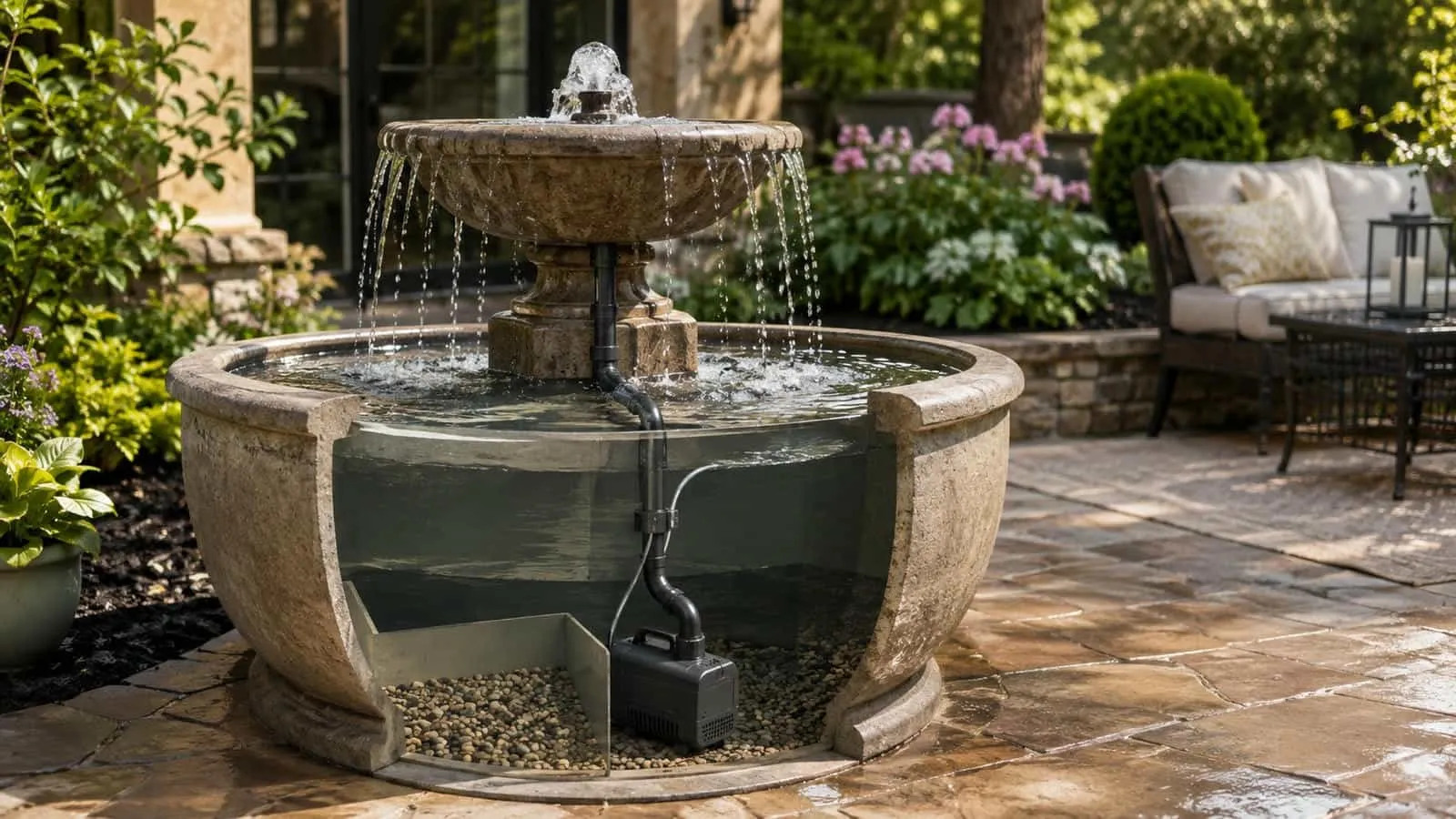
Choosing the best water fountain pump starts with how the fountain moves water. A tabletop fountain may lift water only a few inches, while a tiered or wall fountain may need to push water several feet upward before supplying an upper bowl or spillway.
Water demand also changes by design. A gentle bubbler needs less circulation than a broad wall spillway or strong bubbling rock. A narrow spitter uses a concentrated stream, while a wide outlet needs enough water to remain evenly supplied. Compare these mechanical differences in our complete water fountain types and designs guide.
Vertical lift and plumbing resistance reduce the flow that actually reaches the outlet. Tubing length, diameter, fittings and restrictive passages all affect usable pump performance. Adjustable flow is valuable when the pump has enough capacity to meet the fountain's needs while still allowing the finished water effect to be tuned.
| Fountain Type | Typical Flow Demand | Typical Lift | Common Pump Style | Adjustable Flow Value | Main Sizing Risk |
|---|---|---|---|---|---|
| Tabletop Fountain | Low, controlled circulation | Very low | Compact submersible pump | Useful for fine tuning gentle flow | Oversizing can create splash and unwanted pump noise |
| Birdbath Fountain | Low to moderate gentle movement | Low | Small submersible pump | Helpful for controlling water height | Too much flow can reduce shallow water control |
| Bubbling Urn Fountain | Moderate circulation | Low to moderate | Submersible reservoir pump | Very useful | Not accounting for lift through the urn |
| Wall Fountain | Moderate to stronger continuous flow | Moderate to high | Submersible or system specific pump | Important for balancing the sheet of water | Choosing by maximum GPH without checking head performance |
| Tiered Fountain | Moderate to strong circulation | Moderate to high | Submersible fountain pump | Highly useful | Insufficient delivered flow at the upper bowl |
| Bubbling Rock Fountain | Moderate to strong bubbling flow | Moderate | Hidden reservoir pump | Highly useful | Restricted tubing or insufficient lift performance |
| Spitter or Statuary Fountain | Depends on desired stream | Low to moderate | Compact submersible pump | Useful for setting stream distance | Too little pressure or excessive splash |
| Pondless Fountain | Moderate to substantially higher flow | Varies by design | Higher capacity submersible system pump | Often valuable | Ignoring combined lift and plumbing resistance |
This table is a decision guide rather than a universal fountain pump sizing chart. Two fountains of the same type can need different pumps when their height, outlet size, tubing or intended water effect changes.
Compare submersible fountain pumps with adjustable flow for tabletop fountains, tiered fountains, bubbling urns, garden fountains and other decorative water features.
Choose pump capacity by delivered flow, head height and fountain design, then fine tune the finished water movement.
🛒 Compare Adjustable Water Fountain Pumps on Amazon
⚙️ Fountain Pump Selection Tip: When comparing pumps, check how much flow each model delivers at your fountain's operating height. A larger maximum GPH rating does not always mean stronger usable performance after lift and plumbing resistance are added.
🔧 Water Fountain Pump Selection by Real System Demand
Fountain type gives you a starting point, but four system conditions usually determine the final pump match.
- 📏 Short Lift With Simple Plumbing: Tabletop fountains, birdbaths and compact water features usually need smooth circulation without overpowering a small basin.
- ⬆️ Taller Fountain With Greater Lift: Tiered and wall fountains need stronger head performance so adequate water still reaches the highest outlet.
- 🔄 Long or Restricted Tubing Path: Bubbling rocks, urns and hidden reservoirs can lose useful flow through narrow tubing, fittings and concealed passages.
- 🎚️ Fountain Needing Precise Water Control: Spillways, bubbling stones, urns and spitters benefit from adjustable flow when small output changes affect splash, bubbling height or stream distance.
Section Summary Snapshot: Choose a water fountain pump by matching the fountain's water demand, lift, plumbing and outlet. Tabletop and birdbath fountains usually need modest controlled circulation, while tiered, wall, bubbling rock and pondless systems may require stronger head performance. Compare usable delivered flow and system compatibility before relying on maximum GPH.
📏 Water Fountain Pump Sizing Snapshot: GPH, Head Height and Delivered Flow
To size a water fountain pump, determine the water effect you need, measure the vertical lift, account for tubing and fitting resistance, then check the pump performance chart. Choose a pump that still delivers the required GPH at that operating point, with adjustable flow when practical for final tuning.
Fountain pump demand generally increases as the system requires more water movement, greater vertical lift or more restrictive plumbing. Use this sizing spectrum to see how compact decorative fountains differ from taller tiered fountains, wall features, bubbling rocks and larger pondless fountain systems before comparing individual pump specifications.
Compact Low Lift Fountain Pump
Short water path, small outlet and limited circulation with little vertical lift or plumbing resistance.
- Best For: Tabletop fountains and very small decorative fountains
- Head Requirement: Very low
- Flow Demand: Gentle controlled circulation
- Main Sizing Risk: Oversizing can create splash, turbulence and unwanted pump sound
Low Lift Adjustable Fountain Pump
Modest water movement with short lift where precise flow control often matters more than high capacity.
- Best For: Birdbath fountains, small urns and compact garden fountains
- Head Requirement: Low
- Flow Demand: Low to moderate
- Main Sizing Risk: Excessive flow can empty shallow basins through splash
Moderate Lift Decorative Fountain Pump
Greater water delivery is required because the pump must support visible bubbling, cascading or elevated fountain outlets.
- Best For: Medium urns, spitters, shorter tiered fountains and decorative cascades
- Head Requirement: Low to moderate
- Flow Demand: Moderate
- Main Sizing Risk: Comparing only zero head GPH instead of flow at operating height
Higher Head Fountain Pump System
Taller lift or broader outlets require stronger head performance so enough usable water reaches the highest point.
- Best For: Taller tiered fountains and wall fountain spillways
- Head Requirement: Moderate to high
- Flow Demand: Moderate to strong
- Main Sizing Risk: Water reaches the top but lacks enough delivered flow for proper spillway performance
Higher Flow and Resistance Fountain System
Greater flow combines with lift, long tubing or hidden plumbing resistance, making complete system sizing especially important.
- Best For: Bubbling rocks, larger reservoir fountains and decorative pondless fountain systems
- Head Requirement: Varies from moderate to high
- Flow Demand: Moderate to substantially higher
- Main Sizing Risk: Ignoring total plumbing resistance and assuming a larger maximum GPH solves every restriction
⚠️ Important Pump Sizing Rule: Maximum GPH is only one pump specification. A pump rated for strong flow with no lift may deliver far less water several feet higher. Tubing diameter, tubing length, elbows, valves and fountain passages can reduce flow further. Measure the system first, then use the manufacturer's performance chart to find the pump that still delivers enough water where your fountain actually operates.
📊 Five Step Fountain Pump Sizing Check: Decide the desired water movement, measure the vertical lift, identify tubing and fitting resistance, compare the manufacturer's flow chart, then choose a pump that provides the required delivered flow at that operating point. Adjustable flow gives you useful room for final tuning without making maximum GPH the main decision.
Section Summary Snapshot: Fountain pump sizing moves from water demand to actual delivered flow. Start with the water effect the fountain needs, measure vertical lift, account for plumbing resistance and then read the pump performance chart at that operating point. Compact fountains may need little lift, while taller or more restricted systems require stronger head performance. The correct pump is the one that still delivers enough usable flow after those losses.
🔎 Water Fountain Pump Scenario Engine for GPH, Head Height, Flow and Replacement Problems
Water fountain pump problems are easier to diagnose when you start with the visible symptom and trace the water path. Weak flow, excessive splash, poor bubbling height, uneven spillways, pump hum and no water movement can come from different combinations of GPH, head height, tubing restriction, water level, outlet size and pump condition. Use these eight real world scenarios before changing pump size or buying a replacement.
Open the scenario that best matches your fountain. Each example connects the visible problem with likely pump system causes involving delivered flow, lift, tubing resistance, water level, intake condition, adjustable flow and outlet design.
💧 Small Tabletop Fountain Has Weak Trickling Water
Likely pump issue: Low water, restricted flow or reduced pump performance
Small tabletop fountains use compact pumps and narrow tubing, so even a minor restriction can noticeably weaken the water. Low basin water, intake debris, mineral buildup, kinked tubing or impeller wear can turn normal circulation into a weak trickle.
- 💧 Confirm the normal operating water level
- 🌿 Inspect the pump intake for debris or buildup
- 🔄 Check narrow tubing for kinks or restrictions
- ⚙️ Consider impeller wear if flow remains weak
Micro Recommendation: If the fountain previously worked correctly with the same pump, correct restrictions and check pump condition before increasing GPH.
⛲ Three Tier Fountain Barely Reaches the Top Bowl
Likely pump issue: Insufficient delivered flow at the actual head height
A three tier fountain can have a strong maximum GPH rating yet still produce weak upper bowl flow. The pump must overcome the vertical lift from the reservoir to the highest outlet, and usable flow decreases as operating head increases.
- 📏 Measure vertical lift to the highest outlet
- 📊 Check pump GPH at that operating head
- 🔄 Inspect tubing and fittings for added resistance
- 🚿 Confirm enough water reaches the upper spillway
Micro Recommendation: Judge the pump by delivered flow at the upper bowl rather than maximum GPH measured near zero head.
💦 New Replacement Fountain Pump Causes Too Much Splash
Likely pump issue: Replacement pump is delivering more water than the fountain can contain
Excessive pump flow can make water shoot too high, overflow bowls or splash beyond the basin. Even a moderately stronger replacement pump can create problems when the original fountain was designed for restrained water movement.
- 🎚 Reduce approved adjustable flow gradually
- 💦 Watch for water leaving the basin
- ⛲ Check whether bowls and spillways remain controlled
- 📈 Compare replacement capacity with actual fountain demand
Micro Recommendation: Tune the pump for stable contained water movement. If acceptable flow requires an extreme low setting, the replacement pump may be oversized.
🧱 Wall Fountain Has Weak or Uneven Sheet Flow
Likely pump issue: Insufficient flow, outlet restriction or uneven water distribution
Wall fountains need enough water to reach the upper spillway and spread evenly across its width. Weak flow across the entire wall can point to pump delivery or tubing restriction, while strong flow on one side and weak flow on the other more often suggests leveling, manifold or outlet distribution problems.
- 💧 Determine whether the entire spillway is weak
- 📏 Check vertical lift to the upper outlet
- 🧱 Confirm the fountain and spillway are level
- 🔄 Inspect tubing and distribution passages
Micro Recommendation: Diagnose total weak flow differently from one sided sheet flow before increasing fountain pump capacity.
🪨 Bubbling Rock Fountain Has Almost No Bubbling Height
Likely pump issue: Too little delivered flow after lift and hidden plumbing resistance
A bubbling rock pump must move water from a hidden reservoir through tubing and upward through the stone. Vertical lift, tubing diameter, fittings and the final outlet opening can all reduce the water that reaches the top.
- 📏 Measure lift from the reservoir water level to the outlet
- 🔄 Inspect accessible tubing for restrictions
- 🚿 Check the bubbling outlet diameter
- 📊 Confirm delivered GPH at the operating head
Micro Recommendation: Verify lift, tubing and outlet restrictions before deciding that low bubbling height requires a larger fountain pump.
🚫 Fountain Pump Runs but No Water Comes Out
Likely pump issue: Low water, blocked intake, trapped air, disconnected tubing or impeller problem
A fountain pump can sound like it is running while producing no visible water. The pump may not be receiving enough water, the intake may be blocked, air may be trapped or the tubing may have disconnected. An obstructed impeller or excessive operating head can also prevent useful output.
- 💧 Confirm adequate reservoir water
- 🌿 Inspect the intake for blockage
- 💨 Check for trapped air or interrupted water supply
- 🔄 Confirm accessible tubing remains connected
- ⚙️ Inspect the impeller as directed by the manufacturer
Micro Recommendation: Trace the complete water path from reservoir to outlet before assuming that a running pump motor has failed.
🔊 Fountain Flow Looks Normal but Pump Hum Is Noticeable
Likely pump issue: Vibration, basin contact, low water or impeller condition
Normal water movement with noticeable mechanical humming usually points away from basic pump sizing. A submersible pump touching stone, ceramic, resin or metal can transmit vibration through the fountain body and make a small motor sound much louder.
- ⚙️ Check whether the pump touches a hard basin surface
- 💧 Confirm the proper operating water level
- 🌿 Inspect the intake for debris
- 🔩 Check the impeller if unusual noise continues
Micro Recommendation: Correct pump position, water level and intake conditions before assuming humming means the fountain pump needs replacement.
🔧 Old Fountain Pump Label Is Unreadable and Needs Replacement
Best replacement approach: Rebuild the pump requirements from the fountain system
When the old pump model, GPH or head rating cannot be read, use the fountain itself to determine replacement requirements. Record the fountain type, desired water effect, vertical lift, tubing size, outlet connection and available pump space.
- ⛲ Identify the required water effect
- 📏 Measure vertical lift
- 🔄 Record tubing and connection size
- 📦 Measure the available pump compartment
- 📊 Compare delivered flow at the operating head
- 🎚 Choose adjustable flow where practical
Micro Recommendation: Record the fountain measurements before shopping so the replacement pump is selected by actual system requirements rather than appearance or physical size alone.
🧭 How to Diagnose Water Fountain Pump Problems Before Replacement
Start with the visible fountain symptom, then trace the water delivery system before changing pump size. Check water level and intake condition first, then review tubing, vertical lift, outlet restrictions and pump performance where they apply. Weak flow, excessive splash, uneven distribution, no water movement and mechanical hum can have different causes, so identify the operating problem before deciding whether the fountain needs adjustment, cleaning or a replacement pump.
⚙️ Water Fountain Pump Diagnosis Tip: Correct one meaningful condition at a time. Check water level, intake condition, tubing, flow control and operating head before changing pump size. This helps identify whether the real problem is restricted flow, inadequate head performance, excessive pump capacity or normal pump wear.
Compare adjustable replacement fountain pumps for weak flow, lost bubbling height, failed pumps and unreadable old pump specifications.
Choose a compatible pump that restores steady water movement without creating excessive splash or noise.
🛒 Compare Replacement Fountain Pumps With Adjustable Flow on Amazon
Scenario Engine Summary Snapshot: Water fountain pump symptoms should be matched to the complete water delivery system before equipment is replaced. GPH, head height, tubing resistance, outlet design, water level, intake condition and pump wear can all affect performance. Diagnose the visible symptom first, correct likely restrictions or operating problems, then decide whether adjustment, maintenance or a correctly sized replacement pump is actually needed.
💧 Water Fountain Pump GPH Explained: Maximum Flow, Delivered Flow and Real Fountain Output
GPH means gallons per hour and measures fountain pump flow. Maximum GPH usually describes output under very low resistance, not the water your fountain will actually receive. Vertical lift and plumbing resistance reduce delivered flow, so compare pump GPH at the fountain's expected operating height rather than relying on the largest advertised number.

GPH stands for gallons per hour and describes how much water a pump can move during one hour under stated conditions. It is one of the most common fountain pump specifications, but the number only becomes useful when you know the conditions behind it.
Maximum GPH is commonly measured with very little resistance. Once a pump must lift water into a tiered fountain, wall fountain, bubbling rock or tall urn, usable flow decreases. Tubing and fittings can reduce it further.
The most useful number is therefore delivered flow, the amount of water that actually reaches the bubbler, nozzle, spillway or upper bowl at the fountain's real operating condition.
📊 Water Fountain Pump GPH Terms and What They Actually Mean
Pump specifications use several similar flow terms. Understanding them helps prevent maximum GPH from being mistaken for guaranteed fountain output.
| 💧 Pump Term | 📖 What It Means | ⚙️ Why It Matters | 🏡 Homeowner Guidance |
|---|---|---|---|
| GPH | Gallons of water moved per hour. | Provides a common way to compare pump flow capacity. | Use GPH with head height rather than as a stand alone sizing number. |
| LPH | Litres of water moved per hour. | Represents the same type of flow measurement in metric units. | Convert units before comparing pumps using different measurement systems. |
| Maximum GPH | The pump's highest listed flow under favorable low resistance conditions. | Actual fountain output is usually lower after lift is added. | Do not treat maximum GPH as guaranteed operating flow. |
| Flow at Zero Head | Pump output with essentially no vertical lift. | Often represents or approaches maximum advertised flow. | Use it as a reference point, not the final sizing number for taller fountains. |
| Delivered Flow | The water that actually reaches the fountain outlet under operating conditions. | Determines whether the bubbler, spillway or upper bowl receives enough water. | Base pump decisions on delivered flow at the expected operating head. |
| Adjustable Flow | Pump output that can be reduced within its intended operating range. | Allows the final water movement to be fine tuned. | Useful when the exact visual flow requirement is difficult to predict. |
| 💧 Maximum GPH describes pump capacity under favorable conditions, while delivered flow describes what the fountain actually receives after lift and resistance are added. | |||
⚙️ Maximum GPH vs Actual Water Fountain Pump Flow
Maximum GPH is the starting point of a pump's performance, not the finished fountain output. A low tabletop fountain may operate closer to that rating, while a tall tiered or wall fountain can receive considerably less water after vertical lift is added.
What matters is whether enough water reaches the final outlet. Tiered fountains need sufficient upper bowl flow, while bubbling rocks need enough delivered water to create the intended bubbling height.
📏 Why Fountain Pump GPH Drops as Water Is Lifted
As a fountain pump pushes water higher, more of its available performance is used to overcome head. The remaining flow decreases, and every pump loses flow differently. Two pumps with similar maximum GPH can therefore deliver different amounts of water at the same height.
Head height and pump flow charts are covered in detail later in this guide. The key point here is simple: higher lift normally means less delivered GPH at the fountain outlet.
🔄 Water Fountain Pump GPH vs LPH
GPH and LPH measure the same flow rate using different units. GPH means gallons per hour, while LPH means litres per hour. Convert the measurements when needed, then compare pumps at similar operating head rather than comparing unlike units or maximum ratings alone.
⚠️ When More Fountain Pump GPH Is Not Better
More GPH helps only when the fountain can use the additional water. Excessive flow can cause high bubbling, overflowing bowls, splash beyond the basin, stronger impact and increased water loss.
Some extra usable capacity can be helpful with an adjustable pump, but the goal is still system fit. Choose enough delivered flow for the required water effect, then fine tune the output instead of automatically selecting the largest GPH rating.
💡 GPH Sizing Tip: When comparing fountain pumps, identify the expected vertical lift and check how much GPH each pump still provides at that height. Then consider plumbing resistance and adjustable flow. This gives a much better picture of installed performance than maximum GPH alone.
Section Summary Snapshot: GPH measures fountain pump flow, but maximum GPH is not the same as actual fountain output. Vertical lift and plumbing resistance reduce delivered water. Compare pump flow at the fountain's expected operating head whenever possible, and choose additional capacity only when the complete fountain system can use and control it.
📏 Water Fountain Pump Head Height and Total Dynamic Head Explained
Fountain pump head height is the resistance the pump must overcome while moving water through the fountain system. Static head comes from vertical lift, while dynamic head comes from tubing, fittings, valves and other flow resistance. Total dynamic head combines those effects and helps determine how much water the pump can deliver at the actual operating point.

Head height explains why a pump that moves plenty of water near the basin can deliver much less at an elevated outlet. As vertical lift increases, the pump must work against greater resistance and available flow usually decreases.
Fountain pump head includes more than height alone. Tubing, fittings, valves and internal passages add resistance after the water leaves the pump. This is why a tiered fountain, wall fountain or bubbling rock should be evaluated as a complete water delivery system rather than by fountain height alone.
📏 What Is Head Height on a Water Fountain Pump?
Pump head describes the resistance a pump must overcome while moving water. In a decorative fountain, the most obvious part is the vertical distance from the normal reservoir water level to the highest pumped outlet.
Pump charts commonly show flow at different head heights such as 2, 5 or 10 feet. As head increases, the amount of water the pump can deliver usually decreases.
⬆️ Fountain Pump Static Head and Vertical Lift
Static head is the vertical elevation the pump must overcome. Measure from the normal operating water level in the reservoir or lower basin to the point where pumped water exits at the highest outlet.
Do not automatically measure from the floor or bottom of the pump. A tabletop fountain may have only a few inches of static lift, while a wall or tall tiered fountain can require several feet.
🔄 Dynamic Head From Fountain Tubing, Fittings and Flow Resistance
Dynamic head is the additional resistance created as water moves through tubing and fittings. Longer or narrower tubing, elbows, reducers, valves and restrictive passages can all reduce useful flow.
A short direct tubing run may add little resistance, while a hidden bubbling rock or larger fountain with a longer water path can create substantially more.
⚙️ Water Fountain Pump Total Dynamic Head Explained
Total dynamic head combines vertical lift with resistance from the plumbing system. In practical terms, it describes the overall operating resistance the pump must overcome while delivering water from the reservoir to the final outlet.
Simple Fountain Pump TDH Concept: Static vertical lift plus plumbing resistance equals the total operating resistance the fountain pump must overcome.
Small decorative fountains do not always require a detailed engineering calculation, but a five foot lift through short open tubing is not the same operating condition as the same lift through a long narrow hose with several fittings.
📐 How to Measure Water Fountain Pump Head Height
Measure vertically from the normal operating water level to the highest point where pumped water enters the fountain. Follow the vertical elevation, not total hose length. A long hose that travels mostly sideways adds friction, but it does not create the same amount of static lift.
| ⚙️ Head Factor | 📖 What It Represents | 💧 Effect on Pump Flow | 🏡 Homeowner Guidance |
|---|---|---|---|
| Static Head | Vertical rise from operating water level to the highest pumped outlet. | Greater lift normally reduces delivered GPH. | Measure the actual vertical elevation before comparing pumps. |
| Tubing Length | Total distance water travels through tubing. | Longer runs add friction resistance. | Avoid unnecessary tubing length where practical. |
| Tubing Diameter | Inside diameter of the water carrying tube. | Undersized tubing can create substantial resistance. | Match tubing appropriately to the pump and fountain system. |
| Elbows and Fittings | Connections and direction changes in the water path. | Additional restrictions can reduce delivered flow. | Avoid unnecessary abrupt restrictions. |
| Valves | Devices used to control or divide water flow. | Partially closed valves add resistance. | Include valve position when evaluating operating conditions. |
| Total Dynamic Head | Combined vertical lift and plumbing resistance. | Helps determine the pump's operating point. | Use it with the pump performance chart to estimate delivered flow. |
| 📏 Fountain pump head comes from both vertical lift and resistance through the water path. As total operating resistance increases, less flow generally remains at the outlet. | |||
🚿 How Tubing Length, Elbows, Valves and Diameter Affect Fountain Pump Head
Plumbing resistance matters because the pump must move water through the entire route to the outlet. Narrow tubing, long runs and multiple fittings can reduce delivered flow, especially when combined with meaningful vertical lift.
A larger pump cannot completely correct an unnecessarily restrictive water path. Tubing and fitting details are covered more deeply later in this guide, so the important point here is to include their resistance when estimating pump head.
⚠️ Maximum Fountain Pump Head Height Is Not the Best Operating Height
Maximum head height is the approximate upper limit where pump flow falls toward very low levels. It is not the height where the pump delivers maximum GPH, and it should not be treated as the ideal operating point for a decorative fountain.
A pump listing ten feet of maximum head may technically move water to that elevation while producing very little useful flow. For a fountain that operates several feet high, compare the pump's actual flow at that height instead.
The next section on fountain pump flow charts shows how to find that operating point and compare pumps with similar maximum GPH but different head performance.
🔧 Water Fountain Pump Head Height Sizing Check
- 📏 Measure Vertical Lift: Measure from normal reservoir water level to the highest pumped outlet.
- 🔄 Review the Water Path: Note tubing length, diameter, fittings and flow controls.
- 📊 Check the Pump Curve: Find how much flow remains at the expected operating head.
- ⚠️ Do Not Use Maximum Head as the Target: Maximum head is a performance limit, not the preferred operating height.
💡 Fountain Pump Head Height Tip: If water barely reaches the highest outlet, measure the lift and check flow at that height before choosing a larger pump. Also inspect the water path for restrictions that may be reducing delivered flow.
Compare fountain pumps by operating head, delivered GPH, tubing compatibility and adjustable flow for taller or more restrictive water features.
Choose a pump that maintains steady water movement without struggling at the fountain’s highest outlet.
🛒 Compare Fountain Pumps by Head Height on Amazon
Section Summary Snapshot: Fountain pump head combines vertical lift with resistance from tubing, fittings, valves and other restrictions. Measure lift from the operating water level to the highest outlet, account for the plumbing path, and use total dynamic head with the pump performance curve. Maximum head is a limit, not the fountain's ideal operating height.
📊 How to Read a Water Fountain Pump Flow Chart for GPH, Head Height and Real Delivered Flow
A water fountain pump flow chart shows how pump output changes as head height increases. Find the fountain's expected operating head, then read the remaining GPH or LPH at that point. Choose a pump that still provides enough delivered flow at the required height rather than comparing pumps only by maximum GPH.

Fountain pump performance may be shown as a table, graph or curve, but each format connects two things: flow rate, usually GPH or LPH, and head height, usually feet or metres.
Flow is normally highest at little or no head and decreases as lift increases. The practical goal is to find the part of the chart closest to your fountain's expected operating head and see how much water the pump still delivers there.
📈 How a Water Fountain Pump Flow Chart Works
Start by locating the head height closest to your fountain, then find the corresponding pump flow. If the expected operating head falls between two listed heights, use the nearby values as a practical range rather than assuming the higher flow value is guaranteed.
💧 What Does Zero Head Mean on a Fountain Pump Flow Chart?
💧 Fountain Pump Flow at Zero Head and Maximum GPH
Zero head means the pump is moving water with essentially no vertical lift. This is usually where the highest listed GPH appears. It is useful as a reference point, but it does not represent the operating flow of a fountain that must lift water above the reservoir.
A low tabletop fountain may operate relatively close to zero head, while a wall or multi tier fountain operates much farther along the performance curve.
📏 How to Find Fountain Pump GPH at the Actual Head Height
📏 Reading Fountain Pump GPH at 2, 5 or 10 Feet of Head
Find the fountain's estimated operating head on the pump chart and read the corresponding flow value. If a pump supplies 800 GPH at five feet of head, that number is far more useful for a five foot system than its 1,100 GPH maximum flow near zero head.
Pumps with similar maximum GPH can lose flow at different rates, so compare each model at the same operating height.
⚙️ What Is the Operating Point of a Water Fountain Pump?
⚙️ Fountain Pump Operating Point for Real Delivered Flow
The operating point is the real combination of pump flow and system resistance where the fountain runs. Vertical lift, tubing, fittings, valves and outlet design all influence it, so useful pump output is the flow available under those installed conditions.
The operating point can change if tubing, fittings, valve settings or restrictions change, even when the pump itself remains the same.
📊 Example Water Fountain Pump Flow Chart by Head Height
This simplified example shows the relationship between head height and delivered flow. Always use the performance chart for the specific pump when making a real sizing decision.
| 📏 Head Height | 💧 Example Delivered Flow | ⚙️ What It Shows | 🏡 Fountain Sizing Meaning |
|---|---|---|---|
| 0 ft | 1,100 GPH | Maximum or near maximum unrestricted flow. | Starting specification, not final fountain output. |
| 2.5 ft | 950 GPH | Some flow is lost as the pump works against lift. | May still provide strong output for lower fountains. |
| 5 ft | 800 GPH | Delivered flow has fallen further. | This is the useful value if the fountain operates near five feet of head. |
| 7.5 ft | 550 GPH | Available flow continues to decline. | May be inadequate for a wider spillway or stronger cascade. |
| 10 ft | 300 GPH | Only a smaller portion of zero head flow remains. | A higher flow fountain may require a different pump. |
| Near Maximum Head | Very Low Flow | The pump approaches its useful lift limit. | Maximum head should not be treated as the desired operating point. |
| 📊 As head height increases, delivered flow normally decreases. Select the pump from the flow available near the fountain's expected operating head rather than from maximum GPH alone. | |||
🔍 Why Two Fountain Pumps With Similar Maximum GPH Can Perform Differently
Two fountain pumps can advertise nearly identical maximum GPH yet have different performance curves. One may retain considerably more flow through several feet of head while another loses output faster.
This matters for taller fountains and replacement pumps. A model that performs well in a low bubbling urn may deliver too little water to a wall fountain, even when its maximum GPH looks similar on the package.
Best choice Choose the pump that still provides the required fountain flow near the actual operating head.
Check next After confirming head performance, review tubing and outlet restrictions that may reduce installed flow further.
Best homeowner question Ask, “How much water will this pump still deliver at the height where my fountain actually operates?”
📊 Fountain Pump Flow Chart Tip: Write down your expected operating head before comparing pumps, then compare every model at that same height. This makes usable fountain performance easier to see and prevents maximum zero head GPH from dominating the decision.
Section Summary Snapshot: A fountain pump flow chart shows how output changes as head height increases. Find the expected operating head, read the remaining flow and compare pumps under the same conditions. Similar maximum GPH ratings can hide important differences in real head performance.
⚙️ Submersible vs External Water Fountain Pumps: Which Pump Type Is Best?
Submersible fountain pumps operate inside the basin or reservoir and are the most common choice for decorative residential fountains because they are compact, easy to conceal and use relatively simple plumbing. External pumps remain outside the water and can suit larger or purpose built systems where outside service access provides a practical advantage.

The main difference between submersible and external fountain pumps is location. A submersible pump sits in the basin, vault or hidden reservoir and sends water directly into the fountain tubing. An external pump remains outside the water and connects through separate intake and discharge plumbing.
For most tabletop, urn, tiered, birdbath, bubbling rock and garden fountains, a submersible pump is the simpler arrangement. External pumps become more useful when the fountain is larger, includes a dedicated equipment area or specifically benefits from keeping the pump outside the reservoir. For broader decisions about integrating a fountain with planting, pathways, garden scale and surrounding landscape features, explore our garden water fountain landscaping and design guide.
💧 Submersible Water Fountain Pumps for Decorative Fountains and Hidden Reservoirs
Submersible fountain pumps keep the pump close to the water supply and out of sight. They are commonly placed in a basin, reservoir or pump vault where the fountain design provides suitable water depth and service access.
💧 How Submersible Fountain Pumps Work
💧 How Submersible Water Fountain Pumps Move and Circulate Water
A submersible fountain pump draws water through its intake, moves it with the impeller and sends it through the discharge into the fountain tubing. Because the pump remains in the reservoir, the arrangement is compact and usually needs less intake plumbing than an external system.

This layout works especially well for hidden reservoirs, tiered fountains and bubbling features where the pump must remain concealed. Proper positioning and adequate water level also help keep normal pump vibration from becoming noticeable.
- 💧 Compact Installation: Pump and water supply remain together inside the fountain system.
- 🪨 Easy Concealment: Works well in basins, reservoirs and pump vaults.
- 🔄 Simpler Plumbing: Usually requires less intake plumbing than an external pump.
- 🔧 Service Access: The pump should remain reachable for inspection and replacement.
⚙️ External Water Fountain Pumps for Larger or More Complex Fountain Systems
⚙️ How External Fountain Pumps Differ
⚙️ How External Water Fountain Pumps Work Outside the Reservoir
An external fountain pump operates outside the reservoir and connects through intake and discharge plumbing. This can provide convenient service access in larger systems, but it adds plumbing complexity and requires a fountain designed to supply water reliably to the pump.
External pumps are most useful where a larger fountain has a dedicated equipment location or where keeping the pump outside the reservoir improves serviceability. For compact decorative fountains, the additional intake and discharge plumbing often provides little advantage.
- ⚙️ Outside the Water: Pump remains separate from the basin or reservoir.
- 🔧 Accessible Equipment Area: Can simplify service when the installation is planned for external access.
- 🔄 Additional Plumbing: Requires separate intake and discharge water paths.
- 🏡 Best for Selected Systems: Better suited to larger or purpose built fountain installations.
📊 Submersible vs External Fountain Pump Comparison
Use the comparison below to match the pump arrangement to the fountain rather than assuming one pump type is automatically better.
| ⚙️ Pump Feature | 💧 Submersible Pump | 🔧 External Pump | 🏡 Homeowner Guidance |
|---|---|---|---|
| Pump Location | Inside basin or reservoir. | Outside the water. | Use the arrangement the fountain is designed to support. |
| Typical Fountain Use | Small to medium decorative fountains and many landscape features. | Larger or specialized fountain systems. | Most compact residential fountains do not require an external pump. |
| Plumbing Complexity | Usually simpler. | Requires separate intake and discharge plumbing. | Additional plumbing can add resistance and connection points. |
| Concealment | Easy to hide inside the fountain system. | Needs a suitable external equipment location. | Consider both appearance and future service access. |
| Mechanical Sound | Reservoir placement can help isolate normal pump sound. | External location can make pump placement more noticeable. | Installation and vibration control matter for either type. |
| Service Access | May require reaching into the reservoir. | Can be easier in an accessible equipment area. | Keep either pump reachable for inspection and replacement. |
| System Fit | Excellent for many self contained decorative fountains. | Useful when external circulation provides a clear system benefit. | Choose by fountain requirements rather than pump category alone. |
| ⚙️ Submersible pumps are usually the practical choice for residential decorative fountains because they are compact and use simpler plumbing. External pumps are better reserved for larger or purpose built systems where outside equipment access provides a real advantage. | |||
🔍 How to Choose Between a Submersible and External Fountain Pump
Start with the fountain's physical design and pump location. If the water feature has a basin, lower reservoir or concealed pump chamber designed to hold the pump, a submersible fountain pump is usually the natural choice. This arrangement works well for urn fountains, tiered fountains, bubbling rock fountains and many compact garden water features where the pump needs to remain concealed close to the water supply.
Consider an external fountain pump when a larger water feature has a dedicated equipment area or a practical reason to keep the pump outside the reservoir. Pump location does not determine pump capacity, so do not choose an external design simply to chase a higher GPH rating. The pump still needs to match the fountain's required flow, operating head and plumbing system.
Best residential choice Use a submersible fountain pump when the feature has a suitable reservoir and compact concealed circulation is the priority.
Consider external Use an external pump when the system has dedicated plumbing, accessible equipment space and a practical reason to keep the pump outside the reservoir.
Final check Confirm delivered flow, operating head, plumbing compatibility, pump dimensions and service access before choosing either type.
💡 Submersible vs External Pump Tip: For most decorative residential fountains, begin with a submersible pump when the reservoir provides suitable water depth and service access. Move to an external pump only when the fountain's design, scale or maintenance layout gives it a clear advantage.
Compare compact submersible fountain pumps for tiered, urn, bubbling rock and decorative garden fountains with concealed reservoir installation.
Choose a quiet, adjustable pump that keeps water movement steady while staying hidden and easy to service.
🛒 Explore Submersible Fountain Pumps for Gardens on Amazon
Section Summary Snapshot: Submersible fountain pumps operate inside the reservoir and are the practical choice for many decorative fountains because they are compact, concealed and relatively simple to plumb. External pumps remain outside the water and suit selected larger systems with dedicated equipment access. Whichever type is used, proper flow, head performance and system compatibility still determine pump performance.
⚙️ Water Fountain Pump Motor Types: Magnetic Drive, Direct Drive and Asynchronous Pumps
Water fountain pump motor type can affect energy use, flow capability, durability and service needs. Magnetic drive pumps are common in compact decorative fountains, while direct drive and asynchronous designs may suit higher demand systems. Motor type matters, but the specific pump still has to provide the required GPH at the fountain's actual operating head.

Fountain pump motor type describes how the motor drives the impeller that moves water. Homeowners do not need the internal engineering details, but the design can influence power use, operating range, maintenance and typical fountain application.
Magnetic drive pumps are common in smaller decorative fountains, while direct drive and asynchronous models may be used where the fountain needs greater water movement or stronger head performance. Always compare the specifications of the actual pump rather than choosing from motor category alone.
🧲 Magnetic Drive Water Fountain Pumps
🧲 Magnetic Drive Fountain Pumps for Efficient Decorative Water Circulation
Magnetic drive fountain pumps use magnetic coupling to rotate the impeller assembly. They are common in smaller decorative fountains because they are compact and can provide efficient continuous circulation when properly matched to the required flow and lift.
These pumps are often used in tabletop fountains, birdbaths, urns and smaller tiered features. Their compact size makes them easy to conceal, but intake and impeller condition still affect performance.
- ⚡ Energy Use: Often efficient for small to moderate decorative fountain circulation.
- 💧 Typical Application: Well suited to compact and medium fountain systems.
- 🧼 Maintenance: Intake and impeller cleanliness can strongly affect water delivery.
⚙️ Direct Drive Water Fountain Pumps
⚙️ Direct Drive Fountain Pumps for Higher Flow and More Demanding Water Features
Direct drive fountain pumps transfer motor power directly through the pumping assembly and may be used where stronger flow or more demanding fountain performance is required. Individual designs vary, so compare actual flow, head and wattage specifications rather than assuming every direct drive pump performs the same way.
They can suit larger decorative fountains, broad spillways or landscape water features that need greater delivered flow. Higher output can also mean greater power demand, making correct sizing important.
- 🌊 Flow Potential: Can suit fountains requiring stronger water delivery.
- 📏 Higher Demand Systems: May be considered where greater lift or flow is required.
- ⚡ Energy Use: Compare wattage carefully as pump capacity increases.
🔄 Asynchronous Water Fountain Pumps
🔄 Asynchronous Fountain Pumps for Efficient Higher Performance Water Movement
Asynchronous fountain pumps use an induction based motor design and can provide efficient continuous water movement across medium and higher performance ranges. Depending on the model, they may offer greater flow and head capability than very small decorative pumps.
They can be useful for larger urns, bubbling rocks, tiered fountains and other outdoor water features where both flow and lift matter. Compare the specific pump curve, wattage, discharge size and dimensions before selecting one.
📊 Magnetic Drive vs Direct Drive vs Asynchronous Fountain Pumps
| ⚙️ Pump Motor Type | 💧 Typical Strength | ⚡ Energy Profile | 🏡 Common Fountain Use | ⚠️ Main Consideration |
|---|---|---|---|---|
| Magnetic Drive | Low to moderate decorative flow | Often efficient in smaller systems | Tabletop, birdbath, urn and small tiered fountains | Keep intake and impeller reasonably clean |
| Direct Drive | Moderate to higher water movement | Power use varies with output and design | Larger decorative and landscape fountains | Compare actual flow and head performance |
| Asynchronous | Moderate to higher performance range | Can provide efficient continuous operation | Medium and larger outdoor fountain systems | Compare individual flow curves and wattage |
| ⚙️ Motor type can influence energy use and operating characteristics, but the specific pump's GPH, head performance, discharge size and physical fit determine whether it is suitable for the fountain. | ||||
🔍 How to Choose the Best Water Fountain Pump Motor Type
Start with required water movement and operating head. Compact tabletop, birdbath and urn fountains often pair naturally with smaller magnetic drive pumps, while larger tiered fountains, bubbling rocks and broader spillways may need models designed for greater flow or lift.
After identifying pumps that can meet those hydraulic requirements, compare wattage, dimensions, discharge size, expected debris exposure and service needs.
Small fountain direction Magnetic drive pumps are commonly suitable where flow and lift requirements are modest.
Higher demand direction Compare direct drive or asynchronous models when the fountain needs greater delivered flow or head performance.
Final check Choose the specific pump that meets the required flow, head, wattage, dimensions and plumbing requirements.
💡 Fountain Pump Motor Tip: Treat motor type as a secondary selection factor. First identify pumps that can supply the required delivered flow at the fountain's operating head, then compare motor design, wattage and service needs among those suitable options.
Section Summary Snapshot: Magnetic drive pumps are common in compact decorative fountains, while direct drive and asynchronous designs may suit higher demand systems. Motor technology can affect energy use and operating characteristics, but the best fountain pump is still the specific model that delivers the required flow at the real head height and fits the fountain system.
⛲ How Fountain Design Changes Water Fountain Pump Requirements
Fountain design changes pump requirements because each water feature creates a different combination of lift, outlet demand, tubing resistance and water movement. Tabletop and birdbath fountains usually need controlled low flow, while wall, tiered, bubbling rock and pondless fountains can require stronger delivered flow and head performance.

Fountain type is a useful pump-sizing starting point because the design determines how high water must travel, how wide the outlet is and how much water movement is required. A small bubbler, broad wall spillway and multi tier cascade may all recirculate water, but they place very different demands on the pump.
Use the fountain category to identify those unique demands, then compare the actual lift, outlet and plumbing before choosing the pump. Two fountains in the same category can still require different performance.
🏠 Tabletop and Wall Fountain Pump Requirements for Low Lift and Vertical Flow
🏠 Tabletop Water Fountain Pump Requirements
🏠 Tabletop Fountain Pumps for Compact Low Lift Water Circulation
Tabletop fountain pumps usually handle short lift, small tubing and modest water volume. The priority is controlled circulation rather than maximum GPH. Compact adjustable submersible pumps are useful because excessive output can create splash, overflow or unnecessary pump noise in a small basin.
When replacing a tabletop pump, match the original water effect, tubing size and available pump space rather than choosing the strongest pump that fits. For broader indoor planning around fountain scale, furniture surfaces, splash control and everyday positioning, explore our tabletop water fountain size and placement guide.
🧱 Wall Water Fountain Pump Requirements
🧱 Wall Fountain Pumps for Vertical Lift, Spillway Width and Even Sheet Flow
Wall fountain pumps must lift water to an elevated spillway and provide enough delivered flow to cover the outlet evenly. Pump demand increases with vertical lift and spillway width, while uneven flow may point to leveling or distribution problems rather than pump capacity alone.
When comparing wall water fountain designs and systems, focus on lift and spillway width because those directly affect pump demand.
⛲ Tiered and Urn Fountain Pump Requirements for Lift, Cascades and Bubbling Flow
⛲ Tiered Water Fountain Pump Requirements
⛲ Tiered Fountain Pumps for Upper Bowl Lift and Multiple Spillways
Tiered fountain pumps must deliver enough water to the highest bowl to maintain the cascades below it. Fountain height and bowl width are the main demands, while adjustable flow helps prevent overflowing bowls and excessive splash.
Measure lift to the highest pumped outlet and confirm enough flow remains there to create the intended bowl to bowl overflow. For broader planning around fountain height, bowl proportions, cascade patterns and water movement, explore our tiered water fountain design and flow guide.
🏺 Urn Water Fountain Pump Requirements
🏺 Urn Fountain Pumps for Bubbling Height and Controlled Overflow
Urn fountain pumps move water through the center of the vessel to a top outlet. Urn height, outlet diameter and desired bubbling height determine the pump demand. Too little flow creates a weak trickle, while excessive output can throw water beyond the intended overflow path.
Adjustable flow is especially useful for urn fountains because the final bubbling height is easiest to judge after installation. The pump must still provide enough delivered flow to lift water through the vessel and reach the top outlet without creating excessive bubbling, splash or uncontrolled overflow. For a deeper look at how vessel height, water movement, pump capacity, tubing and reservoir design work together, explore our urn fountain pump sizing and flow guide.
🪨 Bubbling Rock and Birdbath Fountain Pump Requirements for Hidden Lift and Gentle Flow
🪨 Bubbling Rock Fountain Pump Requirements
🪨 Bubbling Rock Pumps for Hidden Reservoirs, Lift and Outlet Diameter
Bubbling rock pumps move water from a hidden reservoir through tubing and upward through the stone. Rock height, tubing size and outlet diameter determine how much delivered flow is required to create the intended bubbling effect.
The best bubbling rock fountain pump systems provide enough water movement to reach the top while allowing the flow to return reliably to the concealed reservoir.
🐦 Birdbath Fountain Pump Requirements
🐦 Birdbath Fountain Pumps for Gentle Bubbling and Shallow Basins
Birdbath fountain pumps usually need gentle controlled flow because the receiving basin is shallow. Low bubbling or modest spray helps keep water contained, while excessive output can increase splash and lower the basin water level quickly.
Adjustable low flow is generally more useful than oversized pump capacity for this fountain type. For broader decisions involving basin depth, wildlife comfort, fountain placement and gentle water movement, explore our birdbath water fountain design and placement guide.
🎋 Japanese and Pondless Fountain Pump Requirements for Controlled Flow and Landscape Circulation
🎋 Japanese Water Fountain Pump Requirements
🎋 Japanese Fountain Pumps for Restrained Spouts and Controlled Water Flow
Japanese inspired fountains often use narrow spouts, stone basins or restrained channels where steady controlled flow matters more than maximum output. Pump demand depends on spout height, outlet size and the amount of water needed to maintain the intended stream.
Adjustable output helps tune the water without overpowering the basin or changing the restrained visual character of the fountain.
🌊 Pondless Fountain Pump Requirements
🌊 Pondless Fountain Pumps for Higher Flow, Hidden Reservoirs and Cascading Water
Pondless fountain pumps can require substantially more delivered flow when water moves through waterfalls, streams or multiple landscape cascades before returning to a hidden reservoir. Total lift, water feature width and plumbing demand are the main sizing factors.
Wider spillways and larger cascades generally need more circulating water than a decorative bubbler, so pump selection should be based on the complete operating system. For broader guidance on hidden reservoirs, waterfall scale, landscape placement and long term system planning, explore our pondless water fountain design and planning guide.
🐸 Spitter and Statuary Fountain Pump Requirements for Outlet Height and Stream Control
Spitter and statuary fountains move water through a small nozzle or outlet. Pump demand depends on outlet height, nozzle restriction and desired stream distance. A short gentle spout may require modest flow, while a higher projected stream needs stronger performance at the operating head.
Adjustable flow helps control projection so the stream lands inside the basin rather than overshooting it.
📊 Water Fountain Pump Requirements by Fountain Design
| ⛲ Fountain Type | 💧 Main Pump Demand | 📏 Lift Importance | 🚿 Outlet Consideration | ⚠️ Main Sizing Risk |
|---|---|---|---|---|
| Tabletop Fountain | Compact controlled circulation | Usually low | Small tubing and outlets | Too much flow for a small basin |
| Wall Fountain | Even elevated flow | High importance | Spillway or manifold width | Weak or uneven sheet flow |
| Tiered Fountain | Flow to highest bowl | High importance | Multiple spillways | Weak upper flow or overflowing bowls |
| Urn Fountain | Controlled top bubbling | Varies with urn height | Top outlet diameter | Weak bubbling or excessive overflow |
| Bubbling Rock | Flow through hidden plumbing and stone | Moderate to high | Rock outlet diameter | Hidden restriction reducing bubbling height |
| Birdbath Fountain | Gentle controlled movement | Usually low | Bubbler or small spray | Splash from excessive output |
| Japanese Fountain | Steady restrained stream | Low to moderate | Narrow spout or channel | Overpowering the intended water effect |
| Pondless Fountain | Higher landscape circulation | Often significant | Waterfall or stream width | Insufficient delivered flow at operating head |
| Spitter or Statuary Fountain | Controlled projected stream | Depends on outlet height | Nozzle restriction | Stream falls short or overshoots basin |
| ⛲ Fountain type identifies the kind of pump demand involved, but final sizing still depends on delivered flow, lift, plumbing and outlet requirements. | ||||
Higher demand designs Tiered, wall, bubbling rock and pondless fountains place greater emphasis on delivered flow and head performance.
Controlled flow designs Tabletop, birdbath, Japanese and small spitter fountains often benefit more from adjustable flow than extra pump capacity.
Final sizing rule Match the pump to the actual lift, plumbing, outlet and desired water effect rather than the fountain category alone.
💡 Fountain Design Pump Sizing Tip: Trace the route from the reservoir to the final outlet and identify what is unique about the fountain design. Measure lift, note the outlet or spillway and determine the intended water movement before choosing the pump.
Section Summary Snapshot: Fountain design changes pump demand by changing lift, outlet size and required water movement. Tabletop, birdbath and restrained spout fountains usually need controlled flow, while wall, tiered, bubbling rock and pondless features can require stronger delivered flow and head performance. Use fountain type as the starting point, then size the pump to the actual system.
🚿 Water Fountain Tubing Size, Outlet Diameter and Pump Flow Restriction
Fountain tubing size directly affects how much water a pump can deliver. Tubing that is too narrow, excessively long, kinked or filled with restrictive fittings increases friction and reduces usable flow. Match the pump discharge, tubing diameter and fountain outlet as one water path so the pump can deliver the intended flow without unnecessary resistance.

A fountain pump does not deliver water through empty space. Every gallon must travel through the pump discharge, tubing, fittings and final fountain outlet. When those parts are sized correctly, the pump can use its available capacity efficiently. When the plumbing is unnecessarily restrictive, some of that useful flow is lost before the water reaches the bubbler, spillway, nozzle or upper bowl.
Tubing diameter is especially important because smaller internal passages create greater resistance as flow increases. A stronger pump can increase pressure against that restriction, but it cannot completely overcome a poorly matched water path. In many cases, correcting the tubing or fittings is more effective than simply installing a larger fountain pump.
🚿 Why Small Fountain Tubing Can Reduce Pump Flow
Water moving through tubing creates friction against the inside wall. As tubing becomes narrower, the same amount of water must move through a smaller passage, which increases resistance. This can reduce delivered GPH and change the fountain's visible water effect.
Small tubing is not automatically wrong. Compact tabletop fountains and narrow decorative outlets may be designed around small hose. Problems appear when the tubing is too restrictive for the amount of water the pump is expected to move.
⚙️ Fountain Pump Discharge Size and Tubing Diameter
The pump discharge is the outlet where water leaves the pump and enters the tubing. Pump manufacturers commonly design particular discharge sizes around the flow range the pump is intended to provide.
Reducing immediately from a larger pump discharge into much smaller tubing can create a bottleneck. The pump may still move water, but the restriction can reduce usable flow and alter the operating point. When possible, use tubing that matches the intended pump connection and fountain system rather than reducing diameter simply because smaller hose is easier to hide.
📏 How Fountain Tubing Length Adds Friction and Reduces Delivered Flow
Longer tubing creates more contact between moving water and the hose wall, which adds friction. A short direct run from a basin pump to an urn outlet creates less plumbing resistance than a long hidden line traveling across a landscape before reaching a bubbling rock.
Horizontal tubing does not add static vertical lift, but it still contributes resistance. Use enough hose to allow proper routing and service access, while avoiding large coils or unnecessary extra length.
🔄 Fountain Pump Elbows, Valves and Fittings That Restrict Water Flow
Elbows, reducers, tees, connectors and valves can all change the water path. One necessary fitting may have little practical effect, but several sharp changes in direction can combine with tubing friction and vertical lift to reduce delivered fountain flow.
Valves are different because some are intentionally used to reduce or balance water output. That can be useful when the pump produces more water than the fountain needs. The important point is to recognize that a partly closed valve adds resistance and changes the final flow.
⚠️ Fountain Hose Kinks, Pinched Tubing and Hidden Flow Restrictions
A kinked hose can create a much larger restriction than normal tubing friction. Flexible tubing may bend sharply behind a fountain, become pinched beneath decorative stone or collapse where it enters a narrow opening. Mineral buildup and debris can also reduce the effective inside diameter.
If a fountain suddenly develops weak flow after previously working well, inspect accessible tubing before assuming the pump has become too small. A new restriction can make a correctly sized pump appear underpowered.
✅ How to Match Fountain Pump Tubing, Discharge Size and Outlet Flow
Begin with the pump connection and follow the water path to the final outlet. Confirm that the tubing fits the discharge correctly, avoids unnecessary reductions, remains free of kinks and is large enough for the intended flow. Then consider the fountain outlet itself because a narrow nozzle, bubbler opening or internal passage can become the final restriction.
| 🚿 Plumbing Factor | 💧 Effect on Flow | ⚠️ Common Problem | ✅ Best Check |
|---|---|---|---|
| Narrow Tubing | Increases friction | Reduced delivered GPH | Compare tubing size with pump discharge requirements |
| Long Tubing Run | Adds cumulative resistance | Weak outlet flow | Remove unnecessary excess length |
| Sharp Elbows | Changes direction and adds resistance | Lower usable flow | Use only necessary fittings |
| Partly Closed Valve | Intentionally restricts flow | Unexpected weak output | Confirm valve position |
| Kinked or Pinched Hose | Creates severe localized restriction | Sudden loss of fountain flow | Inspect the complete accessible tubing path |
| Small Fountain Outlet | Limits final discharge | Pressure builds without useful additional flow | Match outlet design to intended water effect |
| 🚿 Pump, tubing and outlet should be treated as one flow system. A stronger fountain pump cannot fully compensate for tubing, fittings or outlets that are badly restricted. | |||
💡 Fountain Tubing Sizing Tip: Before replacing a pump because the fountain has weak flow, inspect the plumbing path. Confirm the tubing is correctly sized, not kinked, excessively long or partly blocked, and check valves and fittings. Removing an unnecessary restriction can restore useful flow without increasing pump GPH.
Section Summary Snapshot: Fountain tubing diameter, pump discharge size, hose length, elbows, valves, kinks and outlet restrictions all affect delivered water flow. Narrow or poorly routed plumbing increases resistance and can make a properly sized pump appear weak. Match the pump, tubing and fountain outlet as one system, and correct avoidable restrictions before increasing pump capacity.
🎚️ Adjustable Fountain Pump Flow and Water Control for Splash, Sound and Visual Balance
Adjustable fountain pump flow lets you fine tune water movement after installation. Reducing output can control splash, overflowing bowls, water loss and harsh impact, while increasing flow can strengthen weak bubbling, cascades or spillways when the pump has enough available capacity. The best setting creates the intended water effect without overwhelming the basin or fountain outlet.

Adjustable flow gives a fountain pump a useful operating range instead of one fixed water output. Depending on the pump and fountain design, control may come from an integrated adjustment, an approved valve or another manufacturer specified flow control. The goal is not to run the pump at the highest possible setting. It is to deliver enough water for the fountain effect while keeping the system stable.
This is especially useful when replacing a pump or installing a fountain where the ideal water movement is difficult to predict before startup. A bubbling urn may need only a small adjustment to change from a weak trickle to a rounded overflow, while a tiered fountain may need enough flow to keep each bowl supplied without pushing water beyond the basin.
💧 When to Reduce Adjustable Fountain Pump Flow
Reduce fountain pump flow when water is leaving the basin, bowls are overflowing too aggressively, a stream is shooting beyond its landing area or the fountain sounds harsher than intended. Excess output can also increase evaporation and require more frequent water replacement because more droplets are exposed to air or blown outside the basin.
Small basins and shallow birdbath style fountains are especially sensitive to excessive flow. A moderate reduction can often improve containment without changing the pump itself.
🌊 When a Fountain May Need Higher Controlled Pump Flow
Increase flow when the fountain has adequate pump capacity but the visible water effect is weaker than intended. A bubbler may barely rise above the outlet, a tiered fountain may not maintain clean spillways or a wall fountain may show incomplete water coverage.
Increase output gradually rather than moving directly to maximum. Stop when the intended effect is reached. If higher adjustment produces little improvement, the problem may involve tubing restriction, outlet blockage or insufficient pump performance rather than the control setting itself.
💦 Fountain Pump Flow, Splash Control and Basin Capacity
Basin size places a practical limit on useful water movement. A pump can deliver more water than a fountain can safely contain. When that happens, additional flow may create taller splash, unstable streams or water that lands outside the receiving area.
The correct adjustment keeps falling water centered over the basin and allows tiered bowls or spillways to drain at about the same rate they are being supplied. If water continually escapes despite reasonable adjustment, the pump may simply be oversized for the fountain.
🔊 How Adjustable Fountain Pump Flow Changes Water Sound
Pump output also changes fountain sound because it changes the amount and strength of water impact. More flow can create fuller cascades and stronger landing sound, while lower flow can create gentler bubbling or trickling.
Sound should be treated as a result of water movement rather than the main pump sizing measurement. If acoustic character is important, use the complete water fountain sound and flow guide for deeper guidance on drop height, impact, listening distance and fountain acoustics.
⛲ Adjustable Pump Flow for Better Fountain Visual Balance
The best fountain setting often sits between the lowest and highest available output. Water should look intentional for the design. An urn should bubble and spill evenly, a tiered fountain should maintain clean cascades, and a spitter should land inside its basin without producing an overly forceful stream.
Make small adjustments, then allow the fountain to stabilize before changing it again. This makes it easier to separate useful improvements from changes that simply create more water movement.
Too much flow Reduce approved pump output when water splashes outside the basin, bowls overflow aggressively or the stream becomes unstable.
Too little flow Increase output gradually when bubblers, spillways or cascades remain weak and the pump still has available adjustment.
No useful change Check tubing, valves, intake condition and outlet restrictions if adjustment does not noticeably improve fountain performance.
Best final setting Stop adjusting when the fountain produces the intended water effect with controlled splash, stable basin level and comfortable sound.
🎚️ Adjustable Fountain Pump Tip: Start slightly below maximum output and increase flow only until the fountain reaches the water movement you want. Extra flow beyond that point usually adds splash, water loss or stronger impact without improving the fountain's appearance.
Section Summary Snapshot: Adjustable fountain pump flow allows water movement to be tuned after installation. Lower output can reduce splash, overflowing bowls, water loss and harsh sound, while higher controlled flow can strengthen weak bubbling, spillways or cascades. Match the final setting to basin capacity, outlet design and the desired visual effect instead of treating maximum pump output as the goal.
⚡ Water Fountain Pump Wattage, Energy Use and Electricity Cost
Water fountain pump wattage tells you how much electrical power the pump uses while operating, not how much useful water it will deliver. Compare watts together with GPH, head performance and expected running time. A lower watt pump can reduce electricity use, but only if it still provides the flow your fountain needs under real operating conditions.

Fountain pump wattage measures electrical power consumption while the pump is running. A 20 watt pump uses less electricity each hour than an 80 watt pump, but that does not automatically make the smaller pump the better choice. The pump must still provide enough usable water movement for the fountain.
Energy efficiency is therefore a balance between power consumption and useful performance. A properly matched pump that supplies the required flow without excessive capacity is usually a better long term choice than either an undersized pump that struggles or a much larger pump that must be heavily reduced. If you are also deciding how that pump should be powered, compare solar versus electric fountain pump power for differences in pump strength, flow consistency, sunlight dependence, battery backup, operating cost and evening use.
⚙️ Fountain Pump Watts vs GPH: Why They Measure Different Things
Watts measure electrical power use. GPH measures water flow. They describe different parts of pump performance and should not be treated as interchangeable specifications.
Two fountain pumps can have similar GPH ratings while using different amounts of electricity, just as two pumps using similar wattage can have different flow and head performance. Compare the complete specifications rather than assuming the pump with the lowest wattage or highest GPH is automatically more efficient.
🌊 Why Higher Fountain Pump Flow Often Uses More Electrical Power
Moving more water generally requires more mechanical work, especially when the pump must also overcome meaningful lift and plumbing resistance. This is why pumps designed for larger fountains, wider spillways or stronger landscape cascades often use more power than compact pumps designed for tabletop or small decorative fountains.
The practical goal is not minimum wattage at any cost. Choose enough pump capacity for the fountain, then compare energy use among models that can provide that required performance.
🕒 How Much Energy Does a Fountain Pump Use Running 24 Hours a Day?
A fountain pump running continuously uses electricity according to its wattage multiplied by operating time. Because a 24 hour schedule adds many operating hours each month, even modest differences in wattage can affect total energy consumption. Calculate kWh from the pump's rated watts, then multiply that figure by your local electricity rate.
Continuous operation may be appropriate for some fountains and pump designs, while other owners prefer scheduled operation. Always follow the pump manufacturer's operating instructions and make sure the fountain maintains the water level required for safe pump operation.
🍂 Seasonal Fountain Pump Operation and Annual Electricity Use
Outdoor fountain energy use also depends on how many months the feature operates. A pump used during a shorter warm season consumes fewer annual operating hours than the same pump running year round.
This makes annual operating time more useful than looking at wattage alone. Consider how often the fountain will realistically run each day and how many months it will remain active when comparing long term energy consumption. For broader decisions involving outdoor fountain scale, weather exposure, location and seasonal ownership, explore our outdoor water fountain planning and ownership guide.
🍃 Choosing an Energy Efficient Water Fountain Pump
An energy efficient fountain pump should provide the required water effect with reasonable electrical consumption. Compare wattage only among pumps that can actually meet the fountain's flow and operating requirements.
Oversizing can waste energy when substantial extra capacity is never used. Undersizing is not efficient either if the pump cannot maintain the intended fountain effect. The best efficiency comes from matching pump performance closely to the real job.
🧮 How to Calculate Water Fountain Pump Electricity Use and Running Cost
Fountain Pump Energy Formula:
Watts ÷ 1,000 × Hours Used = Kilowatt Hours, or kWh
For example, a 40 watt fountain pump running for 10 hours uses:
40 ÷ 1,000 × 10 = 0.4 kWh
To estimate operating cost, multiply the calculated kWh by your local electricity rate. Do not rely on a universal dollar estimate because utility rates, taxes and pricing structures vary by location.
The same formula can be extended across a month or season by using the total expected operating hours.
⚠️ Why Fountain Pump Wattage Alone Does Not Tell You Performance
Wattage cannot tell you whether water will reach the upper bowl, cover a wall spillway or produce the desired bubbling height. Those results depend on the pump's hydraulic performance and the fountain system.
Use wattage as an operating cost and efficiency specification after confirming that the pump can meet the fountain's actual requirements. A low watt pump that cannot deliver enough water is not a useful energy saving.
Best efficiency Compare wattage among pumps capable of producing the required fountain performance.
Common mistake Buying the lowest watt pump without confirming that it can maintain the intended water movement.
Running cost Calculate kWh from wattage and actual operating hours, then apply your local electricity rate.
Long term choice Avoid unnecessary pump capacity when a smaller correctly matched model can provide the same useful fountain effect.
Section Summary Snapshot: Fountain pump wattage measures electrical consumption, while GPH and pump performance describe water movement. Higher capacity pumps often use more power, but wattage alone cannot tell you whether a pump is suitable. Compare energy use only after confirming required fountain performance, then calculate consumption with watts ÷ 1,000 × operating hours to determine kWh and estimated running cost.
🔧 How to Choose a Replacement Water Fountain Pump by GPH, Head Height and Fit
To replace a water fountain pump, start with the old pump label if it is readable, then compare required GPH, head height, tubing connection, pump dimensions, cord length and indoor or outdoor rating. Do not match maximum GPH alone. The replacement pump must fit the fountain physically and still deliver enough water at the actual operating height.

Replacing a fountain pump is easiest when the old pump information is still available. The original label may show model number, flow rating, wattage, voltage, discharge size and other useful specifications. Photograph the label before removing the pump if it is still readable.
If the original information is missing, work backward from the fountain itself. Identify how high the water travels, the tubing connection, the available pump space and the water effect you want to reproduce. That approach is more reliable than buying a pump that simply appears similar in size.
🏷️ Check the Existing Water Fountain Pump Label Before Replacement
The old pump label is the fastest reference when it can still be read. Look for the model number, maximum GPH or LPH, maximum head, voltage, wattage and outlet or adapter information.
An exact model replacement can simplify the process, but older pumps may be discontinued. When that happens, use the label as a performance reference rather than assuming the nearest current pump by appearance will behave the same way.
💧 Match Replacement Fountain Pump GPH to the Required Water Flow
Matching the old pump's flow rating is a useful starting point when the fountain previously worked well, but maximum GPH should not be the only comparison. Two pumps with similar advertised flow can deliver different amounts of water once the fountain adds lift and plumbing resistance.
If the old fountain produced the correct water effect before the pump failed, aim for comparable usable performance. If the old system was always weak or excessively strong, replacement is also an opportunity to correct the original mismatch.
📏 Check Head Height Before Choosing a Replacement Fountain Pump
A replacement pump must be able to move water to the fountain's highest pumped outlet. This is especially important for tiered fountains, wall fountains, tall urns and bubbling rocks where the pump may work several feet below the final discharge point.
Compare the replacement pump's performance at the fountain's actual operating height rather than treating maximum head as the target. A pump operating near its maximum head may move very little usable water.
🚿 Match Replacement Pump Tubing, Discharge and Outlet Size
Check the inside diameter of the existing tubing and the connection at the pump. A replacement pump may include adapters, but forcing a much larger discharge into very small tubing can create unnecessary restriction.
Also inspect the final fountain outlet. A narrow bubbler, nozzle or internal passage may determine how much water the system can use. Matching the pump and plumbing avoids creating a new bottleneck during replacement.
📐 Replacement Fountain Pump Dimensions, Reservoir Space and Cord Length
Physical fit matters as much as hydraulic performance. Measure the available pump space before ordering, especially in compact basins, tabletop fountains and hidden pump chambers.
Confirm the cord is long enough for the intended installation without relying on an unsafe or awkward routing plan. Pump dimensions, intake position and discharge direction should also allow the pump to sit securely while remaining accessible for future service.
🏡 Choose a Replacement Pump Rated for the Fountain Location
Replace indoor and outdoor fountain pumps with equipment intended for the installation environment. An outdoor fountain exposes the pump and cord system to conditions that may be different from a small indoor tabletop feature.
Follow the replacement pump manufacturer's installation and operating requirements rather than assuming any small submersible pump is suitable everywhere.
🎚️ Use Adjustable Flow When an Exact Replacement Fountain Pump Is Unavailable
Adjustable flow is valuable when the original pump is discontinued or the closest replacement has slightly more usable capacity. A pump that safely meets the fountain's required performance can often be reduced until the water effect matches the fountain.
This is generally more useful than choosing a replacement that is clearly undersized and hoping it will provide enough flow. Adjustment provides tuning room for bubbling height, spillway coverage, cascade strength and splash containment.
✅ Replacement Water Fountain Pump Checklist
- 🏷️ Old Pump Label: Record model number, GPH, maximum head, wattage and connection information.
- 💧 Required Flow: Match the water effect the fountain actually needs.
- 📏 Operating Height: Confirm adequate pump performance at the real vertical lift.
- 🚿 Tubing Connection: Check discharge diameter, hose size and available adapters.
- 📐 Pump Dimensions: Make sure the replacement fits inside the basin, vault or pump chamber.
- 🔌 Cord Length: Confirm enough reach for the intended installation.
- 🏡 Installation Rating: Use equipment suitable for the fountain's indoor or outdoor environment.
- 🎚️ Adjustable Flow: Choose tuning capability when an exact performance match is unavailable.
Compare replacement fountain pumps when you need to match flow, fountain height, tubing size and available pump space.
Adjustable output can make it easier to fine tune a replacement when the original pump model is no longer available.
🛒 Shop Replacement Fountain Pumps by Flow on Amazon
Exact model available Confirm the model and current specifications before replacing the old pump directly.
Old model discontinued Match usable flow, operating height, tubing connection and physical fit rather than appearance alone.
Old label unreadable Measure the fountain, tubing, outlet and available pump space, then select a pump with adjustable capacity.
Final test Start with controlled flow and tune the replacement until the fountain produces stable water movement without excessive splash.
🔧 Replacement Fountain Pump Tip: Before discarding an old fountain pump, photograph the label, connectors and position inside the basin. Those details can make matching the replacement much easier even when the exact model is no longer sold.
Section Summary Snapshot: Choose a replacement water fountain pump by matching the old pump's useful performance and the fountain's real requirements. Check GPH, head height, tubing and discharge size, pump dimensions, cord length and installation rating. When an exact replacement is unavailable, an appropriately sized adjustable pump can provide useful tuning room without relying on maximum GPH alone.
📉 Why Is My Water Fountain Pump Not Producing Enough Flow?
Weak fountain pump flow can come from low water, a clogged intake, mineral buildup, trapped air, kinked tubing, a partly closed valve, excessive lift or a worn impeller. Check these restrictions before replacing the pump. If the water path is clear and flow is still inadequate, the pump may be undersized for the fountain.

Start weak flow troubleshooting with the easiest changes to verify. If a fountain once produced stronger water movement and gradually became weaker, look first for water level changes, debris, scale and plumbing restrictions. A pump that has always struggled may instead be too small for the fountain or unable to maintain enough flow under its operating conditions.
The useful question is not simply, “Is the pump running?” A pump can run normally while delivering too little water because its intake or water path has become restricted. Work from the basin toward the outlet so inexpensive problems are eliminated before the pump is replaced.
💦 Low Fountain Water Level and Blocked Pump Intake
Low basin water can reduce the steady supply reaching a submersible fountain pump and may allow air to enter the intake. This can produce weak, irregular or sputtering output. Restore the fountain to its proper operating water level and observe whether normal flow returns.
Next inspect the pump intake. Leaves, algae, grit and other debris can cover intake openings and reduce the amount of water entering the pump even though the motor continues running.
🧹 Fountain Pump Debris and Mineral Buildup That Reduce Flow
Debris can accumulate around an intake screen, prefilter or pump housing, while mineral scale can gradually narrow small passages and interfere with normal pump operation. These restrictions are especially important when fountain flow has weakened slowly over time.
Follow the pump manufacturer's cleaning instructions rather than forcing tools into internal parts. For detailed cleaning schedules, basin care and mineral control, use our water fountain maintenance and pump care guide.
🚿 Kinked Fountain Tubing, Restricted Hose and Partly Closed Valves
Follow accessible tubing from the pump toward the fountain outlet. Flexible hose can kink behind a fountain, become pinched beneath stone or bend sharply inside a narrow housing. A valve may also be partly closed from a previous flow adjustment.
These restrictions can make a healthy pump appear weak. Correct obvious kinks, confirm valve position and inspect connectors before assuming additional pump capacity is required.
💨 Trapped Air and Fountain Pump Flow Problems
Air entering the pump or tubing can interrupt normal water delivery. The fountain may sputter, pulse or briefly stop producing water even though the pump remains powered.
Confirm adequate water around the pump and follow the manufacturer's startup or priming instructions for the specific pump design. Persistent air problems may also indicate an unstable water supply or a plumbing connection that needs inspection.
⚙️ Worn Fountain Pump Impeller or Pump That Is Too Small
If water level, intake condition and plumbing all check out, inspect the pump according to its service instructions. A damaged, obstructed or worn impeller can reduce water movement because the rotating component responsible for moving water is no longer working effectively.
A pump can also be genuinely undersized. This is more likely when the fountain has never produced adequate flow, especially at a high outlet or broad spillway. At that point, compare the pump's actual performance requirements rather than continuing to troubleshoot a system that simply lacks enough capacity.

📊 Weak Water Fountain Pump Flow: Problems, Causes and First Checks
| 📉 Weak Flow Symptom | 🔍 Likely Cause | ✅ First Check |
|---|---|---|
| Flow weakens as water level drops | Low basin water or air entering intake | Restore correct operating water level |
| Flow gradually becomes weaker | Debris or mineral buildup | Inspect intake and accessible pump surfaces |
| Pump runs but outlet flow is poor | Kinked tubing, restriction or closed valve | Trace the complete accessible water path |
| Water sputters or pulses | Air entering pump or tubing | Check water supply and pump submersion |
| Flow remains weak after restrictions are corrected | Impeller wear or pump performance problem | Inspect pump according to manufacturer instructions |
| Fountain has always had weak output | Pump may be undersized for the system | Recheck fountain flow and operating requirements |
| 📉 Weak fountain flow should be diagnosed from the water supply and intake through the tubing and pump before replacement. A running pump can still deliver poor flow when another part of the system is restricted. | ||
Check first Confirm basin water level and clear visible debris from the pump intake.
Check next Inspect tubing, hose bends, valves and accessible fittings for restrictions.
If flow remains weak Check for trapped air and inspect the pump and impeller according to manufacturer instructions.
Consider replacement last Reevaluate pump capacity when the water path is clear but the fountain still cannot produce the required water movement.
📉 Weak Fountain Pump Flow Tip: If the fountain worked properly in the past, look for something that changed before buying a larger pump. Falling water level, debris, scale, kinked tubing or a shifted valve is often more likely than a fountain suddenly needing greater pump capacity.
Section Summary Snapshot: Weak water fountain pump flow can come from low water, blocked intakes, debris, mineral buildup, trapped air, kinked tubing, restricted valves or impeller problems. Inspect the system from basin to outlet before replacing the pump. If restrictions are corrected and the fountain still lacks adequate water movement, the pump may be worn or undersized.
📈 What to Do When a Water Fountain Pump Is Too Strong or Producing Too Much Flow
A fountain pump is too strong when excessive water flow causes splash, overflowing bowls, unstable streams or water loss outside the basin. Reduce output with the pump's built in adjustment or another manufacturer approved flow control. If the fountain still cannot contain the water at a reasonable setting, the pump may be oversized for the system.

More pump output does not automatically create a better fountain. Every basin, spillway, bowl and outlet has a practical amount of water it can handle. Once flow exceeds that range, the fountain may become harder to control even though the pump itself is working normally.
The goal is to reduce the water movement until the fountain looks full and intentional without forcing water outside its normal return path.
💦 Excessive Fountain Splash and Water Leaving the Basin
Splash is one of the clearest signs of excessive pump flow. Stronger streams can strike the receiving surface with more force, bounce beyond the basin or create fine droplets that are easily carried away by wind.
Reduce approved pump output gradually and watch where the water lands. The correct setting keeps the main stream or cascade inside the intended catch area instead of simply making the fountain look more dramatic.
⛲ Fountain Pump Causing Bowls or Spillways to Overflow
Tiered fountains can become unbalanced when an upper bowl receives water faster than its spillways can release it. Water may rise too high, spill unevenly or escape over edges that were not designed as outlets.
Lower the flow until each bowl fills and drains predictably. If the problem continues at a moderate setting, inspect the spillways for debris or blockage before assuming the pump alone is responsible.
🌊 Strong Fountain Pump Creating an Unstable Stream or Bubbler
A spitter, bubbler or narrow nozzle can also become unstable when supplied with more water than its outlet geometry handles well. The stream may shoot too far, pulse, break apart or create excessive turbulence.
Use only enough flow to produce the intended water shape. A clean controlled stream usually looks better and wastes less water than an outlet being pushed beyond its useful range.
🎚️ How to Reduce Fountain Pump Flow Safely
Use the pump's integrated flow adjustment, an approved valve or another control method specified by the manufacturer. Make small changes and let the water stabilize before adjusting again.
Do not improvise restrictions that the pump manufacturer does not permit. Some pumps are designed to tolerate controlled discharge restriction, while others may have different operating requirements. Follow the instructions for the actual pump being used.
⚠️ When the Fountain Pump Is Simply Oversized
If the fountain still splashes or overflows after the pump is reduced to a reasonable approved setting, the pump may have more capacity than the system can use. This is especially common when a replacement pump was selected mainly because its advertised GPH was higher than the original pump.
In that situation, a smaller correctly matched pump may provide better control, lower energy use and a more natural water effect.
Water splashes outside basin Reduce approved flow until falling water remains inside the catch area.
Bowls keep overflowing Lower pump output and inspect spillways for blockage.
Stream shoots too far Reduce flow until the nozzle or spitter produces a stable controlled pattern.
Flow cannot be reduced enough Consider whether the pump is oversized for the fountain.
📈 Too Much Fountain Pump Flow Tip: Tune the fountain for containment first. Once water consistently returns to the basin without excessive splash or overflow, then make small adjustments for appearance and sound. The strongest setting is rarely the most useful setting.
Section Summary Snapshot: A water fountain pump may be too strong when excessive flow causes splash, overflowing bowls, unstable streams, rapid water loss or harsh impact. Reduce output with a manufacturer approved control and check spillways or outlets for restrictions. If the fountain still cannot contain the water at a reasonable setting, the pump may be oversized.
🔊 Water Fountain Pump Noise, Vibration, Humming and Gurgling Problems
Fountain pump humming, vibration or gurgling often comes from low water, trapped air, intake restriction, debris, pump contact with the basin or an impeller problem. Start by checking water level and pump position, then inspect the intake and impeller according to the manufacturer's service instructions before assuming the pump needs replacement.

A fountain pump normally produces some mechanical sound, but a new or unusually strong hum, rattle or gurgle deserves inspection. The important first step is to separate pump noise from the sound of bubbling or falling water.
If the noise continues as a steady mechanical tone while the water pattern changes, investigate the pump system. Most checks begin with water level, physical contact, intake condition and the rotating impeller assembly.
⚙️ Why Is My Water Fountain Pump Humming?
A steady fountain pump hum may be normal at a low level, but louder humming can appear when the pump is operating with inadequate water, restricted intake flow or increased mechanical resistance.
If the pump hums but produces little or no water, first confirm adequate water around the pump and check for an intake blockage. A pump that receives power but cannot move water normally should be diagnosed before continued operation.
📳 Fountain Pump Vibration Against the Basin or Reservoir
A small pump can sound much louder when its vibration transfers into stone, ceramic, resin or metal. Direct contact with a basin wall, pump cover or loose fountain component can turn normal motor vibration into an obvious buzz or rattle.
Check that the pump sits securely in its intended position and is not pressing against a surface that amplifies vibration. Do not block the intake or alter the pump in an attempt to quiet it.
💨 Fountain Pump Gurgling, Sputtering and Air Intake Problems
Gurgling and sputtering often indicate air entering the water path. This can happen when the basin level falls, the pump receives an inconsistent water supply or air remains in the system during startup.
Restore the correct operating water level and follow the pump manufacturer's startup or priming instructions where applicable. A stable water supply should produce steadier output without repeated bursts of air.
💦 Low Water Level and Noisy Fountain Pump Operation
Evaporation can lower a fountain gradually enough that pump noise becomes noticeable before the owner realizes the basin is low. Less water around a submersible pump may contribute to air intake, irregular flow and louder mechanical sound.
Maintain the fountain within its intended operating water range rather than allowing the water level to fall until pump performance changes.
🧹 Fountain Pump Intake Debris and Impeller Noise
Leaves, algae, grit and mineral deposits around the intake can reduce normal water supply. Debris that reaches the impeller area may also interfere with smooth rotation and contribute to rattling, reduced output or an unusual mechanical sound.
Inspect and clean only as directed for the pump model. For detailed pump cleaning, mineral buildup and ongoing fountain care, use our water fountain maintenance and pump care guide.
Steady humming Check water level, intake condition and whether normal water flow is still being produced.
Buzzing or rattling Inspect pump position and contact with the basin or nearby fountain components.
Gurgling or sputtering Look for low water or air entering the pump and tubing.
Noise with reduced flow Inspect the intake and impeller according to the manufacturer's service instructions.
🔊 Fountain Pump Noise Tip: If the pump suddenly becomes louder, identify what changed before replacing it. A lower water level, shifted pump position, intake debris or trapped air can make a normally quiet system sound noticeably different.
For detailed guidance on the difference between mechanical pump noise and the sound created by bubbling, trickling or falling water, use our complete water fountain sound guide.
Section Summary Snapshot: Water fountain pump humming, vibration and gurgling can come from low water, basin contact, trapped air, debris, intake restriction or impeller problems. Check operating conditions before assuming the motor has failed. Stable pump placement, adequate water and a clear intake help separate correctable system noise from a pump that may require service or replacement.
🛠️ Water Fountain Pump Installation, Placement and Service Access
Install a water fountain pump where it receives a steady water supply, keeps its intake unobstructed and can be reached for cleaning or replacement. Secure the tubing without sharp bends, maintain the required operating water level and use electrical equipment rated for the installation environment. Outdoor fountain power should follow manufacturer instructions, GFCI protection and applicable local electrical requirements.

Good fountain pump installation is not only about making the pump disappear. The pump also needs reliable water around its intake, stable positioning and a practical route for tubing and power. A pump hidden so deeply that it cannot be inspected easily may turn a simple cleaning or replacement into a major repair.
Plan the installation as a serviceable water system. The pump, intake, tubing and access point should remain reachable without dismantling large portions of the fountain whenever routine inspection is needed.
⚙️ Proper Water Fountain Pump Position and Operating Water Level
Position the pump according to the manufacturer's instructions for that specific model. Submersible pumps normally depend on adequate surrounding water during operation, while external pump designs have different installation requirements.
The pump should sit securely rather than shifting, tilting or pressing tightly against other fountain components. Maintain the fountain's intended operating water level so the pump receives a consistent water supply without repeatedly drawing air.
💧 Keep the Fountain Pump Intake Clear and Unobstructed
Water must be able to reach the pump intake freely. Decorative stone, leaves, loose liner, algae or other material placed directly against intake openings can reduce water supply and contribute to weak or irregular flow.
Conceal the pump without sealing it inside a space that prevents normal circulation. When a screen, cage or prefilter is part of the system, leave enough access to inspect it without removing the entire fountain.
🚿 Fountain Pump Tubing Installation and Secure Hose Routing
Route tubing as directly as the fountain design reasonably allows. Avoid sharp kinks, crushed hose and unnecessary coils that can restrict water movement.
Connections should remain secure so tubing does not separate when the pump starts or when the fountain is serviced. At the same time, avoid routing hose where removing the pump requires pulling apart permanent landscaping or decorative components.
🔧 Water Fountain Pump Placement for Cleaning and Service Access
Service access is one of the easiest installation details to overlook. Eventually the pump may need inspection, intake cleaning or replacement, so the homeowner should be able to reach it without draining or dismantling more of the fountain than necessary.
Hidden reservoirs, bubbling rocks and pondless style fountains especially benefit from a dedicated access opening or pump vault. Decorative concealment should never eliminate practical access to the equipment underneath.
🔌 Outdoor Fountain Pump Cord Routing, GFCI Protection and Electrical Safety
Use a fountain pump and electrical components suitable for the intended indoor or outdoor environment. Outdoor receptacles should have appropriate weather protection and GFCI protection, and all equipment should be installed according to manufacturer instructions and applicable local electrical requirements.
Route the pump cord where it is protected from damage, standing water, sharp edges and normal foot traffic. Do not modify plugs, splice damaged cords or create improvised electrical connections near the fountain. Electrical installation or repairs that go beyond normal plug-in equipment should be handled by a qualified electrician.
Pump position Keep the pump stable and supplied with the water level required for its design.
Water intake Leave enough open space around intake areas for reliable circulation.
Tubing route Secure the hose while avoiding kinks, crushing and unnecessary extra length.
Service access Make sure the pump can be removed without dismantling the fountain.
Electrical supply Use correctly rated equipment, GFCI protection and safe outdoor cord routing.
🛠️ Fountain Pump Installation Tip: Before covering the pump with stone, panels or decorative features, test whether you can reach the intake, disconnect the tubing and remove the pump with ordinary hand access. A pump that is easy to service is much easier to own long term.
Fountain location also affects access to power, maintenance and surrounding surfaces. For broader planning beyond the pump itself, use our water fountain placement and location guide.
Section Summary Snapshot: Proper water fountain pump installation keeps the pump stable, supplied with adequate water and accessible for service. Leave the intake unobstructed, route tubing without kinks, maintain the correct basin level and provide practical removal access. Outdoor installations should use appropriately rated equipment, protected cord routing, GFCI protection and applicable local electrical requirements.
✅ How to Choose the Right Water Fountain Pump: Final GPH, Head Height, Flow and Sizing Framework
Choose the right water fountain pump by defining the fountain's water effect, estimating required flow, measuring lift and checking how much GPH remains at the real operating height. Then confirm tubing and outlet compatibility, pump dimensions, adjustable flow, wattage, installation requirements and service access. The correct pump should produce stable water movement without weak flow, excessive splash or unnecessary capacity.

A good fountain pump decision starts with the water effect rather than the pump label. A small bubbler, wide wall spillway, three tier fountain and bubbling rock can require very different combinations of flow, lift and outlet performance even when the fountains look similar in overall size.
By the final selection stage, compare only pumps that can meet the fountain's hydraulic requirements. Then use adjustment range, physical fit, energy use and service access to decide which compatible pump is the better long term choice.
⚙️ 13 Step Water Fountain Pump Selection Checklist
- ⛲ Identify the Fountain Type: Start with the actual fountain design and the water path the pump must supply.
- 🌊 Define the Water Effect: Decide whether you need gentle bubbling, a defined stream, complete spillway coverage or stronger cascading water.
- 💧 Estimate Required Flow: Determine how much usable water movement the fountain needs at its outlet.
- 📏 Measure Static Lift: Measure from the normal operating water level to the highest pumped outlet.
- 🧩 Account for Plumbing Resistance: Include tubing diameter, length, elbows, valves, fittings and restrictive fountain passages.
- 📊 Check the Pump Flow Curve: Confirm that the pump still supplies enough GPH or LPH at the expected operating condition.
- 🔗 Match Tubing and Outlet: Confirm discharge size, adapters, hose diameter and fountain outlet compatibility.
- 📐 Confirm Pump Dimensions: Make sure the pump fits the basin, reservoir or pump chamber with adequate intake clearance.
- 🔌 Confirm Installation Requirements: Check cord reach, intended indoor or outdoor use and manufacturer installation requirements.
- 🎚️ Choose Adjustable Flow When Useful: Adjustment gives you room to fine tune bubbling height, spillways, splash and basin containment.
- ⚡ Compare Fountain Pump Wattage: Consider energy use after confirming that each candidate can provide the required water performance.
- 🔧 Confirm Pump Service Access: Make sure the pump can be inspected, cleaned and replaced without major fountain disassembly.
- ✅ Test the Finished Water Flow: Tune the installed pump until the fountain produces stable movement without weak output, excessive splash or overflowing bowls.
📋 Best Water Fountain Pump Choice by Real World Situation
| ⛲ Fountain Situation | 💧 Main Pump Demand | 🔍 Priority Check | ✅ Best Selection Direction |
|---|---|---|---|
| Small Tabletop Fountain | Gentle compact circulation | Physical fit and low flow control | Compact pump with useful adjustment range |
| Wall Fountain | Flow maintained through vertical lift | Delivered flow at operating height | Pump with suitable head performance |
| Three Tier Fountain | Upper bowl supply and even spillways | Lift and bowl containment | Adjustable pump with adequate delivered flow |
| Bubbling Urn | Controlled upward bubbling | Outlet diameter and flow adjustment | Pump that allows easy final tuning |
| Bubbling Rock Fountain | Water lifted through concealed tubing | Lift, outlet and reservoir access | Pump matched to the complete hidden water path |
| Birdbath Fountain | Gentle contained water movement | Splash and shallow basin capacity | Lower controlled flow with stable circulation |
| Pondless Water Feature | Higher continuous water delivery | Reservoir, lift and service access | Pump sized for the full recirculating system |
| Unknown Replacement Pump | Recreate useful original performance | Lift, tubing, outlet and physical fit | Compatible adjustable replacement pump |
| Fountain Has Weak Flow | Restore intended outlet delivery | Water level, intake and restrictions | Correct system problems before upsizing |
| Fountain Splashes Too Much | Reduce excessive water delivery | Basin containment and adjustment range | Lower controlled output or better matched pump |
| ✅ The best water fountain pump is the one that matches the fountain's required water movement, operating lift, plumbing, outlet and physical installation while still giving enough control to fine tune the finished water effect. | |||
✅ Final Water Fountain Pump Selection Tip: When two pumps can both meet the fountain's hydraulic requirements, choose between them by adjustment range, tubing compatibility, physical fit, wattage and service access. Extra maximum capacity has little value if the fountain cannot use it efficiently.
Compare fountain pumps after determining the flow, operating height, tubing size and pump dimensions your water feature actually requires.
Adjustable output gives you useful room to fine tune bubbling, cascading and spillway flow after installation.
🛒 Compare Submersible Fountain Pumps on Amazon
Section Summary Snapshot: Choosing the right water fountain pump is a complete system decision involving required flow, vertical lift, plumbing resistance, tubing and outlet compatibility, pump dimensions, adjustable output, wattage and service access. Compare pumps at the fountain's real operating conditions, then select the model that provides stable controllable water movement without weak flow, unnecessary capacity or excessive splash.
❓ Water Fountain Pump FAQs: GPH, Sizing, Head Height, Flow and Troubleshooting
The right water fountain pump size depends on the water movement the fountain needs, vertical lift, tubing resistance and outlet design. Determine the desired flow first, measure the operating head, then check how much GPH the pump can deliver at that height. Also confirm tubing size, pump dimensions and adjustable flow before choosing the final pump.
There is no single GPH rating that works for every water fountain. Tabletop fountains, wall fountains, tiered fountains, bubbling rocks and pondless features can require very different flow. Use maximum GPH as a starting specification, then compare the pump's delivered flow at the fountain's actual head height and plumbing conditions.
Fountain pump head height describes the resistance the pump must overcome while moving water through the fountain. Vertical lift creates static head, while tubing, fittings, valves and other restrictions add dynamic resistance. Maximum head is the pump's approximate lifting limit, not the height where it will still deliver its maximum advertised GPH.
Yes. Fountain pump flow normally decreases as vertical lift and total system resistance increase. A pump that moves high GPH near zero head may deliver substantially less several feet higher. Use the manufacturer's pump performance chart to compare delivered GPH at the height where your fountain will actually operate.
Yes. An oversized fountain pump can create excessive splash, overflowing bowls, unstable streams, stronger impact noise and unnecessary water loss. Reduce output with the pump's approved adjustment when available. If the fountain still cannot contain the water at a practical setting, a smaller or better matched pump may provide more stable performance.
A slightly larger adjustable fountain pump can provide useful tuning room when it still matches the fountain's head height, tubing and installation requirements. Reduce output only through the pump's built-in control or another manufacturer-approved method. A severely oversized pump is not ideal because excessive capacity can make fine adjustment, splash control and efficient operation more difficult.
Start with the old pump label when it is readable, then compare required flow, head height, tubing connection, discharge size, pump dimensions, cord length and installation rating. If the exact model is unavailable, measure the fountain's lift, tubing, outlet and pump compartment and choose a compatible replacement that provides enough delivered flow at the real operating height.
A fountain pump can run without producing visible water when the basin level is too low, the intake is blocked, air is trapped, tubing has disconnected or the impeller cannot move water normally. Excessive head height can also leave almost no useful outlet flow. Trace the water path from reservoir to outlet before assuming the pump motor has failed.
Fountain pump flow that gradually becomes weaker usually points to a changing operating condition rather than the fountain suddenly needing more pump capacity. Common causes include low water, intake debris, mineral buildup, kinked tubing, restricted valves, trapped air or impeller wear. Inspect these conditions before replacing the pump with a larger model.
- 💦 Low Water: Can introduce air and interrupt steady pump supply.
- 🧹 Debris or Scale: Can restrict the intake, impeller area or internal water path.
- 🚿 Tubing Restrictions: Kinks, pinched hose and buildup can reduce delivered flow.
Yes. Fountain tubing that is too narrow, unnecessarily long, sharply bent or filled with restrictive fittings can reduce delivered water flow. Match tubing diameter to the pump discharge and fountain requirements, avoid unnecessary restrictions and treat the pump, tubing, fittings and fountain outlet as one connected water-delivery system.
Fountain pump humming, vibration and gurgling can come from low water, trapped air, intake restriction, debris, impeller problems or the pump touching a hard basin surface. Contact with stone, ceramic, resin or metal can amplify normal motor vibration. Check water level, intake condition and pump position before deciding the pump needs replacement.
Many water fountain pumps are designed for continuous operation when installed and maintained according to the manufacturer's instructions. Keep the proper water level, prevent the intake from becoming blocked and monitor pump condition. Continuous operation also increases electricity use, so pump wattage and seasonal operating goals should be considered when deciding how long to run the fountain.
Fountain pump electricity use depends mainly on pump wattage and how many hours it operates. To estimate energy use, divide pump watts by 1,000 and multiply by operating hours to calculate kilowatt-hours. Multiply that result by your local electricity rate. Higher GPH does not automatically mean better efficiency, so compare wattage with usable delivered flow.
A submersible fountain pump should be operated at the water depth and position specified by its manufacturer and should not be allowed to run dry unless the model is specifically designed for that condition. Maintain enough reservoir water to keep the pump supplied properly. External pumps follow different installation requirements because the pump itself remains outside the water.
Final Summary Snapshot: Choosing and troubleshooting a water fountain pump requires matching the complete water-delivery system. Required flow, GPH at operating height, head height, tubing resistance, outlet size, adjustable flow, wattage, water level and pump condition all affect performance. The best pump delivers stable, controllable water movement without unnecessary capacity, excessive splash, weak upper flow or avoidable mechanical noise.